



SL/R230: Installed Snow Performance Stage III MPG-MAX Boost Cooler kit

Thread Starter
Senior Member
Joined: Aug 2005
Posts: 453
Likes: 0
From: Las Vegas
2005 SL600 by SPEEDRIVEN
Installed Snow Performance Stage III MPG-MAX Boost Cooler kit
I installed the Snow Performance Stage III MPG-MAX Boost Cooler kit, which is a water-methanol injection system. The MPG-MAX has the software and hardware capability to inject the correct amounts under the higher load states for serious increases in power. The stages are fully progressive and completely adjustable for the perfect delivery on the SL600 with my Speedriven modifications.
My local race shop, VooDoo Racing set it up and dialed it in. The software creates a delivery map based on boost and EFI signal from just a few easy to set start and full points you punch in. The fully standalone controller does not have to be wired into any diagnostic port or the ECU/ECM. The LCD Screen displays boost pressure, fuel injector duty cycle, as well as water-methanol injection percent. I placed the control unit in my glove box as I can't really watch it while driving.
The water-methanol injection goes right into the throttle body elbow and it is directly noticeable for power. We used the window washer reservoir to hold the water-methanol and the pump is right next to it as shown in the below picture. Car loves the reduce air temperature. Konrad at Speedriven is sending me a 93 and 100 octane tune to use with it. Both are uploadable using the MyGenius handheld unit. I can select the tune I want and upload them via the OBDII port.
Highly recommend both products and performance shops.
My local race shop, VooDoo Racing set it up and dialed it in. The software creates a delivery map based on boost and EFI signal from just a few easy to set start and full points you punch in. The fully standalone controller does not have to be wired into any diagnostic port or the ECU/ECM. The LCD Screen displays boost pressure, fuel injector duty cycle, as well as water-methanol injection percent. I placed the control unit in my glove box as I can't really watch it while driving.
The water-methanol injection goes right into the throttle body elbow and it is directly noticeable for power. We used the window washer reservoir to hold the water-methanol and the pump is right next to it as shown in the below picture. Car loves the reduce air temperature. Konrad at Speedriven is sending me a 93 and 100 octane tune to use with it. Both are uploadable using the MyGenius handheld unit. I can select the tune I want and upload them via the OBDII port.
Highly recommend both products and performance shops.
Last edited by ashutt; Oct 26, 2014 at 01:13 AM.

Member
Joined: Jun 2013
Posts: 148
Likes: 21
2005 SL65 AMG, 04 S600
Very nice, I installed a same stage 3 kit for my buddies 6.7 cummins 3500 and the snow stage 2 kit on his monster E55. His truck gained a lot of power with meth and improved MPG. I like the controller very much as it's so nice and easy to adjust.
Hows your IATs now? Can you feel the power difference?
I have the snow performance stage 2 kit ready to install into my 04 s600, and want to know how you like meth on the v12tt so far?
Hows your IATs now? Can you feel the power difference?
I have the snow performance stage 2 kit ready to install into my 04 s600, and want to know how you like meth on the v12tt so far?
Thread Starter
Senior Member
Joined: Aug 2005
Posts: 453
Likes: 0
From: Las Vegas
2005 SL600 by SPEEDRIVEN
The car loves the Meth injection. I was surprised at how much it likes it. The main goal for install was to reduce ambient temperature in the intake system so I could run a more aggressive tune (93 or 100). It did that and more. The tires will spin and the car step out at WOT at much higher speeds now. I couldn't be more happy with the product!
Member
Joined: Jun 2013
Posts: 148
Likes: 21
2005 SL65 AMG, 04 S600
Hey Ashutt,
Just got a few quick questions for you.
I just finished up my meth install this last week, and noticed a drop of boost due to meth injection. 2-3psi when meth is injecting.
My question to you is are you noticing any drop of boost or it's the same?
The map sensor in the 3rd picture you uploaded, does that get plugged into before the throttle body on your setup, or is it connected to the intake manifold port at the back?
Reason why I ask is I'm still on stock intercoolers on my S600, and I believe that's the map sensor that controls boost. Since I'm spraying meth after that map sensor which is taking it's boost reading from pass side intercooler, the huge temp difference cause lower boost, which in my case reduces power/boost but kills IAT like a nuke. My temps dropped from 120-140 to 60-66 degrees at WOT. Using just the blue -20F washer fluid for now. I'm thinking of relocating the source of boost for that map sensor after meth injection, to have it bring boost back up. Maybe i'll try to just plug it in to the back of the manifold for a test.
I pulled my meth injection fuse out and boost is back to normal. Car pulls a little harder with much hotter air but a little more boost. I logged as high as 215-221kpa intake manifold pressure, where's with meth 190-199kpa peak.
I've got Eurocharged ECU/TCU combo, so hoping to see if Jerry is willing to go aggressive on this setup with his tuning.
Here's a few pictures from my install.
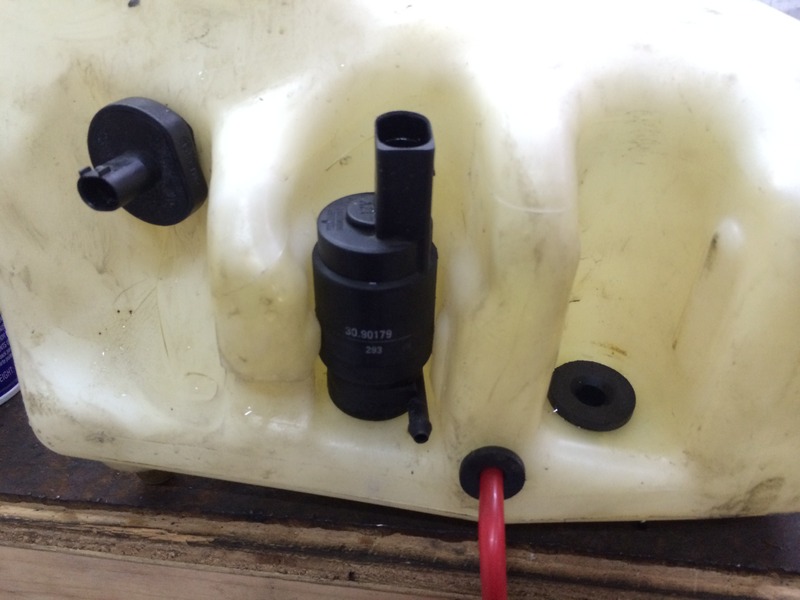
I've used an extra grommet for the washer pump, drilled a same size hole in the lower part of the tank and the 1/4" nylon line for the meth system fit in nice and tight. No leaks and much easier then installing a fitting there.
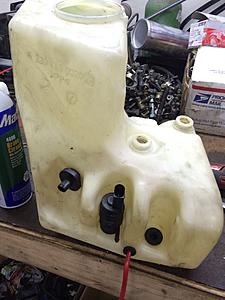
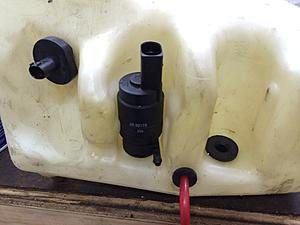
W220 is much easier to setup then the R230. I'll be installing the same kit on my Sl600, unless I sell it and get an Sl65 to mod instead.
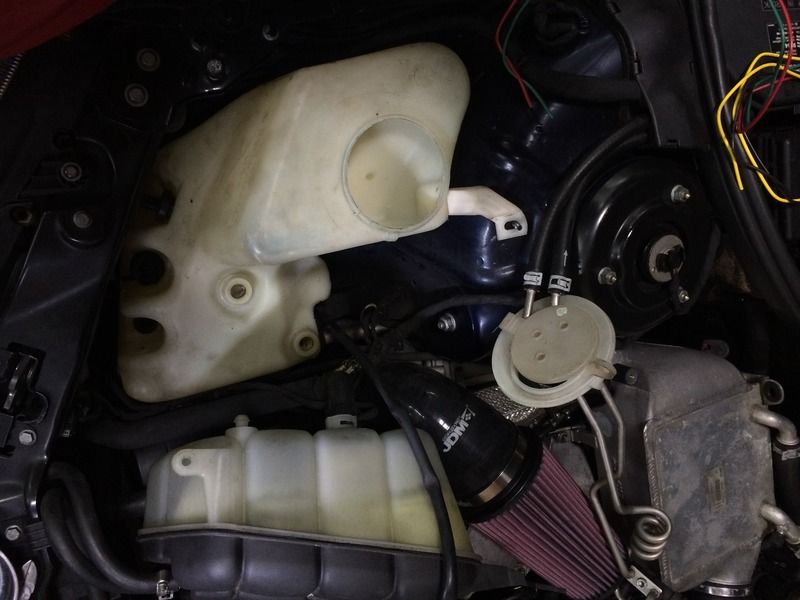
Nozzle placement
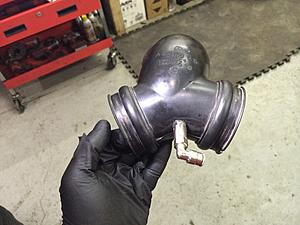
Just got a few quick questions for you.
I just finished up my meth install this last week, and noticed a drop of boost due to meth injection. 2-3psi when meth is injecting.
My question to you is are you noticing any drop of boost or it's the same?
The map sensor in the 3rd picture you uploaded, does that get plugged into before the throttle body on your setup, or is it connected to the intake manifold port at the back?
Reason why I ask is I'm still on stock intercoolers on my S600, and I believe that's the map sensor that controls boost. Since I'm spraying meth after that map sensor which is taking it's boost reading from pass side intercooler, the huge temp difference cause lower boost, which in my case reduces power/boost but kills IAT like a nuke. My temps dropped from 120-140 to 60-66 degrees at WOT. Using just the blue -20F washer fluid for now. I'm thinking of relocating the source of boost for that map sensor after meth injection, to have it bring boost back up. Maybe i'll try to just plug it in to the back of the manifold for a test.
I pulled my meth injection fuse out and boost is back to normal. Car pulls a little harder with much hotter air but a little more boost. I logged as high as 215-221kpa intake manifold pressure, where's with meth 190-199kpa peak.
I've got Eurocharged ECU/TCU combo, so hoping to see if Jerry is willing to go aggressive on this setup with his tuning.
Here's a few pictures from my install.
I've used an extra grommet for the washer pump, drilled a same size hole in the lower part of the tank and the 1/4" nylon line for the meth system fit in nice and tight. No leaks and much easier then installing a fitting there.

W220 is much easier to setup then the R230. I'll be installing the same kit on my Sl600, unless I sell it and get an Sl65 to mod instead.

Nozzle placement


MBWorld Fanatic!
Joined: Apr 2009
Posts: 1,139
Likes: 0
From: Lincoln, NE
2005 SL600, 2016 ES300h, 2012 Hayabusa
I brought up meth injection 5 years ago when I got mine and everyone said it's too corrosive on the internals....this mean there is a change of heart?
Last edited by NEMES1S; Mar 30, 2015 at 01:16 PM.
MBWorld Fanatic!
Joined: Apr 2009
Posts: 1,139
Likes: 0
From: Lincoln, NE
2005 SL600, 2016 ES300h, 2012 Hayabusa
What did you have total dollars to get this up and running? I don't have the upgrade intercoolers so I'm thinking this could be a way to get around needing it at this point, but I'd like to get a couple different tunes (I have ecu/tcu upgraded, scorpion intakes, HE upgrade, and may get catless dp's)
Trending Topics
MB World Stories
The Best of Mercedes & AMG

6 Mercedes Models That Did NOT Age Well (But Are Somehow Still Cool)
Verdad Gallardo
Manual Mercedes? 6 Times Sindelfingen Let Drivers Have All The Fun
Verdad Gallardo
Mercedes SLR McLaren 722 S Is Extremely Rare Example Modified by McLaren
Verdad Gallardo
8 Classic Boxy Mercedes Designs That Have Aged Like Fine Wine
Verdad Gallardo
Flawlessly Restored Mercedes 190E Evo II Heads to Auction
Verdad Gallardo
Electric Mercedes C-Class Unveiled: 11 Things You Need to Know
Verdad Gallardo
Mercedes EQS Gets A Major Update: Everything You Need to Know
Verdad Gallardo
5 Underrated Mercedes-Benz Models That Don't Get the Love They Deserve
Verdad Gallardo
Mercedes 300D Has Pushed Well Past 1 Million Miles and It Ain't Stopping
Verdad Gallardo
Super Member


Joined: Mar 2010
Posts: 643
Likes: 72
From: London UK
2013 W204 C63 AMG, 2008 W221 S65 AMG
Hey Ashutt,
Just got a few quick questions for you.
I just finished up my meth install this last week, and noticed a drop of boost due to meth injection. 2-3psi when meth is injecting.
My question to you is are you noticing any drop of boost or it's the same?
The map sensor in the 3rd picture you uploaded, does that get plugged into before the throttle body on your setup, or is it connected to the intake manifold port at the back?
Reason why I ask is I'm still on stock intercoolers on my S600, and I believe that's the map sensor that controls boost. Since I'm spraying meth after that map sensor which is taking it's boost reading from pass side intercooler, the huge temp difference cause lower boost, which in my case reduces power/boost but kills IAT like a nuke. My temps dropped from 120-140 to 60-66 degrees at WOT. Using just the blue -20F washer fluid for now. I'm thinking of relocating the source of boost for that map sensor after meth injection, to have it bring boost back up. Maybe i'll try to just plug it in to the back of the manifold for a test.
I pulled my meth injection fuse out and boost is back to normal. Car pulls a little harder with much hotter air but a little more boost. I logged as high as 215-221kpa intake manifold pressure, where's with meth 190-199kpa peak.
I've got Eurocharged ECU/TCU combo, so hoping to see if Jerry is willing to go aggressive on this setup with his tuning.
Here's a few pictures from my install.
I've used an extra grommet for the washer pump, drilled a same size hole in the lower part of the tank and the 1/4" nylon line for the meth system fit in nice and tight. No leaks and much easier then installing a fitting there.
W220 is much easier to setup then the R230. I'll be installing the same kit on my Sl600, unless I sell it and get an Sl65 to mod instead.
Just got a few quick questions for you.
I just finished up my meth install this last week, and noticed a drop of boost due to meth injection. 2-3psi when meth is injecting.
My question to you is are you noticing any drop of boost or it's the same?
The map sensor in the 3rd picture you uploaded, does that get plugged into before the throttle body on your setup, or is it connected to the intake manifold port at the back?
Reason why I ask is I'm still on stock intercoolers on my S600, and I believe that's the map sensor that controls boost. Since I'm spraying meth after that map sensor which is taking it's boost reading from pass side intercooler, the huge temp difference cause lower boost, which in my case reduces power/boost but kills IAT like a nuke. My temps dropped from 120-140 to 60-66 degrees at WOT. Using just the blue -20F washer fluid for now. I'm thinking of relocating the source of boost for that map sensor after meth injection, to have it bring boost back up. Maybe i'll try to just plug it in to the back of the manifold for a test.
I pulled my meth injection fuse out and boost is back to normal. Car pulls a little harder with much hotter air but a little more boost. I logged as high as 215-221kpa intake manifold pressure, where's with meth 190-199kpa peak.
I've got Eurocharged ECU/TCU combo, so hoping to see if Jerry is willing to go aggressive on this setup with his tuning.
Here's a few pictures from my install.
I've used an extra grommet for the washer pump, drilled a same size hole in the lower part of the tank and the 1/4" nylon line for the meth system fit in nice and tight. No leaks and much easier then installing a fitting there.
W220 is much easier to setup then the R230. I'll be installing the same kit on my Sl600, unless I sell it and get an Sl65 to mod instead.
If Meth/water is injected between these two MAP sensors, its going to see a different air density. As per DUDMD post, it seems that it will reduce boost. MB have put these sensors before and after the throttle valve for one reason or another, so I don't think its possible to relocate the source.
Any ideas?
EDIT:
Thinking about it, the Meth/water injection will occur before both of those sensors, so not sure why DUDMD is seeing lower boost pressures?
Last edited by alexanderfoti; Sep 4, 2016 at 02:00 PM.

Super Member
Joined: May 2015
Posts: 554
Likes: 37
2004 S600
Would be interested to hear further developments on this. I plan to do the same but wonder what the relationship between b28/7 and b28/6.
If Meth/water is injected between these two MAP sensors, its going to see a different air density. As per DUDMD post, it seems that it will reduce boost. MB have put these sensors before and after the throttle valve for one reason or another, so I don't think its possible to relocate the source.
Any ideas?
EDIT:
Thinking about it, the Meth/water injection will occur before both of those sensors, so not sure why DUDMD is seeing lower boost pressures?
If Meth/water is injected between these two MAP sensors, its going to see a different air density. As per DUDMD post, it seems that it will reduce boost. MB have put these sensors before and after the throttle valve for one reason or another, so I don't think its possible to relocate the source.
Any ideas?
EDIT:
Thinking about it, the Meth/water injection will occur before both of those sensors, so not sure why DUDMD is seeing lower boost pressures?
My experience with water/meth injection on these cars has not been very positive so far. I've used it on most of my previous cars with great luck, but it seems to put extra stress on the coils. When my coil issues started, it would only do it if I had the water/meth kit activated. I thought at first it might be a distribution issue, so I built a spraybar inside the manifold, but that did not seem to help things. I intend to give it another shot with the spraybar once I get my ignition problems sorted out, but if it gives me even a hint of trouble I'll be pulling the kit out altogether. I don't think I need it now that I'm on E85 and have upgraded the heat exchanger and pumps.
Super Member
Joined: Mar 2010
Posts: 643
Likes: 72
From: London UK
2013 W204 C63 AMG, 2008 W221 S65 AMG
It's very normal to see less boost with water/meth injection or other intercooling (ice box), especially when your compressor is @ maximum output already (tuned on stock turbos). The cooler temps mean a given mass of air will take up less space, and the compressor mass flow doesn't increase because air density at the inlet has not changed so the turbo can't make up the lost pressure because it's already giving all it's got.
My experience with water/meth injection on these cars has not been very positive so far. I've used it on most of my previous cars with great luck, but it seems to put extra stress on the coils. When my coil issues started, it would only do it if I had the water/meth kit activated. I thought at first it might be a distribution issue, so I built a spraybar inside the manifold, but that did not seem to help things. I intend to give it another shot with the spraybar once I get my ignition problems sorted out, but if it gives me even a hint of trouble I'll be pulling the kit out altogether. I don't think I need it now that I'm on E85 and have upgraded the heat exchanger and pumps.
My experience with water/meth injection on these cars has not been very positive so far. I've used it on most of my previous cars with great luck, but it seems to put extra stress on the coils. When my coil issues started, it would only do it if I had the water/meth kit activated. I thought at first it might be a distribution issue, so I built a spraybar inside the manifold, but that did not seem to help things. I intend to give it another shot with the spraybar once I get my ignition problems sorted out, but if it gives me even a hint of trouble I'll be pulling the kit out altogether. I don't think I need it now that I'm on E85 and have upgraded the heat exchanger and pumps.
That's a shame to hear that, as this would be easy way to get IAT's in check. Did wonders for my 215.
Do you remember how much water you where injecting? Its possible that the injection rate wasn't ramped up correctly with boost pressure and that it was quenching combustion?
Super Member
Joined: May 2015
Posts: 554
Likes: 37
2004 S600
Ah of course, now you say that, its obvious. I'm not sure, but I noticed only a very small drop in boost pressure on my 55k engine with water/meth injection (maybe 0.5 psi..)
That's a shame to hear that, as this would be easy way to get IAT's in check. Did wonders for my 215.
Do you remember how much water you where injecting? Its possible that the injection rate wasn't ramped up correctly with boost pressure and that it was quenching combustion?
That's a shame to hear that, as this would be easy way to get IAT's in check. Did wonders for my 215.
Do you remember how much water you where injecting? Its possible that the injection rate wasn't ramped up correctly with boost pressure and that it was quenching combustion?
The other thing people don't consider is that the evaporating water/methanol displace air in the manifold as well. So the theoretical density improvement isn't as big as you might think, and is largely dependent on how much of the spray actually vaporizes in the air as opposed to on a hot surface (throttle blade, manifold, port walls, back of the intake valve, etc).
I have been messing around with water injection for quite a long time, and have played with both really small and really large amounts, for the most part, without any trouble. It normally takes a LOT of water injection to cause an issue or stumble. I mean I've sprayed over 20gph through a 300hp engine with no trouble. I had what I consider a fairly conservative nozzle for this car at 12gph. When I went to a spray bar I used .5gph misting nozzles @ 1 per port...however, I've seen various flow charts put these at more around 1.7gph at the 200psi that my system runs at, so I may well be back up to that 20gph figure (but now have 12 very nicely distributed nozzles to do it instead of 1). In any case, I'm not anywhere near what should be the limits...20gph would be something like 40% of my fuel injection quantity which is on the very aggressive side, but within reason. I believe that 20-25% figure is ideal...but again, it depends on the setup and the goals.
I do not use any progressive controller because in my opinion the presently available mechanisms for doing so are terrible. I mean you're either pulsing a really really horrendously slow solenoid, or controlling pump duty cycle to effectively reduce your line pressure. Basically you're either pulsing the nozzle at something like 10x slower than your engine is spinning (which in my opinion could potentially give you terrible cycle to cycle variations) or you're dropping the line pressure resulting in poor atomization. Beyond that, the control scheme for them is terrible. The ones that use MAF frequency are probably the best in terms of matching engine load, but we don't have MAF sensors, so that's kind of out the window. You're stuck relying on TPS, or MAP, or RPM which individually don't necessarily correspond to the mass flow rate through the engine.
While I do love the idea of doing it progressively, I just haven't seen one I like. Ideally, they would just run off injector duty cycle and use actual fuel injectors (obviously alcohol rated ones with stainless guts). But mostly, I think it's something that only needs to be employed under maximum load anyway so my setup is just on an adjustable boost switch.
Super Member
Joined: Mar 2010
Posts: 643
Likes: 72
From: London UK
2013 W204 C63 AMG, 2008 W221 S65 AMG
Many thanks for that, lots of useful information!
On my CL I had a devils own controller, which wasn't great, however it did work sufficiently.
It was a very basic progressive controller based on boost pressure. I had a 10GPH nozzle with 80/20 water/meth and it never bogged down and did a good deal to reduce intake air temps. I was running about 15psi boost on that setup as well.
I may experiment with a controller that only does full injection under full load (As you say). I did find that injection at too low rpm/loads caused hesitation and stumbling on the CL. I am going to inject just before the throttle body, at least then, if it doesn't work well, its trivial to remove the system.
I think the CL was more forgiving as it has a supercharger that generates full boost from very low RPM's
On my CL I had a devils own controller, which wasn't great, however it did work sufficiently.
It was a very basic progressive controller based on boost pressure. I had a 10GPH nozzle with 80/20 water/meth and it never bogged down and did a good deal to reduce intake air temps. I was running about 15psi boost on that setup as well.
I may experiment with a controller that only does full injection under full load (As you say). I did find that injection at too low rpm/loads caused hesitation and stumbling on the CL. I am going to inject just before the throttle body, at least then, if it doesn't work well, its trivial to remove the system.
I think the CL was more forgiving as it has a supercharger that generates full boost from very low RPM's
Super Member
Joined: May 2015
Posts: 554
Likes: 37
2004 S600
Many thanks for that, lots of useful information!
On my CL I had a devils own controller, which wasn't great, however it did work sufficiently.
It was a very basic progressive controller based on boost pressure. I had a 10GPH nozzle with 80/20 water/meth and it never bogged down and did a good deal to reduce intake air temps. I was running about 15psi boost on that setup as well.
I may experiment with a controller that only does full injection under full load (As you say). I did find that injection at too low rpm/loads caused hesitation and stumbling on the CL. I am going to inject just before the throttle body, at least then, if it doesn't work well, its trivial to remove the system.
I think the CL was more forgiving as it has a supercharger that generates full boost from very low RPM's
On my CL I had a devils own controller, which wasn't great, however it did work sufficiently.
It was a very basic progressive controller based on boost pressure. I had a 10GPH nozzle with 80/20 water/meth and it never bogged down and did a good deal to reduce intake air temps. I was running about 15psi boost on that setup as well.
I may experiment with a controller that only does full injection under full load (As you say). I did find that injection at too low rpm/loads caused hesitation and stumbling on the CL. I am going to inject just before the throttle body, at least then, if it doesn't work well, its trivial to remove the system.
I think the CL was more forgiving as it has a supercharger that generates full boost from very low RPM's
I feel like I should point out that the intake cooling is not the primary mechanism for increasing power, nor is it extra timing advance (as people see gains without having timing control as well). It's not 100% clear what exactly is although there are lots of theories. But I've seen testing where physical intercooling to the same resulting temperature resulted in twice the power gains that chemical intercooling alone (water/meth injection) did. Personally, I think it makes more of an impact in-cylinder by absorbing heat during the compression stroke thereby reducing parasitic losses. However, it appears that our ignition system may not be up to the task. Most probably due to the odd orientation of our intake valves to the spark plugs themselves, as I haven't had any trouble with direct port water/meth on my other car.
Super Member
Joined: Mar 2010
Posts: 643
Likes: 72
From: London UK
2013 W204 C63 AMG, 2008 W221 S65 AMG
Injecting through a SC definitely results in a less fussy system. You've got guaranteed vaporization/even distribution. It's a no-brainer in that situation. As far as controlling it, you don't need any kind of controller for fixed injection, just a boost switch and a relay to turn the pump on.
I feel like I should point out that the intake cooling is not the primary mechanism for increasing power, nor is it extra timing advance (as people see gains without having timing control as well). It's not 100% clear what exactly is although there are lots of theories. But I've seen testing where physical intercooling to the same resulting temperature resulted in twice the power gains that chemical intercooling alone (water/meth injection) did. Personally, I think it makes more of an impact in-cylinder by absorbing heat during the compression stroke thereby reducing parasitic losses. However, it appears that our ignition system may not be up to the task. Most probably due to the odd orientation of our intake valves to the spark plugs themselves, as I haven't had any trouble with direct port water/meth on my other car.
I feel like I should point out that the intake cooling is not the primary mechanism for increasing power, nor is it extra timing advance (as people see gains without having timing control as well). It's not 100% clear what exactly is although there are lots of theories. But I've seen testing where physical intercooling to the same resulting temperature resulted in twice the power gains that chemical intercooling alone (water/meth injection) did. Personally, I think it makes more of an impact in-cylinder by absorbing heat during the compression stroke thereby reducing parasitic losses. However, it appears that our ignition system may not be up to the task. Most probably due to the odd orientation of our intake valves to the spark plugs themselves, as I haven't had any trouble with direct port water/meth on my other car.
My primary goal for water/meth injection is not to gain power, but to keep the same power there, doing a long pull, IAT's wil climb past 70 deg, at which point the ECU will pull timing and boost therefore reducing power. If I can keep the IAT's under 70 with W/M injection then that would be ideal!
Super Member
Joined: May 2015
Posts: 554
Likes: 37
2004 S600
I did not inject through the supercharger, I injected after the SC and after the IC. No matter how much I sprayed through the SC, I never reduced intake temperatures.
My primary goal for water/meth injection is not to gain power, but to keep the same power there, doing a long pull, IAT's wil climb past 70 deg, at which point the ECU will pull timing and boost therefore reducing power. If I can keep the IAT's under 70 with W/M injection then that would be ideal!
My primary goal for water/meth injection is not to gain power, but to keep the same power there, doing a long pull, IAT's wil climb past 70 deg, at which point the ECU will pull timing and boost therefore reducing power. If I can keep the IAT's under 70 with W/M injection then that would be ideal!
Is it safe to assume you are talking about keeping temps below 70 C? That's definitely within reason. If you meant F, however, I don't think you're going to get there with water/meth unless it's artificial. By that, I mean the boiling point of water with 15psi of boost is going to be around 250F/121C. So the further you get from that point, the less likely the water is to vaporize in the air as compared to on a hot surface somewhere. If that surface happens to be your intake temperature sensor, then it could read significantly artificially low as compared to the general temperature of the surrounding air. If you're wanting to cool to lower temps then you can try a higher percentage of methanol, which has a much lower boiling point, however it only has about half the cooling energy as well.
Super Member
Joined: Mar 2010
Posts: 643
Likes: 72
From: London UK
2013 W204 C63 AMG, 2008 W221 S65 AMG
Sorry, I'm used to GM 3800 world where there's no intercooler after the SC. Yes, when there is an intercooler in the system you always have to spray after the intercooler to get any net effect. Because cooling from the water/meth then increases the humidity and resulting heat capacity of the air so it becomes more difficult for it to be cooled by another process. The intercoolers waste their effectiveness just condensing that water vapor back out of the air (not to mention the lower temperature differential present reduces the possible heat transfer).
Is it safe to assume you are talking about keeping temps below 70 C? That's definitely within reason. If you meant F, however, I don't think you're going to get there with water/meth unless it's artificial. By that, I mean the boiling point of water with 15psi of boost is going to be around 250F/121C. So the further you get from that point, the less likely the water is to vaporize in the air as compared to on a hot surface somewhere. If that surface happens to be your intake temperature sensor, then it could read significantly artificially low as compared to the general temperature of the surrounding air. If you're wanting to cool to lower temps then you can try a higher percentage of methanol, which has a much lower boiling point, however it only has about half the cooling energy as well.
Is it safe to assume you are talking about keeping temps below 70 C? That's definitely within reason. If you meant F, however, I don't think you're going to get there with water/meth unless it's artificial. By that, I mean the boiling point of water with 15psi of boost is going to be around 250F/121C. So the further you get from that point, the less likely the water is to vaporize in the air as compared to on a hot surface somewhere. If that surface happens to be your intake temperature sensor, then it could read significantly artificially low as compared to the general temperature of the surrounding air. If you're wanting to cool to lower temps then you can try a higher percentage of methanol, which has a much lower boiling point, however it only has about half the cooling energy as well.
I had that issue on the CL, I ended up relocating the AIT sensor further away from the water injection nozzles. I still felt that they where too close though, as the AIT would go under ambient for a small period of time when injection started.
I think on the M275's the elbow before the throttle body is far enough away from the AIT sensor that this isn't a problem?
Super Member
Joined: May 2015
Posts: 554
Likes: 37
2004 S600
My personal opinion is that it's always going to come into play unless you can guarantee that all of the injected liquid has completely vaporized by the time that air gets to the sensor. Which I think is unlikely on any setup that is otherwise intercooled. But it's not necessarily a bad thing, I mean with water/meth going the computer is definitely going to be using too conservative of timing anyway so if you can prevent it from pulling timing, even if the reason for that is artificial, it's probably going to result in good gains without any risk of actual detonation/damage. I do think it's important though to understand that the numbers you are seeing may not actually be accurate.
I mean as big of a supporter of E85 and water/meth injection and the likes as I am, I hate to see these outlandish claims about their performance that just don't make any sense mathematically (claims of 150 degree temp drops, etc). I mean for example let's do the math on what you can reasonably expect on your car...you can use that as a reality-check compared to your sensor reading. If you're talking 600hp worth of airflow on your setup, call it roughly 60lb/min. 10 gallons per hour of 80/20 would be something like 76 lbs/hr or 1.26 lb/min of water/meth injection. So your air to w/m ratio is 47.61:1. 80/20 has a vaporization cooling potential of 871 BTU/lb, or 18.29 BTUs available to act on each pound of air. 1 BTU will cool a pound of air 3-4 degrees F, so if we assume 100% vaporization in the charge air itself 54-73 degrees F, or 30-40 degrees C of max cooling potential. It's unlikely that you'll hit that target figure as a good portion will probably vaporize in contact with hot surfaces instead of directly in the air itself, so it's still kind of a guessing game, but if your intake temp readings exceed that much cooler than you'd expect to see without the water/meth then you'd know for sure that you're getting some artificially low numbers.
I mean as big of a supporter of E85 and water/meth injection and the likes as I am, I hate to see these outlandish claims about their performance that just don't make any sense mathematically (claims of 150 degree temp drops, etc). I mean for example let's do the math on what you can reasonably expect on your car...you can use that as a reality-check compared to your sensor reading. If you're talking 600hp worth of airflow on your setup, call it roughly 60lb/min. 10 gallons per hour of 80/20 would be something like 76 lbs/hr or 1.26 lb/min of water/meth injection. So your air to w/m ratio is 47.61:1. 80/20 has a vaporization cooling potential of 871 BTU/lb, or 18.29 BTUs available to act on each pound of air. 1 BTU will cool a pound of air 3-4 degrees F, so if we assume 100% vaporization in the charge air itself 54-73 degrees F, or 30-40 degrees C of max cooling potential. It's unlikely that you'll hit that target figure as a good portion will probably vaporize in contact with hot surfaces instead of directly in the air itself, so it's still kind of a guessing game, but if your intake temp readings exceed that much cooler than you'd expect to see without the water/meth then you'd know for sure that you're getting some artificially low numbers.
Super Member
Joined: May 2015
Posts: 554
Likes: 37
2004 S600
I should clarify, since I mentioned it, that E85 does in fact have approximately 2x the cooling capacity of your standard 25% of fuel-injected water/meth shot. So the 150 degrees for that form of chemical intercooling would be appropriate actually, but you're not going to be able to reliably measure that effect anyway since it's port-injected.
Super Member
Joined: Mar 2010
Posts: 643
Likes: 72
From: London UK
2013 W204 C63 AMG, 2008 W221 S65 AMG
My personal opinion is that it's always going to come into play unless you can guarantee that all of the injected liquid has completely vaporized by the time that air gets to the sensor. Which I think is unlikely on any setup that is otherwise intercooled. But it's not necessarily a bad thing, I mean with water/meth going the computer is definitely going to be using too conservative of timing anyway so if you can prevent it from pulling timing, even if the reason for that is artificial, it's probably going to result in good gains without any risk of actual detonation/damage. I do think it's important though to understand that the numbers you are seeing may not actually be accurate.
Agreed on the second part as well, they will have to be taken with a pinch of salt.
Super Member
Joined: Mar 2010
Posts: 643
Likes: 72
From: London UK
2013 W204 C63 AMG, 2008 W221 S65 AMG
As a follow up on this, are you running meth on your car successfully? I have dropped nozzle size to 3gph with 25% meth, but am thinking of increasing it just slightly.
Super Member
Joined: May 2015
Posts: 554
Likes: 37
2004 S600
Only 3GPH? I run that much per cylinder on my other car, lol. I've found a good rule of thumb is 25% of your peak power fuel flow. So at say 600hp that's roughly 9 gallons per hour. That's on the high side of what a lot of people will recommend though. I was running 12GPH on the S600. I am not currently running it on the Mercedes because I needed the kit more for a non-intercooled turbo setup I was doing.
Super Member
Joined: Mar 2010
Posts: 643
Likes: 72
From: London UK
2013 W204 C63 AMG, 2008 W221 S65 AMG
I thought so too, but both me and G20wall where advised by EC to drop our nozzle size down, I was on a 14gph nozzle previously. The cooling seems to be as effective although admittedly haven't measured it.
Super Member
Joined: May 2015
Posts: 554
Likes: 37
2004 S600
It depends what you're trying to do with it. The air will only hold so much water vapor at X temperature. So you're only going to get a certain amount of effective charge cooling but that doesn't mean water entering the cylinders and performing cooling during the extreme temperature rise during the compression stroke isn't just as, if not more, useful than the charge cooling. I've found up to even 50% water to fuel doesn't cause a stumble under power. But 25% has been a good all around number for me. If you run too aggressive without any kind of progressive control/ramp to it, you can cause a stumble at the lower load/rpm portion of things. If you're dumping a huge amount of excess in terms of more than you need for charge cooling it's also a good idea to have direct port/metered per cylinder as opposed to a single injection point since liquid isn't going to necessarily evenly distribute itself if it's not all vaporized.


