


Timing Chain and Cam sprocket replacement Question


Thread Starter
Junior Member
Joined: Apr 2015
Posts: 16
Likes: 0
c230K
Timing Chain and Cam sprocket replacement Question
Guys,
There maybe some thread already but cannot find some info via google about this need some pointers to help me understand this.
This video in Youtube looks like a good procedure but I got an important question.
at 3:29 The guys rotate the crank with the cams sprocket removed which means that the cams are stationary. Is that okay?
Thanks in advance.
There maybe some thread already but cannot find some info via google about this need some pointers to help me understand this.
This video in Youtube looks like a good procedure but I got an important question.
at 3:29 The guys rotate the crank with the cams sprocket removed which means that the cams are stationary. Is that okay?
Thanks in advance.
Thread Starter
Junior Member
Joined: Apr 2015
Posts: 16
Likes: 0
c230K
Maybe a newbie question. I always thought that the valves can never all closed. Would that hit atleast one or 2 valves. Just trying to understand it. All of video I watched is people having a hard time trying to feed the chain. This one is too easy if you pull the cam out at tdc and rotate the crank. Too good to be true or I'm just missing something.
What do you tink RedGray.
What do you tink RedGray.

Super Member
Joined: Sep 2016
Posts: 571
Likes: 92
From: New England! :-)
2005 C230K Sport Coupe
COOL!
You know (/read) something about engines!!
The answer is involved. Hence, I wasn't going to waste my time if it was just a semi-random idea.
Very Short Answer:
No/Maybe/Yes.
Short Answer:
It depends on the specific engine, and the exact position of the cams/valves.
Long Answer:
For the older push-rod engines, a few things:
A) A good timing chain never broke from age/use. A broken timing chain meant that the crank was in pieces, and it jammed and broke the timing chain.
Still, timing chains did get longer and looser.
B) Just about every engine was designed to allow for "static" clearance between the valve and the piston.
With the older push-rod engines, "valve float" is a real concern.
As are the changes in clearances as the block/head heat up.
For the Over Head Cam engines (OHC), the use of timing belts and "marginal" timing chains has become "common".
For an OHC engine, many are what are known as "interference designs".
So, if the timing belt/chain brakes, then there is a very likely chance that one or more pistons will hit one of more valves.
Realize, that because of inertia, the cams don't just stop immediately.
And, when the cams do stop, they can stop at any point.
The M271 engine *is* an "interference design".
So, if the timing chain breaks, the engine is very likely "a boat anchor".
The heads and 1+ pistons will be trashed. So likely will the block.
So...... why did I also say "maybe/yes" to rotating the crank with the heads not connected????
Details dude. The details are important.
The M271 has a flat plane crank design:
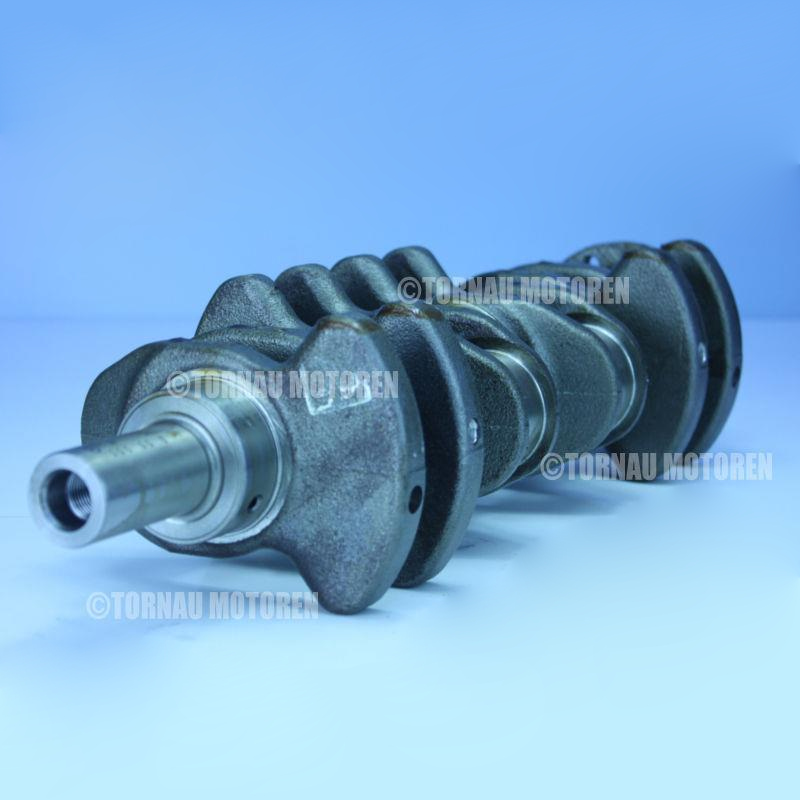
https://www.ebay.com/itm/Mercedes-Be...-/152463933982
https://www.onallcylinders.com/2015/...e-crankshafts/
So, for the M271:
1) The #1 and #4 piston are always in the same relative location.
2) The #2 and #3 piston are always in the same relative location.
3) The #1 and #4 pistons are 180 degrees off from the #2 and #3 pistons.
So:
4) If #1 is at "TDC" (Top Dead Center), so is #4.
5) If #2 & #2 are at "TDC" (Top Dead Center), then #1 & #4 are at BDC (Bottom Dead Center).

For piston to valve interference, we care about when the pistons are at TDC.
Below shows the basic cycles of a 4-cycle gasoline otto engine:

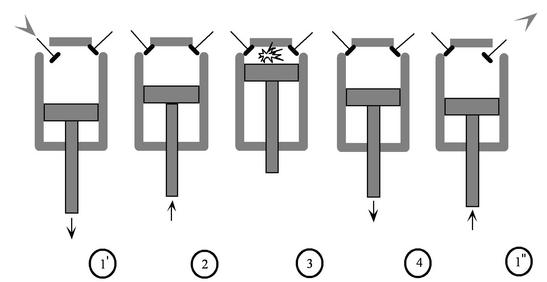
Now, the BIG IMPORTANT THING.....
If the cylinder head/valves/cams were set in the "alignment position" (for a new chain), then the valves would be in the position for #1 cylinder in combustion/spark phase of the ignition cycle.
https://web.mit.edu/16.unified/www/S...es/node25.html
Also importantly, we know that #4 would be at the end of the exhaust phase/beginning of the intake phase.
So, the valves for the #4 cylinder would be opened accordingly.
Later, we'll see that neither the intake nor exhaust valves for the 4th cylinder would be fully opened at that time.
So, #1 and #4 are fine!
Let's look at what happens when all the valves stay in that position, and we now put #2 and #3 piston up at TDC.
Remember, the valves will be set for when #2 and #3 are at BDC (Bottom Dead Center).
We can see from the valve position graphs, that at BDC, regardless at the start of the compression phase, or the start of the exhaust phase, neither the intake nor the exhaust valve are fully open.
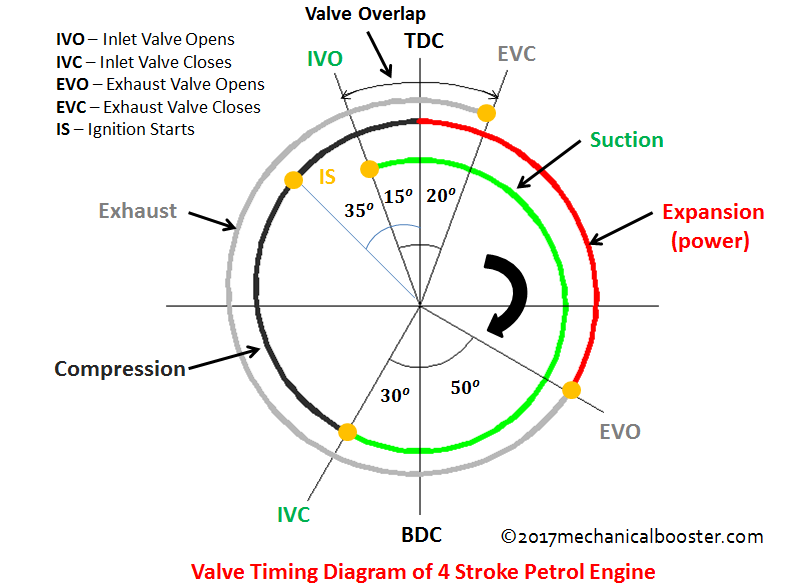

http://www.starracing.com/Cam%20Lobe...0Explained.htm
*** So, for the M271 engine, as long as the cams are set to the "alignment position", the pistons shouldn't touch the valves.
But wait, there's more!!
Like just about all engines, the M271 uses hydraulic "self adjusting" lifters.
What that means, is that unless there is full/normal oil pressure in the system, the lifters will be "collapsed"!
That means, that the valves would not be lifted/extended into the cylinders as much.
So, when turning over the crank by hand, the valves do not have the same amount of lift/travel as they do in a running engine.
But wait, there's EVEN MORE!
Wow, it's your LUCKY DAY!!!!!!!!
The hydraulic "self adjusting" lifters have a spring in them, to keep the "plunger" (that directly pushes against the valve stem) close to ~~95% extended, even when there's no oil pressure.
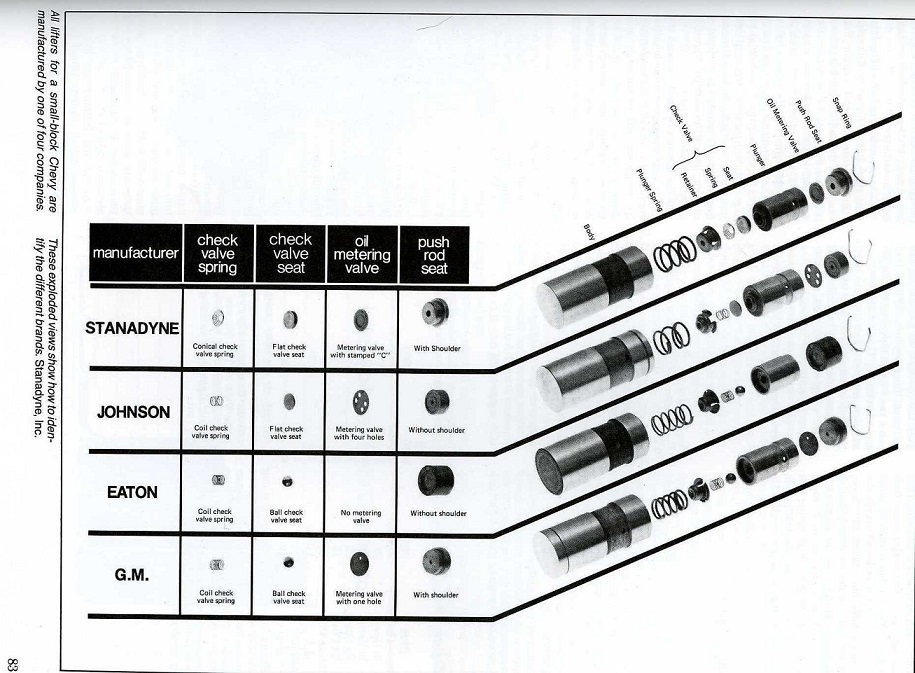
Big Picture:
https://static.summitracing.com/glob...r_exploded.jpg
So, when turning the engine over by hand, the rotation rate is very slow.
Therefore, even if a piston did hit against a valve, because of the spring in the lifter and the very slow rotation rate, very little damage would be done.
Still, any damage is not good. And, hoping that there's another spring compression to avoid damaging the piston or valve is not a good idea at all.
So, that's about it.
NOTE: Regardless of all of the above, in general, I DO NOT SUGGEST TURNING OVER THE CRANK WITH THE CAMS NOT CONNECTED.
And, for the video, imho, there was no need to turn the crank.
The reasons the mechanics turned the crank, is because it was faster for them to do that, instead of juggling the timing chain around the bottom gear.
And, for mechanics, time equals money! Still, imho, it wasn't good practice.
Some additional info:
https://web.mit.edu/16.unified/www/S...es/node25.html
I hope the above helps.
Disclosure BS: I have associations with MIT.
You know (/read) something about engines!!
The answer is involved. Hence, I wasn't going to waste my time if it was just a semi-random idea.
Very Short Answer:
No/Maybe/Yes.
Short Answer:
It depends on the specific engine, and the exact position of the cams/valves.
Long Answer:
For the older push-rod engines, a few things:
A) A good timing chain never broke from age/use. A broken timing chain meant that the crank was in pieces, and it jammed and broke the timing chain.
Still, timing chains did get longer and looser.
B) Just about every engine was designed to allow for "static" clearance between the valve and the piston.
With the older push-rod engines, "valve float" is a real concern.
As are the changes in clearances as the block/head heat up.
For the Over Head Cam engines (OHC), the use of timing belts and "marginal" timing chains has become "common".
For an OHC engine, many are what are known as "interference designs".
So, if the timing belt/chain brakes, then there is a very likely chance that one or more pistons will hit one of more valves.
Realize, that because of inertia, the cams don't just stop immediately.
And, when the cams do stop, they can stop at any point.
The M271 engine *is* an "interference design".
So, if the timing chain breaks, the engine is very likely "a boat anchor".
The heads and 1+ pistons will be trashed. So likely will the block.
So...... why did I also say "maybe/yes" to rotating the crank with the heads not connected????
Details dude. The details are important.
The M271 has a flat plane crank design:
https://www.ebay.com/itm/Mercedes-Be...-/152463933982
https://www.onallcylinders.com/2015/...e-crankshafts/
So, for the M271:
1) The #1 and #4 piston are always in the same relative location.
2) The #2 and #3 piston are always in the same relative location.
3) The #1 and #4 pistons are 180 degrees off from the #2 and #3 pistons.
So:
4) If #1 is at "TDC" (Top Dead Center), so is #4.
5) If #2 & #2 are at "TDC" (Top Dead Center), then #1 & #4 are at BDC (Bottom Dead Center).
For piston to valve interference, we care about when the pistons are at TDC.
Below shows the basic cycles of a 4-cycle gasoline otto engine:
Now, the BIG IMPORTANT THING.....
If the cylinder head/valves/cams were set in the "alignment position" (for a new chain), then the valves would be in the position for #1 cylinder in combustion/spark phase of the ignition cycle.
https://web.mit.edu/16.unified/www/S...es/node25.html
Also importantly, we know that #4 would be at the end of the exhaust phase/beginning of the intake phase.
So, the valves for the #4 cylinder would be opened accordingly.
Later, we'll see that neither the intake nor exhaust valves for the 4th cylinder would be fully opened at that time.
So, #1 and #4 are fine!
Let's look at what happens when all the valves stay in that position, and we now put #2 and #3 piston up at TDC.
Remember, the valves will be set for when #2 and #3 are at BDC (Bottom Dead Center).
We can see from the valve position graphs, that at BDC, regardless at the start of the compression phase, or the start of the exhaust phase, neither the intake nor the exhaust valve are fully open.
http://www.starracing.com/Cam%20Lobe...0Explained.htm
*** So, for the M271 engine, as long as the cams are set to the "alignment position", the pistons shouldn't touch the valves.
But wait, there's more!!
Like just about all engines, the M271 uses hydraulic "self adjusting" lifters.
What that means, is that unless there is full/normal oil pressure in the system, the lifters will be "collapsed"!
That means, that the valves would not be lifted/extended into the cylinders as much.
So, when turning over the crank by hand, the valves do not have the same amount of lift/travel as they do in a running engine.
But wait, there's EVEN MORE!
Wow, it's your LUCKY DAY!!!!!!!!
The hydraulic "self adjusting" lifters have a spring in them, to keep the "plunger" (that directly pushes against the valve stem) close to ~~95% extended, even when there's no oil pressure.
Big Picture:
https://static.summitracing.com/glob...r_exploded.jpg
So, when turning the engine over by hand, the rotation rate is very slow.
Therefore, even if a piston did hit against a valve, because of the spring in the lifter and the very slow rotation rate, very little damage would be done.
Still, any damage is not good. And, hoping that there's another spring compression to avoid damaging the piston or valve is not a good idea at all.
So, that's about it.
NOTE: Regardless of all of the above, in general, I DO NOT SUGGEST TURNING OVER THE CRANK WITH THE CAMS NOT CONNECTED.
And, for the video, imho, there was no need to turn the crank.
The reasons the mechanics turned the crank, is because it was faster for them to do that, instead of juggling the timing chain around the bottom gear.
And, for mechanics, time equals money! Still, imho, it wasn't good practice.
Some additional info:
https://web.mit.edu/16.unified/www/S...es/node25.html
I hope the above helps.
Disclosure BS: I have associations with MIT.
Last edited by RedGray; Aug 22, 2018 at 08:08 PM.
Thread Starter
Junior Member
Joined: Apr 2015
Posts: 16
Likes: 0
c230K
This was very helpful! Thank you very much for spending the time and giving all the full details and it is very appreciated. The last 4 cyl I work on is the engine of my old 2.3-16 and I remember pulling the cams at TDC I swear it is pushing down at least 2 valves. This make all sense now. I will still go to standard method considering I will need the tooling anyway. I'll be saving these in my personal notepad =)












