When you click on links to various merchants on this site and make a purchase, this can result in this site earning a commission. Affiliate programs and affiliations include, but are not limited to, the eBay Partner Network.
What are you guys using to clean your MAF sensors?
Brand? Just follow instructions on can?
Also, what sort of things are you seeing when your MAF sensors are dirty or bad? I haven't noticed any performance or drivability issues but did notice just recently my individual MAF sensor flow rates aren't in sync and at high throttle about 50% off from each other.
Last edited by hachiroku; Dec 1, 2020 at 03:17 AM.
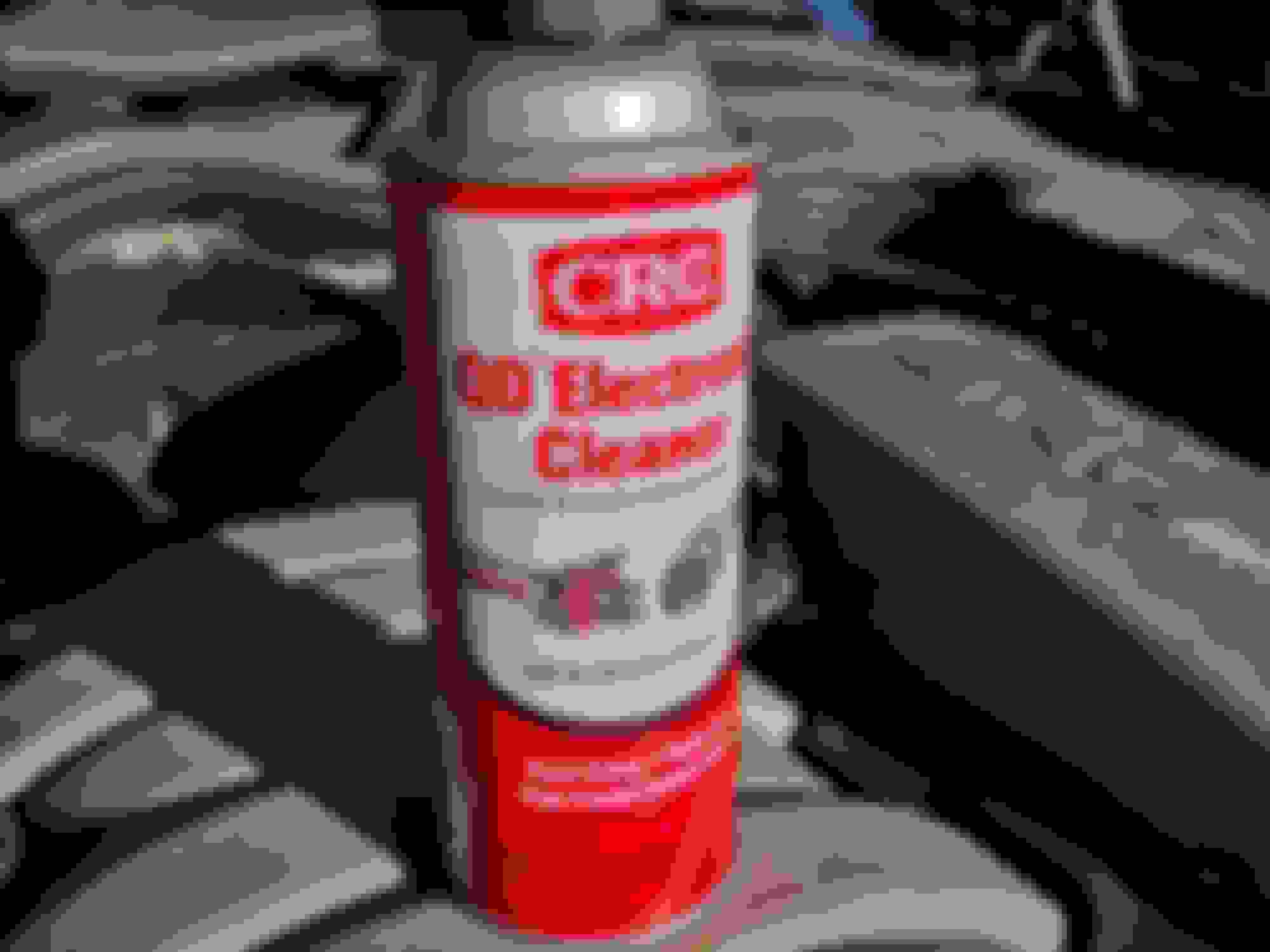
after 2 visits to 2 different auto parts store both being out of stock of CRC MAF Sensor cleaner, I settled on CRC QD Electronics Cleaner. price difference 4.xx versus 9.xx. QD Electronics Cleaner a much better value.
below I've I've included my MAF readings from my recent datalog. you can clearly see that the green trace is clearly off from what the orange trace is registering. although I don't seem to have any drivability issues or performance losses before this morning of which I'm having throttle tip in hesitation. I did clean out my MAF sensors soon after. later today I'll look to gather a new datalog go see how cleaning my MAF sensors may have helped. alternatively, if the one MAF sensor is done, I do have a set of low mileage sensors ready to pop in.
Can you use electrical cleaner on MAF?"Emergency Update!" (98stocker) Do NOT confuse "electronics" and "electrical" on the product. The CRC "ELECTRONICS" cleaner is SAFE, and the SAME as MAF cleaner they sell sometimes at a cheaper price and more readily available at the hardware store. Click to see full answer. Regarding this, can you use QD Electronic Cleaner on MAF sensor? You can use CRC QD electronics cleaner without ANY worry. It is almost the exact same product as the MAF product. The important part is that CRC QD (like the MAF cleaner) is SAFE for plastics, and has NO residue that can be left behind. Likewise, can I use MAF cleaner on throttle body? Yes, you can use a MAF cleaner on a throttle body, but you cannot use throttle body cleaner on a MAF. If you use the wrong kind of cleaner on the MAF sensor and it leaves a residue, it can burn a little wire if it's a hot-wire MAF sensor. But on the throttle body, it cleans it perfectly good.
Last edited by hachiroku; Nov 29, 2020 at 01:46 PM.
after 2 visits to 2 different auto parts store both being out of stock of CRC MAF Sensor cleaner, I settled on CRC QD Electronics Cleaner. price difference 4.xx versus 9.xx. QD Electronics Cleaner a much better value.
below I've I've included my MAF readings from my recent datalog. you can clearly see that the green trace is clearly off from what the orange trace is registering. although I don't seem to have any drivability issues or performance losses before this morning of which I'm having throttle tip in hesitation. I did clean out my MAF sensors soon after. later today I'll look to gather a new datalog go see how cleaning my MAF sensors may have helped. alternatively, if the one MAF sensor is done, I do have a set of low mileage sensors ready to pop in.
I used the CRC MAF Sensor cleaner on mine but didn't feel any difference at all after cleaning them. Although, I didn't data log anything though.
I was having hesitation after a cold start when first backing out of the driveway going from reverse to drive. If I got on it too quick, it would hesitate then be completely fine after driving 200ft to the stop sign.
I think it ended up being the intake tube connection to the Y pipe though.
update...after cleaning both MAF sensors with no positive results, swapping MAF sensors left to right and right to left, and swapping in super low mileage NA airboxes, I literally threw in the towel. also, I only use factory AMG paper filters so I felt it odd that my sensors would be dirty. upon inspection and cleaning they looked exactly the same with no residue on the sensors or that washed off.
the final effort...spraying contact cleaner into the MAF connectors and then packing them with dielectric grease. the result? a huge improvement. although, still not perfect, we are easily 93-95% of perfect.
💆♂️
I'm thinking if I should disassemble the connector and inspect the female pins for wear or corrosion. after 154k miles and countless clipping and unclipping this has been the result of wear and dirt over time.
without the use of good datalogs over the past year or more for comparison, I would have never identified this issue as no CEL appeared for MAF signal, but this was directly impacting my o2 sensor functionality as it was resulting in slow response codes. this is due to the fact of the computer delivering fuel which is not correct based off the MAF reading and then correcting using o2 feedback. from there the computer would constantly need to apply correction and thus began reporting the o2 sensors having slow response. the o2 sensors were replaced 2 weeks ago. I kind of feel they weren't in need of replacement and the faulty MAF reading was the cause all this time.
Last edited by hachiroku; Nov 30, 2020 at 04:41 PM.
the final effort...spraying contact cleaner into the MAF connectors and then packing them with dielectric grease. the result? a huge improvement. although, still not perfect, we are easily 93-95% of perfect.
Welp, just added another thing to put on the off season todo list.
be careful when doing this, I have personally had a situation where packing a maf plug resulted in cross continuity and creating a pig rich condition.
So use dielectric grease sparingsparingly on the plug.
I haven't encountered this as of yet. to weatherproof connectors packing them with dielectric grease is standard practice to prevent rain and other fluids from causing corrosion of the metals. our connectors are weather packed with a gasket but corosion can still come from the moisture in the air or I guess in my case also in combination of many removal and installation intervals over the span of 154k.
you see this in motorcycles at times where a connector will be packed with dielectric grease. my 1974 Honda CB450 had very clean dielectric grease from 1974 in a few of the connectors that I pulled off when I updated it's controls and wiring to modern controls. I know they were original because the connectors were discolored badly over the years and we're practically impossible to separate.
i guess I'm miss stating... I'm not packing the connector full of grease like a bearing. I'm applying it sparingly around so moisture will not enter through any holes if there ever was the case of water entry.
Dielectric grease, or tune-up grease, is a silicone-based grease that repels moisture and protects electrical connections against corrosion. ... The grease does not conduct electricity, so it shouldn't be applied directly to the mating surfaces (pins and sockets) of an electrical connection.Feb 26, 2015
I haven't encountered this as of yet. to weatherproof connectors packing them with dielectric grease is standard practice to prevent rain and other fluids from causing corrosion of the metals. our connectors are weather packed with a gasket but corosion can still come from the moisture in the air or I guess in my case also in combination of many removal and installation intervals over the span of 154k.
you see this in motorcycles at times where a connector will be packed with dielectric grease. my 1974 Honda CB450 had very clean dielectric grease from 1974 in a few of the connectors that I pulled off when I updated it's controls and wiring to modern controls. I know they were original because the connectors were discolored badly over the years and we're practically impossible to separate.
Mine was on my 240, which still had a weather packed connector. I just had too much grease in it. After I figured out what the problem was, I wiped the connector down and cleaned the pins etc. Still had a little bit inside.
My practice now is to pack it with dielectric grease then plug it in and unplug twice then wipe excess.
here is a video with animation of how I use dielectric grease. I do not apply it to the male side like he did though. this is incorrect and will lead spilling out and possible rupture. when he shows the separated connector...the remaining grease shown is how it protects the metal from oxidation by creating an air tight seal.
here is a video with animation of how I use dielectric grease. I do not apply it to the male side like he did though. this is incorrect and will lead spilling out and possible rupture. when he shows the separated connector...the remaining grease shown is how it protects the metal from oxidation by creating an air tight seal.
I will say though he trys hard to show its not conductive. If I didnt infact cause this issue on my own car I would be inclined to agree 100%. But I literally only cleaned and packed the connector and drove off noticing i caused a problem. Could it have been excess contact cleaner that didn't flash off before using grease? Maybe, but hard for me to believe.
not sure, could be excess contact cleaner, could be the contact cleaner itself as there is a more abrasive version which leaves a residue which can cause electrical issues, or could possibly be an over packing of grease preventing clean contact.
what I did was, I sprayed well, shook it off, sprayed again. shook it off, then blew info each connector until dry with more shaking of excess fluid. waited a few minutes then applied dielectric grease. in hindsight I could have inserted the connector while wet then took apart and sprayed once again to ensure mating surfaces have ground cleanly.
That video is complete and utter garbage. Do not use any kind of grease on electrical connectors. EVER.
Electricity 101: Materials have a property called resistance. Low resistance materials (like most metals) conduct electricity well. High resistance materials (like plastics) are called insulators and do not conduct electricity. Every wire and connector has resistance, hopefully a very low one so it is able to conduct said electricity well. Dielectric grease has a high resistance and does not conduct electricity. I am still waiting for someone to show me how putting a material that does not conduct electricity on a connector whose very function is to conduct electricity will improve said electrical connection.
I knew that that electrical engineering degree was going to pay off one day...
The purpose of any such grease, be it dielectric or conductive, would be to protect a connection from oxidation and moisture (which would lead to oxidation). Any electrical connection (a connector, splice or switch) that is subjected to the elements should be designed in a way to protect the electrical connection from said elements. While I am certainly not disputing that greases may and in certain situations should be used near or on SOME electrical connections to protect them, unless the connector manufacturer specifically calls for the use of a grease, it should not be used. Period.
Dielectric grease works on the assumption that the physical pressure of the connection itself is sufficient to displace said grease from the metal-to-metal contact surface, and that by coating the surrounding area it will prevent the metal from oxidizing. While this may work in some cases, it is far from being universally true. It is *an assumption* that all electrical connections where people put greases have sufficient physical pressure to displace it and give you a clean metal-to-metal contact. Furthermore, I have seen various metals as well as the surrounding connector plastics and rubber that react to the grease, ultimately resulting in failure of said connection.
If a spray of DeoxIT or another similar contact cleaner that DOES NOT LEAVE A RESIDUE does not restore the connection, the connector itself is faulty and needs to be replaced.
Dielectric grease works on the assumption that the physical pressure of the connection itself is sufficient to displace said grease from the metal-to-metal contact surface, and that by coating the surrounding area it will prevent the metal from oxidizing. While this may work in some cases, it is far from being universally true. It is *an assumption* that all electrical connections where people put greases have sufficient physical pressure to displace it and give you a clean metal-to-metal contact.
I agree with your thoughts for the most part and this is the only time I ever use dielectric grease which is rarely. for example, any connector that uses a pin and barrel joint should NEVER use dielectric grease near it's pins as there is no exit for the grease at the barrel end. usage of anything should always come with some common knowledge and never be a blanket statement.
I do have to say though, I have pressure washed my engine bay more than a couple of times over it's lifetime.
Mercedes SLR McLaren 722 S Is Extremely Rare Example Modified by McLaren
Slideshow: A one-of-one U.S.-spec Mercedes-Benz SLR McLaren Roadster became even rarer after a factory-backed transformation at McLaren's headquarters.