When you click on links to various merchants on this site and make a purchase, this can result in this site earning a commission. Affiliate programs and affiliations include, but are not limited to, the eBay Partner Network.
Mercedes C190 AMG GT 340-390KW/462-530PS (2015-2020) Mercedes C190 AMG GT S 340-390KW/462-530PS (2015-2020) Mercedes C190 AMG GT C 410KW/557PS (2017+) Mercedes C190 AMG GT R 430KW/585PS (2017+)
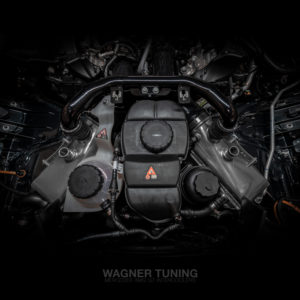
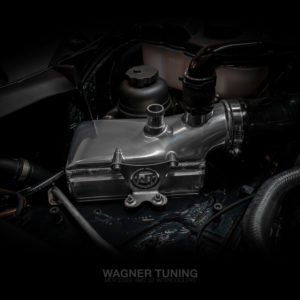
The 4.0 Liter V8 biturbo engine (M178 DE 40 AL) of AMG models is equipped with an indirect charge-air cooling circuit. So the cooling of the charged air is realized by a watercooled intercooler which will be replaced by this WagnerTuning high-performance intercooler.
The WAGNERTUNING high-performance intercooler has got a new performance core with the external core dimensions 209 mm x 175 mm x 110 mm / 8,23Inch x 6,89Inch x 4,33Inch. This intercooler core was directly developed for the high requirements of the AMG engine and offers 86 % more external core volume compared to the stock intercooler. The calculated ratio between the inner and outer cooling surface generates a maximum heat transfer and at the same time the best possible internal air flow. The aluminum cast endtanks were designed in CAD and optimized in CFD simulations. The result is an excellent cooling property with a minimal back pressure. That`s why this kit is also perfect for racing use. An optimal cooling effect of the charged air with a significant increase in performance!
All WAGNERTUNING radiators are equipped with a heat-conductive anti corrosion coating to ensure a lasting cooling effect. The plug & play installation of the system is simple and easy to perform (an installation instruction is included as well).
Advantages of this product: - significantly better cooling performance - less pressure drop - more power and torque for your engine - mechanical discharge of the turbocharger - 100% pressure resistance - 100% Plug and Play - up to 4 years warranty
core dimensions stock intercooler: 177 mm x 153 mm x 80 mm V = 2,16 Liter
core dimensions WT intercooler: 209 mm x 175 mm x 110 mm V = 4,02 Liter (+86%)
Kit comes with: 2 Ladeluftkühler 4 Silikonschläuche Luft 1 Montagematerial
This new? Intrigues me. I was overheating on the track a couple weeks back. Was hitting 120c temps and the acceleration input was dying on me
Just some generic stuff separate and aside from the first post -
When you say you were hitting temps of 120C assuming you mean the ECT. The intercooler uses a separate cooling circuit so your actual air charge wasn't hitting 120C of course.
That said, two (of several) factors that will impact timing negatively are ambient air temps and ECTs. So, the 120C ECT was pulling timing at those temps. Here is a typical timing table "Modifier". Any EMS will pull timing when ECTs hit these areas BC it is negatively impacting cylinder temps. Given that you were tracking the car, and running 120*C ECTs, timing was being pulled assuming your spark air mass was probably in and around 1.00 and over. This modifier table is typical and you were probably pulling 2* to 5* timing BC of the 120*C.
Then there are IATs, which the above addresses. Here too, based on where/when you were tracking and what the ambient air temps were, If the air temps are hot enough (such as where I live in PXH - 105*F today), air coming in that hot is a losing battle and the ECU is going to once again use a modifier table to pull timing. The cooler you can keep it the less timing pulled, but when air temps are already way up there, unless you're drawing the intake into a refrigerator/freezer, they're going to hit the intake hot. How much timing pulled at this time is less a matter of the make/model and more a matter of Physics. The demarcation tends to be around 90*F, but can vary based on some design factors, but not enough to be splitting hairs. Once the intake air charge reaches certain temperatures, fuel starts to act like it has less octane, so w/o a timing adjust, spontaneous combustion starts to impact peak performance.
Here is a typical IAT modifier table the ECU will use to pull timing past approx. 90F. Here too, assuming in a track situation you were pulling some higher spark air masses, and given where/when you were tracking, the IAT was probably seeing some of these timing pulls which can get really severe given the initial Ambient Air Temps.
Just some generic stuff separate and aside from the first post -
When you say you were hitting temps of 120C assuming you mean the ECT. The intercooler uses a separate cooling circuit so your actual air charge wasn't hitting 120C of course.
That said, two (of several) factors that will impact timing negatively are ambient air temps and ECTs. So, the 120C ECT was pulling timing at those temps. Here is a typical timing table "Modifier". Any EMS will pull timing when ECTs hit these areas BC it is negatively impacting cylinder temps. Given that you were tracking the car, and running 120*C ECTs, timing was being pulled assuming your spark air mass was probably in and around 1.00 and over. This modifier table is typical and you were probably pulling 2* to 5* timing BC of the 120*C.
Then there are IATs, which the above addresses. Here too, based on where/when you were tracking and what the ambient air temps were, If the air temps are hot enough (such as where I live in PXH - 105*F today), air coming in that hot is a losing battle and the ECU is going to once again use a modifier table to pull timing. The cooler you can keep it the less timing pulled, but when air temps are already way up there, unless you're drawing the intake into a refrigerator/freezer, they're going to hit the intake hot. How much timing pulled at this time is less a matter of the make/model and more a matter of Physics. The demarcation tends to be around 90*F, but can vary based on some design factors, but not enough to be splitting hairs. Once the intake air charge reaches certain temperatures, fuel starts to act like it has less octane, so w/o a timing adjust, spontaneous combustion starts to impact peak performance.
Here is a typical IAT modifier table the ECU will use to pull timing past approx. 90F. Here too, assuming in a track situation you were pulling some higher spark air masses, and given where/when you were tracking, the IAT was probably seeing some of these timing pulls which can get really severe given the initial Ambient Air Temps.
Anyone have the dimensions of the OEM unit to compare actual core/surface areas with Wagner unit?
On other platforms (Camaro ZL1-1LE, etc) many after-market coolers advertised as 'enhanced cooling' actually had less cooling fins/surface area vs OEM
TRUDAT
This is a good area to be careful as lots of smoke/mirrors stuff in this market space. Not impugning any one company and no comment on the above device.
The performance specialists at Wagner Tuning now have their performance intercoolers in their range for all four variants of the Mercedes-AMG GT (GT, GT S, GT C and GT R). The advantages are manifold, such as a significantly increased cooling capacity, less back pressure, an increase in power and torque and, of course, a mechanical relief of the turbocharger. And as usual with the Wagner-Tuning charge air cooling "Made in Germany" there is a 100% pressure resistance and the assembly can be done in 100% plug-and-play."
This is a good area to be careful as lots of smoke/mirrors stuff in this market space. Not impugning any one company and no comment on the above device.
On my car it was the oil temp that was hitting 120c as well. Mercedes tech was at the track with me that day and he mentioned that thats the 'safety' shut off essentially...
Strange thing is I've put a lot of KM on the car on the track, have over 20,000km on it now and that was the first time ever I had hit temps that high.
Interesting video review of Wagner Tuning intercoolers, their engineering, etc. . . apparently THE manufacturer of high performance intercoolers in the EU:
"
The eight-cylinder unit thrills with its spontaneous response, precisely measured power output and linear power delivery with powerful thrust in all engine speed ranges, all of which makes the car far easier to control when driving at the limit. To make this possible, the sophisticated engine control electronics also take into account the current driving status and control the accelerator characteristics as a function of the occurring lateral forces also. The AMG 4.0-litre V8 comes with well-proven twin turbocharging, with the two chargers not located outside on the cylinder banks, but rather between them in the V of the cylinders. The advantages of the "hot inner V" are a compact engine design, spontaneous response from the turbochargers and low exhaust gas emissions thanks to optimum air flow for the close-coupled catalytic converters. This basic principle of the new AMG V8 family has been further optimised for the AMG GT R, enabling a further improvement in performance. The maximum charge pressure is 1.35 bar; the turbochargers have a maximum speed of 186,000 revolutions per minute. For optimum power output even when outside temperatures are high, Mercedes-AMG uses indirect air-to-water intercooling. With optimum flow of air and water, the intercoolers have a separate, two-stage low-temperature water circuit. The first cooler stage involves two parallel coolers in the left and right wheel arch. Together with the large radiator at the front of the vehicle as a second radiator stage, the system is even more effective than in the AMG GT S. The downstream water-cooled intercoolers ensure that the charge air compressed and heated by the turbochargers is cooled effectively prior to entering the combustion chambers. It therefore remains at a constantly low level even under full load. Extremely short charge-air ducting makes for optimum responsiveness."
Wagner has a very good reputation for her intercoolers. Function as well the high-quality workmanship.
But I don't have any experience specifically for AMG GT.
Also, I personally don't know anyone who has assembled them.
Find the parts really interesting. Unfortunately there is no legal German approval for this.
Mercedes SLR McLaren 722 S Is Extremely Rare Example Modified by McLaren
Slideshow: A one-of-one U.S.-spec Mercedes-Benz SLR McLaren Roadster became even rarer after a factory-backed transformation at McLaren's headquarters.





.jpg)