


Bilstein HD Shock leaking
Thread Starter
Super Member
Joined: Mar 2002
Posts: 826
Likes: 4
From: Southeast PA
2010 VW Golf TDI
Bilstein HD Shock leaking
My front right shock is leaking after about 5 years with my what was once a new set-up of Eibach ProKit springs and the Bilstein HD shocks. I wasn't going to do anything about it, but I noticed that my car is actually sitting at least a half-inch lower on the side with the bad shock. I am thinking about getting all four Bilstein Sports and getting rid of all of the Bilstein HD shocks.
3 Questions:
1. Do you think it is a good idea?
2. Do you think the entire car will drop a half-inch with the change?
3. What do you think of eShocks, since my Indy wasn’t able to source the shocks from his normal supplier?
I could also just get 2 new HD shocks for the front, but it seemed like a good opportunity to try the Sports.
3 Questions:
1. Do you think it is a good idea?
2. Do you think the entire car will drop a half-inch with the change?
3. What do you think of eShocks, since my Indy wasn’t able to source the shocks from his normal supplier?
I could also just get 2 new HD shocks for the front, but it seemed like a good opportunity to try the Sports.

MBWorld Fanatic!
Joined: Feb 2006
Posts: 1,325
Likes: 2
From: Seattle
1990 300ce
yeah, I think this is why bilstein tells you to use the sports for lowered suspensions and the HD's for stock... the shorter springs cause a higher rate of constant compression, causing premature failure.
Although I believe bilstein has a lifetime warranty on their shocks so you might look into that.
Definitely get the sports if you're looking to spend the money. It might lower your slightly- I really have no idea.
Although I believe bilstein has a lifetime warranty on their shocks so you might look into that.
Definitely get the sports if you're looking to spend the money. It might lower your slightly- I really have no idea.
Thread Starter
Super Member
Joined: Mar 2002
Posts: 826
Likes: 4
From: Southeast PA
2010 VW Golf TDI
I will finally have Bilstein Sports!
I considered the warranty, but the reality is that it doubles the labor by doing the replacement twice and needing a spare shock in the interim. In addition, they generally recommend replacing shocks in pairs, so one refurbished shock wouldn't really be so great. I may send the shock to Bilstein after it is off, but I won’t reinstall the shock at this time. Right now I am leaning toward 4 new Bilstein Sports.
I checked prices with Rusty at “buymbparts”. The lower prices would save me $64.00 dollars, compared to eShocks and they both have free shipping. I also checked Phil's Fastlane prices, which were the same as the prices from eShocks. Is there any reason to give up the $64.00 saving and not buy from Rusty?
I was thinking the same thing. It seems that if the HD shocks are constantly supporting the car, rather than just damping, that could definitely cause premature failure. Many posters have commented that installing new HD shocks raised the ride height of their cars.
I'm just a little worried that I will need to readjust the spring pads after the change, depending on how differently the car sits from front to rear with the new shocks. It could turn into a $$$ mess, but I am going for it.
This may be the first step in my refurb quest. So far I have been just hanging around, but I am more and more convinced that I will not give up on my car anytime soon. I think this is a watershed moment for the car industry. The price of gas is going to finally force the issue and we will get much more fuel efficient vehicles. Maybe when those new cars arrive I would consider one, but it will likely be for my son so I wouldn't be changing my own car. Even after getting my son a vehicle, I would probably opt for my wife to have a new car rather than getting a replacement for myself. I really do still love my car.
I checked prices with Rusty at “buymbparts”. The lower prices would save me $64.00 dollars, compared to eShocks and they both have free shipping. I also checked Phil's Fastlane prices, which were the same as the prices from eShocks. Is there any reason to give up the $64.00 saving and not buy from Rusty?
I'm just a little worried that I will need to readjust the spring pads after the change, depending on how differently the car sits from front to rear with the new shocks. It could turn into a $$$ mess, but I am going for it.
This may be the first step in my refurb quest. So far I have been just hanging around, but I am more and more convinced that I will not give up on my car anytime soon. I think this is a watershed moment for the car industry. The price of gas is going to finally force the issue and we will get much more fuel efficient vehicles. Maybe when those new cars arrive I would consider one, but it will likely be for my son so I wouldn't be changing my own car. Even after getting my son a vehicle, I would probably opt for my wife to have a new car rather than getting a replacement for myself. I really do still love my car.
Last edited by ksing44; Jun 24, 2008 at 05:05 AM.
MBWorld Fanatic!
Joined: Feb 2006
Posts: 1,325
Likes: 2
From: Seattle
1990 300ce
When I installed the sports after riding around on the stock shocks and H&R springs, my ride height definitely increased... by around .25".
So either way, the shocks do contribute somewhat to supporting the weight of your car. But it's probably fair to assume that the HD's support more of that weight that the shorter Sports.
But I haven't heard about somebody switching from HD's to sports, so it's just a hunch.
So either way, the shocks do contribute somewhat to supporting the weight of your car. But it's probably fair to assume that the HD's support more of that weight that the shorter Sports.
But I haven't heard about somebody switching from HD's to sports, so it's just a hunch.
Senior Member
Joined: Oct 2006
Posts: 356
Likes: 0
From: Glendale, AZ
'95 E420 SE
I respectfully disagree 100%....the shocks will in NO way effect the ride height of your car. They possess virtually no constant spring force, as it is not their designed function....at all. They dampen the speed of travel in two directions, and to do so, they cannot maintain any spring force. You can compress a Bilstein Sport shock with your hands if you are fairly strong. That MIGHT take about 50-60 lbs force...maximum. In terms of holding up any one of the four corners of your car...it's "in the noise"...not even perceivable by the suspension's geometry. The ride height of your car is set entirely by the spring and sometimes by the geometry, but never, ever by a strut or shock. If you experienced a ride height increase, it was likely because the car was up on jacks and the suspension was able to "relax" for a time. The other possibility is that the spring pad or spring hung up a bit or even that the struts were not fully seated at the top mount and were resting on a false hard-stop. Either way, it wasn't the strut or shock keeping the weight of the car "up" due to internal valving.
The previous poster is correct however, that using a shock that it designed to ride an inch or so lower than stock (i.e. Bilstein Sport, etc.) in a car that is lowered via sport springs will always work better that using a strut or shock that is designed to be used at stock ride height. Always.
The previous poster is correct however, that using a shock that it designed to ride an inch or so lower than stock (i.e. Bilstein Sport, etc.) in a car that is lowered via sport springs will always work better that using a strut or shock that is designed to be used at stock ride height. Always.
Last edited by ShanMan; Jun 24, 2008 at 12:39 PM.
MBWorld Fanatic!
Joined: May 2005
Posts: 2,494
Likes: 17
From: REHOBOTH BEACH DE
88-300CE TWIN TURBO, 99-C43, 05-G55K, 71-280SL, 94-E320 CAB, 08 CLK63 BLACK SERIES
When I installed the sports after riding around on the stock shocks and H&R springs, my ride height definitely increased... by around .25".
So either way, the shocks do contribute somewhat to supporting the weight of your car. But it's probably fair to assume that the HD's support more of that weight that the shorter Sports.
But I haven't heard about somebody switching from HD's to sports, so it's just a hunch.
So either way, the shocks do contribute somewhat to supporting the weight of your car. But it's probably fair to assume that the HD's support more of that weight that the shorter Sports.
But I haven't heard about somebody switching from HD's to sports, so it's just a hunch.
The HD's and sports have identical valving.
The Sport has a shorter piston and a shorter stroke.
They both compress to the same point in the cylinder.
Neither will change ride height as the car weight is carried by the springs.
The HD's are suitable for a moderate drop and are used in many a high performance Porsche setup.
I use the HD/H&R setup in my car and it affords a great handling combo.
I didn't drop to look good, but to better handle the torque I'm putting out.
The OP has a defective shock...lifetime warranty, Bilstein will replace it free of charge.
Trending Topics
Thread Starter
Super Member
Joined: Mar 2002
Posts: 826
Likes: 4
From: Southeast PA
2010 VW Golf TDI
My problem is that if you should always replace shocks in pairs, then why would I want to simply add one free replacement. Plus, I still have to send the thing to Bilstein and find a way to deal with the fact that I will be missing a shock. The warranty sounds good, but the reality is that is seems a bit hard to collect without a hassle of some kind. I could likely just put on one new shock for less hassle and maybe less money than trying to collect on the warranty. Then I think, well, I really should get a pair fronts, the rears are not that expensive, I think the Sports might be better for my car, so what the heck just get four new Sports.
MB World Stories
The Best of Mercedes & AMG

Dubai Tuner Gives the Mercedes G-Class An Entirely New Look
Verdad Gallardo
Six Gift Ideas Your AMG Loving Dad or Grad Will Cherish

7 Craziest Things AMG Gas Ever Built
Verdad Gallardo
New Electric Mercedes-AMG GT 4-Door Coupe Unveiled: 10 Things You Need to Know
Verdad Gallardo
6 Mercedes Models That Did NOT Age Well (But Are Somehow Still Cool)
Verdad Gallardo
Manual Mercedes? 6 Times Sindelfingen Let Drivers Have All The Fun
Verdad Gallardo
Mercedes SLR McLaren 722 S Is Extremely Rare Example Modified by McLaren
Verdad Gallardo
8 Classic Boxy Mercedes Designs That Have Aged Like Fine Wine
Verdad Gallardo
Flawlessly Restored Mercedes 190E Evo II Heads to Auction
Verdad Gallardo
MBWorld Fanatic!
Joined: Apr 2005
Posts: 2,849
Likes: 3
From: Long Beach, Ca
lots of cars
The OP has a defective shock...lifetime warranty, Bilstein will replace it free of charge.

MBWorld Fanatic!
Joined: Feb 2006
Posts: 1,325
Likes: 2
From: Seattle
1990 300ce
Here's the deal. I know I'm not a mechanic. But I can tell you from my personal observation and from observations I've read about from many people on this board that the shocks can have an effect on ride height.
I wasn't smoking crack I promise. My car is still, after 2 years on teh bilstein sports, sitting higher than it was on the stock shocks by about a quarter of an inch.
I still don't get the argument about the bilstein sports vs HD's. Frankly it doesn't matter since I just followed the recommendations of Bilestein. But I don't get how a longer shock on a shorter suspension will not encounter greater compression than a shorter shock on the same suspension. It just seems completely illogical.
And I also don't get the argument that a longer shock won't make your suspension sit slightly higher. If the shock is compressed more, it is sharing some of the weight of the car, just by virtue of teh fact that it is being compressed. Which takes some of the load off of the springs and causes the springs to compress slightly less.
But whatev, it doesn't matter to me. I'm happy with my setup regardless.
I wasn't smoking crack I promise. My car is still, after 2 years on teh bilstein sports, sitting higher than it was on the stock shocks by about a quarter of an inch.
I still don't get the argument about the bilstein sports vs HD's. Frankly it doesn't matter since I just followed the recommendations of Bilestein. But I don't get how a longer shock on a shorter suspension will not encounter greater compression than a shorter shock on the same suspension. It just seems completely illogical.
And I also don't get the argument that a longer shock won't make your suspension sit slightly higher. If the shock is compressed more, it is sharing some of the weight of the car, just by virtue of teh fact that it is being compressed. Which takes some of the load off of the springs and causes the springs to compress slightly less.
But whatev, it doesn't matter to me. I'm happy with my setup regardless.
MBWorld Fanatic!
Joined: Feb 2006
Posts: 1,325
Likes: 2
From: Seattle
1990 300ce
Here, check this out. This is what I'm trying to say. The shock on the left is a Bilstein HD on a stock suspension. the one on the right is the same shock on a lowered suspension.
More compression, more wear, more weight being taken on by the shock, higher ride height.
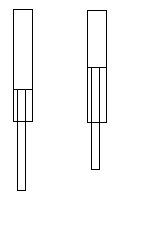
More compression, more wear, more weight being taken on by the shock, higher ride height.
Thread Starter
Super Member
Joined: Mar 2002
Posts: 826
Likes: 4
From: Southeast PA
2010 VW Golf TDI
I still don't get the argument about the bilstein sports vs HD's. Frankly it doesn't matter since I just followed the recommendations of Bilestein. But I don't get how a longer shock on a shorter suspension will not encounter greater compression than a shorter shock on the same suspension. It just seems completely illogical.
RBYCC, I will let you know if there is a significant improvement with the Sports
MBWorld Fanatic!
Joined: May 2005
Posts: 2,494
Likes: 17
From: REHOBOTH BEACH DE
88-300CE TWIN TURBO, 99-C43, 05-G55K, 71-280SL, 94-E320 CAB, 08 CLK63 BLACK SERIES
Here, check this out. This is what I'm trying to say. The shock on the left is a Bilstein HD on a stock suspension. the one on the right is the same shock on a lowered suspension.
More compression, more wear, more weight being taken on by the shock, higher ride height.
More compression, more wear, more weight being taken on by the shock, higher ride height.
Same compression and valving as they both bottom out at the same point in the cylinder.
Just different rebound stroke length.
The amount of impact the shock absorber can accommodate is inversely proportional to the length of its stroke; doubling stroke length will cut the impact of the load in half.
The compression strokes are the same, the Sport has a shorter rebound stroke to keep the springs from extending too fast.
In essence the Sport limits the spring extension in dynamic conditions, but offers no difference when the suspension is static.
The springs carry the weight of the car and with a moderate drop there is no harm to an HD.
All the shock absorber does is keep the tire in contact with the ground as the suspension articulates by damping or limiting spring oscillation.
A slammed vehicle would use the sports, but the overall ride effect is less desirable for street use.
Most of the slammed cars are for visual effect as the suspensions are overkill for a stock powertrain.
The optimum suspension for a stock powertrain is the Sportline option...
Never see a slammed car from the factory as the proper ride height is determined by a well engineered suspension geometry.
You may want a W124 to have a DTM look, but the look is all you'll get.
Too much of a slam and your handling suffers as you don't get enough suspension movement to adequately control dive and squat during acceleration and cornering.
Why ???

Because too much compression damping will push the entire car into the air and reduce the footprint of the tire on the ground, which will risk making the car feel like it is skating.
Too much rebound damping can overcome the spring's ability to expand and hold it falsely short. This can make a car literally "jack" itself down and, over a series of bumps, can cause the car to lower itself to a point where it is riding on the bump stops and has no suspension at all.

Last edited by RBYCC; Jun 25, 2008 at 09:29 AM.
Thread Starter
Super Member
Joined: Mar 2002
Posts: 826
Likes: 4
From: Southeast PA
2010 VW Golf TDI
Last edited by ksing44; Jun 25, 2008 at 01:28 PM.
MBWorld Fanatic!
Joined: May 2005
Posts: 2,494
Likes: 17
From: REHOBOTH BEACH DE
88-300CE TWIN TURBO, 99-C43, 05-G55K, 71-280SL, 94-E320 CAB, 08 CLK63 BLACK SERIES
The optional Porsche M030 factory performance suspension has lowering springs and uses HD's or HD equals.[/quote]
I think less rebound would be nice for me.
You can't realize how the shock/spring combo works until your at 8 to 9 tenths.
No harm when I had the HD, but I am hoping the Sports are a bit better even though I am not slammed.
The real damage to a shock doesn't come with using a long shock with a short spring, but more a short shock with a long spring.
Compression will not weaken a shock as it can only compress so far to the bottom of the cylinder.
Extension on the other hand has no limit and if the spring extends more then the shock travel, the upper seal and stop will eventually fail

MBWorld Fanatic!
Joined: Mar 2005
Posts: 2,647
Likes: 8
Youngtimer
this is the second HD i've heard of on here failing with a lowered suspension. to me it seems that a few years of daily driving takes its toll on the shock eventually, though a lot of people with HDs here don't drive their cars as much as you, so they may not have any problems in the near future, if at all.
get the sports... the people who spend their lives designing these things reccommend the sports for lowered cars. i think you can trust their judgement.
get the sports... the people who spend their lives designing these things reccommend the sports for lowered cars. i think you can trust their judgement.
MBWorld Fanatic!
Joined: Apr 2005
Posts: 2,849
Likes: 3
From: Long Beach, Ca
lots of cars
I have the HD on eibachs and mine have been great for about 7 years on L.A freeways...anyone ever been on the 5 or the 710? The only thing i really need to replace is 1 shock mount.
MBWorld Fanatic!
Joined: May 2005
Posts: 2,494
Likes: 17
From: REHOBOTH BEACH DE
88-300CE TWIN TURBO, 99-C43, 05-G55K, 71-280SL, 94-E320 CAB, 08 CLK63 BLACK SERIES
this is the second HD i've heard of on here failing with a lowered suspension. to me it seems that a few years of daily driving takes its toll on the shock eventually, though a lot of people with HDs here don't drive their cars as much as you, so they may not have any problems in the near future, if at all.
get the sports... the people who spend their lives designing these things reccommend the sports for lowered cars. i think you can trust their judgement.
get the sports... the people who spend their lives designing these things reccommend the sports for lowered cars. i think you can trust their judgement.
This is an excerpt from the Porsche Club of America white paper which addresses the M030 suspension and the shock absorbers.
They utilized Bilsteins lab and test equipment to come to the below conclusions. Note no reference or consideration of the Sport on the lowered Porsche factory optional suspension.
"Our next step was to contact Bilstein, the 996 OEM (original equipment manufacturer) shock supplier to Porsche and they generously agreed to perform dynamometer tests on the six shocks we were analyzing. A rear shock is shown on the Bilstein dyno in Figure 6 and the dyno run printout for a rear RoW sport shock is reproduced in Figure 7 where the sharp-eyed reader will note that there is a typo in the part number which should read "996 333 051 13." The damping force (newtons) vs. shock piston shaft velocity (mm/sec) data points generated on the dyno in rebound and compression were utilized to create the front and rear shock test curves in Chart 9 and Chart 10 with the curves furthest away from the x-axis (piston shaft velocity) exhibiting the stiffest damping characteristics. We also included data on the new Bilstein aftermarket "Heavy Duty" front (VN7-4612) and rear (BE5-2993) shocks.
The front dyno runs revealed that of the three factory installed shocks, the USA standard is the stiffest in rebound and of intermediate stiffness in compression between the stiffer RoW sport and least stiff USA sport. The USA sport was also the least stiff in rebound. The front Bilstein HD shock was by far the stiffest in rebound and compression. The rear dyno runs demonstrated the USA standard shock was the least stiff in rebound and compression while the RoW sport shock was the stiffest and the USA sport was intermediate. The rear Bilstein HD shock was similar to the USA standard with a little more stiffness in rebound. "
Agree with trusting the people who design suspension components and understand compatibility of same....
A lot of you guys are doing things to W124's that truly impede the handling characteristics for the sake of how the vehicle looks...
Large wheels, big tires add unsprung weight that slows down the stock powertrain.
Slamming the vehicle prevents going around cornerts quickly....
It's reality....so no problem if you just want to look good as the current fashion requires..
Some of us old school guys would rather go fast and select the components that give the balance for optimum performance on the street
MBWorld Fanatic!
Joined: Mar 2005
Posts: 2,647
Likes: 8
Youngtimer
"Spring rate and shock dyno data comparing
different 996 C2 six-speed coupe factory
suspension configurations"
there is no mention of the sports, so it really does not give us any information at all regarding sport compared to HD, just OEM vs HD, and obviously the HD will be better than the regular OEM. If they were really testing for the best performance suspension, and not the best stock suspension, they would have included the bilstein sports and even the performance suspension system that bilstein makes for that porsche. that article has no relevance to the sport vs HD discussion.
Im not trying to debate anything, i'm just giving my opinion based on what the manufacturer states and what i was told on the phone back when i bought mine. basic physics tells me that if your car is lower to the ground, it makes sense to have a shorter shock.
unfortunately, unless the manufacturer says otherwise, i won't believe that their 'sport' shock is less 'sporty' than any of their other ones. they designed it for a reason, and reccommend it for lowered cars for a reason, and that's all i need to know.
whether lowering for looks or performance, based on what the manufacturer says, i know why i bought what i bought:
http://www.bilstein.com/ProductDescriptions.pdf
GETTING THE RIDE THAT IS RIGHT FOR YOU
Bilstein mono-tube gas pressure shock absorbers are available in a wide variety of sizes and stiffness settings, depending
upon the vehicle type and use. All Bilstein shocks absorbers instantaneously self-adjust to changing road surfaces; in addition,
their performance does not gradually decline from age, use or heat, requiring no compensating manual adjustments as
with conventional multi-tube shocks. Shock stiffness settings are divided into five usage categories shown below.
SPORT (S)
For the performance-minded driver, Bilstein “Sport” shocks deliver absolute mastery of the road surface.
Designed to push a car’s suspension to it’s performance peak, these shocks are well suited for use with special springs, antisway
bars or other suspension upgrades.
HEAVY DUTY (HD)
For most vehicles including full-size sedans, SUVs and trucks. These shocks provide improved handling and stability without
sacrificing ride comfort. They offer super damping ability that makes them ideal for heavy hauling for occasional off-road use,
while maintaining an exceptional “street” ride.
COMFORT (C)
For the driver who wants maximum ride comfort, with the virtual elimination of “bottoming out” and vehicle sway.
These shocks generally maintain and, in many cases, enhance a vehicle’s original ride qualities while increasing
road-handling and overall stability.
as for most if us modifying our cars for 'current fashion', yes, its true. we drive 2 ton tanks, you're pretty much the only one on here with a turbo setup and any real get-up-and-go, other then the few 500 drivers. so yeah, we hook up our cars for looks, if we wanted sports cars i doubt we would be driving w124s...
Last edited by ZedStyle; Jun 25, 2008 at 04:32 PM.
Member
Joined: Dec 2006
Posts: 122
Likes: 1
From: Romania, Cluj
'88 300CE
I have a huge respect for you RBYCC, and I always reading your arguments. I don't want to turn bash the HD setup, in no way, but I have to say that the Sports score big points in the performance segment, but loose at comfort. I mean I can drive so frikin hard on the winding roads of our mountain areas (I was born at high altitude, therefore my brain is used to les oxigen  ), and the car just melts into the road at high speed on the streights... when the road is perfect... I feel bumps a bit harder (not by that mutch), but I can't complain, I like it more this way.
you just can't drive that fast on bad roads, so you should know when you choose your setup, what kind of roads you might face.
Ksing44- since your ride is not slamed, it's your daily driver, please disregard my previous post, and make a list of "+" and "-" of both setups, and take a good look at the "environment" your ride is ling in. then choose!
), and the car just melts into the road at high speed on the streights... when the road is perfect... I feel bumps a bit harder (not by that mutch), but I can't complain, I like it more this way.you just can't drive that fast on bad roads, so you should know when you choose your setup, what kind of roads you might face.
Ksing44- since your ride is not slamed, it's your daily driver, please disregard my previous post, and make a list of "+" and "-" of both setups, and take a good look at the "environment" your ride is ling in. then choose!
MBWorld Fanatic!
Joined: May 2005
Posts: 2,494
Likes: 17
From: REHOBOTH BEACH DE
88-300CE TWIN TURBO, 99-C43, 05-G55K, 71-280SL, 94-E320 CAB, 08 CLK63 BLACK SERIES
That article starts:
"Spring rate and shock dyno data comparing
different 996 C2 six-speed coupe factory
suspension configurations"
there is no mention of the sports, so it really does not give us any information at all regarding sport compared to HD, just OEM vs HD, and obviously the HD will be better than the regular OEM. If they were really testing for the best performance suspension, and not the best stock suspension, they would have included the bilstein sports and even the performance suspension system that bilstein makes for that porsche. that article has no relevance to the sport vs HD discussion.
"Spring rate and shock dyno data comparing
different 996 C2 six-speed coupe factory
suspension configurations"
there is no mention of the sports, so it really does not give us any information at all regarding sport compared to HD, just OEM vs HD, and obviously the HD will be better than the regular OEM. If they were really testing for the best performance suspension, and not the best stock suspension, they would have included the bilstein sports and even the performance suspension system that bilstein makes for that porsche. that article has no relevance to the sport vs HD discussion.
What you are missing is the shock application is for the lowered M030 optional performance suspension....
Porsche tuners don't consider the Sport as it is overkill for street and occasional track use...
The next step up for a race Porsche suspension would be an adjustable coil over setup.
The relevance is that HD's are used more then the W124 slammers can imagine with lowering springs.
Believe what your basic intuitive physics tell you...I'll go with what automotive performance experience proves....
I tracked cars and went fast with friction shocks...if you know what they are and with skinny bias ply tires...
The stock powertrain in a W124 really doesn't need the lowering and sport setup, it's just for looks...
Why didn't the Mercedes engineers slam the car with the Sportline option ???
Nothing against wanting something that looks fast, but I'd rather have something that goes fast....
Choice is up to the owner for it's his money....


