


DIY Coolant / antifreeze exchange


Thread Starter
MBWorld Fanatic!
Joined: Oct 2006
Posts: 3,642
Likes: 13
From: Caribbean/Florida/Colorado
E-ZGO 53hp., 1999 E 430 sport, 2004 E 55, 2008 Tahoe LTZ on 24"s
DIY Coolant / antifreeze exchange
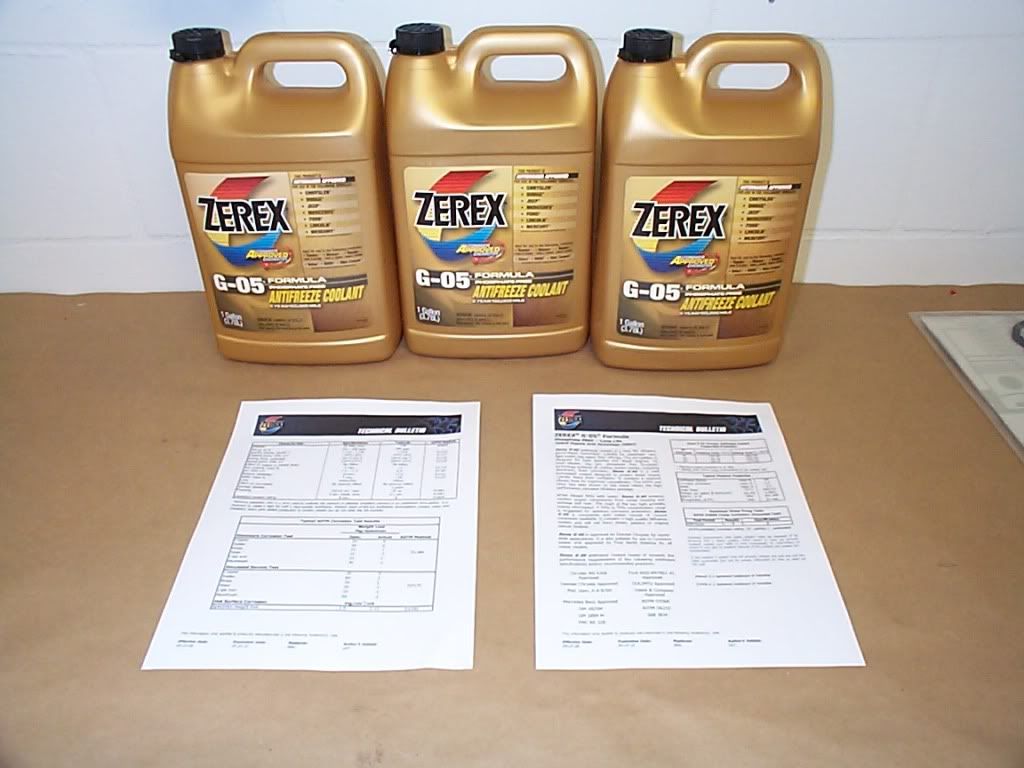
OK this is a DIY for a coolant exchange only. It is a simple quick procedure for cooling systems that are well maintained. In this DIY we will not be cleaning or flushing the cooling system. The last time my system was serviced was 5 years ago by a Mercedes Benz dealer. Here is what a quick search led me to as far as what is the most correct coolant (antifreeze for you up north) Zerex G-05. I purchased this at my local Ft Lauderdale NAPA for $11 a gallon non-diluted, I bought 3 but this procedure only uses 2 gallons.
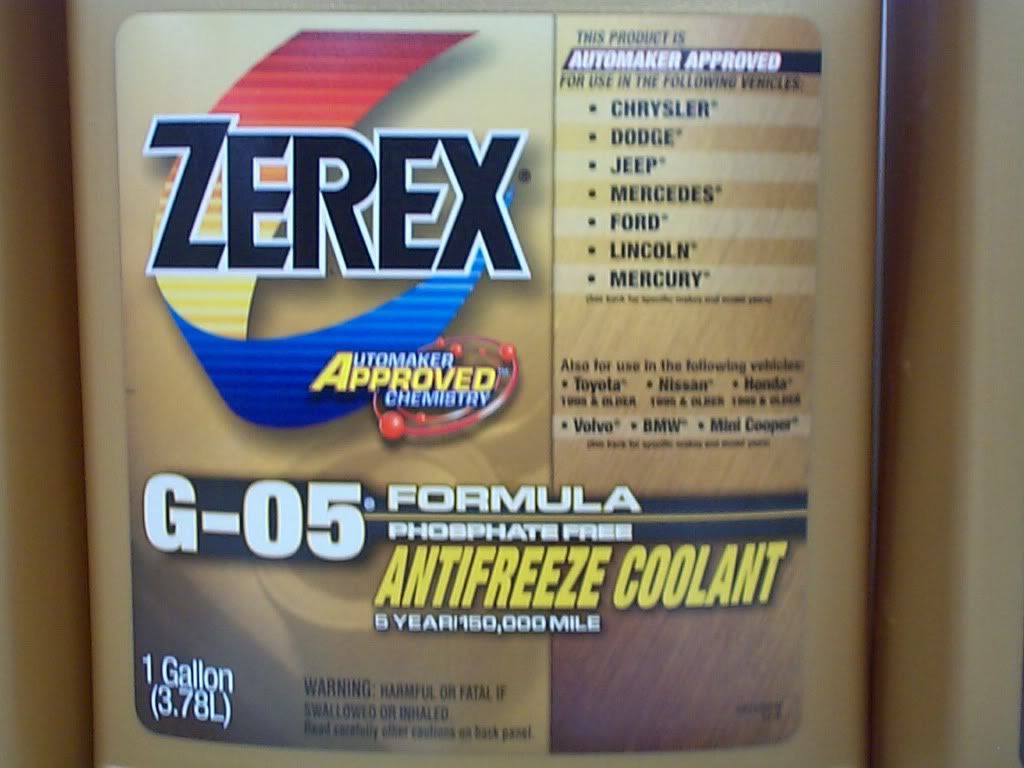
Here is a close up of the label, Has Mercedes listed.
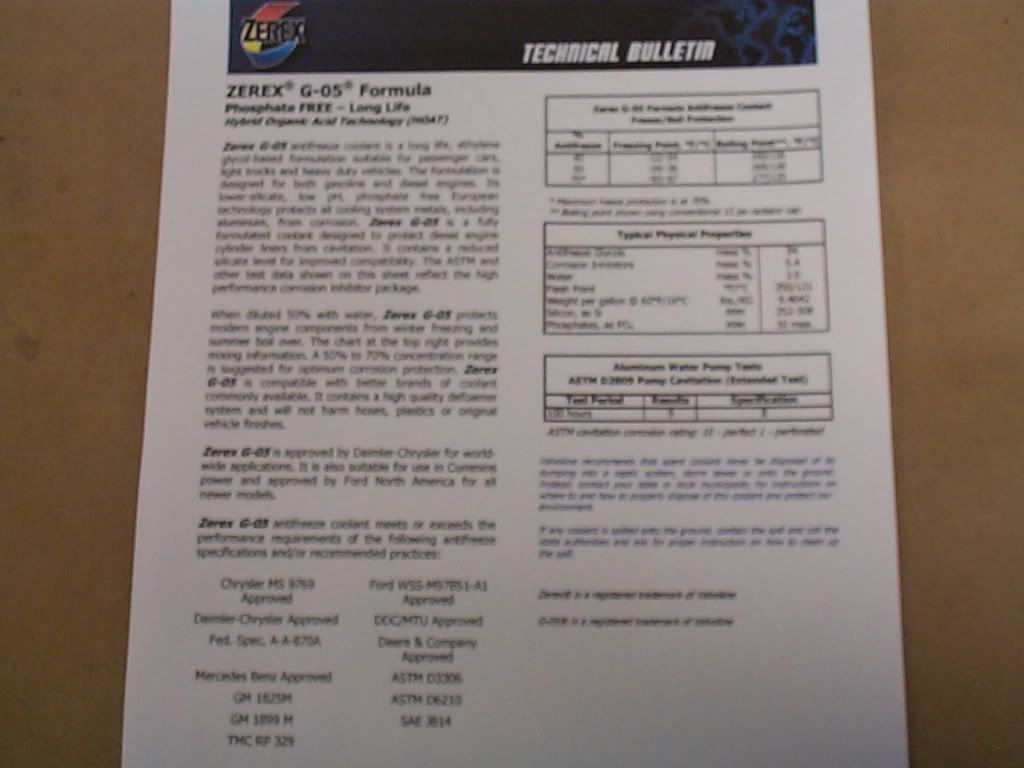
I downloaded the technical papers from Zerex and found "Mercedes Benz approved" and the specs
GM1825M, GM1899M, TMC RP 329. I don't know what spec applies to our E class gassers.
Here is a list of approved coolants
http://bevo.mercedes-benz.com/bevoli...nt_action=show
You may have a lock on your coolant cap. I believe this is to prevent anyone from opening the cooling system when it is hot, this is dangerous to do. Never open a hot cooling system the coolant will erupt from the tank faster than you can move out of the way, resulting in scalding burns on hands, arms, face. Never open a hot cooling system.

To remove my cap I had to dremel (file) the locking tab under the cap. I dressed it to a point where it now acts as a detent and not a lock.

Time to remove the forward valence pan, first remove the 2 bolts in the center.

Then the 3 bolts out by the wheel well, both sides.

Now the 2 further back behind the first 2, these also hold the engine cover.

You should be able to remove the panel now.

Time to get your fluid capture equipment together, I used a hose 3/8 ID, drain pan and gallon jugs.

Here is a close up of the label, Has Mercedes listed.
I downloaded the technical papers from Zerex and found "Mercedes Benz approved" and the specs
GM1825M, GM1899M, TMC RP 329. I don't know what spec applies to our E class gassers.
Here is a list of approved coolants
http://bevo.mercedes-benz.com/bevoli...nt_action=show
You may have a lock on your coolant cap. I believe this is to prevent anyone from opening the cooling system when it is hot, this is dangerous to do. Never open a hot cooling system the coolant will erupt from the tank faster than you can move out of the way, resulting in scalding burns on hands, arms, face. Never open a hot cooling system.
To remove my cap I had to dremel (file) the locking tab under the cap. I dressed it to a point where it now acts as a detent and not a lock.
Time to remove the forward valence pan, first remove the 2 bolts in the center.
Then the 3 bolts out by the wheel well, both sides.
Now the 2 further back behind the first 2, these also hold the engine cover.
You should be able to remove the panel now.
Time to get your fluid capture equipment together, I used a hose 3/8 ID, drain pan and gallon jugs.
Thread Starter
MBWorld Fanatic!
Joined: Oct 2006
Posts: 3,642
Likes: 13
From: Caribbean/Florida/Colorado
E-ZGO 53hp., 1999 E 430 sport, 2004 E 55, 2008 Tahoe LTZ on 24"s
Here is the coolant drain valve, left side lower radiator, viewed from underneath. Above is the drain valve barb that has a clear hose pushed on and a grey ty wrap to hold the hose secure. you can see the tag end of the gray ty wrap.

I am using a common stubby screwdriver to open the valve, use caution and don't force this valve it is only plastic. Most of the time this valve will open quite easily but I have a problem with mine, it is requiring too much effort.

OK valve is open, good and bad, the good part is that my old coolant looks new and is crystal clear, I like that. The bad part is that my valve has a problem and is leaking, you can see the stream coming from the valve. After the coolant was drained I took the valve apart and found that one of the two O-rings had been severed and had two crush marks in it, I can only assume last person caused this (stealer). Replaced o-ring and closed valve, removed hose.

Coolant captured and will be taken to EPA disposal. I used a Arizona tea jug for my used coolant container and that is a bad idea this coolant is toxic and my not putting it in to a properly labeled container is wrong. One other point don't leave any puddles of coolant as pets seem to like the sweet taste and can ingest enough to be fatal.

I always use steam distilled water.

Not counting the spills from the valve leak I recovered almost 2 gallons. To error on the plus side I put one gallon of coolant.

Then one gallon of distilled water.

My good luck that fills the reservoir to the top of the tab. (9:00)

Replace cap, start engine, select heater on full hot run engine till operating temperature is reached.

Check for leaks. at this point you can elect to do this a second time, that way only about 15% of the original coolant is still in the system. If during your first drain the coolant was dark or cloudy (opaque) you may need to do a flush and that is more involved. and a second exchange would be a must.
Replace lower pan and you are done.

I am using a common stubby screwdriver to open the valve, use caution and don't force this valve it is only plastic. Most of the time this valve will open quite easily but I have a problem with mine, it is requiring too much effort.
OK valve is open, good and bad, the good part is that my old coolant looks new and is crystal clear, I like that. The bad part is that my valve has a problem and is leaking, you can see the stream coming from the valve. After the coolant was drained I took the valve apart and found that one of the two O-rings had been severed and had two crush marks in it, I can only assume last person caused this (stealer). Replaced o-ring and closed valve, removed hose.
Coolant captured and will be taken to EPA disposal. I used a Arizona tea jug for my used coolant container and that is a bad idea this coolant is toxic and my not putting it in to a properly labeled container is wrong. One other point don't leave any puddles of coolant as pets seem to like the sweet taste and can ingest enough to be fatal.
I always use steam distilled water.
Not counting the spills from the valve leak I recovered almost 2 gallons. To error on the plus side I put one gallon of coolant.
Then one gallon of distilled water.
My good luck that fills the reservoir to the top of the tab. (9:00)
Replace cap, start engine, select heater on full hot run engine till operating temperature is reached.
Check for leaks. at this point you can elect to do this a second time, that way only about 15% of the original coolant is still in the system. If during your first drain the coolant was dark or cloudy (opaque) you may need to do a flush and that is more involved. and a second exchange would be a must.
Replace lower pan and you are done.



Member
Joined: May 2010
Posts: 95
Likes: 0
2002 C230
Lets say we want to do a flush as well. Would that mean that we should run the hose in the coolant tank for a couple of minutes until it clears out everything. Then close up the plugs and pour in new coolant?
BTW its still a great DIY guide.
BTW its still a great DIY guide.

Junior Member
Joined: May 2010
Posts: 31
Likes: 0
From: Rusk County, Texas
1996 E300D, 2005 E320 CDI
Used coolant works fine in a tractor. The cast iron blocks and heads don't really know the difference and are unaffected by any heavy metals that are present. 
Long years ago, I worked a few days in the antifreeze plant at Dow Chemical. We had two tanks that everything was filled from. One tank was green and one tank was red and the only difference was the color and/or the label on the container it went into.
Ethylene Glycol has been used for a long time, since 1926, and it is usually "junk" that doesn't meet specs for technical grade and certainly not for any better grades. It's mostly wet product that was used to flush the lines when ships are loaded from bulk tanks.
Zerex is ethylene glycol based and has corrosion inhibitors and pH adjusters added (I think, that was 40 years ago, we just used sodium hydroxide to adjust the pH).
A simple device, pHydrion litmus paper, will tell you quickly what the antifreeze pH is, whether you use an ethylene glycol base or propylene glycol base. Check it when it's new and check again periodically.

Ospho has been around since 1917 and has been used effectively for rust conversion to iron phosphate by incorporating 75% phosphoric acid in the formula.
Rust can even be removed with the small amount of phosphoric acid contained in Coca Cola.
So, phosphates are accepted technology in antifreezes and other places for corrosion protection.
The newer antifreezes claim to be organic acid technology, but seem to have run into some problems.
I had thought about getting some propylene glycol drench (used for ketosis treatment in cows) and making something similar to Sierra, but I haven't found a source that is cheap enough to use (drench is USP grade, which isn't necessary for antifreeze).
The only flush for a system, to rid it of old antifreeze, is water. Glycols are completely soluble in water and it costs a whole lot less.
Again, years ago, we used ethylene diamine tetraacetic acid (EDTA) for boiler scale control. Being a very non-specific chelating agent, it had as much affinity for iron boiler tubes as it did for calcium in calcium carbonate deposits. I think it might be better to let the Chevrolet owners try this new technology for a while, before I use it in my cars.
Long years ago, I worked a few days in the antifreeze plant at Dow Chemical. We had two tanks that everything was filled from. One tank was green and one tank was red and the only difference was the color and/or the label on the container it went into.
Ethylene Glycol has been used for a long time, since 1926, and it is usually "junk" that doesn't meet specs for technical grade and certainly not for any better grades. It's mostly wet product that was used to flush the lines when ships are loaded from bulk tanks.
Zerex is ethylene glycol based and has corrosion inhibitors and pH adjusters added (I think, that was 40 years ago, we just used sodium hydroxide to adjust the pH).
The benefits provided by the phosphate include:
- Protect aluminum engine components by reducing cavitation corrosion during high speed driving.
- Provide for corrosion protection to ferrous metals.
- Act as a buffer to keep the antifreeze mixture alkaline. This prevents acid build-up that will damage or destroy metal engine parts.
Ospho has been around since 1917 and has been used effectively for rust conversion to iron phosphate by incorporating 75% phosphoric acid in the formula.
Naval jelly is commercially referred to by general names such as ‘rust killer’ and ‘rust remover.’ The chemical name of this product is ‘orthophosphoric acid.
So, phosphates are accepted technology in antifreezes and other places for corrosion protection.
The newer antifreezes claim to be organic acid technology, but seem to have run into some problems.
Certain cars are built with Organic Acid Technology (OAT) antifreeze (e.g., DEX-COOL<sup id="cite_ref-10" class="reference">[11]</sup>), or with a Hybrid Organic Acid Technology (HOAT) formulation (e.g., Zerex G-05<sup id="cite_ref-11" class="reference">[12]</sup>), both of which are claimed to have an extended service life of five years or 240,000 km (150,000 miles). DEX-COOL specifically has caused controversy. Litigation has linked it with intake manifold gasket failures in GM's 3.1L and 3.4L engines, and with other failures in 3.8L & 4.3L engines. Class action lawsuits were registered in several states, and in Canada,<sup id="cite_ref-12" class="reference">[13]</sup> to address some of these claims. The first of these to reach a decision was in Missouri where a settlement was announced early in December, 2007.<sup id="cite_ref-13" class="reference">[14]</sup> Late in March 2008, GM agreed to compensate complainants in the remaining 49 states.<sup id="cite_ref-14" class="reference">[15]</sup>
The only flush for a system, to rid it of old antifreeze, is water. Glycols are completely soluble in water and it costs a whole lot less.
Valvoline’s ZerexÒ G 05Ò antifreeze coolant is a long life,
fully formulated ethylene glycol-based fluid suitable for
passenger cars, light trucks and heavy duty vehicles. The
formulation is designed for both gasoline and diesel
engines. Its lower-silicate, reduced pH, phosphate free
European technology protects all cooling system metals,
including aluminum, from corrosion. ZerexÒ G 05 is a
nitrite containing coolant designed to protect diesel engine
cylinder liners from cavitation. It contains deposit
control additives for protection from hard water deposits
and scale. The ASTM and other test data shown on this
sheet reflect the high performance corrosion inhibitor
package.
fully formulated ethylene glycol-based fluid suitable for
passenger cars, light trucks and heavy duty vehicles. The
formulation is designed for both gasoline and diesel
engines. Its lower-silicate, reduced pH, phosphate free
European technology protects all cooling system metals,
including aluminum, from corrosion. ZerexÒ G 05 is a
nitrite containing coolant designed to protect diesel engine
cylinder liners from cavitation. It contains deposit
control additives for protection from hard water deposits
and scale. The ASTM and other test data shown on this
sheet reflect the high performance corrosion inhibitor
package.
Last edited by Paul5388; Jun 4, 2010 at 02:20 AM.













