


The MPG Game

Thread Starter
Senior Member
Joined: Apr 2014
Posts: 299
Likes: 3
From: Colorado
'03 SL55 AMG | 2021 AMG GLE 63s Coupe
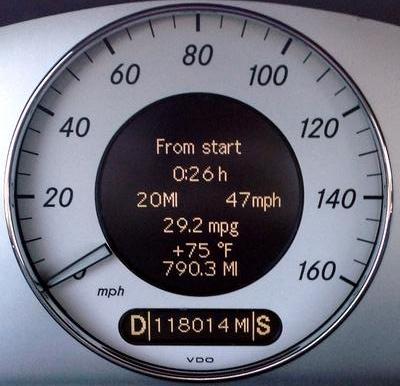
New best for my "naturally aspirated" '07 E350 4Matic.
I get much better mpg off the highway.
Wonder if I drive a bit fast?
Don't know what kind of gas the previous owner used, but I have run a couple of Techron treatments though since I got it, and I always use tier 1 gas.
This picture was siting a stop light. By the time I got to work and parked, it was down to 28.5
I get much better mpg off the highway.
Wonder if I drive a bit fast?
Don't know what kind of gas the previous owner used, but I have run a couple of Techron treatments though since I got it, and I always use tier 1 gas.
This picture was siting a stop light. By the time I got to work and parked, it was down to 28.5
Thread Starter
Senior Member
Joined: Apr 2014
Posts: 299
Likes: 3
From: Colorado
'03 SL55 AMG | 2021 AMG GLE 63s Coupe

Out Of Control!!


Joined: Aug 2010
Posts: 12,517
Likes: 628
From: Charlotte NC area
2019 WS222 S450 4-Matic / 2007 W211 E350 4Matic (Sold) / 2008 X164 GL320 CDI
MB World Stories
The Best of Mercedes & AMG

8 Oddball Mercedes Ideas That Actually Made it to Production
Verdad Gallardo
Dubai Tuner Gives the Mercedes G-Class An Entirely New Look
Verdad Gallardo
Six Gift Ideas Your AMG Loving Dad or Grad Will Cherish

7 Craziest Things AMG Gas Ever Built
Verdad Gallardo
New Electric Mercedes-AMG GT 4-Door Coupe Unveiled: 10 Things You Need to Know
Verdad Gallardo
6 Mercedes Models That Did NOT Age Well (But Are Somehow Still Cool)
Verdad Gallardo
Manual Mercedes? 6 Times Sindelfingen Let Drivers Have All The Fun
Verdad Gallardo
Mercedes SLR McLaren 722 S Is Extremely Rare Example Modified by McLaren
Verdad Gallardo
8 Classic Boxy Mercedes Designs That Have Aged Like Fine Wine
Verdad Gallardo
Super Member
Joined: Sep 2013
Posts: 865
Likes: 61
From: Bay Area
14 550 sedan
It means over the duration of his last 20 miles, he was averaging 29.2 miles per gallon while traveling at an average of 47 miles per hour.
It'd be nice if someone could retrofit cylinder deactivation on my car for me though..
It'd be nice if someone could retrofit cylinder deactivation on my car for me though..

Member
Joined: Sep 2006
Posts: 228
Likes: 42
From: North of San Francisco
14 E550, 07 E550, 69 Mach I, 65 Hipo, 66 Fairlane GTA Conv, 66 Fairlane GT
Cracked off a new best of 31.5 MPG this week on the way to work (75 miles). Did is twice, actually. Also bumped my overall for the last 12k miles to 27.0. I've noticed I get better mileage when the weather is warmer (and 72 is warm for 8:00 AM). I don't get quite as good of mileage on the way home as there is nearly always a head wind (yet never a tail wind in the morning - welcome to the Bay Area).
Kind of amazing mileage for a car with 380+ hp, and 4x better that I used to get in my 428 muscle car with 3x2's that had only slightly more hp.
Kind of amazing mileage for a car with 380+ hp, and 4x better that I used to get in my 428 muscle car with 3x2's that had only slightly more hp.
Last edited by John H; Jun 29, 2014 at 01:07 AM.

Thread Starter
Senior Member
Joined: Apr 2014
Posts: 299
Likes: 3
From: Colorado
'03 SL55 AMG | 2021 AMG GLE 63s Coupe

.
Super Member
Joined: Sep 2013
Posts: 865
Likes: 61
From: Bay Area
14 550 sedan
Probably because I live in a city full of hills where there's always traffic. Sometimes it can take over an hour just to travel 10 miles or less. I live at sea level so if anything I should be getting the best mpg I can get. Fuel quality shouldn't affect it much either, wish we had 93 octane around here though.


Super Member
Joined: Nov 2009
Posts: 724
Likes: 31
Car free at the moment
Probably because I live in a city full of hills where there's always traffic. Sometimes it can take over an hour just to travel 10 miles or less. I live at sea level so if anything I should be getting the best mpg I can get. Fuel quality shouldn't affect it much either, wish we had 93 octane around here though.
You want to see bad, I'll post some photos from my E55 wagon. At a steady 60MPH it might, just barely, achieve 20MPG. At normal Texas road speeds, I've never actually achieved that figure.

MBWorld Fanatic!
Joined: Aug 2011
Posts: 3,184
Likes: 16
From: Highlands Ranch, Colorado
2014 BMW M235i
My experience has been totally the opposite, even though you have less air at elevation doesn't mean the engine consumes less fuel because of less drag, I think those numbers are nominal. The efficiency of your combustion engine at altitude is much less than that of one at sea level so under normal driving conditions (not romping it and redlining it constantly) you are more efficient. Efficiency is lowered because effective compression is lowered with less dense air, and therefore less fuel is added to each stroke - meaning to maintain the same speed or level of acceleration as you would at sea level, you would need to open the throttle more and you waste more fuel making less power.
Last edited by AMGAffalterbach; Jun 30, 2014 at 12:01 PM.
Out Of Control!!
Joined: Aug 2010
Posts: 12,517
Likes: 628
From: Charlotte NC area
2019 WS222 S450 4-Matic / 2007 W211 E350 4Matic (Sold) / 2008 X164 GL320 CDI
My experience has been totally the opposite, even though you have less air at elevation doesn't mean the engine consumes less fuel because of less drag, I think those numbers are nominal. The efficiency of your combustion engine at altitude is much less than that of one at sea level so under normal driving conditions (not romping it and redlining it constantly) you are more efficient. Efficiency is lowered because effective compression is lowered with less dense air, and therefore less fuel is added to each stroke - meaning to maintain the same speed or level of acceleration as you would at sea level, you would need to open the throttle more and you waste more fuel making less power.
What goes down with higher altitude is pumping losses due to the engine working against a more closed throttle plate.
Wind resistance is a significant factor (as any triathlete level bicycle rider) .
Reduced engine peak power is irrelevant.
The real issue is YMMV with driving style, car condition, road condition, hills, curves, crown of road, tire condition, tire inflation, tire type, tire width, weigh in car, style of driving, irregularities in alignment, state of tune, wind, driving style, speed, consistency of speed, steering corrections, and a few (many) other factors. Not to mention differences in how the measurement is taken.

Did I say driving style?

Super Member
Joined: Nov 2009
Posts: 724
Likes: 31
Car free at the moment
My experience mirrors the theory quite well. I always see the best MPG numbers when in the high plains of west Texas (5K above sea level) or Colorado. Of course in the real world there are many factors at play, so different folks have different results.
On engine efficiency. The maximum power output of a naturally aspirated engine is reduced at high elevation. The efficiency of the engine at part throttle operation is the same or better at elevation. This is because gasoline engines experience throttle losses or pumping losses. This is the work required to draw intake air past the mostly closed throttle during part-throttle cruise. At higher elevations the throttle must be opened more to generate the same power output. This reduces the pumping losses and increases the overall efficiency of the engine. A quick google search shows there is lots of material available on throttling losses / pumping losses. Or find some reading on Brake Specific Fuel Consumption. BSFC is the quantity of fuel an engine consumes to produce a specific amount of power output. It basically represents the efficiency of the engine.
Edit: NJAY beat me to it!
On engine efficiency. The maximum power output of a naturally aspirated engine is reduced at high elevation. The efficiency of the engine at part throttle operation is the same or better at elevation. This is because gasoline engines experience throttle losses or pumping losses. This is the work required to draw intake air past the mostly closed throttle during part-throttle cruise. At higher elevations the throttle must be opened more to generate the same power output. This reduces the pumping losses and increases the overall efficiency of the engine. A quick google search shows there is lots of material available on throttling losses / pumping losses. Or find some reading on Brake Specific Fuel Consumption. BSFC is the quantity of fuel an engine consumes to produce a specific amount of power output. It basically represents the efficiency of the engine.
Edit: NJAY beat me to it!
Thread Starter
Senior Member
Joined: Apr 2014
Posts: 299
Likes: 3
From: Colorado
'03 SL55 AMG | 2021 AMG GLE 63s Coupe
@N_Jay BOOM! 
Sooooo... this "MPG Game" has rules like Monopoly...
There are the rules on the lid of the box (laws of physics),
and then there are the rules we all make up as we go along.
In order to 'even the playing field', we'd need a little spread sheet to go along with the "statistics".
I can see four 'high level' categories:
just keep it fun and really loose and enjoy the 'ups and downs of the ride'
If anyone wants to make a little data sheet... I might feed it
.
Sooooo... this "MPG Game" has rules like Monopoly...
There are the rules on the lid of the box (laws of physics),
and then there are the rules we all make up as we go along.
In order to 'even the playing field', we'd need a little spread sheet to go along with the "statistics".
I can see four 'high level' categories:
- car condition - irregularities in alignment, state of tune, weight in car
- road condition - hills, curves, crown of road, elevation, wind
- tire condition - tire inflation, tire type, tire width, wheel size and type
- driving style - speed, consistency of speed, steering corrections
just keep it fun and really loose and enjoy the 'ups and downs of the ride'
If anyone wants to make a little data sheet... I might feed it
.
Last edited by Honcho; Jun 30, 2014 at 12:45 PM.
Out Of Control!!
Joined: Aug 2010
Posts: 12,517
Likes: 628
From: Charlotte NC area
2019 WS222 S450 4-Matic / 2007 W211 E350 4Matic (Sold) / 2008 X164 GL320 CDI
@N_Jay BOOM!
Sooooo... this "MPG Game" has rules like Monopoly...
There are the rules on the lid of the box (laws of physics),
and then there are the rules we all make up as we go along.
In order to 'even the playing field', we'd need a little spread sheet to go along with the "statistics".
I can see four 'high level' categories:
just keep it fun and really loose and enjoy the 'ups and downs of the ride'
If anyone wants to make a little data sheet... I might feed it
.
Sooooo... this "MPG Game" has rules like Monopoly...
There are the rules on the lid of the box (laws of physics),
and then there are the rules we all make up as we go along.
In order to 'even the playing field', we'd need a little spread sheet to go along with the "statistics".
I can see four 'high level' categories:
- car condition - irregularities in alignment, state of tune, weight in car
- road condition - hills, curves, crown of road, elevation, wind
- tire condition - tire inflation, tire type, tire width, wheel size and type
- driving style - speed, consistency of speed, steering corrections
just keep it fun and really loose and enjoy the 'ups and downs of the ride'
If anyone wants to make a little data sheet... I might feed it
.

MBWorld Fanatic!
Joined: Aug 2011
Posts: 3,184
Likes: 16
From: Highlands Ranch, Colorado
2014 BMW M235i
Hahaha, well either way interesting thread. And I guess you're right N_Jay, you can't really negate air resistance as much as I thought. Another factor I would think is 93 octane at sea level where we only get 91 up here, may be a small influential.


