


GL 320 mpg test

Thread Starter
Junior Member
Joined: Nov 2007
Posts: 59
Likes: 0
From: Baltimore
'08 GL320 CDI, '10 Range Rover HSE
GL 320 mpg test
Just for fun I decided to see what kind of mileage I could get if I actually drove the speed limit in my 08 GL320. This was on I-95, with car on cruise control for 20 miles. I usually get around 25, but am usually going 5 10mph faster or so and not trying to be fuel concious
I was impresse with what car can actually get.
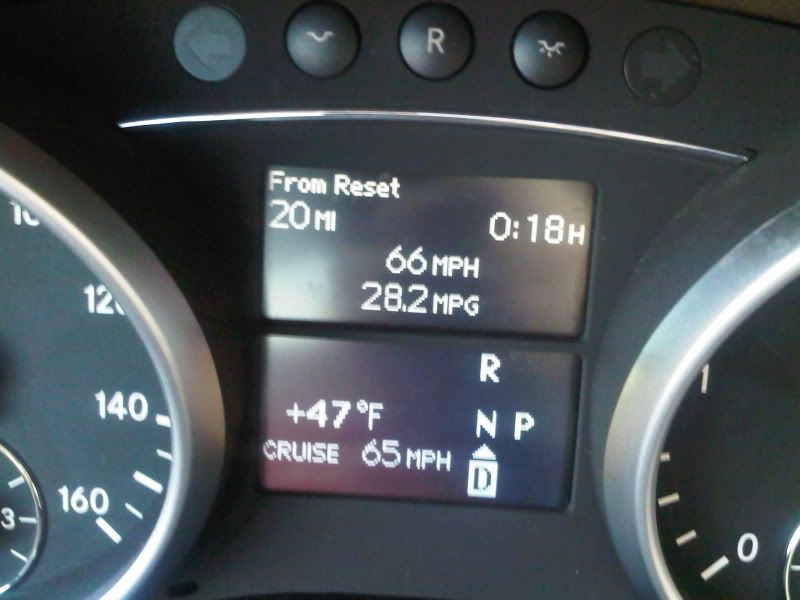
I was impresse with what car can actually get.

MBWorld Fanatic!


Joined: Dec 2004
Posts: 4,268
Likes: 253
sounds right.
also i have noticed that they read slightly pessimistic (ie lower mpg than actual).
in other words i will not be surprised if you actually measure you will be closer to 30mpg.. which is.. amazing to say the least
alex
also i have noticed that they read slightly pessimistic (ie lower mpg than actual).
in other words i will not be surprised if you actually measure you will be closer to 30mpg.. which is.. amazing to say the least
alex

Super Member
Joined: Feb 2009
Posts: 711
Likes: 11
From: NW corner of CONUS
2008 GL 320 CDI, 2004 VW V10 Touareg TDI
alx - My experience is the opposite. The car mpg computer reads optimistically. (Although it really depends on your point of view!) Most of the time when I fill up, the accumulated mpg will read about 2-3 mpg BETTER that my calculator shows when I divide odometer miles by pump delivered gallons (and I ALWAYS fill the tank to the brim). On a 160 mi all freeway road trip I typically get computer mpg to approach 32 mpg - rarely better than that. Speed averages 65 mph. Usually very steady speeds with little or no braking and moderate to light traffic. After such a run, the next fill up will show 28-29 mpg.

MBWorld Fanatic!


Joined: Jan 2010
Posts: 3,122
Likes: 785
NGL450 w/EORP, S550
My experience is that the car turns into a barn door at around 75 mph. It is easy to achieve 25-26 mpg indicated at 60 mph, but once you top 75-ish it drops markedly (22-23mpg). I have another thread going where I'm getting 32mpg by maintaining 2 seconds behind a car that is also 2 seconds behind a truck. Once I can figure out how to host video I'll post a clip. Well crap, Fourdiesel, if you're getting 32mpg with no truck breaking wind for you, then my results would be completely independent of being behind traffic. More testing needed.
To the OP , do you have 18 or 19" wheels? Another thing is a 20 mile sample is going to be optimistic. Your mileage will settle out at around 50 miles or so.
To the OP , do you have 18 or 19" wheels? Another thing is a 20 mile sample is going to be optimistic. Your mileage will settle out at around 50 miles or so.

Junior Member
Joined: Nov 2009
Posts: 33
Likes: 0
'09 GL320-wife '11E350-me
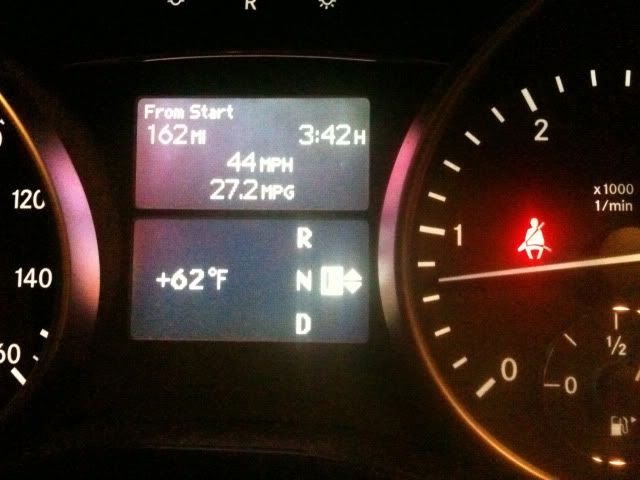
I've noticed I can get around 28mpg going 60mph and it drops to 25-26mpg at 75-80mpg. Here is a good sample of a roundtrip I did with some stop and go and a little city driving last weekend getting 27.2mpg--most of the driving was around 60-65, though the trip avg is a little lower for the 3+ hour roundtrip.
Last edited by nalaskier; Nov 18, 2010 at 10:33 PM.

Member
Joined: Sep 2010
Posts: 156
Likes: 0
From: Hudson Ohio
2014 slk55 amg, 2011 gl350, lambo gallardo, 800hp supercharged viper
Make sure your roof racks are off, only put them on when you use them. Also make sure your tires are a few psi above recommended for best fuel economy.
Junior Member
Joined: Nov 2009
Posts: 37
Likes: 1
'10 E550 Coupe, '67 230 SL, '06 E350 4-Matic, '75 911S, '04 Porsche Boxster S, '04 Cayenne Turbo
My computer consistently calculates 1.5 mpg less than actual. I've also found that I can increase mileage significantly without the cruise control by manually being gentle on the throttle. I don't know how it works but there are instances coming down hills where it feels like the cruise control puts on the brakes to maintain the set point.
And you're right about the racks. When I put on my cargo carrier the mileage drops 5-6 mpg.
I don't know how accurate it is, but the computer tells me that I'm getting 19 mpg at 130 mph
And you're right about the racks. When I put on my cargo carrier the mileage drops 5-6 mpg.
I don't know how accurate it is, but the computer tells me that I'm getting 19 mpg at 130 mph
Trending Topics
MBWorld Fanatic!
Joined: Sep 2005
Posts: 6,192
Likes: 242
From: Albuquerque
'10 CL550, '12 GL550
On one desolate 80-mile stretch (I think it's beautiful) of US56 from Clayton to Springer, NM, I started out with a tailwind and my dash was reading 30mpg. By the time I reached the end, the wind had shifted almost 180 degrees and it was reading 19 mph. Same highway speed all the time.
Those of us that live at higher altitudes get better fuel mileage, too. It's always a little depressing when I leave for Texas or the like and my mileage drops solely for this reason.
Yes, current Mercedes cruise controls do activate brakes when needed.
MB World Stories
The Best of Mercedes & AMG

7 Craziest Things AMG Gas Ever Built
Verdad Gallardo
New Electric Mercedes-AMG GT 4-Door Coupe Unveiled: 10 Things You Need to Know
Verdad Gallardo
6 Mercedes Models That Did NOT Age Well (But Are Somehow Still Cool)
Verdad Gallardo
Manual Mercedes? 6 Times Sindelfingen Let Drivers Have All The Fun
Verdad Gallardo
Mercedes SLR McLaren 722 S Is Extremely Rare Example Modified by McLaren
Verdad Gallardo
8 Classic Boxy Mercedes Designs That Have Aged Like Fine Wine
Verdad Gallardo
Flawlessly Restored Mercedes 190E Evo II Heads to Auction
Verdad Gallardo
Electric Mercedes C-Class Unveiled: 11 Things You Need to Know
Verdad Gallardo
Mercedes EQS Gets A Major Update: Everything You Need to Know
Verdad Gallardo
Member
Joined: Sep 2010
Posts: 156
Likes: 0
From: Hudson Ohio
2014 slk55 amg, 2011 gl350, lambo gallardo, 800hp supercharged viper
Also in my other cars I will often throw the tranny in neutral when coming down a big hill or when coming to a stop as it save alot of fuel and I'm very good at coasting and keeping the perfect distance. However when I test drove the GL I noticed the stalk mounted tranny shifter and it seems like it might not be a good idea to throw the GL in neutral often. Anybody do this or have any suggestions? MY GL is on order so I havnt got to test it out in the real world but I surely wouldnt want to have tranny problems to save a few mpg or is it no problem?

Super Member
Joined: Jul 2009
Posts: 814
Likes: 9
15 GL550
Anybody know if the cruise control will apply the brakes or use heavy engine braking? EDIT: Just seen above that they do activate the brakes for cruise control. Thats terrible IMO. I'll be turning cruise off when coasting down hills for sure!
Also in my other cars I will often throw the tranny in neutral when coming down a big hill or when coming to a stop as it save alot of fuel and I'm very good at coasting and keeping the perfect distance. However when I test drove the GL I noticed the stalk mounted tranny shifter and it seems like it might not be a good idea to throw the GL in neutral often. Anybody do this or have any suggestions? MY GL is on order so I havnt got to test it out in the real world but I surely wouldnt want to have tranny problems to save a few mpg or is it no problem?
Also in my other cars I will often throw the tranny in neutral when coming down a big hill or when coming to a stop as it save alot of fuel and I'm very good at coasting and keeping the perfect distance. However when I test drove the GL I noticed the stalk mounted tranny shifter and it seems like it might not be a good idea to throw the GL in neutral often. Anybody do this or have any suggestions? MY GL is on order so I havnt got to test it out in the real world but I surely wouldnt want to have tranny problems to save a few mpg or is it no problem?
MBWorld Fanatic!
Joined: May 2007
Posts: 2,244
Likes: 1
From: Scottsdale, AZ
2004 RX330, 2008 Scion xB, 2001 Honda Insight Hybrid, 2010 Toyot Prius v ATP
I don't know about the transmission but I have heard from numerous mechanics and public safety officers that letting your vehicle go to idle when you're going down a hill, where you're still using your power steering and possibly your power brakes, can mean your vehicle isn't producing the necessary RPM to keep those pumps alive and give you the necessary control. Granted, this was years and years ago and the systems may be very different, I don't know, but I'd sure hate to be coming down the hill into Verde Valley on I-17 without full braking and steering control! IMHO.
Super Member
Joined: Feb 2009
Posts: 711
Likes: 11
From: NW corner of CONUS
2008 GL 320 CDI, 2004 VW V10 Touareg TDI
Most modern electronic controlled diesel (and maybe even gas) engines put NO fuel in when you have your foot off the pedal AND the engine is spinning at above idle rpm due to 'coasting' downhill. The CDI engine is no exception. BUT, the braking system DOES apply the brakes if cruise control is set and the speed begins to increase without the control system 'asking' for more fuel.
That feature sucks but that's the way it is and the M-B designers made it so that the automatic braking can't be turned off. [Keeps us from getting speeding tickets going down a hill whether we want to of not!] I routinely turn the cruise off when descending a 'decent ' grade. I do NOT shift to neutral because zero fuel input while rolling results in the best possible mileage.
That feature sucks but that's the way it is and the M-B designers made it so that the automatic braking can't be turned off. [Keeps us from getting speeding tickets going down a hill whether we want to of not!] I routinely turn the cruise off when descending a 'decent ' grade. I do NOT shift to neutral because zero fuel input while rolling results in the best possible mileage.
MBWorld Fanatic!
Joined: Sep 2005
Posts: 6,192
Likes: 242
From: Albuquerque
'10 CL550, '12 GL550
Hard to see how the cruise control braking "sucks."
You asked for a speed, it gives you that speed.
I'd say those cruise controls that allow overrun of the selected speed are the ones that "suck" (and are cheap).
You asked for a speed, it gives you that speed.
I'd say those cruise controls that allow overrun of the selected speed are the ones that "suck" (and are cheap).
MBWorld Fanatic!
Joined: May 2007
Posts: 2,244
Likes: 1
From: Scottsdale, AZ
2004 RX330, 2008 Scion xB, 2001 Honda Insight Hybrid, 2010 Toyot Prius v ATP
One of the things MB does right, IMHO.
Member
Joined: Sep 2010
Posts: 156
Likes: 0
From: Hudson Ohio
2014 slk55 amg, 2011 gl350, lambo gallardo, 800hp supercharged viper
Most modern electronic controlled diesel (and maybe even gas) engines put NO fuel in when you have your foot off the pedal AND the engine is spinning at above idle rpm due to 'coasting' downhill. The CDI engine is no exception. BUT, the braking system DOES apply the brakes if cruise control is set and the speed begins to increase without the control system 'asking' for more fuel.
That feature sucks but that's the way it is and the M-B designers made it so that the automatic braking can't be turned off. [Keeps us from getting speeding tickets going down a hill whether we want to of not!] I routinely turn the cruise off when descending a 'decent ' grade. I do NOT shift to neutral because zero fuel input while rolling results in the best possible mileage.
That feature sucks but that's the way it is and the M-B designers made it so that the automatic braking can't be turned off. [Keeps us from getting speeding tickets going down a hill whether we want to of not!] I routinely turn the cruise off when descending a 'decent ' grade. I do NOT shift to neutral because zero fuel input while rolling results in the best possible mileage.
Junior Member
Joined: Nov 2009
Posts: 37
Likes: 1
'10 E550 Coupe, '67 230 SL, '06 E350 4-Matic, '75 911S, '04 Porsche Boxster S, '04 Cayenne Turbo
hmmm that is very interesting. Is that only for diesels? In all my other cars (some manual some automatic) when crusing to a stop or down a hill when I put it in neutral the rpms drop significantly (to idle) and onboard mpg readings jump much higher. Would I use the same amount of gas just coasting in gear?
As far as using the mechanical brakes with a cruise control, maybe that's not a bad idea to maintain exact speed but it sure would be nice to disable that function. Not to mention that it isn't very "green"!
Super Member
Joined: Feb 2009
Posts: 711
Likes: 11
From: NW corner of CONUS
2008 GL 320 CDI, 2004 VW V10 Touareg TDI
regarding 'coasting' MPGs: Even with the old style carburetors (and mechanical injection pumps on diesels) when the throttle was backed off to idle, a SMALL fuel flow continued. The amount was determined mechanically by the idle settings. SO, if one coasted down hill in gear the MPGs DID improve a lot but the fuel flow was not zero. The electronically controlled injectors on modern diesels put fuel in to each cylinder only as necessary to maintain a given engine rpm (or power setting). If the rpm is above the set point, no fuel goes in! As soon as the rpms get near the idle setting (assuming the foot is off the throttle) fuel flow begins again, in just the right amount to maintain set engine speed.
My issue with the automatic braking function when in cruise control is one of degree: Should the brakes begin to be applied @ 0.001 mph over set speed? How about @ 0.01mph over? 1 mph over? 2? 5? My point is that I would like to take control of that, not have the engineers predetermine the parameter. To me, its the difference between a driver and a steer-er
 . And it is definitely greener to not waste the energy unnecessarily. So I push the stalk to off when going down a long enough and steep enough hill where the brakes might be applied. If my speed picks up too much? Well, I touch the brakes or take my chances with a ticket.

My issue with the automatic braking function when in cruise control is one of degree: Should the brakes begin to be applied @ 0.001 mph over set speed? How about @ 0.01mph over? 1 mph over? 2? 5? My point is that I would like to take control of that, not have the engineers predetermine the parameter. To me, its the difference between a driver
and a steer-er. And it is definitely greener to not waste the energy unnecessarily. So I push the stalk to off when going down a long enough and steep enough hill where the brakes might be applied. If my speed picks up too much? Well, I touch the brakes or take my chances with a ticket.
Junior Member
Joined: Nov 2009
Posts: 37
Likes: 1
'10 E550 Coupe, '67 230 SL, '06 E350 4-Matic, '75 911S, '04 Porsche Boxster S, '04 Cayenne Turbo
regarding 'coasting' MPGs: Even with the old style carburetors (and mechanical injection pumps on diesels) when the throttle was backed off to idle, a SMALL fuel flow continued. The amount was determined mechanically by the idle settings. SO, if one coasted down hill in gear the MPGs DID improve a lot but the fuel flow was not zero. The electronically controlled injectors on modern diesels put fuel in to each cylinder only as necessary to maintain a given engine rpm (or power setting). If the rpm is above the set point, no fuel goes in! As soon as the rpms get near the idle setting (assuming the foot is off the throttle) fuel flow begins again, in just the right amount to maintain set engine speed.
My issue with the automatic braking function when in cruise control is one of degree: Should the brakes begin to be applied @ 0.001 mph over set speed? How about @ 0.01mph over? 1 mph over? 2? 5? My point is that I would like to take control of that, not have the engineers predetermine the parameter. To me, its the difference between a driverand a steer-er. And it is definitely greener to not waste the energy unnecessarily. So I push the stalk to off when going down a long enough and steep enough hill where the brakes might be applied. If my speed picks up too much? Well, I touch the brakes or take my chances with a ticket.
My issue with the automatic braking function when in cruise control is one of degree: Should the brakes begin to be applied @ 0.001 mph over set speed? How about @ 0.01mph over? 1 mph over? 2? 5? My point is that I would like to take control of that, not have the engineers predetermine the parameter. To me, its the difference between a driver
and a steer-er. And it is definitely greener to not waste the energy unnecessarily. So I push the stalk to off when going down a long enough and steep enough hill where the brakes might be applied. If my speed picks up too much? Well, I touch the brakes or take my chances with a ticket.How about being able to dial in a range on your cruise control? Say +/- X mph? Depending on the traffic you could let the speed sag up hills and down hills pick up the balance. Now you'd be saving some fuel if you're so inclined!
MBWorld Fanatic!
Joined: May 2007
Posts: 2,244
Likes: 1
From: Scottsdale, AZ
2004 RX330, 2008 Scion xB, 2001 Honda Insight Hybrid, 2010 Toyot Prius v ATP
Yes, gadgets break. Yes, they are just that - gadgets. But for me, it's a little like tire sizes and ratings, and suspensions and tuning boxes and all the other mechanical changes one can make to a car; I am not an engineer, I don't know whether one of the automatic systems should kick in at one point or another. And personally, "green" or not, it's nice on some roads to have to worry almost exclusively about dodging other traffic and not heading down a thousand foot cliff. So ... [ahem] ... what does that have to do with mileage? I will say it seems like mine was off this past weekend going down to Tucson and back every day (~2 hours, 75 MPH speed limit on much). My two reasons? First, of course, was the speeds involved. Second was the traffic (it is amazing how many folks can't read "Slower Traffic Keep Right" in this world!) Last, it was windy as hell out there, a cross-breeze that required nearly constant steering wheel adjustments. I was probably around 21 MPG for the trip, with the CC on and not very heavily loaded. Comments? Questions? Dementia?
Super Member
Joined: Feb 2009
Posts: 711
Likes: 11
From: NW corner of CONUS
2008 GL 320 CDI, 2004 VW V10 Touareg TDI
dementia is good! I'm beginning to specialize in that subject!
Two points re mileage (gas or diesel):
I read an article recently in a cycling mag that said the wheel weight of a racing bike is TWICE as important as weight anywhere else on the bike and that got me to thinking about why that is. It turns out that basic physics is the reason. It takes energy to make a wheel accelerate (change rotational speeds) even though the bike isn't moving along a road. The same exact thing is true for car wheels/tires. Engineers use a term called rotational moment of inertia to measure the effect and the amount. Higher rotational moment of inertia is harder to start rotating and keeps going longer. Lower is easier. Thus it is important to get the lightest wheel assemblies consistent with tire wear, noise, traction under various conditions, handling, etc, etc. So the wheels have two inertia components - weight alone and rotational inertia.
I conclude that it is thus important NOT to have to accelerate the car (which of course includes the four wheels) any more than is absolutely essential. A well designed cruise control will thus sense a very small decrease in speed and add more fuel energy before much acceleration is needed. Over speed caused by gravity - going down hill - is less important because with a good system, the cruise will 'pick up' the set speed precisely. This also means that if you disconnect the cruise going downhill you should be as precise as possible when it is reengaged.
The second point is just common sense:
Avoid braking if possible. EVERY TIME the brakes are used some of the energy of the car is thrown off as heat. The fuel you burned to get to that speed is therefore thrown away. Drive with your 'eyes ahead of the car' as far as possible. Leave enough room to the car ahead so you can back off the throttle instead of using the brakes [if possible]. Try to anticipate an upcoming downgrade and traffic permitting, crest the hill at a slow enough speed so as to be able to negotiate all curves etc without braking.
Two points re mileage (gas or diesel):
I read an article recently in a cycling mag that said the wheel weight of a racing bike is TWICE as important as weight anywhere else on the bike and that got me to thinking about why that is. It turns out that basic physics is the reason. It takes energy to make a wheel accelerate (change rotational speeds) even though the bike isn't moving along a road. The same exact thing is true for car wheels/tires. Engineers use a term called rotational moment of inertia to measure the effect and the amount. Higher rotational moment of inertia is harder to start rotating and keeps going longer. Lower is easier. Thus it is important to get the lightest wheel assemblies consistent with tire wear, noise, traction under various conditions, handling, etc, etc. So the wheels have two inertia components - weight alone and rotational inertia.
I conclude that it is thus important NOT to have to accelerate the car (which of course includes the four wheels) any more than is absolutely essential. A well designed cruise control will thus sense a very small decrease in speed and add more fuel energy before much acceleration is needed. Over speed caused by gravity - going down hill - is less important because with a good system, the cruise will 'pick up' the set speed precisely. This also means that if you disconnect the cruise going downhill you should be as precise as possible when it is reengaged.
The second point is just common sense:
Avoid braking if possible. EVERY TIME the brakes are used some of the energy of the car is thrown off as heat. The fuel you burned to get to that speed is therefore thrown away. Drive with your 'eyes ahead of the car' as far as possible. Leave enough room to the car ahead so you can back off the throttle instead of using the brakes [if possible]. Try to anticipate an upcoming downgrade and traffic permitting, crest the hill at a slow enough speed so as to be able to negotiate all curves etc without braking.
Junior Member
Joined: Nov 2009
Posts: 37
Likes: 1
'10 E550 Coupe, '67 230 SL, '06 E350 4-Matic, '75 911S, '04 Porsche Boxster S, '04 Cayenne Turbo

MBWorld Fanatic!
Joined: May 2007
Posts: 2,244
Likes: 1
From: Scottsdale, AZ
2004 RX330, 2008 Scion xB, 2001 Honda Insight Hybrid, 2010 Toyot Prius v ATP
dementia is good! I'm beginning to specialize in that subject!
The second point is just common sense:
Avoid braking if possible. EVERY TIME the brakes are used some of the energy of the car is thrown off as heat. The fuel you burned to get to that speed is therefore thrown away. Drive with your 'eyes ahead of the car' as far as possible. Leave enough room to the car ahead so you can back off the throttle instead of using the brakes [if possible]. Try to anticipate an upcoming downgrade and traffic permitting, crest the hill at a slow enough speed so as to be able to negotiate all curves etc without braking.
The second point is just common sense:
Avoid braking if possible. EVERY TIME the brakes are used some of the energy of the car is thrown off as heat. The fuel you burned to get to that speed is therefore thrown away. Drive with your 'eyes ahead of the car' as far as possible. Leave enough room to the car ahead so you can back off the throttle instead of using the brakes [if possible]. Try to anticipate an upcoming downgrade and traffic permitting, crest the hill at a slow enough speed so as to be able to negotiate all curves etc without braking.
Enjoy!
STP


