



WTF???

Thread Starter
Super Member
Joined: Sep 2011
Posts: 687
Likes: 10
From: SoCal
2014 E63s

MBWorld Fanatic!
iTrader: (1)
Joined: Jan 2012
Posts: 2,092
Likes: 29
From: Orlando
1967 Pro Touring turbo LSX Camaro
It's probably too far back in the system to be optimal, whose X pipe is it? If its a home grown muffler shop X it might be doing more harm than good.
Thread Starter
Super Member
Joined: Sep 2011
Posts: 687
Likes: 10
From: SoCal
2014 E63s
MBWorld Fanatic!
iTrader: (1)
Joined: Jan 2012
Posts: 2,092
Likes: 29
From: Orlando
1967 Pro Touring turbo LSX Camaro
Ideally you want it right after the collectors where it can still provide some scavenging/pulse dampening like its designed to do. I bet yours sounds nice and smooth now though.
Thread Starter
Super Member
Joined: Sep 2011
Posts: 687
Likes: 10
From: SoCal
2014 E63s
not sure what you mean by "right after the collectors". I wouldn't say it sounds nice and smooth but definitely sounds better and has a bit of backfire sounds on deceleration. Did I lose power or torque?
Trending Topics

MBWorld Fanatic!
Joined: Jul 2010
Posts: 4,921
Likes: 9
From: Streets of SoFlo
you to Hate
MB World Stories
The Best of Mercedes & AMG

6 Mercedes Models That Did NOT Age Well (But Are Somehow Still Cool)
Verdad Gallardo
Manual Mercedes? 6 Times Sindelfingen Let Drivers Have All The Fun
Verdad Gallardo
Mercedes SLR McLaren 722 S Is Extremely Rare Example Modified by McLaren
Verdad Gallardo
8 Classic Boxy Mercedes Designs That Have Aged Like Fine Wine
Verdad Gallardo
Flawlessly Restored Mercedes 190E Evo II Heads to Auction
Verdad Gallardo
Electric Mercedes C-Class Unveiled: 11 Things You Need to Know
Verdad Gallardo
Mercedes EQS Gets A Major Update: Everything You Need to Know
Verdad Gallardo
5 Underrated Mercedes-Benz Models That Don't Get the Love They Deserve
Verdad Gallardo
Mercedes 300D Has Pushed Well Past 1 Million Miles and It Ain't Stopping
Verdad Gallardo
Member
Joined: Jan 2012
Posts: 136
Likes: 1
From: Toronto
2003 E55
Interesting, has anyone actually picked up any documented power/torque from an X-Pipe on our engines, or is everyone going by the magazine claims that it is superior to H-pipe or true duals. Every AMG exhaust I've seen uses an H-Pipe somewhere in the system, whether it's an SLS or an E55, with the exception of the SLR and the G55 which run two separate banks. I wonder if AMG chose the H-pipe strictly to control drone, or......

MBWorld Fanatic!
Joined: Aug 2011
Posts: 3,184
Likes: 16
From: Highlands Ranch, Colorado
2014 BMW M235i
On naturally aspirated engines I know there needs to be optimal back pressure or you'll lose low end power, but is this true of the Kompressor platform as well?
And I would assume so on the H-Pipe it's all about harmonics...
And I would assume so on the H-Pipe it's all about harmonics...
MBWorld Fanatic!
iTrader: (1)
Joined: Jan 2012
Posts: 2,092
Likes: 29
From: Orlando
1967 Pro Touring turbo LSX Camaro
Well sometimes the slowing down of the exhaust gasses that happens with larger diameter pipes is confused for the engine "liking back pressure". No engine likes back pressure, but to try and simplify things, the best exhaust for a particular engine is one that meets the balance point between maximum exhaust velocity and zero back pressure.
You want the exhaust moving as fast through the tubes as possible to help scavenge the old mixture out of the head, and help draw the new mixture in during valve overlap (even a boosted engine still draws the fresh mixture in the cylinder under a vaccum during the split moment the valve opens and the piston rockets to BDC)
You've got to think of the gasses as a series of pulses that need to be moved along at as high a velocity as possible and that's why an improperly designed X pipe can cost power via turbulence in the tubes. So there is an optimum size pipe for a given displacement/power output level where the balance is shifted from the engine gaining power due to reduced back pressure, to the engine losing power due to decreased velocity of the gases as the pipe becomes too large. And this is just at a specific RPM Typically, the higher the RPM range you want to maximize efficiency for, the larger diameter tubes you can get away with before velocity is lost.
You want the exhaust moving as fast through the tubes as possible to help scavenge the old mixture out of the head, and help draw the new mixture in during valve overlap (even a boosted engine still draws the fresh mixture in the cylinder under a vaccum during the split moment the valve opens and the piston rockets to BDC)
You've got to think of the gasses as a series of pulses that need to be moved along at as high a velocity as possible and that's why an improperly designed X pipe can cost power via turbulence in the tubes. So there is an optimum size pipe for a given displacement/power output level where the balance is shifted from the engine gaining power due to reduced back pressure, to the engine losing power due to decreased velocity of the gases as the pipe becomes too large. And this is just at a specific RPM
Typically, the higher the RPM range you want to maximize efficiency for, the larger diameter tubes you can get away with before velocity is lost.
MBWorld Fanatic!
iTrader: (1)
Joined: Jan 2012
Posts: 2,092
Likes: 29
From: Orlando
1967 Pro Touring turbo LSX Camaro
This is why the best X pipes like this one aren't completely open in the center to the full diameter of the tubes. More like a small window that balances pulses while still encouraging the gasses to flow quickly.
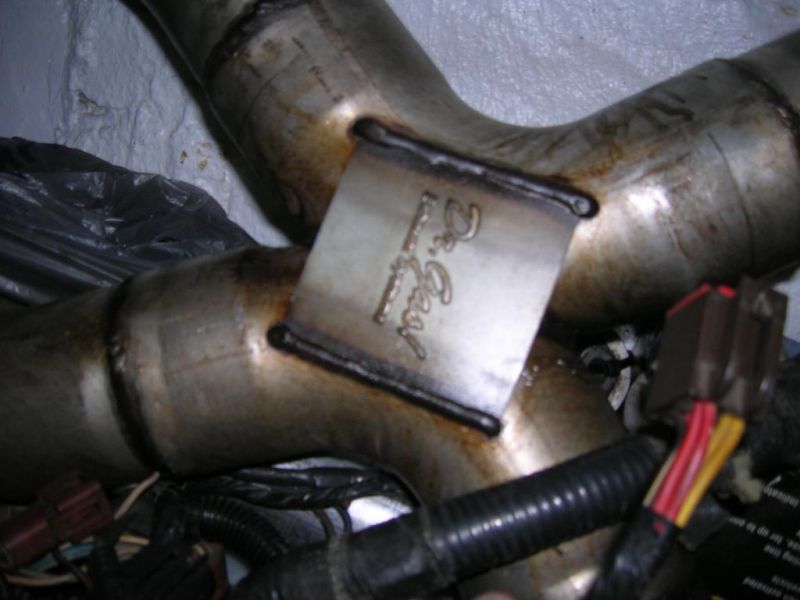
This is probably close to an optimal exhaust for max peak output on a street driven car
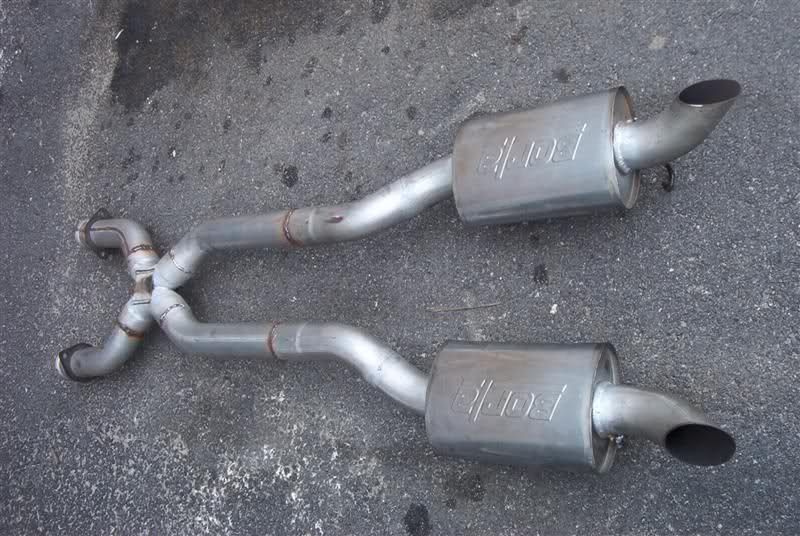
Definitely not optimal for keeping your geriatric neighbors happy, and some power might be lost in the low revs, but thats probably not a concern on the car this would go on.
This is probably close to an optimal exhaust for max peak output on a street driven car
Definitely not optimal for keeping your geriatric neighbors happy, and some power might be lost in the low revs, but thats probably not a concern on the car this would go on.

MBWorld Fanatic!
Joined: Sep 2012
Posts: 1,009
Likes: 2
sl55 amg
here is what you want. this is a pic of the exhausts i used to build for the 350z/g35 platform. it picked up both torque and hp through entire rpm band. this wasn't over stock, it was over all the other manufacturers too. still holds bolt on record as far as i know.
the vq engine had an optimized firing order for the x pipe though going back and forth on each bank.
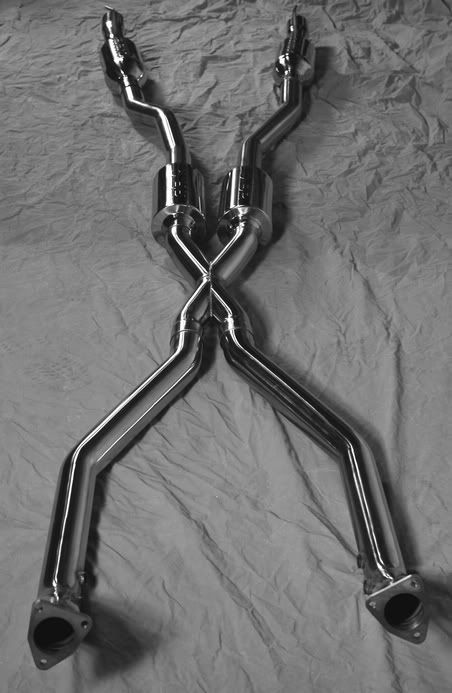
the vq engine had an optimized firing order for the x pipe though going back and forth on each bank.


MBWorld Fanatic!
Joined: Oct 2012
Posts: 1,203
Likes: 2
From: L.I. NY
2011 CTSV auto, 06 E55 white pano, 87 Grand national, 63 split window
I do understand, however, that supercharged cars do need to breathe a little bit more and heard that our exhaust is tiny near where the headers would meet our exhaust so I have heard that certain headers and exhaust works. Doesn't NBH or MBH (not sure of name) have long tubes with certain pipes (again not sure of what it comes with) that 'guarantee 35-40 rwhp? Some more experienced guys will chime in with facts I'm sure.
Thread Starter
Super Member
Joined: Sep 2011
Posts: 687
Likes: 10
From: SoCal
2014 E63s
so after driving the car for a little while today i must say i'm really liking the way it sounds. i didnt really notice any power loss as i was not launching it at all just normal driving with the occational mini punch. I was considering putting back the resonator as soon as today but for now will keep it as is and wait for me tune to be applied and see what happens as i dont really race the car so sacrificing a little power for this amazing sound might be worth it to me. If at any point i'm power hungry ill simply put the res back on and maybe go with headers or who knows.
MBWorld Fanatic!
Joined: Aug 2011
Posts: 3,184
Likes: 16
From: Highlands Ranch, Colorado
2014 BMW M235i
Thanks for all of the details guys, and I don't think that exhaust in very many applications - except perhaps with some crazy forced induction system - will lead to a 40rwhp gain alone... as I always preface my comments in the AMG subforum I might be very wrong, but I don't think you'll see a guaranteed gain that large. Now if you tune the car properly along with other mods yes you probably can, but I see exhaust as a 'supporting mod' not as a bolt on performance mod so I definitely agree with you in that aspect.
But VCCI I think you'll be getting on the gas more now haha =)
But VCCI I think you'll be getting on the gas more now haha =)


