







How to drive a manual efficiently

Thread Starter
Senior Member
Joined: Dec 2004
Posts: 453
Likes: 3
From: Bay Area, CA
'04 Mars Red C230K Sport Coupe (not Coup-EH)
How to drive a manual efficiently
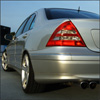
As my car's interior is basically non-existent at this point (I bring pictures!), I've been borrowing my brother's car for the month that he's gone, the 2004 white C230 sedan that we got for him, which is a manual (friggin, fraggin).
Anyway, I can drive my automatic coupe in such a way on my normal commute as to get about 32 MPG peak and 30 MPG door-to-door, which consists of mostly highway driving, mostly flat. However, I can't seem to do this with his car; I usually top out at 27 MPG and average at 24-25 MPG. Naturally I'm not pushing it up to 5000 rpm through every gear and expecting it to get good mileage, but I get some odd things that don't correspond (naturally) between the auto and the manual, like coasting at 25-30 mph, I lose mileage sometimes when the engine is running at 1500 rpm (which is not the case in the auto), yet it gets better mileage when I'm in 4th at about 2500 rpm. Yes, I'm a manual noob.
I know it's the difference between the way I drive the cars, so I'm hoping some people who have manuals can give some advice as to how to drive the thing efficiently. Things like, shift at 2500 rpm for the first four gears, coast on 4th gear at 30ish mph, stuff like that, just tips so I can start driving this thing cleaner, since I haven't been having much luck so far. The help is much appreciated.
Now all of you who want to tell me to figure it out myself and that I'm a pansy for asking such questions....
Have at it.
Anyway, I can drive my automatic coupe in such a way on my normal commute as to get about 32 MPG peak and 30 MPG door-to-door, which consists of mostly highway driving, mostly flat. However, I can't seem to do this with his car; I usually top out at 27 MPG and average at 24-25 MPG. Naturally I'm not pushing it up to 5000 rpm through every gear and expecting it to get good mileage, but I get some odd things that don't correspond (naturally) between the auto and the manual, like coasting at 25-30 mph, I lose mileage sometimes when the engine is running at 1500 rpm (which is not the case in the auto), yet it gets better mileage when I'm in 4th at about 2500 rpm. Yes, I'm a manual noob.
I know it's the difference between the way I drive the cars, so I'm hoping some people who have manuals can give some advice as to how to drive the thing efficiently. Things like, shift at 2500 rpm for the first four gears, coast on 4th gear at 30ish mph, stuff like that, just tips so I can start driving this thing cleaner, since I haven't been having much luck so far. The help is much appreciated.
Now all of you who want to tell me to figure it out myself and that I'm a pansy for asking such questions....
Have at it.
Thread Starter
Senior Member
Joined: Dec 2004
Posts: 453
Likes: 3
From: Bay Area, CA
'04 Mars Red C230K Sport Coupe (not Coup-EH)
Well, it's less about the cost savings and more about the learning something new, as well has having the sinking feeling that I'm doing something wrong 

MBWorld Fanatic!
Joined: Nov 2001
Posts: 6,211
Likes: 2
From: Laguna Niguel, CA
Ideally you should shift around the point where torque nears maximum. If I remember right, torque starts leveling out at about 2,500 so I would shift at that point for a good combination of accelleration vs. economy. If you want to lean towards better economy, treat that gas pedal as though a raw egg was between it and your foot. Smooth easy pedal action and conservative shifts will get you decent fuel mileage. Don't exceed posted speed limits, the faster you go, the lower your fuel mileage. I can get 32-33 mpg if I drive at a steady state at 65 mph, but drops down to 28 mpg at my normal driving speed of 80 mph.

Super Member
Joined: Sep 2005
Posts: 511
Likes: 0
From: Nuevo México
2005 C230K Sport Sedan, 6 speed manual
The first thing I always tell people new to manual transmissions is to listen to your engine. That means turn off the stereo and hang up the cell phone for the first few weeks. Put other distractions on hold.
Observe the tachometer as you are listening to your engine. The M271 engine is a very smooth 4 cylinder, but it has the sport exhaust, so you can listen. Your car is communicating with you.
Does the engine sound strained? Then you are revving too high. Shift up a gear (or two).
Is the engine bogging down and lurching? Then you need to shift down a gear. Be careful to not select a too-low gear, because it can over-rev your engine, possibly causing damage.
As stated in another post above, the peak torque is often the best fuel economy. If the RPM's are too high (or too low), you are wasting fuel.
If you know someone who is a really smooth manual transmission driver, ride with them a few times, and observe the technique for smoothness.
Incidentally, I congratulate you for taking the challenge and learning to drive a manual. Once you master the art, you may not want to return to an automatic.

Observe the tachometer as you are listening to your engine. The M271 engine is a very smooth 4 cylinder, but it has the sport exhaust, so you can listen. Your car is communicating with you.
Does the engine sound strained? Then you are revving too high. Shift up a gear (or two).
Is the engine bogging down and lurching? Then you need to shift down a gear. Be careful to not select a too-low gear, because it can over-rev your engine, possibly causing damage.
As stated in another post above, the peak torque is often the best fuel economy. If the RPM's are too high (or too low), you are wasting fuel.
If you know someone who is a really smooth manual transmission driver, ride with them a few times, and observe the technique for smoothness.
Incidentally, I congratulate you for taking the challenge and learning to drive a manual. Once you master the art, you may not want to return to an automatic.

Super Member
Joined: Oct 2007
Posts: 537
Likes: 2
From: Charlotte, NC
2013 S550, CLS500, ‘03 SL500, “92 190E Sportline
come for a ride with me...
I drive my manual c230 sedan like a grandma, and, like said above, as if an egg were under my foot...I try to shift so as not to make the car jerk...pretend you had a bucket full of wet manure on your roof, and you have the sunroof open...hehehe...
Trending Topics

MBWorld Fanatic!
Joined: Feb 2005
Posts: 3,543
Likes: 2
From: Connecticut
excites your girlfriend
is it really possible to over-rev? I've been going say 65 mph in 4th and if u hold the clutch and attempt to shift into 1st or 2nd there is some physical lock that blocks u from selecting those gears, or atleast it seems on my car. does anyone else notice this?
MB World Stories
The Best of Mercedes & AMG

8 Oddball Mercedes Ideas That Actually Made it to Production
Verdad Gallardo
Dubai Tuner Gives the Mercedes G-Class An Entirely New Look
Verdad Gallardo
Six Gift Ideas Your AMG Loving Dad or Grad Will Cherish

7 Craziest Things AMG Gas Ever Built
Verdad Gallardo
New Electric Mercedes-AMG GT 4-Door Coupe Unveiled: 10 Things You Need to Know
Verdad Gallardo
6 Mercedes Models That Did NOT Age Well (But Are Somehow Still Cool)
Verdad Gallardo
Manual Mercedes? 6 Times Sindelfingen Let Drivers Have All The Fun
Verdad Gallardo
Mercedes SLR McLaren 722 S Is Extremely Rare Example Modified by McLaren
Verdad Gallardo
8 Classic Boxy Mercedes Designs That Have Aged Like Fine Wine
Verdad Gallardo
MBWorld Fanatic!
Joined: Nov 2001
Posts: 6,211
Likes: 2
From: Laguna Niguel, CA
Absolutely, but that doesn't mean that others on tighter budgets need to squeeze out every last drop. Heck, I can get 65mpg on my Buell if I baby it, but then what's the fun in that so I typically get 45mpg but that's half the time at 100mph and the other half splitting lanes, just my weird commute to work.
Thread Starter
Senior Member
Joined: Dec 2004
Posts: 453
Likes: 3
From: Bay Area, CA
'04 Mars Red C230K Sport Coupe (not Coup-EH)
Thanks for the replies. As gift I show you why my car can't be driven. It's all the little things, I tell you...


alpinweiss, if it were up to me, the coupe would have been a manual. Unfortunately, given the deal offered at the time for that particular car and the people involved in the decision-making process, it didn't happen. Next time
alpinweiss, if it were up to me, the coupe would have been a manual. Unfortunately, given the deal offered at the time for that particular car and the people involved in the decision-making process, it didn't happen. Next time
Super Member
Joined: Oct 2007
Posts: 537
Likes: 2
From: Charlotte, NC
2013 S550, CLS500, ‘03 SL500, “92 190E Sportline
what happened to your car?
did your mice rebel and strip it? Did you turn off the hot water so that they couldn't take showers?
Took the coffee away?
Goodness, what are we to do with you?
you're mice took a real
Took the coffee away?
Goodness, what are we to do with you?
you're mice took a real

Thread Starter
Senior Member
Joined: Dec 2004
Posts: 453
Likes: 3
From: Bay Area, CA
'04 Mars Red C230K Sport Coupe (not Coup-EH)
First pop off the manual adjust knob on the seat back if you have a manual seat. If not, continue to step B.
There are two T25 screws on the bottom of the seat back. Remove those and the entire seat back comes right off. Once that's done you can see that the front part of the upholstery is attached to small metal tabs; you can slip them right off. If you look up the back of the seat you'll see the headrest mechanism. Be careful if you have power headrests; there's probably quite a bit more machinery in your seat, but in any event, you need to release the headrest from the black plastic piece that attaches the bottom stalks of the headrest to the headrest mechanism.
Of the tubes that hold the headrest to the seat, one is attached to the mechanism, and the other is simply sitting in the top part of the seat. This is important because they hold the upholstery down. If you look underneath the top part of the seat, it will be obvious which is which. Of the one that is part of the mechanism, just pop the top cover off. For the other one, however, you have to remove the whole thing. This is relatively easy if you use some thing like the handle end of a screwdriver and a hammer to pop it up while prying with a flathead under the top portion.
For coupes, you have to pop off the plastic piece surrounding the handle that releases the seat. Once all this is complete, the fun part comes in removing the seat back itself. If a sedan, this should just be a bit of pulling and prying up until it comes off, foam back and all. If a coupe, things get tricky because the seat release gets in the way. You have to use a flathead screwdriver (or similar) to pry the foam pieces out from around the release and pull up until the whole thing comes off. Now for part 2.
The seat bottom is just attached by clips to the bottom of the seat, which is obvious once you flip the seat over. However, you'll need to remove the plastic pieces on the sides, at least on the coupe, to get the cloth out comfortably. There are three or four T25 torx screws holding the plastic pieces together, and two of them are dastardly to find; one is hidden underneath the seat bottom itself. You have to push the rear part of the seat bottom down a bit, and you'll see a hole on the inside side of the plastic piece.
Once you do get it off however, if this is the passenger seat, the seat sensor is attached to the foam part, and this needs to be removed as well. If you look at that part that you unplugged wires from in the beginning, you'll see a small tab on one side, that, when you release it, allows you to take individual plugs out. Take out the one that traces in to a hole in the metal bottom of the seat so the foam part will release as well.
To remove the upholstery from the foam pieces (both top and bottom), you need to pry open a bunch of plastic tabs that attach metal rods (called staples in the Mercedes part catalog) on the upholstery to metal rods in the foam pieces. Using a flathead you should be able to make short work of them. Be careful on the passenger seat, as the sensors may tear and cause you problems later. Anywhere you see a seam on the seating areas on the upholstery, there is a staple.
Uhh... I don't think I missed anything
MBWorld Fanatic!
Joined: Feb 2005
Posts: 3,543
Likes: 2
From: Connecticut
excites your girlfriend

Thread Starter
Senior Member
Joined: Dec 2004
Posts: 453
Likes: 3
From: Bay Area, CA
'04 Mars Red C230K Sport Coupe (not Coup-EH)
Super Member
Joined: Oct 2007
Posts: 537
Likes: 2
From: Charlotte, NC
2013 S550, CLS500, ‘03 SL500, “92 190E Sportline
Super Member
Joined: Sep 2005
Posts: 511
Likes: 0
From: Nuevo México
2005 C230K Sport Sedan, 6 speed manual
Thread Starter
Senior Member
Joined: Dec 2004
Posts: 453
Likes: 3
From: Bay Area, CA
'04 Mars Red C230K Sport Coupe (not Coup-EH)
On a related note, the car just started to give me a pretty rough idle and a check engine light, with 60 miles left to go on the warranty. Somewhat decent timing, though it feels just like a coil pack issue, probably. It went straight to the dealers, so we'll see what happens in the morning.
Damn, and three months ago I had five cars (parents' cars, mine, brother's, and brother's old car, the 300CE), and now, with my car out of it 'cause of the interior, the 300CE sold, and the white one out due to check engine, I'm down to two cars!

MBWorld Fanatic!
Joined: Feb 2005
Posts: 3,543
Likes: 2
From: Connecticut
excites your girlfriend
Super Member
Joined: Sep 2005
Posts: 511
Likes: 0
From: Nuevo México
2005 C230K Sport Sedan, 6 speed manual
A great feature indeed. I don't think any of my other cars have this, although I have not actually tried it. Is it an electronic lockout, or how does it work?
A lockout on the manual transmission certainly addresses one of the justifications given by manufacturers (et. al.) for going to automatic transmissions only.
A lockout on the manual transmission certainly addresses one of the justifications given by manufacturers (et. al.) for going to automatic transmissions only.
Thread Starter
Senior Member
Joined: Dec 2004
Posts: 453
Likes: 3
From: Bay Area, CA
'04 Mars Red C230K Sport Coupe (not Coup-EH)
On a related note, the car just started to give me a pretty rough idle and a check engine light, with 60 miles left to go on the warranty. Somewhat decent timing, though it feels just like a coil pack issue, probably. It went straight to the dealers, so we'll see what happens in the morning.


