


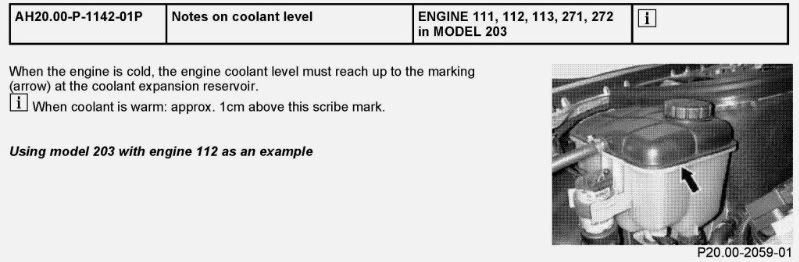


Check coolant level when heating
Super Moderator

Joined: Jun 2008
Posts: 19,942
Likes: 192
From: Llandudno, Cape Town, South Africa
late 2009 CLK 350 Coupe Elegance, '65 Jaguar S Type wires
What amount is considered "normal"? There is no MB publication that I have ever seen that has stated what amount is normal, and what amount you should be taking your car to the dealer.
The day my car arrived at the dealer, it was ~1/8 from the black top when cold. Now it is about a little over 1" from the top when cold. Never a drop added, and I have owned the car exactly 1 year and 8 months.
The day my car arrived at the dealer, it was ~1/8 from the black top when cold. Now it is about a little over 1" from the top when cold. Never a drop added, and I have owned the car exactly 1 year and 8 months.
This is strange because Benz have so many rules of thumb such as oil consumption shall not exceed 1% of fuel consumption - yes 1%! I think this needs revision with the latest low emissions engines.
I drain my coolant every 2 years and replace with MB premix to prevent gel formation in the system which might agglomerate with any particulate matter.
If any member has an answer on "normal" coolant consumption I would appreciate this for my edification. I'm unable to have a stab at it apart from that the MB closed system reduces consumption.
What a great question for my 1000th post! - & I could not answer it! - but it gives me something to research.
Last edited by Glyn M Ruck; Nov 25, 2008 at 01:13 AM.

Super Moderator
Joined: Jul 2006
Posts: 3,365
Likes: 12
From: Orange County, CA
GMC - Miata - Trek - P-Car
...One should be checking this regularly with a refractometer....
Posted previously, but still pertinent, is MB’s perspective on using the correct antifreeze mixture:
http://www.mbwholesaleparts.com/Star...iFreeDec04.pdf
Super Moderator
Joined: Jun 2008
Posts: 19,942
Likes: 192
From: Llandudno, Cape Town, South Africa
late 2009 CLK 350 Coupe Elegance, '65 Jaguar S Type wires
I've trampled through this thread enough already – no sense stopping now.
Posted previously, but still pertinent, is MB’s perspective on using the correct antifreeze mixture:
http://www.mbwholesaleparts.com/Star...iFreeDec04.pdf
Posted previously, but still pertinent, is MB’s perspective on using the correct antifreeze mixture:
http://www.mbwholesaleparts.com/Star...iFreeDec04.pdf
I used to travel the world handing out refractometers to customers like M&Ms. Damn it's hard to get people to watch concentrations - especially with the long life coolants. I'm so tired of seeing cavitation erosion of cylinder liners in half the bus fleets of the world you have no idea. When I was talking about "what's not in the MB fluid" above I was referring to phosphates amongst other things but decided not to complicate the issue. People have no idea what they are playing with. Phosphates directly attack the radiator "solder" in some Japanese vehicles that shall remain unamed because thay have a major problem. Benz know exactly what they are doing for their vehicles & spend millions on research. Why is it so difficult to get people to adhere to their guidance on service products ????


Super Moderator
Joined: Dec 2006
Posts: 2,403
Likes: 64
From: Camas, WA
2007 C230SS; 2014 ML350 BT
Your question is, of course, excellent & I, like you, would like an answer. I don't have any idea. It's so usage & ambient condition dependent. - It leads to the other, obvious to some, question of coolant concentration. One should be checking this regularly with a refractometer. Benz publish no guidelies in this regard that I have seen. The dealers always top up with premix & I have queried that concentration & got no sensible answer. I think 50/50%. This I can always check with a colleague - Dr Paul van der Ven at our European Technology Centre in Ghent, Belgium. Paul is our coolant guru & deals with the OEMs on a day to day basis.
This is strange because Benz have so many rules of thumb such as oil consumption shall not exceed 1% of fuel consumption - yes 1%! I think this needs revision with the latest low emissions engines.
I drain my coolant every 2 years and replace with MB premix to prevent gel formation in the system which might agglomerate with any particulate matter.
If any member has an answer on "normal" coolant consumption I would appreciate this for my edification. I'm unable to have a stab at it apart from that the MB closed system reduces consumption.
What a great question for my 1000th post! - & I could not answer it! - but it gives me something to research.
This is strange because Benz have so many rules of thumb such as oil consumption shall not exceed 1% of fuel consumption - yes 1%! I think this needs revision with the latest low emissions engines.
I drain my coolant every 2 years and replace with MB premix to prevent gel formation in the system which might agglomerate with any particulate matter.
If any member has an answer on "normal" coolant consumption I would appreciate this for my edification. I'm unable to have a stab at it apart from that the MB closed system reduces consumption.
What a great question for my 1000th post! - & I could not answer it! - but it gives me something to research.
So last time I had my car in for warranty work, (They replaced your favorite - Caster bushings
 ) I asked them to check my cooling system for leaks, as the coolant level was down a little. When I talked to the tech, he said cooling system was fine, and I just needed to top off the level. I then asked him what was considered normal evaporation, and he said he didn't know a specific amount, he just said "You'll know if it is abnormal". He told me to top off the fluid with 50/50 mix, as that is what they do during service.
What has really bugged me about the level, is I thought there should be virtually no evaporation from a closed cooling system, but after a bit of research, I guess that is not the case.
The other reason I am nervous about the loss of coolant, is occasionally I get a slight coolant like smell inside the car. But, I also know that the plastics in these cars can give off a similar smell.
Wow, you replace the coolant every 2 years? My manual states a change interval of 143K miles or 15 years.
Super Moderator
Joined: Jun 2008
Posts: 19,942
Likes: 192
From: Llandudno, Cape Town, South Africa
late 2009 CLK 350 Coupe Elegance, '65 Jaguar S Type wires
Thanks! Coming from you that means a lot. I always enjoy reading your posts as they are always full of great information. Ok, now that we just got done waxing each other's cars, lets get down to business.
The manual is vague, but is very specific on this point: "Add premixed coolant solution only. Adding water and MB 325.0 Anticorrosion/Antifreeze separately from each other, could cause engine damage not covered by the Mercedes-Benz Limited Warranty"
So last time I had my car in for warranty work, (They replaced your favorite - Caster bushings ) I asked them to check my cooling system for leaks, as the coolant level was down a little. When I talked to the tech, he said cooling system was fine, and I just needed to top off the level. I then asked him what was considered normal evaporation, and he said he didn't know a specific amount, he just said "You'll know if it is abnormal". He told me to top off the fluid with 50/50 mix, as that is what they do during service.
What has really bugged me about the level, is I thought there should be virtually no evaporation from a closed cooling system, but after a bit of research, I guess that is not the case.
The other reason I am nervous about the loss of coolant, is occasionally I get a slight coolant like smell inside the car. But, I also know that the plastics in these cars can give off a similar smell.
Wow, you replace the coolant every 2 years? My manual states a change interval of 143K miles or 15 years.
The manual is vague, but is very specific on this point: "Add premixed coolant solution only. Adding water and MB 325.0 Anticorrosion/Antifreeze separately from each other, could cause engine damage not covered by the Mercedes-Benz Limited Warranty"
So last time I had my car in for warranty work, (They replaced your favorite - Caster bushings
) I asked them to check my cooling system for leaks, as the coolant level was down a little. When I talked to the tech, he said cooling system was fine, and I just needed to top off the level. I then asked him what was considered normal evaporation, and he said he didn't know a specific amount, he just said "You'll know if it is abnormal". He told me to top off the fluid with 50/50 mix, as that is what they do during service.What has really bugged me about the level, is I thought there should be virtually no evaporation from a closed cooling system, but after a bit of research, I guess that is not the case.
The other reason I am nervous about the loss of coolant, is occasionally I get a slight coolant like smell inside the car. But, I also know that the plastics in these cars can give off a similar smell.
Wow, you replace the coolant every 2 years? My manual states a change interval of 143K miles or 15 years.
I must go to bed. It's 3.30am again! Thanks for polishing my car but I try and help. We all have our areas of strength & weakness. Like all of us I make mistakes but I'm prepared to learn.
I'm going to do some more scratching but I'm not convinced that we are going to come to a satisfactory conclusion as to what is normal as I think that there are too many variables.
My consumption of premix seems similar to yours. A top off at every 15,000Km service. Never measured it as a %age of the total capacity but it's low.
Obviously perfect concentrations are ideal but I speculate that Benz is worried about talented amateurs and err on the side of caution by stipulating 50/50 premix only. Potential problems of too high a concentration are poor heat transfer and potential overheating & the concentrates can be aggressive to certain metals & elastomers. Concentrations too low don't give you the corrosion protection or low enough freeze point.
There is a question that I should know the answer to but don't and will talk to our coolant guru about. Old basic water/glycol coolants used to steadily loose the water component to evapouration in a closed system that does not blow the stuff out on the road. The long life coolants are very different animals such as our carboxylate technology. I want to know if all constituents of the premix don't evapourate at a similar rate so that you are not endlessly loosing only the water component. My basic brain tells me that this could be the answer as to why 50/50 premix is satisfactory as endless top up with little concern for concentration. The real reason we give refractometers to customers is that they endlessly top up with water only leading to declining concentration.
Last edited by Glyn M Ruck; Nov 25, 2008 at 08:35 PM.

Senior Member
Joined: Oct 2008
Posts: 254
Likes: 0
From: Brooklyn
2009 Mini Cooper Clubman S
Thread resurrection here, but I got this same message today, and my coolant level is about 1.5-2" below the black area. I bought the car used 3 months ago and have to admit that I haven't checked the coolant before.
Has anyone come up with a conclusion for how much loss due to evaporation is normal? There are no puddles of any kind where I park, so I don't have an obvious leak, but I would like to assure myself of the fact. Also, are there certain points where I should look while the engine is running to check for a leak? Like certain points more likely to leak?
I'm going to stop by the dealership parts dept and pick up some OEM coolant tomorrow morning. The parts guy there said, when I spoke to him on the phone, that for just a top up I can pour the coolant in unmixed. Is this correct or should you always top up with 50/50?
Has anyone come up with a conclusion for how much loss due to evaporation is normal? There are no puddles of any kind where I park, so I don't have an obvious leak, but I would like to assure myself of the fact. Also, are there certain points where I should look while the engine is running to check for a leak? Like certain points more likely to leak?
I'm going to stop by the dealership parts dept and pick up some OEM coolant tomorrow morning. The parts guy there said, when I spoke to him on the phone, that for just a top up I can pour the coolant in unmixed. Is this correct or should you always top up with 50/50?
Hi John,
I must go to bed. It's 3.30am again! Thanks for polishing my car but I try and help. We all have our areas of strength & weakness. Like all of us I make mistakes but I'm prepared to learn.
I'm going to do some more scratching but I'm not convinced that we are going to come to a satisfactory conclusion as to what is normal as I think that there are too many variables.
My consumption of premix seems similar to yours. A top off at every 15,000Km service. Never measured it as a %age of the total capacity but it's low.
Obviously perfect concentrations are ideal but I speculate that Benz is worried about talented amateurs and err on the side of caution by stipulating 50/50 premix only. Potential problems of too high a concentration are poor heat transfer and potential overheating & the concentrates can be aggressive to certain metals & elastomers. Concentrations too low don't give you the corrosion protection or low enough freeze point.
There is a question that I should know the answer to but don't and will talk to our coolant guru about. Old basic water/glycol coolants used to steadily loose the water component to evapouration in a closed system that does not blow the stuff out on the road. The long life coolants are very different animals such as our carboxylate technology. I want to know if all constituents of the premix don't evapourate at a similar rate so that you are not endlessly loosing only the water component. My basic brain tells me that this could be the answer as to why 50/50 premix is satisfactory as endless top up with little concern for concentration. The real reason we give refractometers to customers is that they endlessly top up with water only leading to declining concentration.
I must go to bed. It's 3.30am again! Thanks for polishing my car but I try and help. We all have our areas of strength & weakness. Like all of us I make mistakes but I'm prepared to learn.
I'm going to do some more scratching but I'm not convinced that we are going to come to a satisfactory conclusion as to what is normal as I think that there are too many variables.
My consumption of premix seems similar to yours. A top off at every 15,000Km service. Never measured it as a %age of the total capacity but it's low.
Obviously perfect concentrations are ideal but I speculate that Benz is worried about talented amateurs and err on the side of caution by stipulating 50/50 premix only. Potential problems of too high a concentration are poor heat transfer and potential overheating & the concentrates can be aggressive to certain metals & elastomers. Concentrations too low don't give you the corrosion protection or low enough freeze point.
There is a question that I should know the answer to but don't and will talk to our coolant guru about. Old basic water/glycol coolants used to steadily loose the water component to evapouration in a closed system that does not blow the stuff out on the road. The long life coolants are very different animals such as our carboxylate technology. I want to know if all constituents of the premix don't evapourate at a similar rate so that you are not endlessly loosing only the water component. My basic brain tells me that this could be the answer as to why 50/50 premix is satisfactory as endless top up with little concern for concentration. The real reason we give refractometers to customers is that they endlessly top up with water only leading to declining concentration.
Super Moderator
Joined: Jun 2008
Posts: 19,942
Likes: 192
From: Llandudno, Cape Town, South Africa
late 2009 CLK 350 Coupe Elegance, '65 Jaguar S Type wires
Thread resurrection here, but I got this same message today, and my coolant level is about 1.5-2" below the black area. I bought the car used 3 months ago and have to admit that I haven't checked the coolant before.
Has anyone come up with a conclusion for how much loss due to evaporation is normal? There are no puddles of any kind where I park, so I don't have an obvious leak, but I would like to assure myself of the fact. Also, are there certain points where I should look while the engine is running to check for a leak? Like certain points more likely to leak?
I'm going to stop by the dealership parts dept and pick up some OEM coolant tomorrow morning. The parts guy there said, when I spoke to him on the phone, that for just a top up I can pour the coolant in unmixed. Is this correct or should you always top up with 50/50?
Has anyone come up with a conclusion for how much loss due to evaporation is normal? There are no puddles of any kind where I park, so I don't have an obvious leak, but I would like to assure myself of the fact. Also, are there certain points where I should look while the engine is running to check for a leak? Like certain points more likely to leak?
I'm going to stop by the dealership parts dept and pick up some OEM coolant tomorrow morning. The parts guy there said, when I spoke to him on the phone, that for just a top up I can pour the coolant in unmixed. Is this correct or should you always top up with 50/50?

MB World Stories
The Best of Mercedes & AMG

7 Craziest Things AMG Gas Ever Built
Verdad Gallardo
New Electric Mercedes-AMG GT 4-Door Coupe Unveiled: 10 Things You Need to Know
Verdad Gallardo
6 Mercedes Models That Did NOT Age Well (But Are Somehow Still Cool)
Verdad Gallardo
Manual Mercedes? 6 Times Sindelfingen Let Drivers Have All The Fun
Verdad Gallardo
Mercedes SLR McLaren 722 S Is Extremely Rare Example Modified by McLaren
Verdad Gallardo
8 Classic Boxy Mercedes Designs That Have Aged Like Fine Wine
Verdad Gallardo
Flawlessly Restored Mercedes 190E Evo II Heads to Auction
Verdad Gallardo
Electric Mercedes C-Class Unveiled: 11 Things You Need to Know
Verdad Gallardo
Mercedes EQS Gets A Major Update: Everything You Need to Know
Verdad Gallardo
Super Moderator
Joined: Jun 2008
Posts: 19,942
Likes: 192
From: Llandudno, Cape Town, South Africa
late 2009 CLK 350 Coupe Elegance, '65 Jaguar S Type wires
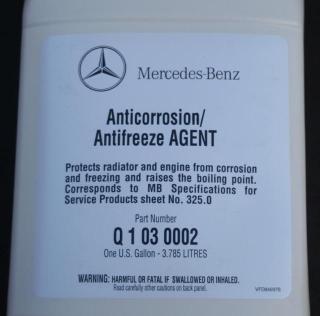
Before I give you bad info. When buying Coolant from your dealer you had better ask if it is premix or neat. I lifted this pic from Splinter's radiator replacement thread & I see that nothing on this bottle says that it is 50/50 premix - In South Africa the Genuine stuff comes as premix so you can just pour it in - but the bottle is clearly marked 50/50 PREMIX

MBWorld Fanatic!
Joined: Nov 2007
Posts: 2,078
Likes: 4
From: NYC
2012 C300 4Matic
As long as this very informative coolant thread continues, I think I should mention a bit more about the 143k miles / 15 year change interval. This info is off the top of my head, so it should probably be checked for accuracy.
For most MB vehicles starting from 2005 up (including the C) the coolant interval changed to 143k/15 years. This is because MB now puts a special gel pack inside of the coolant reservoir that leaches the proper chemicals into the coolant to keep it at the right ratio of water to antifreeze. I believe they also use different rubber but I'm not sure. There are pretty detailed documents available on this if you search around.
For most MB vehicles starting from 2005 up (including the C) the coolant interval changed to 143k/15 years. This is because MB now puts a special gel pack inside of the coolant reservoir that leaches the proper chemicals into the coolant to keep it at the right ratio of water to antifreeze. I believe they also use different rubber but I'm not sure. There are pretty detailed documents available on this if you search around.
Senior Member
Joined: Oct 2008
Posts: 254
Likes: 0
From: Brooklyn
2009 Mini Cooper Clubman S
I was actually one step ahead of you, and spoke to the guy at the parts department, who confirmed what you suspect, that the genuine stuff sold here (the US) is neat. At least from my dealership.
Thanks for all the great info by the way.
Thanks for all the great info by the way.
Before I give you bad info. When buying Coolant from your dealer you had better ask if it is premix or neat. I lifted this pic from Splinter's radiator replacement thread & I see that nothing on this bottle says that it is 50/50 premix - In South Africa the Genuine stuff comes as premix so you can just pour it in - but the bottle is clearly marked 50/50 PREMIX
Super Moderator
Joined: Jun 2008
Posts: 19,942
Likes: 192
From: Llandudno, Cape Town, South Africa
late 2009 CLK 350 Coupe Elegance, '65 Jaguar S Type wires
My worry is keeping the antifreeze properties of the coolant charge adequate. If you loose coolant for whatever reason this is unlikely for 15 years!!! If the mechanism of loss is purely evapourative then you stand a better chance because it is mainly the water component that evapourates. Loss for any other reason would definitely put you in trouble from an antifreeze protection perspective if some service station tops up with water. I'm doing some scratching at present but many are still on Xmas vacation until 12th. The converse also applies. If you loose coolant to evapouration & keep topping up with premix - the water to concentrate ratio is going to continue going up - i.e. less water. This is also undesireable because the heat transfer capability of the concentrate is poor without the water component.
Last edited by Glyn M Ruck; Jan 6, 2009 at 05:15 AM.
MBWorld Fanatic!
Joined: Nov 2007
Posts: 2,078
Likes: 4
From: NYC
2012 C300 4Matic
I'm nit picking & I know what you are trying to say. The gel pack can only keep the anti corrosive etc levels at close to normal for an extended period.
My worry is keeping the antifreeze properties of the coolant charge adequate. If you loose coolant for whatever reason this is unlikely for 15 years!!! If the mechanism of loss is purely evapourative then you stand a better chance because it is mainly the water component that evapourates. Loss for any other reason would definitely put you in trouble from an antifreeze protection perspective if some service station tops up with water. I'm doing some scratching at present but many are still on Xmas vacation until 12th. The converse also applies. If you loose coolant to evapouration & keep topping up with premix - the water to concentrate ratio is going to continue going up - i.e. less water. This is also undesireable because the heat transfer capability of the concentrate is poor without the water component.
My worry is keeping the antifreeze properties of the coolant charge adequate. If you loose coolant for whatever reason this is unlikely for 15 years!!! If the mechanism of loss is purely evapourative then you stand a better chance because it is mainly the water component that evapourates. Loss for any other reason would definitely put you in trouble from an antifreeze protection perspective if some service station tops up with water. I'm doing some scratching at present but many are still on Xmas vacation until 12th. The converse also applies. If you loose coolant to evapouration & keep topping up with premix - the water to concentrate ratio is going to continue going up - i.e. less water. This is also undesireable because the heat transfer capability of the concentrate is poor without the water component.
Senior Member
Joined: Mar 2008
Posts: 426
Likes: 1
05 c230k 6spd
Umm didn't wan't to start a new thread since my question is related but I got the same message and my coolant level is below the black top so I need to refill right? The Zerex G-O5 is safe to use in my m271 c class correct?
http://www.napaonline.com/Search/Det...051_0166552650
that one?
http://www.napaonline.com/Search/Det...051_0166552650
that one?


