


URGENT HELP! C240 w203 2001 wont start!

Thread Starter
Super Member
Joined: Mar 2011
Posts: 546
Likes: 0
From: Jakarta, Indonesia
C240
URGENT HELP! C240 w203 2001 wont start!
Hey guys I need urgent help for my car, any, and I mean ANY input even the most bizarre ones are very welcome.
My car is a 2001 right hand steering wheel c240 w203 with no engine modifications or whatsoever.
I have a problem with my car, 3 days ago I switched off my car and run a short errand and my car wont start. I called my mechanic and he told me I might've blown a fuse. So I checked it and lo-and-behold, the starter 15a fuse (the most left one if you're looking from the front/bonnet) is busted. I ran to a nearby workshop and they only had a 10a fuse available so I bought it and the car went back up and ran just fine.
I knew I had to change that fuse eventually to its original 15a size, but I thought I'd leave it for a day or so before I go to my worksgop and have it checked anyway.
22 hours later, after stopping and starting for about 7-8 times, it finally died and the fuse blew once more. So I figured well its a 10a fuse anyway on a 15a switch so its bound to bust sooner rather than later. So I bought more fuses and a correct one this time and restocked on other sizes as well. I replaced it with a 20a since the 15 wasnt available and I checked with my mechanic he said it should be fine but get to the workshop and he'll fix me up with a 15a. But it never started, I blew about 5-6 20a fuse and I tried using a 25a just to get it running so I dont have to tow it, but it didnt work. The fuse didnt bust but was hot. So I stopped trying and towed it.
At the workshop we checked for fault codes using the star and found nothing (except my occassional esp/bas fault that has been there for a while) and everything else was fine.
My mechanic suspected it would be my starter dynamo and it would need to be fixed and/or replaced. So we replaced it, and voila the fuse didnt bust but the car wont start either! Turns out the dynamo starter he had in stock had a defect and he doesnt have any other stock. So we tried fixing my dynamo, then replacing some of my original dynamo innards, and then replaced all the innards, and my car still wont start (it kept blowing a fuse).
We tried running the dynamo OUTSIDE the car using the same wiring as it would when its installed in the car, it ran just fine, so we established that there is no shorts there. But as soon as it gets back to where its suppsed to be, its blows my fuse again.
In short:
Blows up a fuse when dynamo starter is installed
Blows up a fuse after my original dynamo is repaired in all conditions.
Doesnt blow up a fuse using his new but defect dynamo but car wont start due to weak dynamo spin.
Doesnt blow up a fuse using the same wiring but dynamo is OUTSIDE the car (not installed)
Doesnt blow up a fuse when I start it using my ignition key with all proper wirings attached but OUTSIDE the car.
NO FAULT CODES on front sam.
They loosened my engine compression to lighten the load on my dynamo but it still bust a fuse so we established its not heavy engine turn problem.
My large cable that delivers power has been repairs before due to its inner buster fuse but when checked is all good. Power is stable at 12v on both the large and small cable.
So what now?
Any suggestions would help thanks!
My car is a 2001 right hand steering wheel c240 w203 with no engine modifications or whatsoever.
I have a problem with my car, 3 days ago I switched off my car and run a short errand and my car wont start. I called my mechanic and he told me I might've blown a fuse. So I checked it and lo-and-behold, the starter 15a fuse (the most left one if you're looking from the front/bonnet) is busted. I ran to a nearby workshop and they only had a 10a fuse available so I bought it and the car went back up and ran just fine.
I knew I had to change that fuse eventually to its original 15a size, but I thought I'd leave it for a day or so before I go to my worksgop and have it checked anyway.
22 hours later, after stopping and starting for about 7-8 times, it finally died and the fuse blew once more. So I figured well its a 10a fuse anyway on a 15a switch so its bound to bust sooner rather than later. So I bought more fuses and a correct one this time and restocked on other sizes as well. I replaced it with a 20a since the 15 wasnt available and I checked with my mechanic he said it should be fine but get to the workshop and he'll fix me up with a 15a. But it never started, I blew about 5-6 20a fuse and I tried using a 25a just to get it running so I dont have to tow it, but it didnt work. The fuse didnt bust but was hot. So I stopped trying and towed it.
At the workshop we checked for fault codes using the star and found nothing (except my occassional esp/bas fault that has been there for a while) and everything else was fine.
My mechanic suspected it would be my starter dynamo and it would need to be fixed and/or replaced. So we replaced it, and voila the fuse didnt bust but the car wont start either! Turns out the dynamo starter he had in stock had a defect and he doesnt have any other stock. So we tried fixing my dynamo, then replacing some of my original dynamo innards, and then replaced all the innards, and my car still wont start (it kept blowing a fuse).
We tried running the dynamo OUTSIDE the car using the same wiring as it would when its installed in the car, it ran just fine, so we established that there is no shorts there. But as soon as it gets back to where its suppsed to be, its blows my fuse again.
In short:
Blows up a fuse when dynamo starter is installed
Blows up a fuse after my original dynamo is repaired in all conditions.
Doesnt blow up a fuse using his new but defect dynamo but car wont start due to weak dynamo spin.
Doesnt blow up a fuse using the same wiring but dynamo is OUTSIDE the car (not installed)
Doesnt blow up a fuse when I start it using my ignition key with all proper wirings attached but OUTSIDE the car.
NO FAULT CODES on front sam.
They loosened my engine compression to lighten the load on my dynamo but it still bust a fuse so we established its not heavy engine turn problem.
My large cable that delivers power has been repairs before due to its inner buster fuse but when checked is all good. Power is stable at 12v on both the large and small cable.
So what now?
Any suggestions would help thanks!
Thread Starter
Super Member
Joined: Mar 2011
Posts: 546
Likes: 0
From: Jakarta, Indonesia
C240
Also when we disconnect the starter dynamo cable and tried to ignite the car, no fuse was busted. So we established it could not be a short on the ignition either.
Please keep in mind that using the same power wiring when we tested the dynamo OUTSIDE the car as if the dynamo was installed, the dynamo runs perfectly fine. My ignition key has a total uninterruped communication with the starter and no fuse was busted. And yes I tried this at least 4 times before trying to install the dynamo back in. Could it be bad grounding?
I also replaced my battery with a brand new one when the first incident happened. So no excuse for not having power. The replacement was 3 days ago.
Please keep in mind that using the same power wiring when we tested the dynamo OUTSIDE the car as if the dynamo was installed, the dynamo runs perfectly fine. My ignition key has a total uninterruped communication with the starter and no fuse was busted. And yes I tried this at least 4 times before trying to install the dynamo back in. Could it be bad grounding?
I also replaced my battery with a brand new one when the first incident happened. So no excuse for not having power. The replacement was 3 days ago.
Last edited by Silver C; Dec 21, 2012 at 11:08 AM.

Super Moderator

Joined: Jun 2008
Posts: 19,942
Likes: 192
From: Llandudno, Cape Town, South Africa
late 2009 CLK 350 Coupe Elegance, '65 Jaguar S Type wires
Blowing fuse 52 on these cars is common & Benz require it upspec'ed to 20 amp. There is a DTB out on it. Copy in the Wiki.
Also see start enable process in the W203 Wiki. What you are calling a dynamo is a starter motor. The fact that the fuse blows when the starter motor is placed on the engine is because you are putting it under load by cranking the engine. When you run it removed from the engine it is not under load.
I'll almost put money on the fact that you have a defective starter motor. Take it to an auto electrician & tell them to test it under load.
You must obviously check all HT wiring & earth straps & read the start enable procedure.
Good luck.
Also see start enable process in the W203 Wiki. What you are calling a dynamo is a starter motor. The fact that the fuse blows when the starter motor is placed on the engine is because you are putting it under load by cranking the engine. When you run it removed from the engine it is not under load.
I'll almost put money on the fact that you have a defective starter motor. Take it to an auto electrician & tell them to test it under load.
You must obviously check all HT wiring & earth straps & read the start enable procedure.
Good luck.
Super Moderator
Joined: Jun 2008
Posts: 19,942
Likes: 192
From: Llandudno, Cape Town, South Africa
late 2009 CLK 350 Coupe Elegance, '65 Jaguar S Type wires
Here:
https://mbworld.org/forums/c-class-w...t-process.html
https://mbworld.org/wiki/index.php/F...to_20_amp..pdf
https://mbworld.org/forums/c-class-w...t-process.html
https://mbworld.org/wiki/index.php/F...to_20_amp..pdf
Last edited by Glyn M Ruck; Dec 21, 2012 at 02:20 PM.
Super Moderator
Joined: Jun 2008
Posts: 19,942
Likes: 192
From: Llandudno, Cape Town, South Africa
late 2009 CLK 350 Coupe Elegance, '65 Jaguar S Type wires
Auto electricians usually have some sort of rig to load the motor. When the motor runs unloaded it draws very little power & thus won't blow a fuse.
I did not realise you had tried 3 starter motors. Are any of them new? Has the mechanic read what amperage is being drawn across the fuse when cranking the car?
I did not realise you had tried 3 starter motors. Are any of them new? Has the mechanic read what amperage is being drawn across the fuse when cranking the car?
Thread Starter
Super Member
Joined: Mar 2011
Posts: 546
Likes: 0
From: Jakarta, Indonesia
C240
Yes one of them was new but was a defective one, didnt een run properly without any load at all. The two are a used, one is mine being repaired the other was a rebuilt by a well known motor shop that fixed a CLS starter motor recently.
They lighten the load by taking compression out of my engine and then tried to start the car but it still blew a fuse.
They lighten the load by taking compression out of my engine and then tried to start the car but it still blew a fuse.
Trending Topics
MB World Stories
The Best of Mercedes & AMG

7 Craziest Things AMG Gas Ever Built
Verdad Gallardo
New Electric Mercedes-AMG GT 4-Door Coupe Unveiled: 10 Things You Need to Know
Verdad Gallardo
6 Mercedes Models That Did NOT Age Well (But Are Somehow Still Cool)
Verdad Gallardo
Manual Mercedes? 6 Times Sindelfingen Let Drivers Have All The Fun
Verdad Gallardo
Mercedes SLR McLaren 722 S Is Extremely Rare Example Modified by McLaren
Verdad Gallardo
8 Classic Boxy Mercedes Designs That Have Aged Like Fine Wine
Verdad Gallardo
Flawlessly Restored Mercedes 190E Evo II Heads to Auction
Verdad Gallardo
Electric Mercedes C-Class Unveiled: 11 Things You Need to Know
Verdad Gallardo
Mercedes EQS Gets A Major Update: Everything You Need to Know
Verdad Gallardo
Super Moderator
Joined: Jun 2008
Posts: 19,942
Likes: 192
From: Llandudno, Cape Town, South Africa
late 2009 CLK 350 Coupe Elegance, '65 Jaguar S Type wires
Normally under 15 amps but a little bit borderline.
Please check the starter relay in Cavity S in the front SAM.
Check the main power cable & terminations.
Can you try your starter motor in another car?
Just hang in there. I'm trying to find something.
Please check the starter relay in Cavity S in the front SAM.
Check the main power cable & terminations.
Can you try your starter motor in another car?
Just hang in there. I'm trying to find something.
Thread Starter
Super Member
Joined: Mar 2011
Posts: 546
Likes: 0
From: Jakarta, Indonesia
C240
No we have not tried it on another car. Will have them do that when possible. And will check the cavity s as well, do you have a diagram in it? My mechanic doesnt speak english..
Super Moderator
Joined: Jun 2008
Posts: 19,942
Likes: 192
From: Llandudno, Cape Town, South Africa
late 2009 CLK 350 Coupe Elegance, '65 Jaguar S Type wires
Sorry this diagram covers both left & righthand drive. Check all connections. Also get your mechanic to check the high current fusible link No 270
Please see picture at bottom.
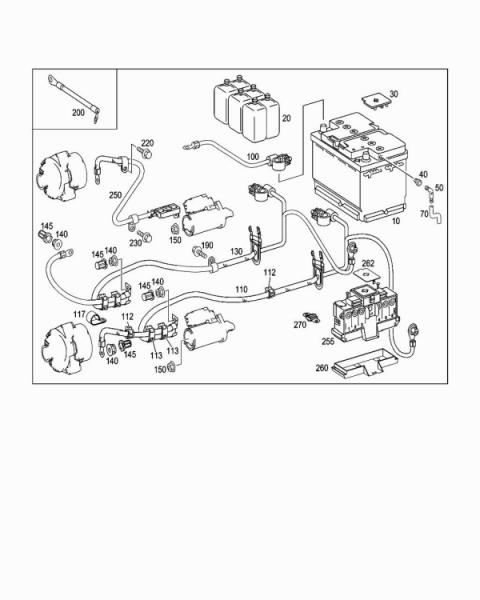
30 A 001 546 08 35 PROTECTIVE CAP
POS. POLE 001
40 A 002 997 24 86 PLUG
BATTERY VENTING
6X8 MM 001
50 A 000 990 38 72 ELBOW FITTING
BATTERY VENTING 001
70 A 024 997 49 82 HOSE
BATTERY VENTING
5 X 1 MM [404]
NB
100 A 203 540 00 31 NEG. CABLE 001 L
100 A 203 540 00 31 NEG. CABLE 001 R
110 A 203 540 19 06 WIRING HARNESS
STARTING MOTOR AND ALTERNATOR 001 L
110 A 203 540 20 06 WIRING HARNESS
Replaced_By: A 203 540 99 10 001 R
110 A 203 540 99 10 WIRING HARNESS
STARTING MOTOR AND ALTERNATOR 001 R
140 N 000934 4008045 NUT
STARTING MOTOR TERMINAL 30
M8 [033], [034], [035]
001
140 A 000 548 04 72 NUT
STARTING MOTOR TERMINAL 30
M8 [036], [037], [038]
001
140 N 000934 4008045 NUT
GENERATOR CIRCUIT 30
M8 [033], [034], [035]
001
140 A 000 548 04 72 NUT
GENERATOR CIRCUIT 30
M8 [036], [037], [038]
001
145 A 000 546 72 35 PROTECTIVE CAP
NUT [033], [034], [035]
001
145 A 001 546 61 35 PROTECTIVE CAP
NUT [036], [037], [038]
001
150 N 910112 2006003 NUT
STARTING MOTOR TERMINAL 50
M6 001
200 A 210 540 03 31 NEG. CABLE
ENGINE GROUND LINE
290 MM 001
200 A 123 540 01 31 GROUND CABLE
ENGINE GROUND LINE
220 MM Code: 423
001
200 A 124 540 00 41 GROUND CABLE
ENGINE TO POWER-STEERING PUMP
300 MM 001
230 N 000000 0003853 SCREW
GROUND STRAP MOUNTING
M8X16 001
255 A 203 545 03 01 FUSE BOX
JUMP-START PLUG SOCKET 001
260 A 203 545 08 03 .COVER
FUSES 001
262 A 203 545 10 03 .COVER
JUMP-STARTING POINT 001
270 N 000000 0000412 .FUSE
60A NB
270 N 000000 0000416 .FUSE
125 A NB
270 N 000000 0000316 .FUSE
200A NB
Get your mechanic to check the HT cable connector block for any sign of burning/bad connections. We have had a number of these give trouble but it is usually visible.
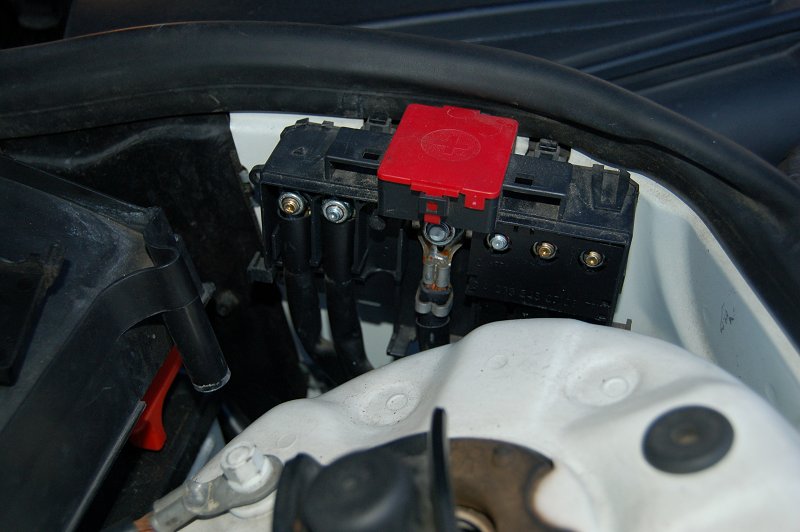
Good luck.
Please see picture at bottom.
30 A 001 546 08 35 PROTECTIVE CAP
POS. POLE 001
40 A 002 997 24 86 PLUG
BATTERY VENTING
6X8 MM 001
50 A 000 990 38 72 ELBOW FITTING
BATTERY VENTING 001
70 A 024 997 49 82 HOSE
BATTERY VENTING
5 X 1 MM [404]
NB
100 A 203 540 00 31 NEG. CABLE 001 L
100 A 203 540 00 31 NEG. CABLE 001 R
110 A 203 540 19 06 WIRING HARNESS
STARTING MOTOR AND ALTERNATOR 001 L
110 A 203 540 20 06 WIRING HARNESS
Replaced_By: A 203 540 99 10 001 R
110 A 203 540 99 10 WIRING HARNESS
STARTING MOTOR AND ALTERNATOR 001 R
140 N 000934 4008045 NUT
STARTING MOTOR TERMINAL 30
M8 [033], [034], [035]
001
140 A 000 548 04 72 NUT
STARTING MOTOR TERMINAL 30
M8 [036], [037], [038]
001
140 N 000934 4008045 NUT
GENERATOR CIRCUIT 30
M8 [033], [034], [035]
001
140 A 000 548 04 72 NUT
GENERATOR CIRCUIT 30
M8 [036], [037], [038]
001
145 A 000 546 72 35 PROTECTIVE CAP
NUT [033], [034], [035]
001
145 A 001 546 61 35 PROTECTIVE CAP
NUT [036], [037], [038]
001
150 N 910112 2006003 NUT
STARTING MOTOR TERMINAL 50
M6 001
200 A 210 540 03 31 NEG. CABLE
ENGINE GROUND LINE
290 MM 001
200 A 123 540 01 31 GROUND CABLE
ENGINE GROUND LINE
220 MM Code: 423
001
200 A 124 540 00 41 GROUND CABLE
ENGINE TO POWER-STEERING PUMP
300 MM 001
230 N 000000 0003853 SCREW
GROUND STRAP MOUNTING
M8X16 001
255 A 203 545 03 01 FUSE BOX
JUMP-START PLUG SOCKET 001
260 A 203 545 08 03 .COVER
FUSES 001
262 A 203 545 10 03 .COVER
JUMP-STARTING POINT 001
270 N 000000 0000412 .FUSE
60A NB
270 N 000000 0000416 .FUSE
125 A NB
270 N 000000 0000316 .FUSE
200A NB
Get your mechanic to check the HT cable connector block for any sign of burning/bad connections. We have had a number of these give trouble but it is usually visible.
Good luck.
Thread Starter
Super Member
Joined: Mar 2011
Posts: 546
Likes: 0
From: Jakarta, Indonesia
C240
Main power cable is also checked out fine. Evidently it can run the motor outside. We also have tried to connect the starter with a long wire to connect it to the main power cablr and I started the motor WITH MY IGNITION key and I starts just fine. But when I place the moto in the car it blew up my fuse.
Super Moderator
Joined: Jun 2008
Posts: 19,942
Likes: 192
From: Llandudno, Cape Town, South Africa
late 2009 CLK 350 Coupe Elegance, '65 Jaguar S Type wires
That's fantastic. That will make diagnosis easier.
We'll get it sorted. Good luck! I need to go to bed. 3.39 in the morning here.
We'll get it sorted. Good luck! I need to go to bed. 3.39 in the morning here.

MBWorld Fanatic!


Joined: Jan 2005
Posts: 2,848
Likes: 15
From: Orange County
2005 C Wagon (No snickering please!)
The starter motor itself does not have a fuse. The several hundred amps needed along with a variable load make a fuse of little value. The 15A fuse (superseded to 20A) is to protect the wiring to the starter solenoid.
This device uses electrical current to generate a magnetic field. The field moves a plunger with both a mechanical and electrical purpose. The electrical purpose is to close a huge contact so the fat battery cable current can flow through the starter motor windings to turn the starter gear. The mechanical function is to move the starter gear into mesh contact with the flywheel.
There are several failure modes of the solenoid:
Open coil. Not our problem, it would not blow a fuse if open.
A short in the windings to the case ground (earth.) Possible. This could blow a fuse if the short is close to the "top" of the windings.
A mechanical problem that does not allow the plunger to complete the full stroke. If the full stroke of the plunger is prevented because of gear mismatch or a sticky shaft the current in the solenoid coil will be too high, and blow the fuse. If something in the flywheel area is making the plunger stick this is why it works off the car, and not on.
The current not only needs to flow into the starter, but it needs to flow out and back to the battery. There is a cable from the battery negative terminal to a post on the car. It is a fat wire. Make sure the connection is shiney and tight. There is also a cable from the engine block to a post on the car. This fat wire must also be shiney and tight. It is Nr. 200 in the diagram. If a high impedence connection were here there might not be enough current to allow the full stroke of the plunger. Without a full stroke the coil quickly heats and can blow the fuse.
The EIS tells the front SAM to energize the starter relay. Doubt there is a problem here, because you blew many fuses. When the relay contacts close, they send the energy to the solenoid. These contacts become corroded and pitted over time and won't supply full voltage to the solenoid. To test the contacts connect a voltmeter between the + post on the battery and the small terminal on the solenoid. When not cranking the voltage should be near 12 volts, when you crank the voltage should drop to near zero. 1 or 2 volts points to a bad relay.
This device uses electrical current to generate a magnetic field. The field moves a plunger with both a mechanical and electrical purpose. The electrical purpose is to close a huge contact so the fat battery cable current can flow through the starter motor windings to turn the starter gear. The mechanical function is to move the starter gear into mesh contact with the flywheel.
There are several failure modes of the solenoid:
Open coil. Not our problem, it would not blow a fuse if open.
A short in the windings to the case ground (earth.) Possible. This could blow a fuse if the short is close to the "top" of the windings.
A mechanical problem that does not allow the plunger to complete the full stroke. If the full stroke of the plunger is prevented because of gear mismatch or a sticky shaft the current in the solenoid coil will be too high, and blow the fuse. If something in the flywheel area is making the plunger stick this is why it works off the car, and not on.
The current not only needs to flow into the starter, but it needs to flow out and back to the battery. There is a cable from the battery negative terminal to a post on the car. It is a fat wire. Make sure the connection is shiney and tight. There is also a cable from the engine block to a post on the car. This fat wire must also be shiney and tight. It is Nr. 200 in the diagram. If a high impedence connection were here there might not be enough current to allow the full stroke of the plunger. Without a full stroke the coil quickly heats and can blow the fuse.
The EIS tells the front SAM to energize the starter relay. Doubt there is a problem here, because you blew many fuses. When the relay contacts close, they send the energy to the solenoid. These contacts become corroded and pitted over time and won't supply full voltage to the solenoid. To test the contacts connect a voltmeter between the + post on the battery and the small terminal on the solenoid. When not cranking the voltage should be near 12 volts, when you crank the voltage should drop to near zero. 1 or 2 volts points to a bad relay.
Thread Starter
Super Member
Joined: Mar 2011
Posts: 546
Likes: 0
From: Jakarta, Indonesia
C240
Now they are now also saying the same thing, no problem on the eis but turns out the main HT cord is bad and does not supply enough power despite it on 12v when not cranking. Is it possible?
Thread Starter
Super Member
Joined: Mar 2011
Posts: 546
Likes: 0
From: Jakarta, Indonesia
C240
My mechanics also told me that they have tried by passing the EIS to try to activate the starter motor but it also blew a fuse. So I guess we can be sure to say there is no problem on the EIS there?
Super Moderator
Joined: Jun 2008
Posts: 19,942
Likes: 192
From: Llandudno, Cape Town, South Africa
late 2009 CLK 350 Coupe Elegance, '65 Jaguar S Type wires
The starter motor itself does not have a fuse. The several hundred amps needed along with a variable load make a fuse of little value. The 15A fuse (superseded to 20A) is to protect the wiring to the starter solenoid.
This device uses electrical current to generate a magnetic field. The field moves a plunger with both a mechanical and electrical purpose. The electrical purpose is to close a huge contact so the fat battery cable current can flow through the starter motor windings to turn the starter gear. The mechanical function is to move the starter gear into mesh contact with the flywheel.
There are several failure modes of the solenoid:
Open coil. Not our problem, it would not blow a fuse if open.
A short in the windings to the case ground (earth.) Possible. This could blow a fuse if the short is close to the "top" of the windings.
A mechanical problem that does not allow the plunger to complete the full stroke. If the full stroke of the plunger is prevented because of gear mismatch or a sticky shaft the current in the solenoid coil will be too high, and blow the fuse. If something in the flywheel area is making the plunger stick this is why it works off the car, and not on.
The current not only needs to flow into the starter, but it needs to flow out and back to the battery. There is a cable from the battery negative terminal to a post on the car. It is a fat wire. Make sure the connection is shiney and tight. There is also a cable from the engine block to a post on the car. This fat wire must also be shiney and tight. It is Nr. 200 in the diagram. If a high impedence connection were here there might not be enough current to allow the full stroke of the plunger. Without a full stroke the coil quickly heats and can blow the fuse.
The EIS tells the front SAM to energize the starter relay. Doubt there is a problem here, because you blew many fuses. When the relay contacts close, they send the energy to the solenoid. These contacts become corroded and pitted over time and won't supply full voltage to the solenoid. To test the contacts connect a voltmeter between the + post on the battery and the small terminal on the solenoid. When not cranking the voltage should be near 12 volts, when you crank the voltage should drop to near zero. 1 or 2 volts points to a bad relay.
This device uses electrical current to generate a magnetic field. The field moves a plunger with both a mechanical and electrical purpose. The electrical purpose is to close a huge contact so the fat battery cable current can flow through the starter motor windings to turn the starter gear. The mechanical function is to move the starter gear into mesh contact with the flywheel.
There are several failure modes of the solenoid:
Open coil. Not our problem, it would not blow a fuse if open.
A short in the windings to the case ground (earth.) Possible. This could blow a fuse if the short is close to the "top" of the windings.
A mechanical problem that does not allow the plunger to complete the full stroke. If the full stroke of the plunger is prevented because of gear mismatch or a sticky shaft the current in the solenoid coil will be too high, and blow the fuse. If something in the flywheel area is making the plunger stick this is why it works off the car, and not on.
The current not only needs to flow into the starter, but it needs to flow out and back to the battery. There is a cable from the battery negative terminal to a post on the car. It is a fat wire. Make sure the connection is shiney and tight. There is also a cable from the engine block to a post on the car. This fat wire must also be shiney and tight. It is Nr. 200 in the diagram. If a high impedence connection were here there might not be enough current to allow the full stroke of the plunger. Without a full stroke the coil quickly heats and can blow the fuse.
The EIS tells the front SAM to energize the starter relay. Doubt there is a problem here, because you blew many fuses. When the relay contacts close, they send the energy to the solenoid. These contacts become corroded and pitted over time and won't supply full voltage to the solenoid. To test the contacts connect a voltmeter between the + post on the battery and the small terminal on the solenoid. When not cranking the voltage should be near 12 volts, when you crank the voltage should drop to near zero. 1 or 2 volts points to a bad relay.
Movie has explained it far more elegantly than I have. I take to much as a given.
This is not an EIS problem from the information given.
It could be the solenoid on the starter motor. But 3 starter motors?
Let us know how the starter motor swap with the S class works out.
Last edited by Glyn M Ruck; Dec 22, 2012 at 07:21 AM.
Super Moderator
Joined: Jun 2008
Posts: 19,942
Likes: 192
From: Llandudno, Cape Town, South Africa
late 2009 CLK 350 Coupe Elegance, '65 Jaguar S Type wires
The current draw through fuse 52 is at its max while solenoid 20 is engaged & you are cranking. The HT is switched to the motor by the solenoid. Burnt & pitted contacts in the solenoid could prevent sufficient current flow to the starter motor while cranking. This is why the motor will spin unloaded out of the car.

Thread Starter
Super Member
Joined: Mar 2011
Posts: 546
Likes: 0
From: Jakarta, Indonesia
C240
The problem is not from the starter motor. They tried installing a brand new motor and it stoll blew up a fuse. My mechanics said it must be the fat HT cable that powers it is weak and thus mot giving enough power when cranked. My mechanic said the motor didnt even move when it was attached to the flywheel- so a sticky flywheel is not an option since they tested my engine turn manually and is smooth and fine.
Thread Starter
Super Member
Joined: Mar 2011
Posts: 546
Likes: 0
From: Jakarta, Indonesia
C240
Yes that number 20 on the diagram is where you attach the wirings right? Yes I have tested and swapped and even tried a brand new one and still blew up a fuse.
The only time it DIDNT BLOW A FUSE was when it was installed with a defect starter motor that wont spin properly EVEN OUTSIDE the car. So I guess the defected starter motor didnt even try to draw power..
The only time it DIDNT BLOW A FUSE was when it was installed with a defect starter motor that wont spin properly EVEN OUTSIDE the car. So I guess the defected starter motor didnt even try to draw power..
Thread Starter
Super Member
Joined: Mar 2011
Posts: 546
Likes: 0
From: Jakarta, Indonesia
C240
Awkwardly that power fat HT cable reads fine at 12v when not engaged and they have checked it a few times. But my mechanic said it may be a faux reading since the current tested was not under load pressure. But when called upon the wiring was too weak to transfer the large amount of power and created a short..


