



Code3 + ASP 1/4 mile results...Your children should leave the room

Super Moderator
Joined: Jul 2006
Posts: 3,365
Likes: 12
From: Orange County, CA
GMC - Miata - Trek - P-Car
MBWorld Fanatic!
Joined: Jun 2007
Posts: 2,949
Likes: 0
From: Philadelphia, PA
2008 A8L, 2002 996TT X50, 2009 X5
I don't blame you at this point, but I think it has the potential to make lots of power. Look at the charts Brandon provided; 390 lbs of torque! I'm hoping the top-end can be made to work that well, too. We're still in the R&D stage of this mod. I'm sure that eventually (if proven feasible) it will just be a matter of buying the parts and having the ECU tuned.
Upgrading to a 3 bar MAP is a very common (and necessary) upgrade for many high boost cars, and works fine once the ECU is retuned. I think that and larger injectors (if necessary) will tell us if this combo makes efficient high RPM power. If not, it's probably going to be due to compressor efficiency.
I'm hoping the top-end can be made to work that well, too. We're still in the R&D stage of this mod. I'm sure that eventually (if proven feasible) it will just be a matter of buying the parts and having the ECU tuned. Upgrading to a 3 bar MAP is a very common (and necessary) upgrade for many high boost cars, and works fine once the ECU is retuned. I think that and larger injectors (if necessary) will tell us if this combo makes efficient high RPM power. If not, it's probably going to be due to compressor efficiency.
From what I've gathered from various reliable sources, this combo is right at the ragged edge (or perhaps a bit past it) for the S/C's efficiency. Frankly, I'm amazed you had it up to 180 - from what I recall, Jerry's old car w/ stock S/C pulley and 192mm crank hits a wall around 130-140 or so.

SPONSOR
Joined: Jul 2007
Posts: 5,459
Likes: 152
From: Houston/ Austin /Toronto / UAE / Minneapolis / Orlando /Cincinnati
Eurocharged Performance ML63 and TT lambo
+1, Completely agree
From what I've gathered from various reliable sources, this combo is right at the ragged edge (or perhaps a bit past it) for the S/C's efficiency. Frankly, I'm amazed you had it up to 180 - from what I recall, Jerry's old car w/ stock S/C pulley and 192mm crank hits a wall around 130-140 or so.
From what I've gathered from various reliable sources, this combo is right at the ragged edge (or perhaps a bit past it) for the S/C's efficiency. Frankly, I'm amazed you had it up to 180 - from what I recall, Jerry's old car w/ stock S/C pulley and 192mm crank hits a wall around 130-140 or so.
Andy is going to actually put the 185 back on and do some other things instead to achieve his boost levels.
The combo does scare me, but it is interesting to see what others are doing. Peronally, I am just going to stick with the 185.

Thread Starter
Member
Joined: Jan 2008
Posts: 233
Likes: 0
From: South Jersey
2002 C32 AMG
+1, Completely agree
From what I've gathered from various reliable sources, this combo is right at the ragged edge (or perhaps a bit past it) for the S/C's efficiency. Frankly, I'm amazed you had it up to 180 - from what I recall, Jerry's old car w/ stock S/C pulley and 192mm crank hits a wall around 130-140 or so.
From what I've gathered from various reliable sources, this combo is right at the ragged edge (or perhaps a bit past it) for the S/C's efficiency. Frankly, I'm amazed you had it up to 180 - from what I recall, Jerry's old car w/ stock S/C pulley and 192mm crank hits a wall around 130-140 or so.
Senior Member
Joined: Oct 2004
Posts: 471
Likes: 33
From: Germany
SL65 R230
Yeah, absolutely no problem pushing past 140 MPH. It didn't really start to go flat until about 165-170, then it took a while to get that extra 10-15 MPH. As you can see on Brandon's chart, there is plenty of low and mid-range power; you don't start hitting the higher RPM's in 5th gear until you approach warp speed, and that's when it begins to drop off. What's amazing is that I didn't melt my pistons considering it goes lean so early according to Brandon's chart.


MBWorld Fanatic!
Joined: Mar 2008
Posts: 4,165
Likes: 4
PLAID
correct....Jerrys old car (andys new car) defiantely hit the wall at 140
Andy is going to actually put the 185 back on and do some other things instead to achieve his boost levels.
The combo does scare me, but it is interesting to see what others are doing. Peronally, I am just going to stick with the 185.
Andy is going to actually put the 185 back on and do some other things instead to achieve his boost levels.
The combo does scare me, but it is interesting to see what others are doing. Peronally, I am just going to stick with the 185.
Exactly my point. Jerry and I have discussed this at length and the best combo would be a 170 (what is the stock crank pulley dia??) to about a 172. I think the 178 & Code III is a lil much for boost levels. Given that, a smaller pulley like discussed would probably avoid the "overboosting" and CELs that come with that. Even a tune can't adjust for the overboosting since that's a mechanical issue.

MBWorld Fanatic!
Joined: Feb 2007
Posts: 3,443
Likes: 2
From: Desert
02 CLK 55 AMG,09 C63 loaded with P30
Well it's pretty gruesome, but I figured I owe it to mankind to post my results one way or another. Let me just say that low-torque is amazing, and makes this thing move on the street. However, track results sucked! I will try to post up the time slips next week when I get back to work (where I left half of them... I just had to show off my disappointment to one of my coworkers ). I actually still can't believe it, as my trap speeds were the same as the ASP alone
Anyway, I left the best timeslip at work, but the 2nd best run went like this:
Atco Raceway, NJ
40*F
60' - 1.862 (best of the night was 1.80!)
330' -5.293
1/8 - 8.142 @ 86.46
1000' - 10.589
1/4 - 12.669 @ 108.34 (Huge W.T.F.???)
I think my best run was a 12.60x @ 108.xx. I was getting great launches w/ 1.8xx 60's on every run, and a best of 1.80x with my cheap Firestone Fuzion street tires (I love those tires)!!! I am definitely not making the power up top, though. Once the car hits 3rd gear, it starts to taper off. I just remember waiting and waiting and waiting for the car to sift to 4th (where it would get a good jump as the RPM dropped back into the sweet spot). Finally, it would shift about two seconds before the finish line. I should be hitting 4th gear much sooner.
B.T.W. I'm not counting this pulley combination out yet. I'm going to try to set something up with TVT Design and Jerry to see if I can get this on a dyno to get the tune dialed in for this set-up. I'm hitting 22 lbs. of boost, so the mechanical potential should be there. It should at least produce the power the 185mm pulley does, as boost levels are very similar, however my MPH is way off what the 185 guys are running!
). I actually still can't believe it, as my trap speeds were the same as the ASP aloneAnyway, I left the best timeslip at work, but the 2nd best run went like this:
Atco Raceway, NJ
40*F
60' - 1.862 (best of the night was 1.80!)
330' -5.293
1/8 - 8.142 @ 86.46
1000' - 10.589
1/4 - 12.669 @ 108.34 (Huge W.T.F.???)
I think my best run was a 12.60x @ 108.xx. I was getting great launches w/ 1.8xx 60's on every run, and a best of 1.80x with my cheap Firestone Fuzion street tires (I love those tires)!!! I am definitely not making the power up top, though. Once the car hits 3rd gear, it starts to taper off. I just remember waiting and waiting and waiting for the car to sift to 4th (where it would get a good jump as the RPM dropped back into the sweet spot). Finally, it would shift about two seconds before the finish line. I should be hitting 4th gear much sooner.
B.T.W. I'm not counting this pulley combination out yet. I'm going to try to set something up with TVT Design and Jerry to see if I can get this on a dyno to get the tune dialed in for this set-up. I'm hitting 22 lbs. of boost, so the mechanical potential should be there. It should at least produce the power the 185mm pulley does, as boost levels are very similar, however my MPH is way off what the 185 guys are running!

Senior Member
Joined: Nov 2005
Posts: 396
Likes: 3
From: Morehead, KY USA
SLK55 AMG, E320 BlueTec, ML350, (formerly) C32 AMG, MR2 Turbo, HD-FLH-FSE, BMW R100RS, Ducati M900
Boosting
I am still new to these cars and mine is still stock but have been hotrodding turbo cars for years. I am posting not my knowledge but in an effort to engage others to learn the limits of these cars for my own efforts to tune mine.
Often when increasing boost on the turbo cars, we would hit the flow limits of the fuel system. With the MR2 Turbo (3sGTE engine), the injectors would max out at about 16 psi above which you would go lean and detonate, causing the ECU to pull (retard timing) losing power. Went to higher flow Supra injectors and could boost higher. Then the fuel rail became the flow limit causing the same problem but at higher boost. Bored out or replaced the rail=more boost and power without going lean.
At some point a higher flow fuel pump and adjustable regulator became a useful mod, but usually required stand alone ECU and custom mapping. This is a 2.0 liter engine and 250+ hp was possible with the stock Turbo and system. 325 rwhp with mods to the fuel systems. With bigger turbo and more mods like stand alone ECU over 400 hp was possible but by then other issues with clutch and axles became issues. Some guys with strokers at either 2.3 or 2.5 liter are dynoing over 560 hp at the wheels. Those are running race gas and boost in the 22-24psi range and have lots of other mods. While a turbo system is not like a supercharged system, in a lot of ways the issues such as fueling and engine management are the same. Both are forced induction and the engine itself cannot tell the difference when the intake valves open it is all the same to it. So this is relevent to a degree.
Another issue: Pump gas. If running on 93 octane pump gas the Winter fuel blend is more prone to detonation than the Summer blend. I cannot say why but it is. My understanding of the C32 system is that if it experiences detonation it will retard the timing (darned old Mexican gas, lol). If you are boosting to the limits of the fuel or if you are going lean (it can be either or both), it is going to lose some power. High boost is harder on the ignition system so if any voltage leakage is taking place or the plugs are worn or not gapped right, it will affect the power especially at the higher rpm portion of the band. My understanding of engines is that our 3 valve design is more efficient at lower rpm but as clyinder pressures increase and/or rpm's increase it will begin to reach its limits sooner than a comparable 4 valve pent roof head design. For induction alone the supercharger compensates nicely for this but when pressure limits are approached the inherent design limits come into play limiting how much boost the engine will tolerate for a given fuel, IAT and FA ratio set of conditions. I suspect that part of what may be causing the loss of power at high rpm and slow accelleration/trap speeds is that you are reaching the limits of one or more of these variables: Fuel, Fuel-Air ratio, cylinder pressures, ignition system, IAT, etc. In fact there is a good chance if you are running 22 psi boost on pump gas (an assumption), you may be hitting the limit on several of these variables. Things like richer mixture, cooler air charge, more octane might help but your still running at the upper limits.
Any air pump be it centrifugal (turbo), roots or the screw type in our cars has a natural sweet spot where its efficiency is at max. When you drive it beyond that point, it starts to lose efficiency and at that point the parasitic load from the SC goes up and the intake air temps can also go up. The later can also contribute to detonation and loss of power. 22 psi sounds like a lot of boost to me for any car on pump gas. If you are on race fuel, that may be better. If the SC drive belt is slipping, that is a indicator of rise in parsitic load. I have wondered for a while if the smaller Code3 SC pulley would cause belt slipage due to its smaller diameter? Any others seeing this. I would like to use one if I know it is not going to cause problems.
MB like most manufacturers has to tune their cars to be reliable with the worst 80 octane PEMEX regular gas that you can buy in Tijuana (you know when we are racing in Mexico ). This is less of an issue with a sophisticated ECU that can compensate for bad gas, etc. Still even AMG must allow for variables. This leaves some HP on the table that a tuning can capture albeit with less margin for error. The pulleys and ECU tune are ways to get that but it is not unlimited. At some point you hit the wall and other items such as fuel system will prevent our running higher boost. Sounds like we are bumping up toward that area now. Does anybody disagree? I am all ears.
Often when increasing boost on the turbo cars, we would hit the flow limits of the fuel system. With the MR2 Turbo (3sGTE engine), the injectors would max out at about 16 psi above which you would go lean and detonate, causing the ECU to pull (retard timing) losing power. Went to higher flow Supra injectors and could boost higher. Then the fuel rail became the flow limit causing the same problem but at higher boost. Bored out or replaced the rail=more boost and power without going lean.
At some point a higher flow fuel pump and adjustable regulator became a useful mod, but usually required stand alone ECU and custom mapping. This is a 2.0 liter engine and 250+ hp was possible with the stock Turbo and system. 325 rwhp with mods to the fuel systems. With bigger turbo and more mods like stand alone ECU over 400 hp was possible but by then other issues with clutch and axles became issues. Some guys with strokers at either 2.3 or 2.5 liter are dynoing over 560 hp at the wheels. Those are running race gas and boost in the 22-24psi range and have lots of other mods. While a turbo system is not like a supercharged system, in a lot of ways the issues such as fueling and engine management are the same. Both are forced induction and the engine itself cannot tell the difference when the intake valves open it is all the same to it. So this is relevent to a degree.
Another issue: Pump gas. If running on 93 octane pump gas the Winter fuel blend is more prone to detonation than the Summer blend. I cannot say why but it is. My understanding of the C32 system is that if it experiences detonation it will retard the timing (darned old Mexican gas, lol). If you are boosting to the limits of the fuel or if you are going lean (it can be either or both), it is going to lose some power. High boost is harder on the ignition system so if any voltage leakage is taking place or the plugs are worn or not gapped right, it will affect the power especially at the higher rpm portion of the band. My understanding of engines is that our 3 valve design is more efficient at lower rpm but as clyinder pressures increase and/or rpm's increase it will begin to reach its limits sooner than a comparable 4 valve pent roof head design. For induction alone the supercharger compensates nicely for this but when pressure limits are approached the inherent design limits come into play limiting how much boost the engine will tolerate for a given fuel, IAT and FA ratio set of conditions. I suspect that part of what may be causing the loss of power at high rpm and slow accelleration/trap speeds is that you are reaching the limits of one or more of these variables: Fuel, Fuel-Air ratio, cylinder pressures, ignition system, IAT, etc. In fact there is a good chance if you are running 22 psi boost on pump gas (an assumption), you may be hitting the limit on several of these variables. Things like richer mixture, cooler air charge, more octane might help but your still running at the upper limits.
Any air pump be it centrifugal (turbo), roots or the screw type in our cars has a natural sweet spot where its efficiency is at max. When you drive it beyond that point, it starts to lose efficiency and at that point the parasitic load from the SC goes up and the intake air temps can also go up. The later can also contribute to detonation and loss of power. 22 psi sounds like a lot of boost to me for any car on pump gas. If you are on race fuel, that may be better. If the SC drive belt is slipping, that is a indicator of rise in parsitic load. I have wondered for a while if the smaller Code3 SC pulley would cause belt slipage due to its smaller diameter? Any others seeing this. I would like to use one if I know it is not going to cause problems.
MB like most manufacturers has to tune their cars to be reliable with the worst 80 octane PEMEX regular gas that you can buy in Tijuana (you know when we are racing in Mexico
). This is less of an issue with a sophisticated ECU that can compensate for bad gas, etc. Still even AMG must allow for variables. This leaves some HP on the table that a tuning can capture albeit with less margin for error. The pulleys and ECU tune are ways to get that but it is not unlimited. At some point you hit the wall and other items such as fuel system will prevent our running higher boost. Sounds like we are bumping up toward that area now. Does anybody disagree? I am all ears.
MB World Stories
The Best of Mercedes & AMG

Manual Mercedes? 6 Times Sindelfingen Let Drivers Have All The Fun
Verdad Gallardo
Mercedes SLR McLaren 722 S Is Extremely Rare Example Modified by McLaren
Verdad Gallardo
8 Classic Boxy Mercedes Designs That Have Aged Like Fine Wine
Verdad Gallardo
Flawlessly Restored Mercedes 190E Evo II Heads to Auction
Verdad Gallardo
Electric Mercedes C-Class Unveiled: 11 Things You Need to Know
Verdad Gallardo
Mercedes EQS Gets A Major Update: Everything You Need to Know
Verdad Gallardo
5 Underrated Mercedes-Benz Models That Don't Get the Love They Deserve
Verdad Gallardo
Mercedes 300D Has Pushed Well Past 1 Million Miles and It Ain't Stopping
Verdad Gallardo
10 Most Reliable Mercedes-Benz Models You Can Buy Used
Verdad Gallardo
Member
Joined: Feb 2008
Posts: 92
Likes: 0
From: Naperville, IL
2008 BMW 135i
damn mindreaders...
correct....Jerrys old car (andys new car) defiantely hit the wall at 140
Andy is going to actually put the 185 back on and do some other things instead to achieve his boost levels.
The combo does scare me, but it is interesting to see what others are doing. Peronally, I am just going to stick with the 185.
Andy is going to actually put the 185 back on and do some other things instead to achieve his boost levels.
The combo does scare me, but it is interesting to see what others are doing. Peronally, I am just going to stick with the 185.
MBWorld Fanatic!


Joined: Feb 2006
Posts: 6,213
Likes: 8
LET C32 2002
I am still new to these cars and mine is still stock but have been hotrodding turbo cars for years. I am posting not my knowledge but in an effort to engage others to learn the limits of these cars for my own efforts to tune mine.
Often when increasing boost on the turbo cars, we would hit the flow limits of the fuel system. With the MR2 Turbo (3sGTE engine), the injectors would max out at about 16 psi above which you would go lean and detonate, causing the ECU to pull (retard timing) losing power. Went to higher flow Supra injectors and could boost higher. Then the fuel rail became the flow limit causing the same problem but at higher boost. Bored out or replaced the rail=more boost and power without going lean.
At some point a higher flow fuel pump and adjustable regulator became a useful mod, but usually required stand alone ECU and custom mapping. This is a 2.0 liter engine and 250+ hp was possible with the stock Turbo and system. 325 rwhp with mods to the fuel systems. With bigger turbo and more mods like stand alone ECU over 400 hp was possible but by then other issues with clutch and axles became issues. Some guys with strokers at either 2.3 or 2.5 liter are dynoing over 560 hp at the wheels. Those are running race gas and boost in the 22-24psi range and have lots of other mods. While a turbo system is not like a supercharged system, in a lot of ways the issues such as fueling and engine management are the same. Both are forced induction and the engine itself cannot tell the difference when the intake valves open it is all the same to it. So this is relevent to a degree.
Another issue: Pump gas. If running on 93 octane pump gas the Winter fuel blend is more prone to detonation than the Summer blend. I cannot say why but it is. My understanding of the C32 system is that if it experiences detonation it will retard the timing (darned old Mexican gas, lol). If you are boosting to the limits of the fuel or if you are going lean (it can be either or both), it is going to lose some power. High boost is harder on the ignition system so if any voltage leakage is taking place or the plugs are worn or not gapped right, it will affect the power especially at the higher rpm portion of the band. My understanding of engines is that our 3 valve design is more efficient at lower rpm but as clyinder pressures increase and/or rpm's increase it will begin to reach its limits sooner than a comparable 4 valve pent roof head design. For induction alone the supercharger compensates nicely for this but when pressure limits are approached the inherent design limits come into play limiting how much boost the engine will tolerate for a given fuel, IAT and FA ratio set of conditions. I suspect that part of what may be causing the loss of power at high rpm and slow accelleration/trap speeds is that you are reaching the limits of one or more of these variables: Fuel, Fuel-Air ratio, cylinder pressures, ignition system, IAT, etc. In fact there is a good chance if you are running 22 psi boost on pump gas (an assumption), you may be hitting the limit on several of these variables. Things like richer mixture, cooler air charge, more octane might help but your still running at the upper limits.
Any air pump be it centrifugal (turbo), roots or the screw type in our cars has a natural sweet spot where its efficiency is at max. When you drive it beyond that point, it starts to lose efficiency and at that point the parasitic load from the SC goes up and the intake air temps can also go up. The later can also contribute to detonation and loss of power. 22 psi sounds like a lot of boost to me for any car on pump gas. If you are on race fuel, that may be better. If the SC drive belt is slipping, that is a indicator of rise in parsitic load. I have wondered for a while if the smaller Code3 SC pulley would cause belt slipage due to its smaller diameter? Any others seeing this. I would like to use one if I know it is not going to cause problems.
MB like most manufacturers has to tune their cars to be reliable with the worst 80 octane PEMEX regular gas that you can buy in Tijuana (you know when we are racing in Mexico ). This is less of an issue with a sophisticated ECU that can compensate for bad gas, etc. Still even AMG must allow for variables. This leaves some HP on the table that a tuning can capture albeit with less margin for error. The pulleys and ECU tune are ways to get that but it is not unlimited. At some point you hit the wall and other items such as fuel system will prevent our running higher boost. Sounds like we are bumping up toward that area now. Does anybody disagree? I am all ears.
Often when increasing boost on the turbo cars, we would hit the flow limits of the fuel system. With the MR2 Turbo (3sGTE engine), the injectors would max out at about 16 psi above which you would go lean and detonate, causing the ECU to pull (retard timing) losing power. Went to higher flow Supra injectors and could boost higher. Then the fuel rail became the flow limit causing the same problem but at higher boost. Bored out or replaced the rail=more boost and power without going lean.
At some point a higher flow fuel pump and adjustable regulator became a useful mod, but usually required stand alone ECU and custom mapping. This is a 2.0 liter engine and 250+ hp was possible with the stock Turbo and system. 325 rwhp with mods to the fuel systems. With bigger turbo and more mods like stand alone ECU over 400 hp was possible but by then other issues with clutch and axles became issues. Some guys with strokers at either 2.3 or 2.5 liter are dynoing over 560 hp at the wheels. Those are running race gas and boost in the 22-24psi range and have lots of other mods. While a turbo system is not like a supercharged system, in a lot of ways the issues such as fueling and engine management are the same. Both are forced induction and the engine itself cannot tell the difference when the intake valves open it is all the same to it. So this is relevent to a degree.
Another issue: Pump gas. If running on 93 octane pump gas the Winter fuel blend is more prone to detonation than the Summer blend. I cannot say why but it is. My understanding of the C32 system is that if it experiences detonation it will retard the timing (darned old Mexican gas, lol). If you are boosting to the limits of the fuel or if you are going lean (it can be either or both), it is going to lose some power. High boost is harder on the ignition system so if any voltage leakage is taking place or the plugs are worn or not gapped right, it will affect the power especially at the higher rpm portion of the band. My understanding of engines is that our 3 valve design is more efficient at lower rpm but as clyinder pressures increase and/or rpm's increase it will begin to reach its limits sooner than a comparable 4 valve pent roof head design. For induction alone the supercharger compensates nicely for this but when pressure limits are approached the inherent design limits come into play limiting how much boost the engine will tolerate for a given fuel, IAT and FA ratio set of conditions. I suspect that part of what may be causing the loss of power at high rpm and slow accelleration/trap speeds is that you are reaching the limits of one or more of these variables: Fuel, Fuel-Air ratio, cylinder pressures, ignition system, IAT, etc. In fact there is a good chance if you are running 22 psi boost on pump gas (an assumption), you may be hitting the limit on several of these variables. Things like richer mixture, cooler air charge, more octane might help but your still running at the upper limits.
Any air pump be it centrifugal (turbo), roots or the screw type in our cars has a natural sweet spot where its efficiency is at max. When you drive it beyond that point, it starts to lose efficiency and at that point the parasitic load from the SC goes up and the intake air temps can also go up. The later can also contribute to detonation and loss of power. 22 psi sounds like a lot of boost to me for any car on pump gas. If you are on race fuel, that may be better. If the SC drive belt is slipping, that is a indicator of rise in parsitic load. I have wondered for a while if the smaller Code3 SC pulley would cause belt slipage due to its smaller diameter? Any others seeing this. I would like to use one if I know it is not going to cause problems.
MB like most manufacturers has to tune their cars to be reliable with the worst 80 octane PEMEX regular gas that you can buy in Tijuana (you know when we are racing in Mexico
). This is less of an issue with a sophisticated ECU that can compensate for bad gas, etc. Still even AMG must allow for variables. This leaves some HP on the table that a tuning can capture albeit with less margin for error. The pulleys and ECU tune are ways to get that but it is not unlimited. At some point you hit the wall and other items such as fuel system will prevent our running higher boost. Sounds like we are bumping up toward that area now. Does anybody disagree? I am all ears. if upgrade is needed or required or if current system can handle it.
Super Moderator
Joined: Jul 2006
Posts: 3,365
Likes: 12
From: Orange County, CA
GMC - Miata - Trek - P-Car
I've contemplated some additional boost, but would prefer to avoid creating another Chernobyl under the hood.
Unless you have upgraded injectors, and the proper tuning to utilize them..your injectors go static...
Of course, it’s also within the realm of possibilities that our OE fuel pump is not up to the task of supplying sufficient volume and its commensurate pressure, either. I’ve spoken with Linder and visited RC Engineering regarding their upgraded injectors and fuel supply systems. They’re available. I’d rather go with one of our vendors instead.
’09 is almost here and it’s time to get after it.
Thread Starter
Member
Joined: Jan 2008
Posts: 233
Likes: 0
From: South Jersey
2002 C32 AMG
Have you had an opportunity to fit your new intercooler core?
I've contemplated some additional boost, but would prefer to avoid creating another Chernobyl under the hood.
Seems our Bosch 280 156 304 (113 078 01 23) injectors ostensibly flow ~45.8 lbs/hr or 482 cc/min at the industry standard of 3 bar/43.5 psi, and 51.6 lbs/hr or 542 cc/min at our system’s design pressure of 3.8 bar/55.1 psi. source
Of course, it’s also within the realm of possibilities that our OE fuel pump is not up to the task of supplying sufficient volume and its commensurate pressure, either. I’ve spoken with Linder and visited RC Engineering regarding their upgraded injectors and fuel supply systems. They’re available. I’d rather go with one of our vendors instead.
’09 is almost here and it’s time to get after it.
I've contemplated some additional boost, but would prefer to avoid creating another Chernobyl under the hood.
Seems our Bosch 280 156 304 (113 078 01 23) injectors ostensibly flow ~45.8 lbs/hr or 482 cc/min at the industry standard of 3 bar/43.5 psi, and 51.6 lbs/hr or 542 cc/min at our system’s design pressure of 3.8 bar/55.1 psi. source
Of course, it’s also within the realm of possibilities that our OE fuel pump is not up to the task of supplying sufficient volume and its commensurate pressure, either. I’ve spoken with Linder and visited RC Engineering regarding their upgraded injectors and fuel supply systems. They’re available. I’d rather go with one of our vendors instead.
’09 is almost here and it’s time to get after it.
MBWorld Fanatic!
Joined: Mar 2008
Posts: 4,165
Likes: 4
PLAID
Unfortunately, I have not received the intercooler yet. I don't even know if they've shipped them. From what a lot of people are saying, the stock injectors seem like they should be sufficient, but like you mentioned, there is also fuel pressure to consider. At those higher boost levels, fuel supply to the injectors may not be up to par. An car fuel pressure gauge would answer that question.
 Come on Aaron and Brandon, the fires are out already and the Pig just passed Saturn on his way to Pluto!!! !!!

MBWorld Fanatic!
Joined: Jan 2006
Posts: 1,052
Likes: 1
CLS55 Designo 030
You guys should get yours shortly.
I can't drive the car with the IC leaking... and you shouldn't drive yours.
Once you build boost, the car will inject hot air to the closed loop cooling system (via the leaked IC). The whole thing collapses after that.
It took a while to figure out. There were no signs of an IC leaking since I was just running water. I got two blown hoses (one by the reservoir and the main one that feeds the engine by the thermostat). The engine temperature will get +100 F only after a quick over 4K rpm run, boiling in no time reaching +120 F sometimes. Oh, and my reservoir also couldn't take it and got a small crack at the bottom.
This IC is the weakest POS component of our cars...
I can't drive the car with the IC leaking... and you shouldn't drive yours.
Once you build boost, the car will inject hot air to the closed loop cooling system (via the leaked IC). The whole thing collapses after that.
It took a while to figure out. There were no signs of an IC leaking since I was just running water. I got two blown hoses (one by the reservoir and the main one that feeds the engine by the thermostat). The engine temperature will get +100 F only after a quick over 4K rpm run, boiling in no time reaching +120 F sometimes. Oh, and my reservoir also couldn't take it and got a small crack at the bottom.
This IC is the weakest POS component of our cars...
MBWorld Fanatic!
Joined: Mar 2008
Posts: 4,165
Likes: 4
PLAID
You guys should get yours shortly.
I can't drive the car with the IC leaking... and you shouldn't drive yours.
Once you build boost, the car will inject hot air to the closed loop cooling system (via the leaked IC). The whole thing collapses after that.
It took a while to figure out. There were no signs of an IC leaking since I was just running water. I got two blown hoses (one by the reservoir and the main one that feeds the engine by the thermostat). The engine temperature will get +100 F only after a quick over 4K rpm run, boiling in no time reaching +120 F sometimes. Oh, and my reservoir also couldn't take it and got a small crack at the bottom.
This IC is the weakest POS component of our cars...
I can't drive the car with the IC leaking... and you shouldn't drive yours.
Once you build boost, the car will inject hot air to the closed loop cooling system (via the leaked IC). The whole thing collapses after that.
It took a while to figure out. There were no signs of an IC leaking since I was just running water. I got two blown hoses (one by the reservoir and the main one that feeds the engine by the thermostat). The engine temperature will get +100 F only after a quick over 4K rpm run, boiling in no time reaching +120 F sometimes. Oh, and my reservoir also couldn't take it and got a small crack at the bottom.
This IC is the weakest POS component of our cars...
and I thought it was the Bosch pump and the seat heaters!!!


Super Moderator
Joined: Jul 2006
Posts: 3,365
Likes: 12
From: Orange County, CA
GMC - Miata - Trek - P-Car
Recently had a chance to verify WOT fuel pressure through the top of fourth gear. My driveway is obviously shorter than Eleventeen’s. Used a quality analog gauge connected to the Schrader valve on the fuel rail, read by a competent observer aboard on the starboard side. The readings remained at ~3.8 bar (55 psi) throughout the duration of the test.
Its relatively stock combination of LET exhaust manifolds and heat exchanger, combined with an evosport 178mm dampened ODPS, is apparently not enough to tax the OE fuel system.
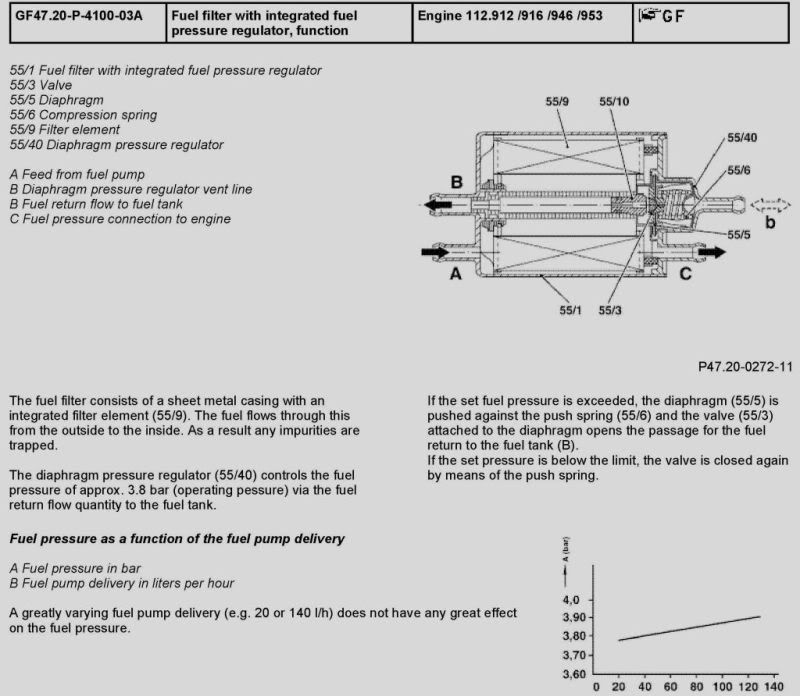
MB publishes scant reference to the correct fuel pressure in their service literature. This is the only applicable documentation I’ve yet to locate specifying the system’s designed working pressure:
Its relatively stock combination of LET exhaust manifolds and heat exchanger, combined with an evosport 178mm dampened ODPS, is apparently not enough to tax the OE fuel system.
MB publishes scant reference to the correct fuel pressure in their service literature. This is the only applicable documentation I’ve yet to locate specifying the system’s designed working pressure:


