

Header Types Defined/Discussed + Photos of all C63 Headers and Manifolds
Subscribe
Member
Here is some more food for thought. These are excerpts and quotes from the same guy MBH quoted. Actually the same article he posted. He just left this stuff out.
From this article. http://www.popularhotrodding.com/tec...ech/index.html
Quote:
One of the largest errors street enthusiasts make is in running too large of a primary pipe, and too large of a collector. For example, NHRA and IHRA Stock teams using Burns' headers in H/SA in traditional small-block powered musclecars are running 1.5-inch diameter primary pipes- much smaller than many street machines are trying to use.
"The purpose and rpm range of the engine determine the primary pipe length, while pipe diameter is governed by engine displacement, valve diameter, and valve curtain area (determined by camshaft dimensions). The exhaust port design is critical in determining the size differential and placement of steps in a step header, and since we create our headers individually on a case-by-case basis, we can create truly optimal headers. We don't make any production headers; each and every set is custom."
The primary header pipe diameter is determined using basic engine mechanical specifications, such as: Bore Stroke Compression Ratio Valve diameter Cam specifications (lift and duration) Target rpm range.
"The overall length of the primary header pipe is governed almost exclusively by the target engine's rpm range, which is dependent upon wave tuning. Typically, a lower engine rpm range likes a longer primary pipe, while a high rpm engine prefers a shorter primary."
One of the largest errors street enthusiasts make is in running too large of a primary pipe, and too large of a collector. For example, NHRA and IHRA Stock teams using Burns' headers in H/SA in traditional small-block powered musclecars are running 1.5-inch diameter primary pipes- much smaller than many street machines are trying to use.
"The purpose and rpm range of the engine determine the primary pipe length, while pipe diameter is governed by engine displacement, valve diameter, and valve curtain area (determined by camshaft dimensions). The exhaust port design is critical in determining the size differential and placement of steps in a step header, and since we create our headers individually on a case-by-case basis, we can create truly optimal headers. We don't make any production headers; each and every set is custom."
The primary header pipe diameter is determined using basic engine mechanical specifications, such as: Bore Stroke Compression Ratio Valve diameter Cam specifications (lift and duration) Target rpm range.
"The overall length of the primary header pipe is governed almost exclusively by the target engine's rpm range, which is dependent upon wave tuning. Typically, a lower engine rpm range likes a longer primary pipe, while a high rpm engine prefers a shorter primary."
From this article. http://www.popularhotrodding.com/tec...ech/index.html

Former Vendor of MBWorld
Quote:
From this article. http://www.popularhotrodding.com/tec...ech/index.html
I'm not attacking you at all. Just calling it how I see it. If you want to believe that my headers are not good, that so be it. Originally Posted by TexasEngineer
Here is some more food for thought. These are excerpts and quotes from the same guy MBH quoted. Actually the same article he posted. He just left this stuff out. From this article. http://www.popularhotrodding.com/tec...ech/index.html
One thing is for sure, Jack Bruns hasn't seen how huge the exhaust ports are on a the 63 motor.
Member
Quote:
One thing is for sure, Jack Bruns hasn't seen how huge the exhaust ports are on a the 63 motor.
Yes, but he has seen the exhaust ports of race cars. Oh, and the exhuast port shape and size does not determine the proper size of the primaries.Originally Posted by MBH motorsports
I'm not attacking you at all. Just calling it how I see it. If you want to believe that my headers are not good, that so be it. One thing is for sure, Jack Bruns hasn't seen how huge the exhaust ports are on a the 63 motor.

Super Member
Quote:
How do you know this? Have you personally asked him?Originally Posted by MBH motorsports
One thing is for sure, Jack Bruns hasn't seen how huge the exhaust ports are on a the 63 motor.
Quote:
Instead of explaining something in a technical format (by the way, this was supposed to be a technical tread) you have attacked me and some company that went out of business. Goodness, I sure hope you stay in business forever. If not, you might be considered a know nothing.
I was really hoping you would come back with some kind real technical explanation or documentation backing your claims. By the way, why would it cause a hot spot? There is no way that a 1 ¾” piping or 1 7/8” is causing a restriction. In fact, velocities increase with the smaller diameter. Also, what problem would a “hot spot” cause? Also, you keep talking about tuned area. If tuned area is so important to your design, why are all of you primary lengths and secondary lengths so different? As I understand it, this completely defeats the purpose.
I think we are all disappointed in how this thread turned out. I was simple asking questions and seeking some data.
I guess we can all talk theory tell we are blue in the face, but results are what really matters. Maybe we should put together a headers results page with dyno numbers and track times, but that would probably end up with name calling and ticked off vendors as well just like all the other threads have ended up lately.
Please note that I tried to be respectful here and felt no need to use red font.
Dude, look through all the threads that Hooley posts about his "most researched headers in the world." His fallback is that his fabricator is famous in the IRL world, and because of that his design is beyond reproach. He's used that in at least four different threads. Isn't that good enough for you? Originally Posted by TexasEngineer
Hooleyboy,Instead of explaining something in a technical format (by the way, this was supposed to be a technical tread) you have attacked me and some company that went out of business. Goodness, I sure hope you stay in business forever. If not, you might be considered a know nothing.
I was really hoping you would come back with some kind real technical explanation or documentation backing your claims. By the way, why would it cause a hot spot? There is no way that a 1 ¾” piping or 1 7/8” is causing a restriction. In fact, velocities increase with the smaller diameter. Also, what problem would a “hot spot” cause? Also, you keep talking about tuned area. If tuned area is so important to your design, why are all of you primary lengths and secondary lengths so different? As I understand it, this completely defeats the purpose.
I think we are all disappointed in how this thread turned out. I was simple asking questions and seeking some data.
I guess we can all talk theory tell we are blue in the face, but results are what really matters. Maybe we should put together a headers results page with dyno numbers and track times, but that would probably end up with name calling and ticked off vendors as well just like all the other threads have ended up lately.
Please note that I tried to be respectful here and felt no need to use red font.
What all his responses show is that despite all the contradictory data, he made the headers different because sometimes different sells. They make good power and they use less tubing so they're cheaper to make and sell (Seriously, he uses straight tubing in his merges). That's good enough for a lot of people. Pretty much any kind of mid-long tube header design with a dyno tune will make solid power on the M156 and I'm guessing he's smart enough to know that. I mean, seriously, Keith's car made 460rwhp with the MKB shorties. It's not hard to make power on our cars, even with a marginal design.
All the empirical data in the world isn't going go get him to admit he chose different just to be different (but continually prodding him for honest technical design information does make for some entertaining outbursts).
Josh

Super Member
I have one question, if your fabricator has his roots in IRL which all use 4 into 1 design, why are the C63 headers (another NA application) Tri-Y?
I just can't get past that fact. ?
I just can't get past that fact. ?
MBWorld Fanatic!
Quote:
This thread isn't about header pricing, etc. I'd prefer us not going down that road. It is what it is.
I'm 100% in favor of having an educated discussion of the various types of header designs.
Let's keep it civil & professional so this thread grows as a valuable resource.
Originally Posted by superlubricity
Great follow-up, Tex. Thank you for adding to the technical discussion in a very data-driven manner.This thread isn't about header pricing, etc. I'd prefer us not going down that road. It is what it is.
I'm 100% in favor of having an educated discussion of the various types of header designs.
Let's keep it civil & professional so this thread grows as a valuable resource.
Quote:
Note to all: Let's keep this a technically-oriented thread free of emotion and/or personal attacks. We haven't crossed that line "yet" but I know this forum.
Data-driven discussion and argument is welcome. In fact, we need more of it!
Guys, this has the potential to be a great thread. Let's respect the OP's wishes to keep it clean and on-topic.Originally Posted by superlubricity
Tex, thanks again for contributing with data. You touched on a few of the same points I've made. Note to all: Let's keep this a technically-oriented thread free of emotion and/or personal attacks. We haven't crossed that line "yet" but I know this forum.
Data-driven discussion and argument is welcome. In fact, we need more of it!
Former Vendor of MBWorld
Quote:
I just can't get past that fact. ?
Every other header we make is a 4 into 1. We originally made a 4 into 1 for the c63 and after testing we found that the Tri-Y made more power on the 63. I'll state this as fact. its cheaper to make a 4 into 1 header than a Tri-y. We are going to make what makes the most power. I currently have a jig for a 4 into 1 header for the C63. There is no scene in making that header if it makes us less power. My turn around time for my guys to build a 4 into 1 header is about 2 days. The Tri-Y header takes about 1 week once building starts. Problem is people don't see what I do outside of MBW. I'm constantly trying to improve my products. Until I see my data come back staying my 4-1 header is out performaning my tri-y. Thats what we are sticking with. Plus the customers are not complaining about the performance of the Tri-y either.Originally Posted by RStevens63
I have one question, if your fabricator has his roots in IRL which all use 4 into 1 design, why are the C63 headers (another NA application) Tri-Y?I just can't get past that fact. ?

MBWorld Fanatic!
Any MKB dyno results?
MB World Stories
The Best of Mercedes & AMG
Explore

Manual Mercedes? 6 Times Sindelfingen Let Drivers Have All The Fun
Verdad Gallardo
Mercedes SLR McLaren 722 S Is Extremely Rare Example Modified by McLaren
Verdad Gallardo
8 Classic Boxy Mercedes Designs That Have Aged Like Fine Wine
Verdad Gallardo
Flawlessly Restored Mercedes 190E Evo II Heads to Auction
Verdad Gallardo
Electric Mercedes C-Class Unveiled: 11 Things You Need to Know
Verdad Gallardo
Mercedes EQS Gets A Major Update: Everything You Need to Know
Verdad Gallardo
5 Underrated Mercedes-Benz Models That Don't Get the Love They Deserve
Verdad Gallardo
Mercedes 300D Has Pushed Well Past 1 Million Miles and It Ain't Stopping
Verdad Gallardo
10 Most Reliable Mercedes-Benz Models You Can Buy Used
Verdad Gallardo
Super Member
Hooley, Hooley, Hooley...
Here's the truth: You consistently ignore legitimate technical questions about your headers and then go ballistic when people make assumptions because you give them nothing to go on. I'm not even the only one questioning you, I'm just the best at baiting you into showing your depth of knowledge and, unexpectedly, true colors as a person. I've never said anything about you or your personal life or even your general design skills. Just specifically the design theory and fact behind your Tri-Y headers.
By the way, yes, I did specifically ask "did you make a header that was to be different?" (Well, I actually asked in English, not jibberish, but it was the same idea) Your refusal to answer that simple question in the first place was what started all of this animosity between us. C'mon, try to keep up. Nonetheless, thank you for FINALLY admitting it.
Also, if your fabricator takes a week to make those headers, I could probably be persuaded to make myself available to help you with production design, because they should really only take 2-3 days max, especially in any kind of batch quantity. You do know I'm a full time designer AND fabricator, right? I also happen to be really good at my job.
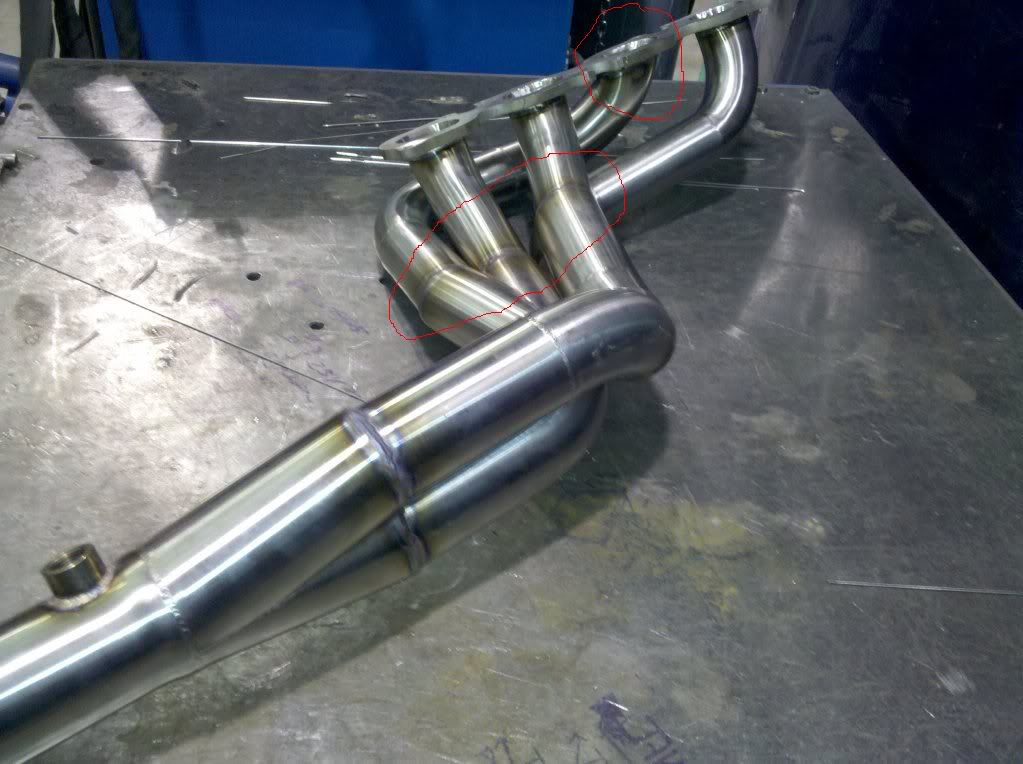
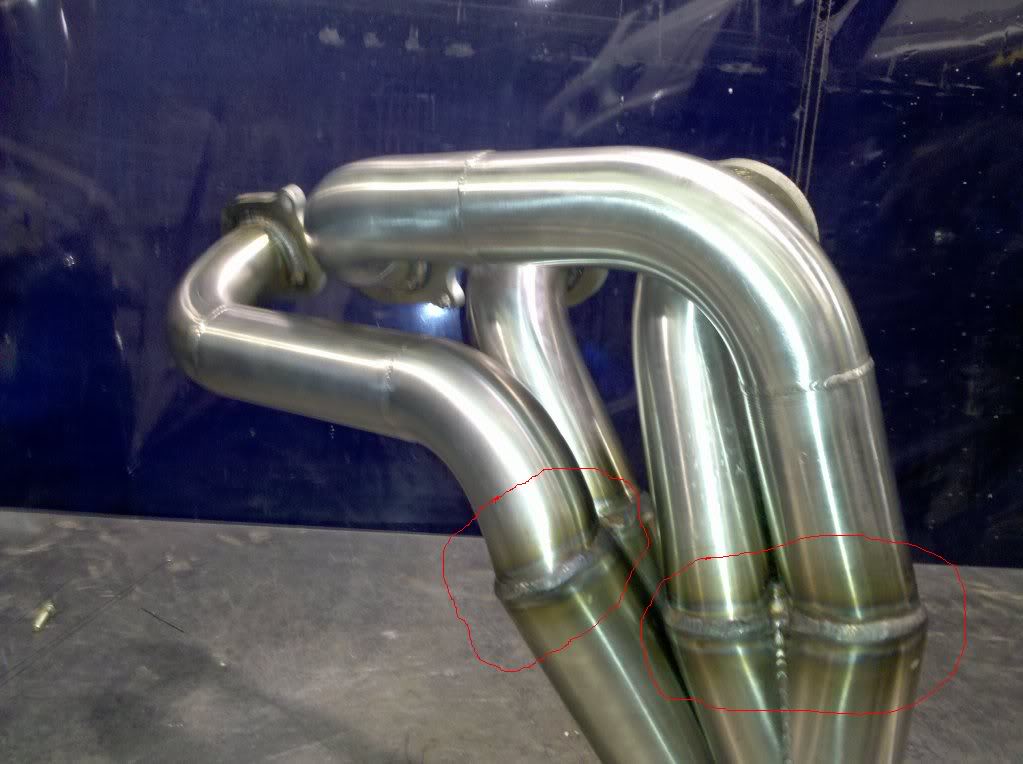
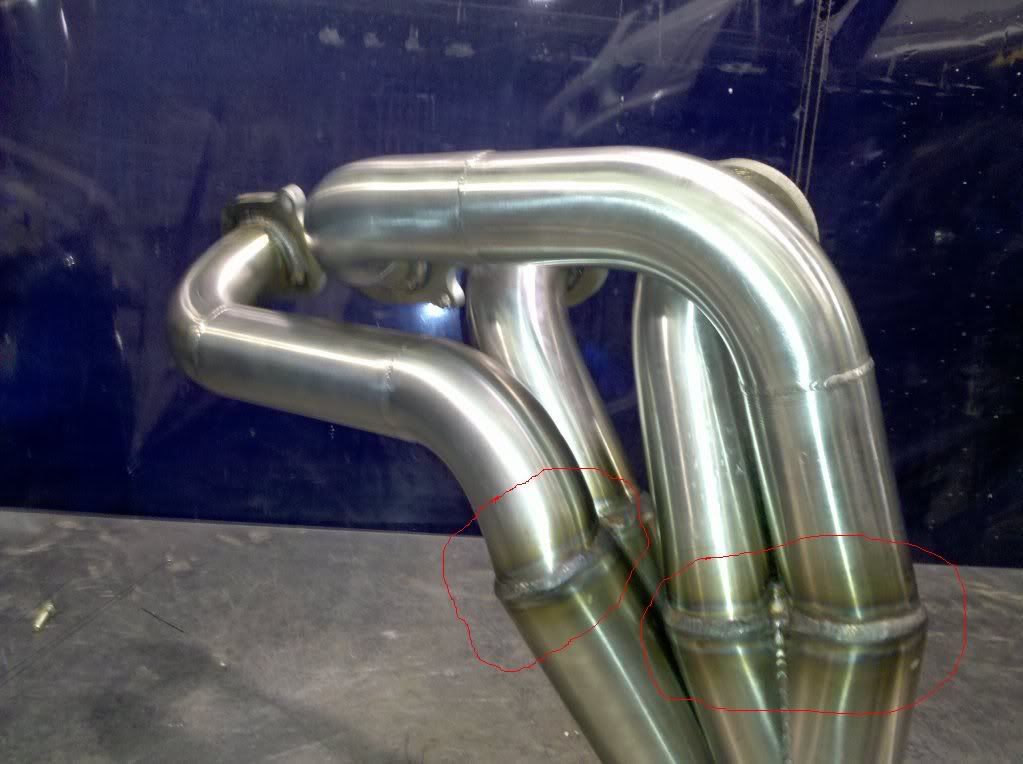
I thought it might fair to attach your picture of your headers with all the visibly cheated (i.e. non tangential) joints circled in red. If you're going to quote Jack Burns regarding tri-y design (even though he was actually only referring to collector design) I thought it might also be good to post how he feels about cheated welds such as the ones you have throughout your headers:
Though not directly related to welding, this is a good time to discuss "cheating bends." We consider a properly cut tubing bend as one where the tube is cut perpendicular to the tangent of the bend (Figure 5). It will often be tempting while fabricating a primary tube to "cheat" the bend, that is, cutting it "off-tangent." This is one of the most common "power-robbers" that is over looked by mediocre fabricators. (emphasis added)
source: http://www.burnsstainless.com/weldingarticle2.aspx
So there's that. Thank you Uncle Jack for not making me say it. Also, you're probably not going to answer me regarding your supposed discussion with Jack about the port size, are you?
Anyway I'm bored. These are your headers with just a few of the obviously cheated bends circled in red. Best built, indeed.

Josh
Here's the truth: You consistently ignore legitimate technical questions about your headers and then go ballistic when people make assumptions because you give them nothing to go on. I'm not even the only one questioning you, I'm just the best at baiting you into showing your depth of knowledge and, unexpectedly, true colors as a person. I've never said anything about you or your personal life or even your general design skills. Just specifically the design theory and fact behind your Tri-Y headers.
By the way, yes, I did specifically ask "did you make a header that was to be different?" (Well, I actually asked in English, not jibberish, but it was the same idea) Your refusal to answer that simple question in the first place was what started all of this animosity between us. C'mon, try to keep up. Nonetheless, thank you for FINALLY admitting it.
Also, if your fabricator takes a week to make those headers, I could probably be persuaded to make myself available to help you with production design, because they should really only take 2-3 days max, especially in any kind of batch quantity. You do know I'm a full time designer AND fabricator, right? I also happen to be really good at my job.
I thought it might fair to attach your picture of your headers with all the visibly cheated (i.e. non tangential) joints circled in red. If you're going to quote Jack Burns regarding tri-y design (even though he was actually only referring to collector design) I thought it might also be good to post how he feels about cheated welds such as the ones you have throughout your headers:
Though not directly related to welding, this is a good time to discuss "cheating bends." We consider a properly cut tubing bend as one where the tube is cut perpendicular to the tangent of the bend (Figure 5). It will often be tempting while fabricating a primary tube to "cheat" the bend, that is, cutting it "off-tangent." This is one of the most common "power-robbers" that is over looked by mediocre fabricators. (emphasis added)
source: http://www.burnsstainless.com/weldingarticle2.aspx
So there's that. Thank you Uncle Jack for not making me say it. Also, you're probably not going to answer me regarding your supposed discussion with Jack about the port size, are you?
Anyway I'm bored. These are your headers with just a few of the obviously cheated bends circled in red. Best built, indeed.
Josh
MBWorld Fanatic!
Quote:
source: http://www.burnsstainless.com/weldingarticle2.aspx
So there's that. Thank you Uncle Jack for not making me say it. Anyway I'm bored. These are your headers with just a few of the obviously cheated bends circled in red. Best built, indeed.
Josh
Guys, let's keep it technical. FWIW, I'd wondered about the "cheated bends" (I'd always heard it called "cheated radius" - but I think they're synonymous) on a few of the AMG header offerings, including MBH's. Since we're all universally fond of Burns Stainless, here's a quote:Originally Posted by C63 Guy
Though not directly related to welding, this is a good time to discuss "cheating bends." We consider a properly cut tubing bend as one where the tube is cut perpendicular to the tangent of the bend (Figure 5). It will often be tempting while fabricating a primary tube to "cheat" the bend, that is, cutting it "off-tangent." This is one of the most common "power-robbers" that is over looked by mediocre fabricators. (emphasis added)source: http://www.burnsstainless.com/weldingarticle2.aspx
So there's that. Thank you Uncle Jack for not making me say it. Anyway I'm bored. These are your headers with just a few of the obviously cheated bends circled in red. Best built, indeed.
Josh
Quote:
A "cheated" tube radius is where a tubing bend is not cut perpendicular to the "tangent" line. The tangent line is a line perpendicular to a radius line. A line off-tangent would not be in line with the true radius. Both dashed cut lines in the diagram at right are perpendicular to tangent and intersect at the origin of the bend radius.
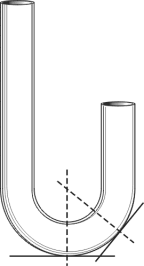
Any time two tubes are joined, they must be checked for alignment and be "on-plane" and tangent. Flow restriction is caused by cheated joints. Sometimes there is no choice due to space constraints and lack of a suitable bend radius, so some cheating may be necessary. Try to catch potential cheating in the mock-up stage and eliminate it as much as possible. Another tip is to try to use a bend with a straight section attached rather than to "piece" a tube together. A more professional appearance is made with the least possible weld joints.
Source: http://www.burnsstainless.com/construction.aspxOriginally Posted by Burns Stainless
The section of tubing coming off of the head flange should be aligned properly and not "cheated", either side to side or up or down. It is very important for the exhaust gases to enter the header tube in the same plane as the port itself (visualize the flange/tube interface as an extension of the port). A straight section or slight angle up with the direction of port flow is preferable, but not always possible. Many headers are built with a cheated radius angled downward at the flange, away from port flow, causing a disruption of exhaust flow and a loss of power. Be sure your header design does not make this mistake! Check that header bolts can be installed and removed at this time with wrench or socket clearance, and make sure spark plugs and socket can fit around your tubes.A "cheated" tube radius is where a tubing bend is not cut perpendicular to the "tangent" line. The tangent line is a line perpendicular to a radius line. A line off-tangent would not be in line with the true radius. Both dashed cut lines in the diagram at right are perpendicular to tangent and intersect at the origin of the bend radius.
Any time two tubes are joined, they must be checked for alignment and be "on-plane" and tangent. Flow restriction is caused by cheated joints. Sometimes there is no choice due to space constraints and lack of a suitable bend radius, so some cheating may be necessary. Try to catch potential cheating in the mock-up stage and eliminate it as much as possible. Another tip is to try to use a bend with a straight section attached rather than to "piece" a tube together. A more professional appearance is made with the least possible weld joints.
Pictures of what appear, in my non-professional opinion, to perhaps be cheated radii:
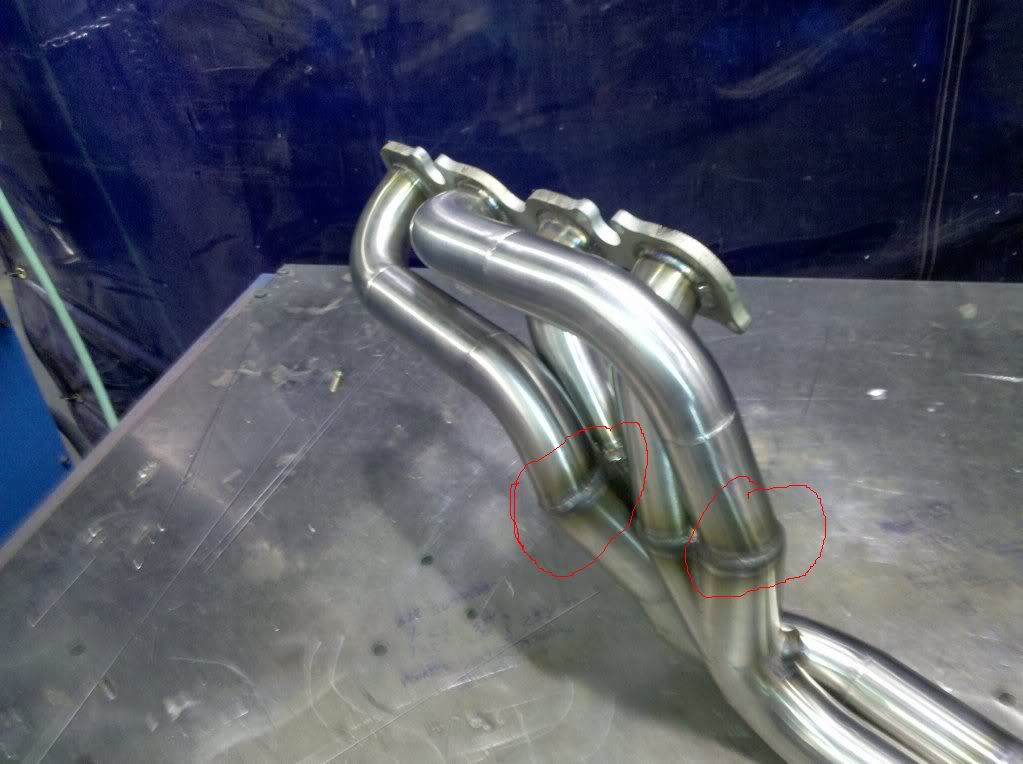
I think the easiest way to envision this, is to just logically consider the natural direction of flow that a pipe is producing - then look at the joint and subsequent direction of the new pipe/collector. Do the angles and joint cause as little disturbance to the direction of flow possible? Or, are there any areas where the surfaces mate that would cause unnecessary turbulence and loss of flow?
My post is not intended to slam MBH's product - they've demonstrated that their headers and tuning offer a significant improvement in output over the stock AMG wares. Also, they may be knowingly making some of those cheated radii compromises because there may just not be enough room to do otherwise (especially with those 2" primaries) - so it might be a conscious decision and concession made. But, IMHO, a few of those areas could likely be improved with a little extra attention, effort, and perhaps a tweak or two to the bends/piping they use and/or overall product design. Please consider this simply a third-party observation and constructive criticism from an admitted non-expert on the subject matter.

I've spent some time cleaning up this thread:
1. Pricing discussion and related posts have been removed.
2. Personal/irrelevant content has been removed.
Suggestions.
1. If you can't handle discussing things in a respectful manner please do not post.
2. Debate is healthy and not everyone will be right. If you disagree, politely present your reasons or agree to disagree and move on.
3. It's not personal. Keep it on subject and bring data.
1. Pricing discussion and related posts have been removed.
2. Personal/irrelevant content has been removed.
Suggestions.
1. If you can't handle discussing things in a respectful manner please do not post.
2. Debate is healthy and not everyone will be right. If you disagree, politely present your reasons or agree to disagree and move on.
3. It's not personal. Keep it on subject and bring data.
Super Member
Quote:
Source: http://www.burnsstainless.com/construction.aspx
Pictures of what appear, in my non-professional opinion, to perhaps be cheated radii:
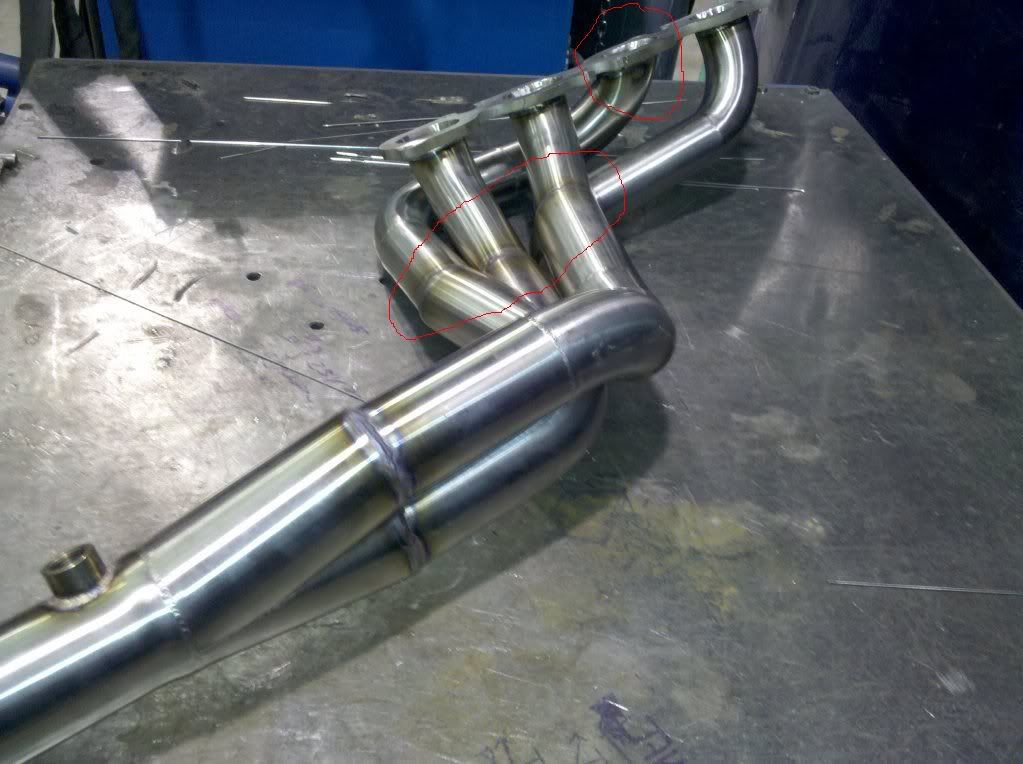
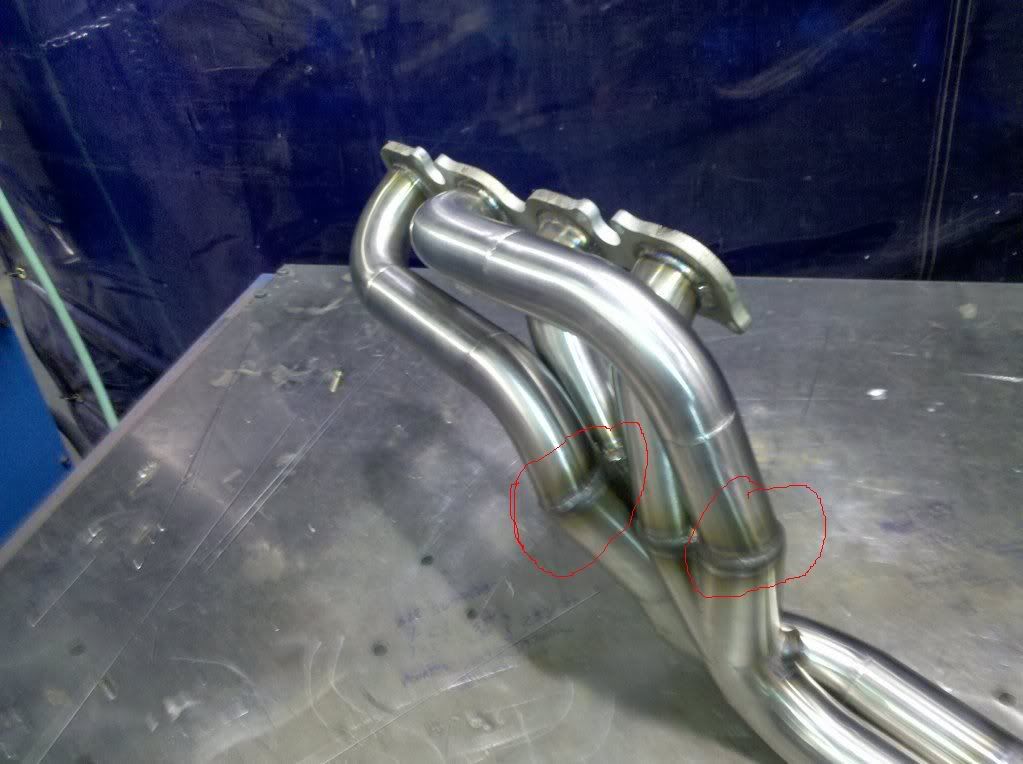
I think the easiest way to envision this, is to just logically consider the natural direction of flow that a pipe is producing - then look at the joint and subsequent direction of the new pipe/collector. Do the angles and joint cause as little disturbance to the direction of flow possible? Or, are there any areas where the surfaces mate that would cause unnecessary turbulence and loss of flow?
My post is not intended to slam MBH's product - they've demonstrated that their headers and tuning offer a significant improvement in output over the stock AMG wares. Also, they may be knowingly making some of those cheated radii compromises because there may just not be enough room to do otherwise (especially with those 2" primaries) - so it might be a conscious decision and concession made. But, IMHO, a few of those areas could likely be improved with a little extra attention, effort, and perhaps a tweak or two to the bends/piping they use and/or overall product design. Please consider this simply a third-party observation and constructive criticism from an admitted non-expert on the subject matter.
Excellent posts via you and Josh, good finds guys. This goes along with what has been stated previously about non parallel cut and welds (diff terminology for the same issue, non tangenital welds or joints). Also notice the filler rod most specifically located where the primary's come together. Originally Posted by c32AMG-DTM
Guys, let's keep it technical. FWIW, I'd wondered about the "cheated bends" (I'd always heard it called "cheated radius" - but I think they're synonymous) on a few of the AMG header offerings, including MBH's. Since we're all universally fond of Burns Stainless, here's a quote:Source: http://www.burnsstainless.com/construction.aspx
Pictures of what appear, in my non-professional opinion, to perhaps be cheated radii:
I think the easiest way to envision this, is to just logically consider the natural direction of flow that a pipe is producing - then look at the joint and subsequent direction of the new pipe/collector. Do the angles and joint cause as little disturbance to the direction of flow possible? Or, are there any areas where the surfaces mate that would cause unnecessary turbulence and loss of flow?
My post is not intended to slam MBH's product - they've demonstrated that their headers and tuning offer a significant improvement in output over the stock AMG wares. Also, they may be knowingly making some of those cheated radii compromises because there may just not be enough room to do otherwise (especially with those 2" primaries) - so it might be a conscious decision and concession made. But, IMHO, a few of those areas could likely be improved with a little extra attention, effort, and perhaps a tweak or two to the bends/piping they use and/or overall product design. Please consider this simply a third-party observation and constructive criticism from an admitted non-expert on the subject matter.
As stated each one of those non parallel cut and welds, cheated bends or welds, causes a huge disruption in flow. Just one is enough to disrupt flow throughout the entire header design, and I see multiple per primary or secondary in this set.
Good eyes gents.


So out of all the Long Tube Headers that were posted on the first page, which of them produces the most HP?
Thanks
Thanks
Quote:
Thanks
I don't think anyone has done a side-by-side comparison of the four different long-tube brands on the same dyno or track on the same car.Originally Posted by JamE55
So out of all the Long Tube Headers that were posted on the first page, which of them produces the most HP?Thanks

MBWorld Fanatic!
Quote:
Thanks
Its very difficult if not impossible to get a side by side comparison on the same car, same day, same dyno because no one buys multiple header types and pays to install them all and then try to return the ones they don't keep. Originally Posted by JamE55
So out of all the Long Tube Headers that were posted on the first page, which of them produces the most HP?Thanks
Check out dragtimes and get your answer.

MBWorld Fanatic!
Quote:
Thanks
Depends on how you want to measure power output.Originally Posted by JamE55
So out of all the Long Tube Headers that were posted on the first page, which of them produces the most HP?Thanks
Using a machine with which a stationary car turns a set of rollers and a computer analyses the data to provide a HP measurement.........there is no clear distinction between designs or manufacturers.
Moving a 4,000 pound car 1,320 feet in the quickest time......the answer is obvious.

Newbie
Quote:
Using a machine with which a stationary car turns a set of rollers and a computer analyses the data to provide a HP measurement.........there is no clear distinction between designs or manufacturers.
Moving a 4,000 pound car 1,320 feet in the quickest time......the answer is obvious.
I disagree that the answer is obvious.Originally Posted by hhughes1
Depends on how you want to measure power output.Using a machine with which a stationary car turns a set of rollers and a computer analyses the data to provide a HP measurement.........there is no clear distinction between designs or manufacturers.
Moving a 4,000 pound car 1,320 feet in the quickest time......the answer is obvious.
There is no denying the amazing times put down by the MHP crew, however that doesn't "prove" anything. It simply shows the strength of that set-up. Just because the handfull of individuals who are dedicated to racing use a specific set-up doesn't imply similar results couldn't be obtained using a different product.
Dodger, Mthis, Dads, etc are dedicated to making the C63 go fast and have countless trips down the 1/4 mile to improve their technique. I am not aware of similar dedicated folks using a competing set-up. Thus, there is no true way to compare vehicles, let alone 1 piece of an over all package.
Until somebody tests different headers on the same car and same day to isolate variables, everything else is speculation.
Disclaimer - My car is bone stock, including the sexy Conti tires
Super Member
Quote:
There is no denying the amazing times put down by the MHP crew, however that doesn't "prove" anything. It simply shows the strength of that set-up. Just because the handfull of individuals who are dedicated to racing use a specific set-up doesn't imply similar results couldn't be obtained using a different product.
Dodger, Mthis, Dads, etc are dedicated to making the C63 go fast and have countless trips down the 1/4 mile to improve their technique. I am not aware of similar dedicated folks using a competing set-up. Thus, there is no true way to compare vehicles, let alone 1 piece of an over all package.
Until somebody tests different headers on the same car and same day to isolate variables, everything else is speculation.
Disclaimer - My car is bone stock, including the sexy Conti tires
I disagree with your comments. It's been 2+ years since headers and tuning were introduced on this make. Are you trying to tell me that one of the smallest tuning operations in MB land has more track racers than anyone else? Or could it be everyone else has just as many passes however only a few make them public since the rest of the results are not on par with the segment leader?Originally Posted by WhiteC63
I disagree that the answer is obvious.There is no denying the amazing times put down by the MHP crew, however that doesn't "prove" anything. It simply shows the strength of that set-up. Just because the handfull of individuals who are dedicated to racing use a specific set-up doesn't imply similar results couldn't be obtained using a different product.
Dodger, Mthis, Dads, etc are dedicated to making the C63 go fast and have countless trips down the 1/4 mile to improve their technique. I am not aware of similar dedicated folks using a competing set-up. Thus, there is no true way to compare vehicles, let alone 1 piece of an over all package.
Until somebody tests different headers on the same car and same day to isolate variables, everything else is speculation.
Disclaimer - My car is bone stock, including the sexy Conti tires
I think more the later.
There have been cars like Petro that have ran in as good or better air than what the MHP cars have ran in and the results were not the same or close to it.
You can claim speculation all you want but there are too many numbers from too many cars across the world for you to feel comfortable with that assumption.
Sorry, not buying it.
Quote:
I think more the later.
There have been cars like Petro that have ran in as good or better air than what the MHP cars have ran in and the results were not the same or close to it.
You can claim speculation all you want but there are too many numbers from too many cars across the world for you to feel comfortable with that assumption.
Sorry, not buying it.
I actually agree with WhiteC63. He pretty much nailed it in my eyes.Originally Posted by RStevens63
I disagree with your comments. It's been 2+ years since headers and tuning were introduced on this make. Are you trying to tell me that one of the smallest tuning operations in MB land has more track racers than anyone else? Or could it be everyone else has just as many passes however only a few make them public since the rest of the results are not on par with the segment leader?I think more the later.
There have been cars like Petro that have ran in as good or better air than what the MHP cars have ran in and the results were not the same or close to it.
You can claim speculation all you want but there are too many numbers from too many cars across the world for you to feel comfortable with that assumption.
Sorry, not buying it.
There is no side-by-side data on the same car, yet. Maybe I'll throw a different set of headers on after I've tested my new combo. I've already tested manifolds, catless down-pipes and long-tubes back-to-back at the same track in similar conditions. Perhaps this Spring I'll throw a set of Tri-Ys into the testing pool.
While certainly reflective of the overall Power output, you can't quite use Petro's car as a standalone header comparison. It just isn't 1:1. How do you know which of Petro's modifications are responsible for the lower output? Is it the headers? Is it the tune? Octane? Launch technique? Air pressure? Weight? There is simply more than one variable that could be responsible.
Super Member
Quote:
There is no side-by-side data on the same car, yet. Maybe I'll throw a different set of headers on after I've tested my new combo. I've already tested manifolds, catless down-pipes and long-tubes back-to-back at the same track in similar conditions. Perhaps this Spring I'll throw a set of Tri-Ys into the testing pool.
While certainly reflective of the overall Power output, you can't quite use Petro's car as a standalone header comparison. It just isn't 1:1. How do you know which of Petro's modifications are responsible for the lower output? Is it the headers? Is it the tune? Octane? Launch technique? Air pressure? Weight? There is simply more than one variable that could be responsible.
I think you should do it (try some tri-ys). Originally Posted by superlubricity
I actually agree with WhiteC63. He pretty much nailed it in my eyes.There is no side-by-side data on the same car, yet. Maybe I'll throw a different set of headers on after I've tested my new combo. I've already tested manifolds, catless down-pipes and long-tubes back-to-back at the same track in similar conditions. Perhaps this Spring I'll throw a set of Tri-Ys into the testing pool.
While certainly reflective of the overall Power output, you can't quite use Petro's car as a standalone header comparison. It just isn't 1:1. How do you know which of Petro's modifications are responsible for the lower output? Is it the headers? Is it the tune? Octane? Launch technique? Air pressure? Weight? There is simply more than one variable that could be responsible.
I never stated which specific parts or tuning from other tuners were responsible for the difference, just that others with the same parts changed (tuning, headers, airboxes, DRs) are not even close to the same results.
I would negate weight (especially when comparing against mthis's car) since he has no weight reduction mods. mthis didn't even have an airbox and from Petro's testing we know the RT boxes work.
Thanks
Newbie
Quote:
I think more the later.
There have been cars like Petro that have ran in as good or better air than what the MHP cars have ran in and the results were not the same or close to it.
You can claim speculation all you want but there are too many numbers from too many cars across the world for you to feel comfortable with that assumption.
Sorry, not buying it.
I am not trying to convince you of anything, you are entitled to your opinion. However, your defense again is complete speculation. The bottom line is that a lack of evidence to the contrary does not provide evidence for your argument. Originally Posted by RStevens63
I disagree with your comments. It's been 2+ years since headers and tuning were introduced on this make. Are you trying to tell me that one of the smallest tuning operations in MB land has more track racers than anyone else? Or could it be everyone else has just as many passes however only a few make them public since the rest of the results are not on par with the segment leader?I think more the later.
There have been cars like Petro that have ran in as good or better air than what the MHP cars have ran in and the results were not the same or close to it.
You can claim speculation all you want but there are too many numbers from too many cars across the world for you to feel comfortable with that assumption.
Sorry, not buying it.
The die-hard racers on this forum use 1 particular set-up, and have had great results. There is no evidence those results would not have been acheived using a competing set-up. Nothing anybody can say changes this fact. Perhaps once dodger achieves his goal, he can swap out headers and make 200+ passes with another brand.
In 1491, all the experts felt the world was flat; it turns out they were mistaken too... Until an unbiased experiment is performed, isolating headers as the single variable, conclusive exidence will remain unavailable.
Quote:
I never stated which specific parts or tuning from other tuners were responsible for the difference, just that others with the same parts changed (tuning, headers, airboxes, DRs) are not even close to the same results.
I would negate weight (especially when comparing against mthis's car) since he has no weight reduction mods. mthis didn't even have an airbox and from Petro's testing we know the RT boxes work.
Thanks
Gotcha. This is a header-discussion so it was implied you were keeping to the topic and referring to headers. No one is arguing the output of the setup. Trying to isolate the performance of one component from the combo is the challenge.Originally Posted by RStevens63
I think you should do it (try some tri-ys). I never stated which specific parts or tuning from other tuners were responsible for the difference, just that others with the same parts changed (tuning, headers, airboxes, DRs) are not even close to the same results.
I would negate weight (especially when comparing against mthis's car) since he has no weight reduction mods. mthis didn't even have an airbox and from Petro's testing we know the RT boxes work.
Thanks
Quote:
The die-hard racers on this forum use 1 particular set-up, and have had great results. There is no evidence those results would not have been acheived using a competing set-up. Nothing anybody can say changes this fact. Perhaps once dodger achieves his goal, he can swap out headers and make 200+ passes with another brand.
In 1491, all the experts felt the world was flat; it turns out they were mistaken too... Until an unbiased experiment is performed, isolating headers as the single variable, conclusive exidence will remain unavailable.
Bravo and thank you for adding to this discussion.Originally Posted by WhiteC63
I am not trying to convince you of anything, you are entitled to your opinion. However, your defense again is complete speculation. The bottom line is that a lack of evidence to the contrary does not provide evidence for your argument. The die-hard racers on this forum use 1 particular set-up, and have had great results. There is no evidence those results would not have been acheived using a competing set-up. Nothing anybody can say changes this fact. Perhaps once dodger achieves his goal, he can swap out headers and make 200+ passes with another brand.
In 1491, all the experts felt the world was flat; it turns out they were mistaken too... Until an unbiased experiment is performed, isolating headers as the single variable, conclusive exidence will remain unavailable.
Super Member
Quote:
It is a challenge but again, when you consider the same tuner holds both tune only and tune and header records, and not by a insignificant amount, the answer becomes even more clear. Originally Posted by superlubricity
Gotcha. This is a header-discussion so it was implied you were keeping to the topic and referring to headers. No one is arguing the output of the setup. Trying to isolate the performance of one component from the combo is the challenge.
Love to see the comparo happen, just don't believe it will. Other tuners seem to shy away from direct testing especially race testing vs this combo.

MBWorld Fanatic!
Quote:
There is no side-by-side data on the same car, yet. Maybe I'll throw a different set of headers on after I've tested my new combo. I've already tested manifolds, catless down-pipes and long-tubes back-to-back at the same track in similar conditions. Perhaps this Spring I'll throw a set of Tri-Ys into the testing pool.
While certainly reflective of the overall Power output, you can't quite use Petro's car as a standalone header comparison. It just isn't 1:1. How do you know which of Petro's modifications are responsible for the lower output? Is it the headers? Is it the tune? Octane? Launch technique? Air pressure? Weight? There is simply more than one variable that could be responsible.
Super,Originally Posted by superlubricity
I actually agree with WhiteC63. He pretty much nailed it in my eyes.There is no side-by-side data on the same car, yet. Maybe I'll throw a different set of headers on after I've tested my new combo. I've already tested manifolds, catless down-pipes and long-tubes back-to-back at the same track in similar conditions. Perhaps this Spring I'll throw a set of Tri-Ys into the testing pool.
While certainly reflective of the overall Power output, you can't quite use Petro's car as a standalone header comparison. It just isn't 1:1. How do you know which of Petro's modifications are responsible for the lower output? Is it the headers? Is it the tune? Octane? Launch technique? Air pressure? Weight? There is simply more than one variable that could be responsible.
I have a great idea. I'll send you my MBH headers and you can send me
your MHP headers and we can finally put this to rest.

All kidding aside, I've been pushing hard for a custom dyno tune, preferably
something for 100 octane to eliminate that possibility.


