





Is ABC flush a DIY job YES!

Thread Starter
Junior Member
Joined: Jan 2010
Posts: 66
Likes: 6
CL600
Is ABC flush a DIY job YES!
Hi guys.
Just to let any doubters know, its very easy to flush the abc oil on your CL. You do not need a STAR for this job.
1. Do a good cleaning around the ABC container. - See awiners post below he also recommends that the entire container is drained first, because there can be lots of dirt in the buttom.
2. Disconnect the hose going to the big cap on top on the ABC container. Connect the end of this hose to a clear hose and put it in a bowl that can contain at least 10 liters of oil. You need a clear hose, because then you can watch when the oil running through is a nice clean green color.
3. Remove the lid and ABC oil filter, again take care so that dirt do not get into the ABC oil container. Ready 10 liters of Pentosin CHF 11S.
4. Have some good light available so you can always observe the oil level in the container during the flush.
5. Have a friend turn on the car.
6. From the inside of the car, use the raise button up and down to cycle the ABC oil. Take GREAT care not to let the ABC container run dry. The flow is not very fast, even when the car is being raised, but if you need a brake, just turn of the engine and fill the container again.
7. After flushing about 8 liters the oil should be nice green again. I used 10 liters because that was what I was recommended.
8. After you are finished, replace the ABC oil filter and make sure the oil level is correct.
9. You are done and its more easy that changing the engine oil!
David
Just to let any doubters know, its very easy to flush the abc oil on your CL. You do not need a STAR for this job.
1. Do a good cleaning around the ABC container. - See awiners post below he also recommends that the entire container is drained first, because there can be lots of dirt in the buttom.
2. Disconnect the hose going to the big cap on top on the ABC container. Connect the end of this hose to a clear hose and put it in a bowl that can contain at least 10 liters of oil. You need a clear hose, because then you can watch when the oil running through is a nice clean green color.
3. Remove the lid and ABC oil filter, again take care so that dirt do not get into the ABC oil container. Ready 10 liters of Pentosin CHF 11S.
4. Have some good light available so you can always observe the oil level in the container during the flush.
5. Have a friend turn on the car.
6. From the inside of the car, use the raise button up and down to cycle the ABC oil. Take GREAT care not to let the ABC container run dry. The flow is not very fast, even when the car is being raised, but if you need a brake, just turn of the engine and fill the container again.
7. After flushing about 8 liters the oil should be nice green again. I used 10 liters because that was what I was recommended.
8. After you are finished, replace the ABC oil filter and make sure the oil level is correct.
9. You are done and its more easy that changing the engine oil!
David
Last edited by duhdenmark; Apr 9, 2014 at 08:41 AM.

Member
Joined: Feb 2006
Posts: 145
Likes: 0
From: United Kingdom
2004 CL500
I would recommend syphoning the 2.5 litres out of the reservoir first and replacing with clean fluid to begin. Now I just replace the fluid in the reservoir with clean fluid and a new filter every time I do an engine oil change.
Last edited by lloyds; Apr 7, 2014 at 04:17 PM.
Thread Starter
Junior Member
Joined: Jan 2010
Posts: 66
Likes: 6
CL600
I bet that if the ABC oil is changed along with filter every 20000 miles from new, there would not be any problems with the system at all, maybe a change of the pulsation dampers as well, but no pump problems.
David
David

MBWorld Fanatic!
Joined: Oct 2009
Posts: 1,924
Likes: 38
cl600
i believe you would still have problems with the pump because there are seals in there that will break down and leak over time, also possible hose problems and strutt leaks. unfortunately, i don't believe there is any fail safe to this system. of course proper maintenance will help.
Trending Topics

MBWorld Fanatic!


Joined: Nov 2001
Posts: 6,340
Likes: 22
From: Southern California, USA
2003 CL55 AMG
If you have ever taken out the ABC reservoir and emptied it, you would be amazed at how much sludge and crap is in there.
I would recommend draining and removing the reservoir before doing this process to get most of that crap out of the system.
I would recommend draining and removing the reservoir before doing this process to get most of that crap out of the system.
MB World Stories
The Best of Mercedes & AMG

7 Craziest Things AMG Gas Ever Built
Verdad Gallardo
New Electric Mercedes-AMG GT 4-Door Coupe Unveiled: 10 Things You Need to Know
Verdad Gallardo
6 Mercedes Models That Did NOT Age Well (But Are Somehow Still Cool)
Verdad Gallardo
Manual Mercedes? 6 Times Sindelfingen Let Drivers Have All The Fun
Verdad Gallardo
Mercedes SLR McLaren 722 S Is Extremely Rare Example Modified by McLaren
Verdad Gallardo
8 Classic Boxy Mercedes Designs That Have Aged Like Fine Wine
Verdad Gallardo
Flawlessly Restored Mercedes 190E Evo II Heads to Auction
Verdad Gallardo
Electric Mercedes C-Class Unveiled: 11 Things You Need to Know
Verdad Gallardo
Mercedes EQS Gets A Major Update: Everything You Need to Know
Verdad Gallardo
Member
Joined: Feb 2006
Posts: 145
Likes: 0
From: United Kingdom
2004 CL500
The Mercedes workshop manual, WIS, which all dealers are supposed to follow, actually says the dimple in the bottom of the reservoir should be cleaned during a fluid change.

MBWorld Fanatic!


Joined: Aug 2003
Posts: 8,882
Likes: 1,214
From: In my garage
E55, GLS450, GL63, GLE350
Pump, hoses, control blocks, and struts can still fail. MB has no recommended service interval for the ABC system. Why?
Thread Starter
Junior Member
Joined: Jan 2010
Posts: 66
Likes: 6
CL600
Wish I would have thought of that! Well that will be done with the next flush.
I have added your excellent idea to the first post.
David
Thread Starter
Junior Member
Joined: Jan 2010
Posts: 66
Likes: 6
CL600
You are likely right. However today we have places rebuilding struts/pumps and reasonable prices and a youtube video showing how easy you can clean the valve block yourself. So for us DIY its getting more and more durable to keep the ABC system running at a reasonable cost.
We just need someone to sell high quality replacement hoses as a kit.
David
Thread Starter
Junior Member
Joined: Jan 2010
Posts: 66
Likes: 6
CL600
Well I am from Europe, so my suppliers would most likely not help you (too costly), but I bet you can find a company on Ebay that supplies rebuild pumps.
Edit: here is one:
http://www.ebay.com/itm/MERCEDES-ABC-TANDEM-POWER-STEERING-PUMP-CL-S-CLASS-/290481017206?pt=Motors_Car_Truck_Parts_Accessories&hash=item43a2049176&vxp=mtr
David


Super Member
Joined: May 2011
Posts: 556
Likes: 10
From: UK
S55K AMG
Thanks to duhdenmark for this excellent thread.
I have read of people doing the ABC flush various times but its always been made harder than what it actually is, a break down like this means that even i am likely to try it at some point in the next few months.
Hoses are still a big failing point, and my big hose at the front of the car (under the radiator) im sure is seeping.
Does anyone know what i should ask for when i go to a hydraulics shop, what kind of ose, what kind of connections, sizes, bore etc etc. I would like to have the new hose before i take the old one off?
Many thanks
I have read of people doing the ABC flush various times but its always been made harder than what it actually is, a break down like this means that even i am likely to try it at some point in the next few months.
Hoses are still a big failing point, and my big hose at the front of the car (under the radiator) im sure is seeping.
Does anyone know what i should ask for when i go to a hydraulics shop, what kind of ose, what kind of connections, sizes, bore etc etc. I would like to have the new hose before i take the old one off?
Many thanks

MBWorld Fanatic!

Joined: Jan 2008
Posts: 6,151
Likes: 533
Mercedes
You need the metal ends /fittings of your old hose for them to make the new one
What you can do is buy a used one from a car being parted out, then have that one rebuilt so its ready to do a direct swap when you remove yours
What you can do is buy a used one from a car being parted out, then have that one rebuilt so its ready to do a direct swap when you remove yours
Super Member
Joined: May 2011
Posts: 556
Likes: 10
From: UK
S55K AMG
Overall not a bad idea, but the problem there is that a second hand hose pipe is likely to cost about as much as the new one your getting made, and then you have to find one in the first place which is not easy where we are.

MBWorld Fanatic!

Joined: Nov 2010
Posts: 2,605
Likes: 343
From: Welwyn, Herts, UK
2006 S600
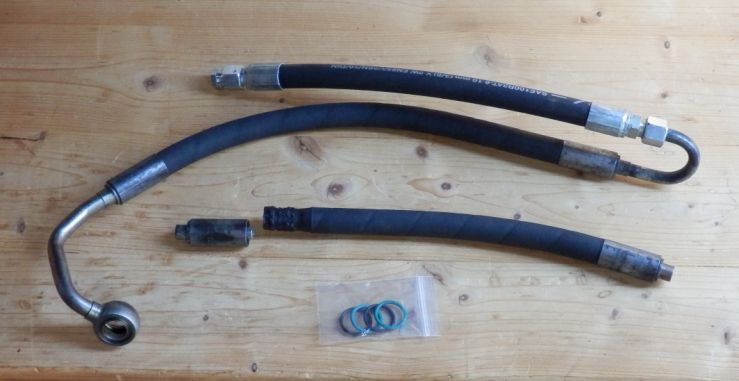
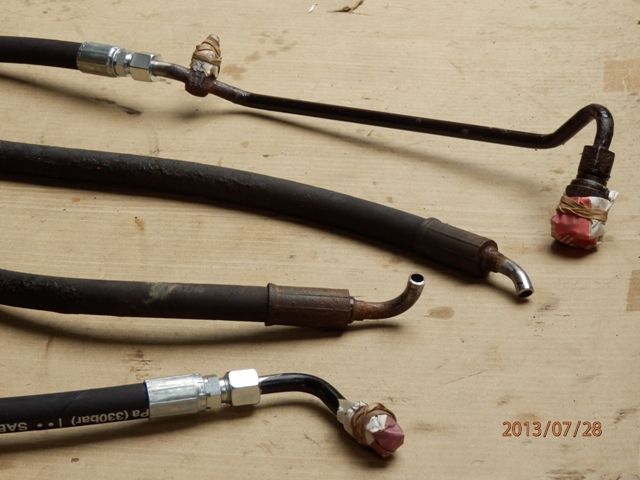
Here's what I did with my car.
Drain the oil and remove the hose.
Scrape and clean the metal pipe close to the flexible section.
Measure the flexible section and get a hydraulic shop to make a new section.
Use 3/8" two-wire flexible hose - its totally ubiquitous, same as everyone uses for almost everything, and costs a few pounds.
Terminate it with 10mm compression fittings at each end.
Cut out the old flexible section using a plumber's pipe cutting wheel.
Fit the new section to the cleaned solid pipe ends.
Nick
Drain the oil and remove the hose.
Scrape and clean the metal pipe close to the flexible section.
Measure the flexible section and get a hydraulic shop to make a new section.
Use 3/8" two-wire flexible hose - its totally ubiquitous, same as everyone uses for almost everything, and costs a few pounds.
Terminate it with 10mm compression fittings at each end.
Cut out the old flexible section using a plumber's pipe cutting wheel.
Fit the new section to the cleaned solid pipe ends.


Nick
Last edited by Welwynnick; Apr 25, 2014 at 10:10 AM.

Thread Starter
Junior Member
Joined: Jan 2010
Posts: 66
Likes: 6
CL600
Here's what I did with my car.
Drain the oil and remove the hose.
Scrape and clean the metal pipe close to the flexible section.
Measure the flexible section and get a hydraulic shop to make a new section.
Use 3/8" two-wire flexible hose - its totally ubiquitous, same as everyone uses for almost everything, and costs a few pounds.
Terminate it with 10mm compression fittings at each end.
Cut out the old flexible section using a plumber's pipe cutting wheel.
Fit the new section to the cleaned solid pipe ends.
Nick
Drain the oil and remove the hose.
Scrape and clean the metal pipe close to the flexible section.
Measure the flexible section and get a hydraulic shop to make a new section.
Use 3/8" two-wire flexible hose - its totally ubiquitous, same as everyone uses for almost everything, and costs a few pounds.
Terminate it with 10mm compression fittings at each end.
Cut out the old flexible section using a plumber's pipe cutting wheel.
Fit the new section to the cleaned solid pipe ends.
Nick
David
MBWorld Fanatic!
Joined: Nov 2010
Posts: 2,605
Likes: 343
From: Welwyn, Herts, UK
2006 S600
This is a capitalist world. The hard pipes are quite exacting (but quite robust once made). The tooling would be expensive, so I guess it's difficult to justify the investment, when large volumes aren't guaranteed. There's lower hanging fruit....
For a moderately resourceful and experienced DIY'er, using new hoses with compression fittings is a quick and easy win, and last year I told everyone about it for free.
You may even be able to cut out the leaky hose and fit a new section without even removing the pipe assembly!
Nick
For a moderately resourceful and experienced DIY'er, using new hoses with compression fittings is a quick and easy win, and last year I told everyone about it for free.
You may even be able to cut out the leaky hose and fit a new section without even removing the pipe assembly!
Nick
Last edited by Welwynnick; Apr 29, 2014 at 08:06 AM.


