



Refit Oxygen Sensor in 300E

Thread Starter
Junior Member
Joined: Jul 2007
Posts: 66
Likes: 0
Refit Oxygen Sensor in 300E
My car has no oxygen sensor. It was removed a long time ago by previous owner. We used to have only leaded fuel in this country, so those sensors used to fail prematurely and where simply removed. But for some years now unleaded fuel is available (they call it the "green" fuel), so now I would like to try to refit a O2 sensor to correct a chronic over rich fuel mixture problem and lower emissions. There is always a lot of sooth in the exhaust tips, and exhaust gases itself smell way too rich anyway. Fuel economy is not really an issue (premium 95 oct unleaded costs only about 9 cents a gallon), but it would be nice too if it can be improved. As it is now I get only about 160 miles (of mostly stop and go city driving) out of a full tank.
My present exhaust system consists of dual pipes all the way down between the manifolds to the central muffler (no catalytic converter), and then a single pipe follows to the rear muffler. The downward pipe portion where the sensor used to be mounted is long gone, so I'm wondering what can be done in order to attach the sensor to one of the pipes between the manifold and the central muffler. Maybe have a muffler shop braze a big nut to the pipe so the sensor can be screwed on?
I'm already planning on ordering a 1990 Ford Mustang 5.0L V8, Bosch PN 13942, which should be equivalent to the original Mercedes sensor, but only 1/3 the price.
Any suggestions on how to attach the sensor to the pipe will be much appreciated.
-Alex
My present exhaust system consists of dual pipes all the way down between the manifolds to the central muffler (no catalytic converter), and then a single pipe follows to the rear muffler. The downward pipe portion where the sensor used to be mounted is long gone, so I'm wondering what can be done in order to attach the sensor to one of the pipes between the manifold and the central muffler. Maybe have a muffler shop braze a big nut to the pipe so the sensor can be screwed on?
I'm already planning on ordering a 1990 Ford Mustang 5.0L V8, Bosch PN 13942, which should be equivalent to the original Mercedes sensor, but only 1/3 the price.
Any suggestions on how to attach the sensor to the pipe will be much appreciated.
-Alex
MBWorld Fanatic!


Joined: Dec 2006
Posts: 1,042
Likes: 1
From: Bellevue, NE
1995 E320 SE, 162,000 Miles (Sold) 2007 CLK350 Cabriolet 2014 ML550
My car has no oxygen sensor. It was removed a long time ago by previous owner. We used to have only leaded fuel in this country, so those sensors used to fail prematurely and where simply removed. But for some years now unleaded fuel is available (they call it the "green" fuel), so now I would like to try to refit a O2 sensor to correct a chronic over rich fuel mixture problem and lower emissions. There is always a lot of sooth in the exhaust tips, and exhaust gases itself smell way too rich anyway. Fuel economy is not really an issue (premium 95 oct unleaded costs only about 9 cents a gallon), but it would be nice too if it can be improved. As it is now I get only about 160 miles (of mostly stop and go city driving) out of a full tank.
My present exhaust system consists of dual pipes all the way down between the manifolds to the central muffler (no catalytic converter), and then a single pipe follows to the rear muffler. The downward pipe portion where the sensor used to be mounted is long gone, so I'm wondering what can be done in order to attach the sensor to one of the pipes between the manifold and the central muffler. Maybe have a muffler shop braze a big nut to the pipe so the sensor can be screwed on?
I'm already planning on ordering a 1990 Ford Mustang 5.0L V8, Bosch PN 13942, which should be equivalent to the original Mercedes sensor, but only 1/3 the price.
Any suggestions on how to attach the sensor to the pipe will be much appreciated.
-Alex
My present exhaust system consists of dual pipes all the way down between the manifolds to the central muffler (no catalytic converter), and then a single pipe follows to the rear muffler. The downward pipe portion where the sensor used to be mounted is long gone, so I'm wondering what can be done in order to attach the sensor to one of the pipes between the manifold and the central muffler. Maybe have a muffler shop braze a big nut to the pipe so the sensor can be screwed on?
I'm already planning on ordering a 1990 Ford Mustang 5.0L V8, Bosch PN 13942, which should be equivalent to the original Mercedes sensor, but only 1/3 the price.
Any suggestions on how to attach the sensor to the pipe will be much appreciated.
-Alex
 .09/Gallon??? So, how would one go about relocating to Venezuela?
Thread Starter
Junior Member
Joined: Jul 2007
Posts: 66
Likes: 0
Unfortunately that is pretty much the only thing that is still ok here. Our local madman that some even call "president" hasn't spared much else so far. And he has mentioned that a price hike should be in the works, but that was some months ago, and so far the issue seems to have been forgotten.
Getting back to the 02 sensor issue, c'mon guys, in such a knowledgeable forum I'm sure someone must have an idea of how to refit one in my car. Thanks.
Getting back to the 02 sensor issue, c'mon guys, in such a knowledgeable forum I'm sure someone must have an idea of how to refit one in my car. Thanks.
Last edited by azurite300e; Jul 6, 2007 at 09:38 PM.
MBWorld Fanatic!
Joined: Dec 2006
Posts: 1,042
Likes: 1
From: Bellevue, NE
1995 E320 SE, 162,000 Miles (Sold) 2007 CLK350 Cabriolet 2014 ML550
OK, as far as installing a new sensor, you would first need to locate the wiring connector and make sure it is intact. On my car it is under a metal shield and the wire disappears through a rubber grommet. You would then have to weld a small fitting to the exhaust pipe that has the same thread size as the sensor. It would be a lot of work, and might never work correctly. These Lambda sensors are extremely sensitive.
A easier solution is to simply adjust the mixture screw slightly leaner to achieve the proper mixture. Yours seems to be running quite rich so any leaner you make the adjustment should be an improvement. See step 26.
A easier solution is to simply adjust the mixture screw slightly leaner to achieve the proper mixture. Yours seems to be running quite rich so any leaner you make the adjustment should be an improvement. See step 26.
Thread Starter
Junior Member
Joined: Jul 2007
Posts: 66
Likes: 0
On my car it is under a metal shield and the wire disappears through a rubber grommet. You would then have to weld a small fitting to the exhaust pipe that has the same thread size as the sensor. It would be a lot of work, and might never work correctly. These Lambda sensors are extremely sensitive.
Another concern would be if the tip of the sensor does not reach inside the pipe far enough if the fitting is not correctly positioned, or is simply not the right size. Any ideas in that respect are still a bit hazy, and someone else's experiences would be very valuable input.
Thanks for posting the job 07.3-1100 PDF, much appreciated.

Last edited by azurite300e; Jul 7, 2007 at 01:00 AM.
MBWorld Fanatic!
Joined: Dec 2006
Posts: 1,042
Likes: 1
From: Bellevue, NE
1995 E320 SE, 162,000 Miles (Sold) 2007 CLK350 Cabriolet 2014 ML550
I have an idea. Yours should be be an ordinary, common 2-wire sensor. Maybe you could find a car with about the same size exhaust pipe in the junk yard. Pull the pipe out and cut out the area with the threaded part in it. Cut a piece out of your exhaust pipe and weld the other piece into it. Screw the sensor in, connect the 2 wires, and you're done.
Thread Starter
Junior Member
Joined: Jul 2007
Posts: 66
Likes: 0
I believe my sensor should have 3 wires, at least the Bosch PN 13942 has them, two for the heater, one for the sensor itself. Not sure if my car actually uses the wiring for the heater, and I assume that is why you mentioned the 2-wire sensor. I'll have to take a look, maybe today after washing the car I'll take a peek under the front passenger carpet.
I thought about the piece of pipe thing, but I would have to take it off from another Mercedes, and that might not be so easy. Junkyards down here aren't exactly flowing over with Mercedes. There are a couple of places that specialize on importing cut-up cars from the US to resell here as individual parts, but they charge an arm and leg for everything, never mind its just old used parts. That is why, except maybe with rare exceptions, I never buy any parts locally, I import everything I need for my car and that way it ends up costing me less then half of what it costs here off the shelf, or even for used parts, for that matter.
Is there any way of knowing what the tread size of the sensor is? I'll have to order it anyway, but hadn't plan to do so until I had worked out a plan to install it. If there is no other way then I'll go ahead and order it.
I thought about the piece of pipe thing, but I would have to take it off from another Mercedes, and that might not be so easy. Junkyards down here aren't exactly flowing over with Mercedes. There are a couple of places that specialize on importing cut-up cars from the US to resell here as individual parts, but they charge an arm and leg for everything, never mind its just old used parts. That is why, except maybe with rare exceptions, I never buy any parts locally, I import everything I need for my car and that way it ends up costing me less then half of what it costs here off the shelf, or even for used parts, for that matter.
Is there any way of knowing what the tread size of the sensor is? I'll have to order it anyway, but hadn't plan to do so until I had worked out a plan to install it. If there is no other way then I'll go ahead and order it.
Trending Topics
MBWorld Fanatic!
Joined: Dec 2006
Posts: 1,042
Likes: 1
From: Bellevue, NE
1995 E320 SE, 162,000 Miles (Sold) 2007 CLK350 Cabriolet 2014 ML550
I believe my sensor should have 3 wires, at least the Bosch PN 13942 has them, two for the heater, one for the sensor itself. Not sure if my car actually uses the wiring for the heater, and I assume that is why you mentioned the 2-wire sensor. I'll have to take a look, maybe today after washing the car I'll take a peek under the front passenger carpet.
I thought about the piece of pipe thing, but I would have to take it off from another Mercedes, and that might not be so easy. Junkyards down here aren't exactly flowing over with Mercedes. There are a couple of places that specialize on importing cut-up cars from the US to resell here as individual parts, but they charge an arm and leg for everything, never mind its just old used parts. That is why, except maybe with rare exceptions, I never buy any parts locally, I import everything I need for my car and that way it ends up costing me less then half of what it costs here off the shelf, or even for used parts, for that matter.
Is there any way of knowing what the tread size of the sensor is? I'll have to order it anyway, but hadn't plan to do so until I had worked out a plan to install it. If there is no other way then I'll go ahead and order it.
I thought about the piece of pipe thing, but I would have to take it off from another Mercedes, and that might not be so easy. Junkyards down here aren't exactly flowing over with Mercedes. There are a couple of places that specialize on importing cut-up cars from the US to resell here as individual parts, but they charge an arm and leg for everything, never mind its just old used parts. That is why, except maybe with rare exceptions, I never buy any parts locally, I import everything I need for my car and that way it ends up costing me less then half of what it costs here off the shelf, or even for used parts, for that matter.
Is there any way of knowing what the tread size of the sensor is? I'll have to order it anyway, but hadn't plan to do so until I had worked out a plan to install it. If there is no other way then I'll go ahead and order it.

MB World Stories
The Best of Mercedes & AMG

6 Mercedes Models That Did NOT Age Well (But Are Somehow Still Cool)
Verdad Gallardo
Manual Mercedes? 6 Times Sindelfingen Let Drivers Have All The Fun
Verdad Gallardo
Mercedes SLR McLaren 722 S Is Extremely Rare Example Modified by McLaren
Verdad Gallardo
8 Classic Boxy Mercedes Designs That Have Aged Like Fine Wine
Verdad Gallardo
Flawlessly Restored Mercedes 190E Evo II Heads to Auction
Verdad Gallardo
Electric Mercedes C-Class Unveiled: 11 Things You Need to Know
Verdad Gallardo
Mercedes EQS Gets A Major Update: Everything You Need to Know
Verdad Gallardo
5 Underrated Mercedes-Benz Models That Don't Get the Love They Deserve
Verdad Gallardo
Mercedes 300D Has Pushed Well Past 1 Million Miles and It Ain't Stopping
Verdad Gallardo
Thread Starter
Junior Member
Joined: Jul 2007
Posts: 66
Likes: 0
I was thinking the pipe could be from any car with a similar size pipe. Also, I didn't think they used heated sensors in '86. O2 sensors were new technology at that time. Also, the thread size should be the same on most sensors. Sounds like your on the right track. Good luck!
Mail me some gas would you? I just paid $3.29/gallon for Premium 91 octane!
92 octane is leaded, cost is about 7 cents/gal.

But who needs it when there is 95 unleaded at 9 cents/gal.

Thread Starter
Junior Member
Joined: Jul 2007
Posts: 66
Likes: 0
Today I checked under the passenger carpet, found two loose connectors, one is a rectangular one with two wires (a brown and a black), and another round connector with a green wire, this wire much thicker then the ones from the other connector. Looks like after all I do have the connections for a 3-wire O2 sensor.

Member
Joined: Mar 2007
Posts: 196
Likes: 0
300E
was the original exhaust replaced? I asked because the o2 senson slot should be right underneath the passanger seat. The hole should be facing up so looking at the car from underneath you would not see it. If its the original exhaust system it most likely has the slot already. I just replaced my o2 on my euro Benz 300E-24v
Thread Starter
Junior Member
Joined: Jul 2007
Posts: 66
Likes: 0
was the original exhaust replaced? I asked because the o2 senson slot should be right underneath the passanger seat. The hole should be facing up so looking at the car from underneath you would not see it. If its the original exhaust system it most likely has the slot already. I just replaced my o2 on my euro Benz 300E-24v
Furthermore, I now have two exhaust pipes reaching all the way from the manifolds to the center muffler instead of being joined together just before where the catalytic converter used to go. I understand the sensor used to be attached to the pipe after the joining "Y". But I guess just putting one sensor on one of the pipes should also be adequate.
MBWorld Fanatic!
Joined: May 2005
Posts: 2,494
Likes: 17
From: REHOBOTH BEACH DE
88-300CE TWIN TURBO, 99-C43, 05-G55K, 71-280SL, 94-E320 CAB, 08 CLK63 BLACK SERIES
Yes it was replaced. So I need to get a fitting brazed on to the exhaust pipe that matches the threads on the sensor, at about the old location. Thing is, I have no idea how far the sensor probe should go into the pipe, or if it has to be at any particular angle, etc.
Furthermore, I now have two exhaust pipes reaching all the way from the manifolds to the center muffler instead of being joined together just before where the catalytic converter used to go. I understand the sensor used to be attached to the pipe after the joining "Y". But I guess just putting one sensor on one of the pipes should also be adequate.
Furthermore, I now have two exhaust pipes reaching all the way from the manifolds to the center muffler instead of being joined together just before where the catalytic converter used to go. I understand the sensor used to be attached to the pipe after the joining "Y". But I guess just putting one sensor on one of the pipes should also be adequate.
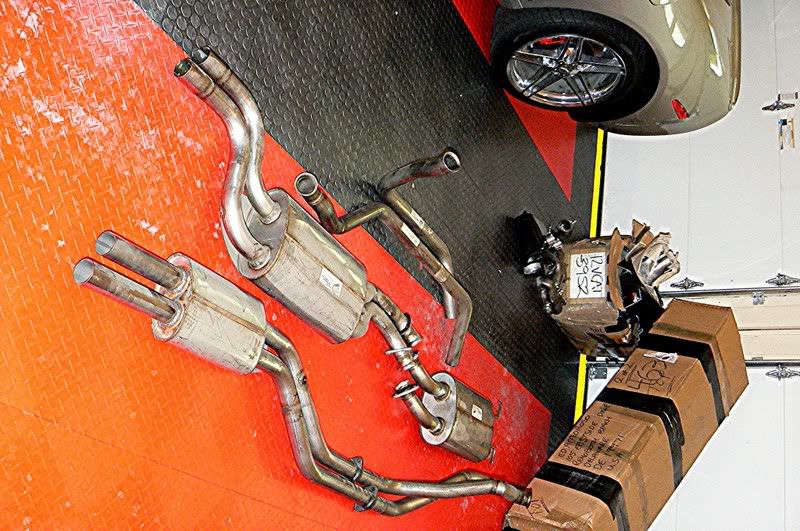
Notice that on the far right side assembly the O2 bung welded in the down pipe from the rear three cylinders before the silencer.
That's all you need to do !!!
Thread Starter
Junior Member
Joined: Jul 2007
Posts: 66
Likes: 0
MBWorld Fanatic!
Joined: May 2005
Posts: 2,494
Likes: 17
From: REHOBOTH BEACH DE
88-300CE TWIN TURBO, 99-C43, 05-G55K, 71-280SL, 94-E320 CAB, 08 CLK63 BLACK SERIES
The exhaust was supplied as part of a twin turbo kit that was recently installed on my 1988 300CE M103-12V.
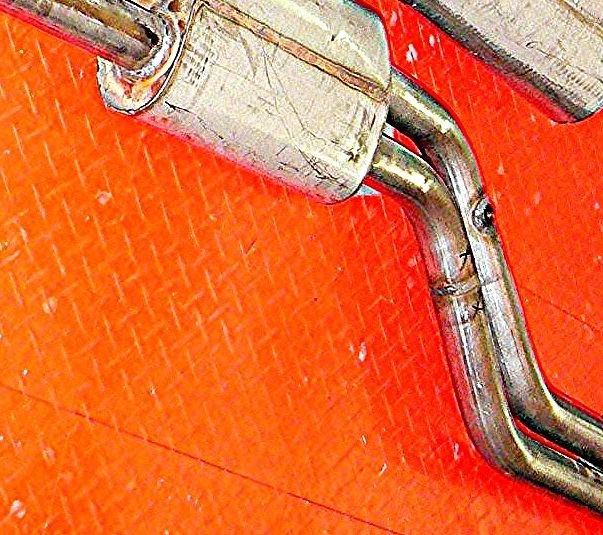
A second O2 bung was later installed for tuning purposes...the one pictured accepted the stock O2 sensor
Thread Starter
Junior Member
Joined: Jul 2007
Posts: 66
Likes: 0
That dual turbo system of yours sounds very interesting. 
Was it a tight fit, or did it go on easily? How many additional HP do you estimate getting out of that setup? Who sells it?
Thanks for the more detailed picture, it gives a good idea of the location of the sensor but unfortunately it still doesn't show much detail of the fitting itself. I have no idea how exactly the stock sensor fitting looks like. Is it just kind of a threaded fitting brazed onto the pipe, or is there more to it? I was going to look for a big nut that would fit the thread on the sensor and then have it brazed on to the pipe, but since I'm not sure how far the sensor tip has to go into the pipe, and if the distance (and maybe also the angle?) is critical, not sure this would work.
Was it a tight fit, or did it go on easily? How many additional HP do you estimate getting out of that setup? Who sells it?
Thanks for the more detailed picture, it gives a good idea of the location of the sensor but unfortunately it still doesn't show much detail of the fitting itself. I have no idea how exactly the stock sensor fitting looks like. Is it just kind of a threaded fitting brazed onto the pipe, or is there more to it? I was going to look for a big nut that would fit the thread on the sensor and then have it brazed on to the pipe, but since I'm not sure how far the sensor tip has to go into the pipe, and if the distance (and maybe also the angle?) is critical, not sure this would work.
Thread Starter
Junior Member
Joined: Jul 2007
Posts: 66
Likes: 0
OK so I went to google and made a "02 sensor bung" search and found serveral places where they sell these. For example:
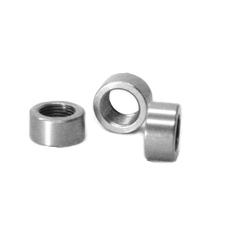
Or this other one that even includes a plug:
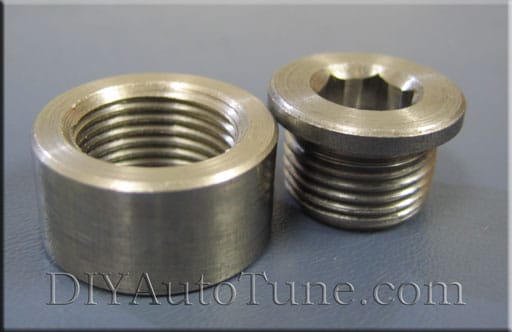
OK, now I understand. So this basically is a stainless-steel ring with a thread on the inside. Now the question would be, are 02 sensor threads in general the same size, or do I need to look for a Mercedes sensor (Bosch) specific thread size bung?
Or this other one that even includes a plug:
OK, now I understand. So this basically is a stainless-steel ring with a thread on the inside. Now the question would be, are 02 sensor threads in general the same size, or do I need to look for a Mercedes sensor (Bosch) specific thread size bung?
MBWorld Fanatic!
Joined: May 2005
Posts: 2,494
Likes: 17
From: REHOBOTH BEACH DE
88-300CE TWIN TURBO, 99-C43, 05-G55K, 71-280SL, 94-E320 CAB, 08 CLK63 BLACK SERIES
Jut weld the bung into your pipe, thread the sensor in, connect the wires and you're good to go !!!!
Thread Starter
Junior Member
Joined: Jul 2007
Posts: 66
Likes: 0
Thanks for the info. I'm now finally getting somewhere. I just sent an inquiry about the thread size to both the bung and sensor sellers. See if they match up.
You didn't comment on your twin turbo system, was it hard to fit? how many additional HP's with it do you estimate getting out of it?
I'm now finally getting somewhere. I just sent an inquiry about the thread size to both the bung and sensor sellers. See if they match up.You didn't comment on your twin turbo system, was it hard to fit? how many additional HP's with it do you estimate getting out of it?
MBWorld Fanatic!
Joined: May 2005
Posts: 2,494
Likes: 17
From: REHOBOTH BEACH DE
88-300CE TWIN TURBO, 99-C43, 05-G55K, 71-280SL, 94-E320 CAB, 08 CLK63 BLACK SERIES
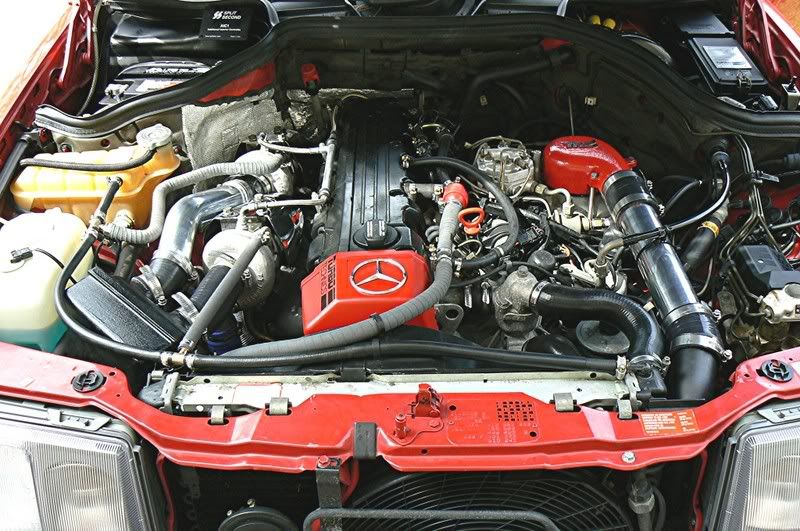
They had the kits made for them in the early nineties by TurboTechnics for install on new 300E/300CE Mercs at their dealership.
Currently selling off old inventory for the incredible price of 1000 pounds sterling.
Quite a few Forum members have purchased the kit.
I was the first to complete the install.
Do a Forum search for TurboTechnics and you'll find all the details.
Dyno numbers are just a comparitive tuning tool.
From stock baseline to turbo install power increased by more then 50%.
Moe importantly are actual performance results.
Best recorded 0-60 is 5.46 seconds in high temp and humidity.
Better launch technique to limit wheel spin and cooler temps/low humidity should help to pick up a few more tenths !!
Thread Starter
Junior Member
Joined: Jul 2007
Posts: 66
Likes: 0
So I did a bit of research and yes, it turns out most sensors do have a M18x1.5 thread. Some people even sell plain nuts in this size for $5+s/h as a bung. So after all my initial idea of using a welded on nut wasn't so far fetched as I though, I just wasn't sure what the proper name for the fitting was ("bung"), and the thread size of the sensor.
I can now order the Bosch 13942 sensor, and then just look for a appropriately sized nut, and might even get a plug, just in case.
Thanks for all the info.
I can now order the Bosch 13942 sensor, and then just look for a appropriately sized nut, and might even get a plug, just in case.
Thanks for all the info.
Thread Starter
Junior Member
Joined: Jul 2007
Posts: 66
Likes: 0
Finally got the o2 sensor and new muffler installed. I had the workshop braze on a nut in the position where the sensor has to be mounted. I spliced the wires remaining from the long gone original sensor, and plugged all 3 wires back together. The sensor (while hooked into the CIS-E) reads 0.59V cold and rises to 0.84V after 2-3 minutes of warm up, which I believe is still a rich mixture reading. I haven't had a chance yet to replace the "Check Engine" bulb on the instrument panel to see if it now stays off, but I suspect it will not.
What else would I need to check in order to correct a rich mixture condition? All I did so far was to try and adjust "by ear" the mixture screw setting on the fuel distributor as per job 07.3-1100. I went both ways until the engine began to stall, and then I left the setting about half way in between. BTW had to make the adjustment with the air filter housing removed, as the extender is missing that enables the adjustment to be made while the housing is in place. I know one is supposed to do it while its in place, but does it make a lot of difference? If so, I'd need to find a really long 3mm hex key.
Thanks.
-Alex
What else would I need to check in order to correct a rich mixture condition? All I did so far was to try and adjust "by ear" the mixture screw setting on the fuel distributor as per job 07.3-1100. I went both ways until the engine began to stall, and then I left the setting about half way in between. BTW had to make the adjustment with the air filter housing removed, as the extender is missing that enables the adjustment to be made while the housing is in place. I know one is supposed to do it while its in place, but does it make a lot of difference? If so, I'd need to find a really long 3mm hex key.
Thanks.
-Alex
Last edited by azurite300e; Oct 27, 2007 at 05:44 PM.
Thread Starter
Junior Member
Joined: Jul 2007
Posts: 66
Likes: 0
Update:
After adjusting the mixture screw with a 3mm hex key I managed to get the system into "closed loop". Now the o2 sensor voltage fluctuates between 0.3 and 0.7 volts, which is the desired condition which means the ECU is actively controlling the mixture between slightly lean and slightly rich.
In order to reach the closed loop condition I had to turn the mixture screw about 3/4 turn anti-clockwise.
The Check Engine bulb was on all the time because it was the wrong bulb socket (by mistake I used the SRS indicator, which stays on all the time, and is a separate problem I have to deal with sometime). I'm now using the correct bulb socket and it comes on as it should only after rotating the key all the way to the RUN position, and extinguishes shortly after the engine starts.
Because the exhaust fumes still smell a bit off, I will play a little further with the mixture adjustment to refine the setting by connecting a scope to pins 2 and 3 at the diagnostic socket, and adjust for 50-55% duty cycle as MB calls for.
After adjusting the mixture screw with a 3mm hex key I managed to get the system into "closed loop". Now the o2 sensor voltage fluctuates between 0.3 and 0.7 volts, which is the desired condition which means the ECU is actively controlling the mixture between slightly lean and slightly rich.
In order to reach the closed loop condition I had to turn the mixture screw about 3/4 turn anti-clockwise.
The Check Engine bulb was on all the time because it was the wrong bulb socket (by mistake I used the SRS indicator, which stays on all the time, and is a separate problem I have to deal with sometime). I'm now using the correct bulb socket and it comes on as it should only after rotating the key all the way to the RUN position, and extinguishes shortly after the engine starts.
Because the exhaust fumes still smell a bit off, I will play a little further with the mixture adjustment to refine the setting by connecting a scope to pins 2 and 3 at the diagnostic socket, and adjust for 50-55% duty cycle as MB calls for.

Member
Joined: Feb 2007
Posts: 117
Likes: 1
From: Northern Michigan
92 300TE 4Matic


