When you click on links to various merchants on this site and make a purchase, this can result in this site earning a commission. Affiliate programs and affiliations include, but are not limited to, the eBay Partner Network.
My dipstick housing has a vent relief pinhole 5 mm below the dipstick oring - fully vented by the time you turn off the engine.
Does anyone have a picture of this vent hole? With other threads discussing how the dipstick sometimes pops up from its seat, it would seem this is not possible if there was a vent hole?
Our magical dipstick tube has another trick besides keeping the stick dry.
The tube goes all the way down to the bottom of oil sump.
You can suck the engine dry just by sucking from the tube itself. When extracting oil the vacuum hose only needs to seal inside the dipstick tube.
I would like to see some way to measure how far above the sump bottom the dipstick tube ends.
I agree from personal experience that the tube must go all the way down to the bottom of the oil sump, as I can vacuum extract all but about a teaspoon or two of oil with each oil change. But there must be a small gap of some measure to allow the oil to enter during extraction and prevent clogs from debris. But how much?
But the dipstick may pop up from its seat
due to the pressure, that I described
But... there can't be any pressure if there really is a pinhole in the tube below the stick o-ring, which would vent any pressure. Hence my question above.
Something else............ while we are discussing oil.
.
I am wondering, at 6.5 liters M276 oil capacity is, when engine is running what is the stable amount of the oil quantity at the crankcase ?
When engine is running :
01. Oil filter + oil cooler filled up 100%, assumed . 1 liter ?
02. Oil spread at both banks upper/valves drive train. X liter.
03. Oil at other delivery locations . Y liter.
Balance 6.5 liters less 1 liter less X and Y = ??? Liters available at crankcase oil pan.
What is the oil capacity/availability of the deeper section of the oil pan when engine is running ?
The oil suction snorkel is here........
M276 3.5 NA
.
M276 3.5NA
Quite a distance for the oil pump to suck the oil. Hhmm.
.M276 3.5NA
M276 3.0 turbo. Middle/main oil pan is the same as M276 3.5NA
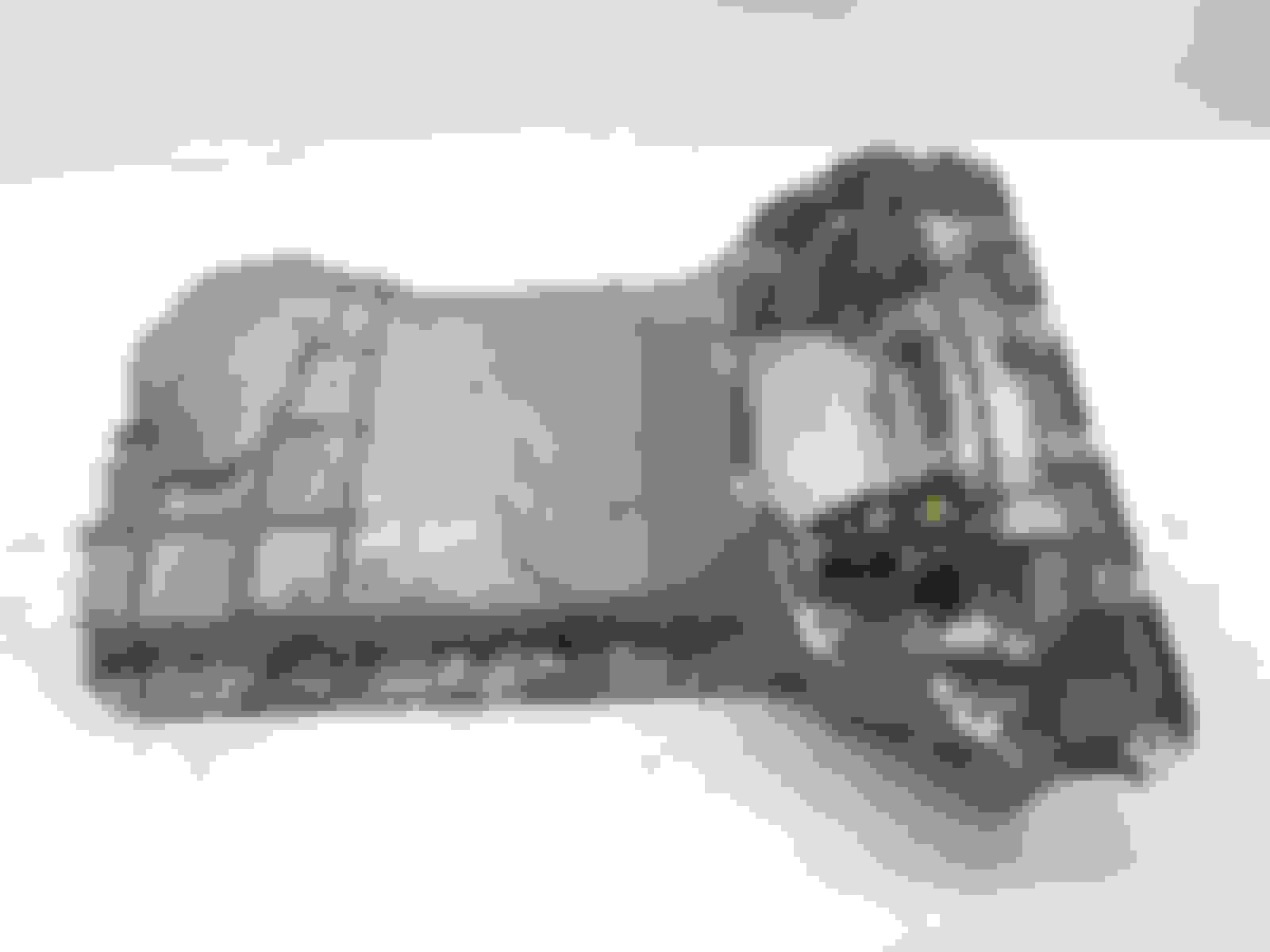
Middle/main oil pan sky view, P/N A2760142800
The plastic oil pan baffle therefore is the same too for M276.xxx where the deeper part of main oil pan is at the rear of engine, as per the youtube video and below my photo.
.
.
The oil suction snorkel internal volume is quite a lot , being that long.
I wonder, at what quantity of oil deficit in an M276, with rear deep oil pan, the oil pump starts to experience liquid oil shortage due to air bubbles from low oil level ?
I never experience low oil level warning from that oil level float..., I will kick myself if ever that alarm get triggered
At what oil quantity does the low oil level alarm actually get triggered ?
I am looking as WIS now and could not find it yet, only Install-Remove information for oil level sensor.
Oil capacity/availability of the deeper section of the oil pan when engine is running would be good to know for oil suction safety.
There is only one eng I've seen with vacuum, and that's my truck, because I made it that way. Some race engines do it, but I've only seen pictures. Maybe if Benz added a check valve for emissions, which sounds like something they'd do, but my eng has zero vacuum. Vacuum or not, the end result is oil going up the tube after it sits.
If the dipstick pops up it's from blowby, which I assume a lot of people have seen? Sometimes a tranny will do this too :o
I remember someone saying a hole in the tube below the O-ring, but I've never seen one. All I've seen are a hole above the O-ring and I always wondered why they bother? All it seems to do is collect dirt, which can then fall in. I specifically recall looking at the hole in mine a few years ago, mostly filled with crap. I pull the dipstick out, wipe inside with my finger and try to mush the dirt out but it won't. Then when I pushed the stick back in and could feel the gritty scraping as the O-ring pulled some crud in.
Then I did what we're doing now; wonder why the f did they do that?
The only thing I can think of is maybe the theory was it's better to push it up past the hole to vent vs pushing the rest of the way up? I dunno what difference it makes but it's all I can think of.
Some engines I've seen blow the dipstick out quite a bit, like they popped, like a cork. I've seen it mostly at the desert where it's sand and dust city and who knows how much ended up getting in.
How much oil is not in the pan depends on flow and drainage, obviously, but fyi: My truck has a pretty big pump, and I always wondered how the Benz compares, but it can suck my pan dry if oil level is 1/2 qt low. I think it's 7.5, or maybe 8.5 qts total. So 2 in the filter and maybe one in the system? The rest is wherever but not enough in the bottom to cover the pickup.
I actually ported the drains, and added a crank scraper. It helped, but not a cure.
I think Prihadi needs to install a camera in his engine and catch the Gremlin red handed. Gotta be a Gremlin... Or Aliens.
S-Prihadi When engine is running : 01. Oil filter + oil cooler filled up 100%, assumed . 1 liter ? 02. Oil spread at both banks upper/valves drive train. X liter. 03. Oil at other delivery locations . Y liter. Balance 6.5 liters less 1 liter less X and Y = ??? Liters available at crankcase oil pan. What is the oil capacity/availability of the deeper section of the oil pan when engine is running ?
In that case, I'd say the bottom of the dipstick tube is exposed in the sump
and that explains how the oil can run off the dipstick
and then the dipstick tube is at vacuum same as the sump
then when the sump oil rises again after engine shut down
the dipstick tube is at pressure relative to the sump and the oil can't rise up the tube
It wouldn't matter if there was vacuum in the sump or not.
If the sump is at atmospheric pressure and the tube is the same
when you start to push the oil up the tube with rising sump level now covering the opening to the tube, you compress the air inside the tube and it can't rise up.
If they put a pinhole at the top of the tube in some of them, then it would be to release the pressure in the tube and allow the oil to rise up
Fill the kitchen sink
put a glass in the sink upside down
Pull the dipstick twice as recommended for an accurate measurement
Last edited by Bruce Hubbard; Mar 15, 2024 at 03:17 AM.
You know the ONLY reason they say that is to avoid warranty claims on a new engine. No way should a well built engine consume that much oil in 1000km.
I have found that when I pull out the dipstick first, there is virtually NO oil on it. Yet, when I reinsert it and pull it out, it reads an accurate level. The only part that I disagree with is letting the engine cool down for four hours. Your above page shows to shut down for 5 minutes if at normal operating temp or 30 minutes if not at normal operating temp. I like to wait 3 hours and 59 minutes.
That is normal, there is an airtight seal, nothing to worry about. As long as the second pull yields oil.
You keep forgetting about heat Bruce. So regardless of vacuum or any other shenanigans, it would suck oil up.
This is why we're all stumped. Or why I'm stumped, but so either way nobody has an answer. It's probably something stupid and we'll kick ourselves when we find out, but meanwhile it's frustrating.
You keep forgetting about heat Bruce. So regardless of vacuum or any other shenanigans, it would suck oil up.
This is why we're all stumped. Or why I'm stumped, but so either way nobody has an answer. It's probably something stupid and we'll kick ourselves when we find out, but meanwhile it's frustrating.
Yup that too but the air tight seal is the main reason why the first pull is empty.
2015 SL400 (M276 Turbo), 2014 C350 Sport (M276 NA), 2004 SL500 (M113), 2004 Audi TT225 (BEA)
My M276 3.5L NA engine does blow out the dipstick about an inch or so every now and then. (It doesn't happen on my M276 3.0L bi-turbo.) It always causes the sound in the engine compartment to sound like a knocking and I get all concerned until I see the stick is out. Push it back in and the sound goes away. In my car, the pull ring is black, so it is not aways apparent that it is out of the tube on first glance. I got the car with about 50,000 miles on it about 4 ½ years ago and it now has 125,000 miles, and has always done this.
This tells me that when the engine is running, clearly the bottom of the tube is above any oil and I am hearing the explosions in the pistons as they fire and the sound travels to the crankshaft.
Last edited by JettaRed; Mar 17, 2024 at 09:19 AM.
When the tube is hot it'll blow air out, then as the eng cools the will suck oil in. The only time it does this mystery thing is when it's cool.
So regardless of oil level in the tube when running, it can only suck oil further up when it has cooled, never push it down.
Engine crankcase is under mild vacuum while in operation, more so non turbo engine.
Even turbo engine , the check valve and diversion to Bank 1 turbo ( M276.8 ) intake side is how the engine prevent positive/boost pressure from "contaminating" crankcase region
I nearly wet myself when I pulled out the the dipstick the first time and saw nothing. Thankfully after reinserting it there was an adequate amount of oil.
Quality thread, bringing it up again because well.. quality thread.
I do have a few questions though : ) as I am not sure I have been checking my engine oil level the wrong way over the years...
I understand the first check the dipstick is dry, normal. I wipe it then I put it back in... here is the question, how long do I wait before pulling it out? 5 seconds? 15 seconds? 30 seconds? 1 minute?
Additional questions are:
Is the dipstick (M276 3.0L) meant to be not completely straight (like it is slightly twisted/bent? Is it normal when I insert the dipstick, it likes to rotate around before I can fully seat it? It also makes a hitting sound when I pull and insert it before it starts rotating.
How much oil does the oil filter 2761800009 hold? Asking as I am trying to figure out the oil capacity without the filter (just out of curiosity) (the operator's manual shows the filling capacity with the filter considered).
For those who use an extraction device to do oil change, my current one seems to be failing and it wasn't that good to begin with so I want to replace with something that works better and is quality made. What are some good recommendations for my next oil change a few months down the road? Specific adapters/valves things recommend I should get to be used for the new extraction device?
For oil extraction, what oil temperature should it be before I extract it (to not melt the extractor hose), I have been doing 130-140F over the years. How should I clean the extractor for next use (asking to confirm if I had been doing it wrong over the years).
Wait 5 seconds when dipstick had been inserted the 2nd time, its good enough.
It does not matter the orientation ( rotation ) of the dipstick red plastic, as long as dispstick goes in maximum depth. You are good.
Do twice for 2nd insertion will be good.
If you use oil extraction device and is using vacuum power, hot oil 60C or hotter is a must, easier to suck.
Oil Filter holds approx 400cc of oil
Extractor suck pipe is the one you must maintain clean, that is the only component inside your oil pan/crankcase
Last edited by S-Prihadi; Jul 9, 2024 at 09:59 PM.
Wait 5 seconds when dipstick had been inserted the 2nd time, its good enough.
It does not matter the orientation ( rotation ) of the dipstick red plastic, as long as dispstick goes in maximum depth. You are good.
Do twice for 2nd insertion will be good.
If you use oil extraction device and is using vacuum power, hot oil 60C or hotter is a must, easier to suck.
Oil Filter holds approx 400cc of oil
Extractor suck pipe is the one you must maintain clean, that is the only component inside your oil pan/crankcase
2015 SL400 (M276 Turbo), 2014 C350 Sport (M276 NA), 2004 SL500 (M113), 2004 Audi TT225 (BEA)
I use a Mityvac pneumatic (i.e., air compressor) extractor. I've had it since 2016 and it works great. I've also used it to extract tranny fluid from my 2000 Ford F150 since the truck has a fill tube but no drain plug. Mityvac is pretty much the top product for extractors, though there may be some knock-offs just as good. The benefit of going with a name brand is the availability of replacement parts if you every need them (kinda like a Weber grill -- not the cheapest but can last indefinitely using replacement parts). Mityvac also has a manually pumped extractor if you don't have an air compressor.
@S-Prihadi is right to recommend a warm engine. Get the oil to operating temp (or at least 60°C/128°F) so it doesn't take half a day to suck all the oil out (that's an exaggeration). Trying to suck the oil out on a cold engine seems to take forever. On a warm engine, probably 10-15 minutes.
EDIT: Warm engine, not hot!
Last edited by JettaRed; Jul 10, 2024 at 11:14 AM.
Mercedes SLR McLaren 722 S Is Extremely Rare Example Modified by McLaren
Slideshow: A one-of-one U.S.-spec Mercedes-Benz SLR McLaren Roadster became even rarer after a factory-backed transformation at McLaren's headquarters.




























 , I will kick myself if ever that alarm get triggered