When you click on links to various merchants on this site and make a purchase, this can result in this site earning a commission. Affiliate programs and affiliations include, but are not limited to, the eBay Partner Network.
Tesna visit yesterday was a lot of fun ...he brought donuts too
I learnt a new WHAT IF yesterday, but will need to test again once Tesna has replaced the leaking seals of MAF lower Air Elbow and other component with issue.
Tesna, you were wondering how the MAF secure itself on the Air Elbow, that small steel U latch is it. Since this is vacuum based system of NA engine, it does not use much securing method like my
turbocharged intake manifold system which is 0.8 BAR positive at boost.
.
M272 vacuum pump small port is interference fit. There is no small bolt. I dare not pull it out to inspect it
That small port has lost its membrane for sure, as I can't get it to hold vacuum pressure using vacuum hand pump.
The small hose connected to it also torn, hence oil spits out of that baby port.
Emergency Fix, using 4mm x 9mm silicone vacuum hose
Here is the WHAT-IF part I was thinking since last night.
Vacuum pump sucks air from enclosed space, like vacuum actuators on the engine and brake booster.
Whatever air get sucked into a vacuum pump, it must be dumped out too. The vacuum pump dumped out the air to the engine crankcase, via its mounting spot at the camshaft end Bank 2.
If HVAC type general purpose vacuum pump, it dumps out air to the atmosphere.
Why my thoughts shifted to the vacuum pump ?
Because yesterday I was trying to read Tesna M272 crankcase vacuum pressure and I hardly can get -1 millibar, where my M276.820 can do -36 millibar.
This test was before I found out that the small hose of vacuum pump was torn.
Our engine PCV system sucks air out of the crankcase, but the air is from piston blow by, it is not fresh air.
In Tesna's M272 vacuum pump leaking hose scenario , it may also suck some fresh air and naturally dumped it back to crankcase.
I am wondering, how much negative crankcase pressure improvement will I read ?.... when the vacuum pump leaking issue corrected.
Tesna visit yesterday was a lot of fun ...he brought donuts too
I learnt a new WHAT IF yesterday, but will need to test again once Tesna has replaced the leaking seals of MAF lower Air Elbow and other component with issue.
Tesna, you were wondering how the MAF secure itself on the Air Elbow, that small steel U latch is it. Since this is vacuum based system of NA engine, it does not use much securing method like my
turbocharged intake manifold system which is 0.8 BAR positive at boost.
M272 vacuum pump small port is interference fit. There is no small bolt. I dare not pull it out to inspect it
That small port has lost its membrane for sure, as I can't get it to hold vacuum pressure using vacuum hand pump.
The small hose connected to it also torn, hence oil spits out of that baby port.
Emergency Fix, using 4mm x 9mm silicone vacuum hose
Here is the WHAT-IF part I was thinking since last night.
Vacuum pump sucks air from enclosed space, like vacuum actuators on the engine and brake booster.
Whatever air get sucked into a vacuum pump, it must be dumped out too. The vacuum pump dumped out the air to the engine crankcase, via its mounting spot at the camshaft end Bank 2.
If HVAC type general purpose vacuum pump, it dumps out air to the atmosphere.
Why my thoughts shifted to the vacuum pump ?
Because yesterday I was trying to read Tesna M272 crankcase vacuum pressure and I hardly can get -1 millibar, where my M276.820 can do -36 millibar.
This test was before I found out that the small hose of vacuum pump was torn.
Our engine PCV system sucks air out of the crankcase, but the air is from piston blow by, it is not fresh air.
In Tesna's M272 vacuum pump leaking hose scenario , it may also suck some fresh air and naturally dumped it back to crankcase.
I am wondering, how much negative crankcase pressure improvement will I read ?.... when the vacuum pump leaking issue corrected.
regarding the elbow seals, and the securing method, it is very much important to set it properly, make sure it got latched. But since it's a rubber, and rubber do age, I'll order it.
vacuum pump, will get the full vacuum pump assembly, just for peace of mind. If that port is not holding vacuum properly then the vacuum system connected to that port also not working properly then? since it burst out oils instead sucking air...
It seems it is common issue the valve can fail. If it failed, it can introduce exhaust gas to the secondary pump and damaging the pump. I was trying to inspect it for carbon deposits on the bank 1 valve, but failed to open up the hose (tried with all my ability but seems stuck). bank 2 no problem opening and it seems clean. Trying to inspect the hose intake from the secondary air pump to the air filter box that one seems clean tho, although I do smell exhaust smell on it. (or maybe its the silicone grace applied yesterday?) Tried to block it with plastics but the plastics does not get bulge/larger.
Most probably this is caused by weak vacuum system because the port is squirting oils. No CEL. I'm going to order new vacuum pump, its 14 year old anyway and its not that expensive.
Regarding the air flow secondary air system code yesterday I tried to plug the air supplying the pump so that code is expected. I thought it only turned on once during cold start up, I experimenting that whether plugging the hole will fix my fuel trims or not ) once II heard the pump is running (again) when it was plugged I immediately switch off the engine
I cannot find the air control valve in the local market , perhaps needs to order from FCPeuro again and boy it is quite expensive. Can I delete it? I can order custom blank metal plates to cover the hole.. Can I code it out the air injection system?
Most probably this is caused by weak vacuum system because the port is squirting oils. No CEL. I'm going to order new vacuum pump, its 14 year old anyway and its not that expensive.
Regarding the air flow secondary air system code yesterday I tried to plug the air supplying the pump so that code is expected. I thought it only turned on once during cold start up, I experimenting that whether plugging the hole will fix my fuel trims or not ) once II heard the pump is running (again) when it was plugged I immediately switch off the engine
I cannot find the air control valve in the local market , perhaps needs to order from FCPeuro again and boy it is quite expensive. Can I delete it? I can order custom blank metal plates to cover the hole.. Can I code it out the air injection system?
From what I seen, the ECM only knows air injection is working or not based on the electric air pump M33.
Good idea to delete. W212 E200 with M271.8 EVO for Indonesian market, they do not install Secondary Air Injection system.
Since the baby Lauch seems to be able to code it out...even better
Finally I'm able to disconnect the hose on the secondary air valve bank 1 (sorry for bad potato quality), surprisingly its clean, no sign of exhaust / carbon deposits. I've put my finger there no sign of contaminants.
Turned on the engine, no exhaust noise were heard. Then I actuate the valve to open using launch, and it still actuates :O exhaust noise then heard from the valve (and quite loud too). So this valve still somewhat works
Anyway I'm still planning to delete it. Maybe there's still small leak (since the valve does not hold vacuum) it's the only remaining explanation why on bank 1 LTFT is positive. If deleting/replacing the valve still giving me positive LTFT I'm going maaaaddddddd maybe I'll just replace the car
anyone with M272 engine share their LTFT results? maybe it's their nature........
Saturday smoke test on the Bank 1 air shut off valve was showing smoke from engine crankcase exiting the vacuum actuator suction port......
That means the main valve is minor leaking and membrane a bit torn. That is why we keep loosing vacuum pressure when testing with hand vacuum pump.
When the MAF Air Elbow seal fixed, your fuel trim should improve a bit.
Can the seal alone be ordered ?
Saturday smoke test on the Bank 1 air shut off valve was showing smoke from engine crankcase exiting the vacuum actuator suction port......
That means the main valve is minor leaking and membrane a bit torn. That is why we keep loosing vacuum pressure when testing with hand vacuum pump.
When the MAF Air Elbow seal fixed, your fuel trim should improve a bit.
Can the seal alone be ordered ?
Today just got the vacuum pump replaced, because I always had the tumble flap error codes now, and I feel its lacking power on the top end. After replacing the pump I ask the mechanic to check the secondary air valve. He did check using "manual" smoke test aka cigarette lol. While the smoke did leak from the vacuum port, but it did not go to the exhaust side. The mechanic block the vacuum port and blow from the clean air port, nothing goes to the exhaust port. So the air is not leaking to the exhaust side, I can ignore the valve for now.
But then, nothing else explain the imbalance fuel trims between bank 1 and bank 2, I replaced almost everything except... maybe ECU? Or maybe just live with it. Set the fuel quantity to lean out every time I want to pass emission test
Btw, the seals between throttle body and MAF on order, it will be replaced soon.
shiny new parts
new intake manifold but I get this now...
Be patient.....
You still have minor intake/vacuum leak at the MAF's lower elbow orange seal.
The 02 sensor front ones still old one.
I think the mechanic mouth blowing power is not as powerful as my smoke machine ,,,,
BTW,
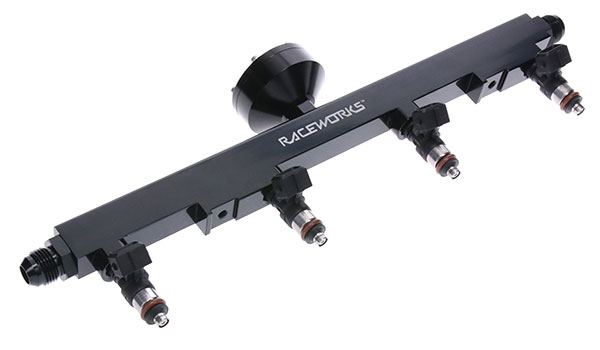
Have you ever tested the fuel pressure at the mechanical valve at the end of the fuel rail ?
See below :
Reading fuel press here reads the NET pressure the injectors are provided with.
Reading at the fuel filter electronic fuel pressure sensor is a GROSS pressure.
I want to see NET fuel pressure.
This thing is like a regulator/reservoir of some sort.... I wonder how important this one is.
.
I looked at the WIS, I can't find any technical information or function about this 17/1 .
I would think it acts like a mini pressure/volume regulator. You know in a fresh water pump, we have those 5 liters air tank, which is actually water filled to 50% and the other 50%
is pressurized by a membrane typical at 30 PSI of air.
@S-Prihadi Yes I'm patient, perhaps I need to accept as it is. As long no errors on scanner )
Of course I never check the fuel pressure on the rail mechanically, since I don't have (any) tools ) But I dont think I have problem with fuel delivery as no hesitation at WOT, the power is there.
And after replacing the vacuum pump, I still have the tumble flap code it is current and stored, not stored only so it is a current issue. I can hear the flap actuates if I do tumble flap actuation test. Vacuum line contaminated with oil? or the replacement hose is too bendy hence partially blocking the flow? or somehow the sensor disconnected? But the secondary air injection valve still actuates....so the vacuum still there somehow.
I cleared the codes, lets see tomorrow the code comes back or not.
The Intake Manifold tells ECM when and if tumble flap is in X or Y position using 2 position sensors.
Are those 2 sensors new with Pierburg unit ? Or the old one is being transferred to the Pierburg ?
.
If you can see that the actuators are moving, that means it is moving.
Could be as simple as bad contact on the connector/s to the sensors or loose, not plugged in well.
My friend's M271.8 EVO engine after 60 days engine being out/removed, I have to clean with contact cleaner many sensors connector as they
gave out DTC...from bad contact.
Last edited by S-Prihadi; Oct 16, 2024 at 08:21 AM.
Reason: add info
2015 SL400 (M276 Turbo), 2014 C350 Sport (M276 NA), 2004 SL500 (M113), 2004 Audi TT225 (BEA)
These devices (17/1) may be labeled as reservoir, but they are fuel pressure regulators used to limit or buffer the fuel pressure going to conventional fuel injectors. They are common on cars with traditional fuel injection. They ensure a constant delivery of fuel because the injector spray time is controlled by the ECU and not pressure. Spray duration will adjust with time if you were to replace the FPRs with a higher or lower pressure device, but the change is not instantaneous. They rarely fail, but since they are available as a separate device (on other cars), we can assume that they do fail. Are the ones on that fuel rail replaceable?
2015 SL400 (M276 Turbo), 2014 C350 Sport (M276 NA), 2004 SL500 (M113), 2004 Audi TT225 (BEA)
As I think about it, if one of the two FPRs is malfunctioning, that would cause the discrepancy between the two cylinder banks. Say one FPR was at 4 bar and the other at 3.5 bar, that would mess up fueling to one or the other bank.
When I was into tuning my Audi, I think the stock FPR was 3 bar, and with a tune I had to use a 4 bar FPR to deliver more fuel. Some tunes required both bigger injectors and a 4 bar FPR.
Last edited by JettaRed; Oct 16, 2024 at 11:29 AM.
As I think about it, if one of the two FPRs is malfunctioning, that would cause the discrepancy between the two cylinder banks. Say one FPR was at 4 bar and the other at 3.5 bar, that would mess up fueling to one or the other bank.
When I was into tuning my Audi, I think the stock FPR was 3 bar, and with a tune I had to use a 4 bar FPR to deliver more fuel. Some tunes required both bigger injectors and a 4 bar FPR.
Good info Jetta, thanks.
There is only 1 port to test fuel pressure at the end of the fuel rail at Bank 1 - Right Bank., which will be reading both 17/1 reservoir doing its work and averaged out.
It can leak, one member here asking :
There been 2 cases where M276 3.5NA has intermittent bad to mild misfire come and go and it took ages to troubleshoot. You may remember them.
Both of them basically has "contamination" at the fuel rail. One is a US member, the other is from Holland.
This is what I want to check with Tesna's M272, at the least I will read fuel pressure at the rail first as it is easiest.
2015 SL400 (M276 Turbo), 2014 C350 Sport (M276 NA), 2004 SL500 (M113), 2004 Audi TT225 (BEA)
Are FPRs used for DI engines? I truly don't know. But I think the HPFP sitting right on the fuel rail effectively performs the same function and is not affected by voltage fluctuations (and therefore pressure fluctuations) like the LPFP/traditional fuel pump is.
2015 SL400 (M276 Turbo), 2014 C350 Sport (M276 NA), 2004 SL500 (M113), 2004 Audi TT225 (BEA)
Correct. While the pulsation damper looks like an FPR, it is missing the pressure/vacuum port that controls the fuel pressure. The fuel pressure is variable depending on the amount of pressure applied. Still, could a faulty pulsation damper cause irregular fuel delivery?
ok the charge movement flap code is still there . I can feel the difference on driving, the engine is not as responsive as before I have that code. Maybe I'll replace the hose with longer one so it does not bend so bad. Btw, can I clean the vacuum lines by spraying brake cleaner? is it safe for rubber and plastics?
Pak @S-Prihadi, regarding the sensors, there are 3 actuators right? 1 is the swirl flap for both banks (in the center) and the other 2 is the intake runner short and long. Which one is the charge movement flap? Is all sensors located on the same location?
Regarding the FPR, thanks for the input @JettaRed , I'll leave it to the expert Master Surya
EDIT: add video
I thiink this is the vacuum cable supplying vacuum to the intake manifold. contaminated with oils and very loose..... very easily disconnected.
Finally I took the car for a long trip. (400km in one day trip!) What I noticed is when the engine under heavy load on longer period (eg long uphill on the highway ), the LTFT tend to improve, and for the first time ever the LTFT goes to 7-ish %! Usually the best I got is 8.5%. And that during a HOT day too, so I can wrote off high temp as the cause of higher LTFT. However, when stuck in traffic then it goes bad quicky (reaching 14%) When cruising on flat highway on cruise control set at 100kph, LTFT usually on 8-9%.
Fuel consumption is quite good too, on heavy foot I get average 9 ishL/100km on the highway. perhaps if I baby it can get better. Engine power and response also very good, no pinging/misfiring, no hesitation, no noticeable problem what so ever.
So do I need to close the book of getting LTFT closer to 0%? or do I need to check on another things? seeing LTFT got improved when the engine under higher load, do I still have vacuum leak somewhere? or its not vacuum leak? what else should I check?
2015 SL400 (M276 Turbo), 2014 C350 Sport (M276 NA), 2004 SL500 (M113), 2004 Audi TT225 (BEA)
Generally, any value between +/- 10% is considered "normal". Going over +/- 25% will trigger a fault and CEL. What that means is that the ECU is able to control the amount of fuel to keep the A/F mixture Stoichiometric and the car is consider operating within acceptable limits.
As long as you can pass your emissions test and there a no DTCs, I'd put the Lufi away or change the display to not show LTFT.
Mercedes SLR McLaren 722 S Is Extremely Rare Example Modified by McLaren
Slideshow: A one-of-one U.S.-spec Mercedes-Benz SLR McLaren Roadster became even rarer after a factory-backed transformation at McLaren's headquarters.









 ...he brought donuts too





 ) once II heard the pump is running (again) when it was plugged I immediately switch off the engine
 and boy it is quite expensive. Can I delete it? I can order custom blank metal plates to cover the hole.. Can I code it out the air injection system?

 maybe I'll just replace the car