My last trip having fun in super narrow snake-y road ( 20% of it ) , high gradient climb, totally dark, having fun with my additional AUX lights , is the best data logging I got so far.
This trip stress my engine, tranny and DIFF big time.
I never thought much about altitude reducing my engine power, as I live in a sea level city.
My daily climate and atmospheric condition is already a typical 6% power reduction on my engine for my city, but I never yet seen close to 30% power reduction because of altitude.
This is me going back home from destination point. The journey altitude is as below :
Below : The SAE J607 correction factor is easy to translate as how much power I am loosing at the given altitude ( barometric pressure ), temperature and humidity.
At the peak of the mountain 5,500 ish feet, I loose 30% power. The air density is at a sad 77%.
My engine supposedly under proper DIN test condition , produces 333PS or 245Kw and 480Nm of torque starting at super low RPM 1,400 for the torque.
Test conditions : The SAE standard specifies operating conditions of 99 kPa / 29.23 InHg of dry air and 25 °C / 77 F temperature. The DIN and ECE standards are calculated at higher pressure (101.3 kPa / 29.33 InHg of dry air) and lower temperature (20 °C / 68 F)
Thus you see the power correction factor I shown :
Power Correction Factors
The power output of an internal combustion engine is significantly influenced by barometric pressure, ambient air temperature, and air humidity.
• Lower ambient barometric pressure reduces the density of the air, thus reduces the amount of oxygen filling the cylinder for each cycle, resulting in lower power output. Conversely, higher barometric pressure increases power.
• Lower ambient air temperature results in increased density of the air, thus increases the amount of oxygen filling the cylinder for each cycle, resulting in higher power output. Conversely, higher air temperature reduces power output.
• Lower air humidity (less water vapor) leaves more room for oxygen per cubic foot of air, thus increases the amount of oxygen filling the cylinder for each cycle, resulting in higher power output. Conversely, higher air humidity reduces power output.
.
This M276.820 3.0 Turbo engine is very impressive for its comfort turbo setting from a 3 liter engine.
I call it comfort turbo because it focus its torque at very low city driving RPM.
This engine doing all those high gradient climbs at such low speed in 2nd gear, damn, that is superb. I was in SPORT MODE.
This is the first time I seen the coolant path out of my turbo Column E - Coolant Temp - Engine Out, matched general engine coolant temperature. Usually it is 10C cooler.
Excel data points 16,200 ish is 53 - 54th minutes part of the log. Where I can't go faster due to two slower cars in front of me and its a high gradient climb while at it.
.
.
Village grade road, crazy tight and narrow road. The location above in dashcam, if in daylight , below :
.
The black Toyota SUV in front of me seems to love to drop to 1st gear by going super slow.
He made me has to stop at times on the climb and that night is a light rainy night and the tarmac is slippery.
A few times my traction control was activated from mild wheel spin when climbing up with steering angle very high.
This trip home going up a mere 5,500 ish feet mountain but at steep angle and slow speed, is the highest heat build up my DIFF has ever seen at 95C while ambient temp was only 19C. Delta is 76C.
I have seen DIFF at 92C usually as highest, and at high speed, but at 30-32C ambient temp. So Delta is only 60C approx.
Tranny has oil cooler, my DIFF does not.
Engine oil and coolant temp also stressed out. Engine Oil temp Oil Cooler Inlet in oil pan skin temperature, and is before the oil cooler Engine Oil Temp is oil pressure sensor skin temperature. The oil pressure sensor is at the designated oil pressure test port. Engine Coolant Temp is OE from the engine ECM, that is the coolant sensor located at Bank 2 most rear azz, near the outlet to heater core HVAC. This sensor is submerged in coolant. Engine Coolant Temp - Engine Out is coolant temp after it exit the turbocharger cooling gallery and is a coolant pipe skin temperature.
110C is 230F. , 105C is 221F , 100C is 212F.
The engine load is not too bad and less when I had to be behind the 2 slow cars at data points 16,000 to about 30,000 ish, where the by data points 29,000 ish...it is going down the mountain, no more climbing.
.
The ECM will not allow the turbo to boost maximum to 11.6 PSI at higher altitude.
I guess air is too light and turbine wheel may over-spin... after all this car is a family sedan and longevity is the tuning target by MB.
Oky doky, hope you guys at high altitude can find this data helpful..
Your road trip is a great test drive for data acquisition. oil + coolant temps
I see gaps that I am unable to make sense of. Perhaps it would be interesting to understand what's happening to cause tracking data to split apart.
We can compare... :
coolant A with coolant B
oil C with oil D
coolant ? with oil ?
BLU tracks RED then splits ....
BLK tracks YLW somewhat loosely.....
These nice datasets tell the story of heat exchange cooling... I'd expect a strong correlation.
You are too focused on the temperatures only.
You forgot I was at the mountain going down-hill free power....almost free power, coasting
The zone u pointed out as strange sudden cooling, at 31,000 to 44,000 data points are all down-hill.
So the engine oil and the turbos are no more getting heat load, in fact speedy free cooling.
These are 29,159 to 33,425 data points, for better view.
1,600 feet of altitude drop freebie coasting power for my car for about 4,000 data points or 13.3 minutes.
sorry MS!... you gime fresh numbers, I can't help it
up and down hill
Does it kinda seems BLK-Oil tracks RPM unlike RED-Coolant ?
I thought engines turbos were invented to counter power losses of fighter airplanes.
I don't fully understand how your ECU controls your boost pressure with wastegate but mountain would seem like a perfect application... duno - I guess not, right?
I been telling this at least 3 times to you this past 1 year, let me repeat : ( our Senior Moment Cali ....LOL )
The black line is oil temperature exiting the oil cooler into the oil filter and to the oil pressure sensor & a temperature sensor at the skin of the oil pressure sensor. It is cooled oil, cooled by coolant.
The coolant into our engine has cool and hot zones, the same with the engine oil. This we must keep in mind and do not get lost my simply believing 1 ECT sensor provided by MB.
The coolant mechanical pump its inlet and a short distance of its output is the coolest coolant, can be up to 20C cooler than what the radiator input gets.
M157 and M278 takes its turbo coolant source from water pump outer shell directly using those fragile plastic hoses.
The 20C is the Delta between radiator input and output, or the cooling power the radiator can provide. I got this from testing.
The engine OE coolant temp sensor is at the "spent" coolant zone, the hot zone.
It has cooled 3 cylinders ( per side ) and has cooled down the cylinder head, because its location is at the rear of Bank 2, LEFT BANK.
Coolest coolant is at the lowest part of engine block and the front, hence the engine oil cooler is located there.
The higher region of the engine is hottest, hence engine coolant hot output towards radiator is located up there, between the V bank.
.
.
This is what I have measured, too bad I can't use immersed in coolant temperature sensor, but I managed to read the radiator hose steel coupling skin temperature.
About 20C is the cooling , and this is purely electric fan cooling only from a non moving car. The fan was also not at highest speed.
The thermostat has open up 100% assisted by its heater control. Mechanically my engine thermostat will open a 100% max on its own at about 103C, starts to open at 95C, if without heater assist.
The orange line at the graph, the PID named Engine oil temperature oil cooler inlet , since this is oil pan exterior skin temperature reading, that is "spent" oil, hottest oil.
However this reading is only accurate if the car is moving 60 KM/H or less, if car move faster.... the cooling effect of wind velocity under the car will "contaminate" a bit giving more cooled reading.
Thus at best cooling opportunity Engine Oil Temp black color line compared to orange color line ( oil pan, skin ) , we can see up to 10C cooler for black color line.
----------------------------
Now the sensor called : COOLANT TEMPERATURE ENGINE OUT
The one at the output/return coolant pipe of the turbocharger Bank 1, RIGHT BANK. its a pipe skin temperature, not an immersed-in-coolant sensor.
.
.
M278 and M157 has the best still-a-virgin cool ( from radiator out ) coolant source for their turbos, mine is not too bad.
There is no cooler coolant than the mechanical water/coolant pump direct output, which its coolant source is direct from the radiator cooled output.
M276.8 3.0 Turbo, coolant source for turbocharger.
When one has many sensors like I do, we can learn a lot : which region gets hotter and when and how.
This extra coolant temp sensor I installed initially is to be a back up to the OE ECT at the rear of Bank 2/LEFT azz, while I wanted to know how hot can the turbo coolant out will be.
Its a very cool turbo mine is, it is small boost only, nothing aggressive. Being oil cooled and water cooled, its good.
=======================
Cali asked : I thought engines turbos were invented to counter power losses of fighter airplanes.
I don't fully understand how your ECU controls your boost pressure with wastegate but mountain would seem like a perfect application... duno - I guess not, right?
Turbocharged engine will suffer less at altitude than normally aspirated engine, that is the benefit.
I still loose TOTAL power compared to sea level, but I do not need total power, I only use less than 60% of my engine power for the climb.
At sea level and horsepower friendly atmospheric condition city , a normally aspirated engine with a 100% air density can develop its full design power, easy.
The top of the mountain at 5,500 ish feet showed air density of that region is 77% ish, and too bad in my city even at sea level I only get 92% air density due to my hot climate.
At sea level , typical atmospheric pressure is as per NOAA 1,013.25 millibar or 101.3 kilo pascal or +14.69 PSI.
International Standard Atmosphere (ISA) , uses this value :
Pressure of 101.325 kPa at mean sea level (MSL).
Temperature of +15 °C at MSL Air Density of 1.225 kg/m³ at MSL.
Power is from air density, turbo boost and aftercooling can add air density.
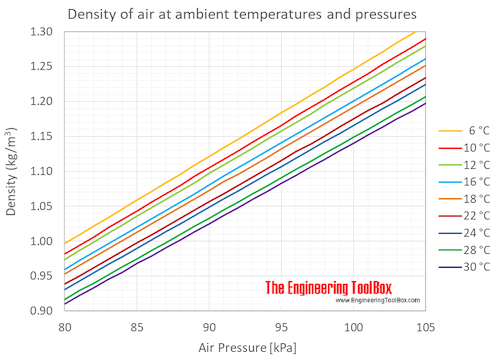
At that mountain, this is my air density ( surrounding ) at 5,500 feet altitude in kg/m3, see the lowest 9.5kg/m3 ( 95kg per 100 m3 ) Even back home in Jakarta, I only get 1.12kg/m3 and that is far from 1.225 kg/m3
Be careful, Banks log is at per 100 cubic meters of air and not 1 cubic meter. So move 2 decimal points to the left if we want to see it as 1 cubic meter.
Now, a normally aspirated engine will loose this much air pressure pushing into its intake manifold at 5,500 feet, I use PSI for easier read.
While we do not much discuss air pressure value in PSI, the one surrounding us, it is to be known that without that 14.7PSI at sea level, there will be no proper suction at engine intake.
Engine does not actually suck air , it creates lower pressure than atmospheric, and thus the higher pressure of the atmosphere air is the one PUSHING air into the engine.
Pressure or air always goes from higher pressure zone to low pressure zone, not the other way round.
So, an NA engine loose the 2.6 PSI extra push or air into its intake manifold at 5,500 feet, that is the ballpark. Air density is then reduced, less breathing, and then reduced power.
A turbo engine creates a boosted atmospheric pressure into its intake manifold, thus it can get away from the power loss at altitude.
But if you dyno my turbo engine at sea level vs at 5,500 feet, I will still get TOTAL power reduced when at 5,500 feet.
The turbos created this extra air density for my engine : At 5,500 feet I am getting help of near 60% in increased air density over the available surrounding/ambient air density.
Therefore my total air manifold intake air density while boosted, is way above the 1.225kg per m3 per ISA, approx 50% higher.
This is where my turbo engine wins over NA when at altitude. The turbos reduce the loss, but remember the turbos can not eliminate the overall loss at WOT.
Final say.......
Honestly, for hot climate countries and challenging temperature drive profile, relying on MB white liar gauge is too risky.
Its too much a lie when at a true 110C which means engine is loaded hot and could get hotter .....or
cooling system maybe compromised* ( *when the drive is a relax one and flat ground not climbing ), where needle will show no higher than 95C - 98C probably.
The reaction time when the needle gauge shows its true honesty at only 120C, is insane-ly short for the driver.
I was already being extra cautious when I started seeing 108C to 110C. The 110C is my main fear, because that happened while ambient temp is at cool 23C.
While I have extra 9C of cooling power from ambient temperature of 23C over my usual 32C, seeing that 110C made it way more scary.
Seeing 110C when at 32C ambient, is not so scary.
Note : Green line is under-hood temperature.
I know from fun at the track, my cooling system is not good enough for more than 3 hard laps or 4KM x 3.
I will see 120C ECT and I had to slow down. And that day ambient temp was 33C - 34C..
To date, this trip temperature wise is the most challenging* so far for a regular drive. ( *Sentul race track not included , because it is forced/abused driving and not regular drive )
I wonder if the first 50KM from that AlfaMart can be made as a guaranteed no opposite traffic or anyone crossing the road at blind corners and
I then can drive as comfortably fast as I can and in day time, will my engine coolant hit 120C or not ?
You don't even want to install a non lying OBD gauge for ECT , that I find weird for someone who I know loves to monitor his engine heat.
Sorry my man, your oil mix is not something I want. I am good with the 40 and stop pushing me to try your cocktail mix.
If you like Whisky with coke and I like Whisky on the rock, we keep it that way.
Again here you don't have oil pressure gauge with oil temperature probe on it, and using only "feeling" on the subject of "heat soak"... you should not do that Cali.
My question to you ...
Do you have data logging for any of your rather hard driving activity ?, 1 hour data is enough .
I need to see your ECT as per OBD / ECM data out
- Your oil pressure
- Your oil temperature
Oil related data from the test port available on the M276.
As a friend, from me to you :
We post often on the same thread, like the Oil Solenoid at AMG.section.
There your post gets kinda weird lately ever since you start your oil mix cocktail, to me its weird because you do not have the instrument to measure the claimed values.
You can't use "feeling" to measure those Cali, you need proper sensors and you know that.
Whatever improvement you get on your engine, I am happy for you but please support them with instrumented data if you love to keep repeating the same information over and over
to other members as if you have Dyno & Oil Lab facility like Lake Speed Jr. It will sound like a broken vinyl record if you keep doing that.
So keep your Whisky mix with Cola, I keep my Whisky with ice. We still go to the same party anyway
You don't even want to install a non lying OBD gauge for ECT , that I find weird for someone who I know loves to monitor his engine heat.
Sorry my man, your oil mix is not something I want. I am good with the 40 and stop pushing me to try your cocktail mix.
If you like Whisky with coke and I like Whisky on the rock, we keep it that way.
Again here you don't have oil pressure gauge with oil temperature probe on it, and using only "feeling" on the subject of "heat soak"... you should not do that Cali.
My question to you ...
Do you have data logging for any of your rather hard driving activity ?, 1 hour data is enough .
I need to see your ECT as per OBD / ECM data out
- Your oil pressure
- Your oil temperature
Oil related data from the test port available on the M276.
As a friend, from me to you :
We post often on the same thread, like the Oil Solenoid at AMG.section.
There your post gets kinda weird lately ever since you start your oil mix cocktail, to me its weird because you do not have the instrument to measure the claimed values.
You can't use "feeling" to measure those Cali, you need proper sensors and you know that.
Whatever improvement you get on your engine, I am happy for you but please support them with instrumented data if you love to keep repeating the same information over and over
to other members as if you have Dyno & Oil Lab facility like Lake Speed Jr. It will sound like a broken vinyl record if you keep doing that.
So keep your Whisky mix with Cola, I keep my Whisky with ice. We still go to the same party anyway
Yes, single-malt Scotch straight up.
The broken record is not me making progress in 100°F heat, its your daily struggle with mild tropical heat. Malaysian friend's teaching Indonesian ABC's
I had lunch with a group of friends and one is from Malaysia says he knows Indonesian ???
Master Surya this is no longer about measuring ECT... That ship has sailed long ago !
The struggle with extreme heat has been resolved and reward's available in awesome driveability.
Experimental blending to bump viscosity is not a favorite practice, I only do it instead of dumping clean oil. I foresee this no longer being necessary with next upgrade to 5/10w50.
The way my engine responds to viscosity is well encouraging.
I think I understand why your still on the starting line. You are only data driven. It is well.
I've spend most of my career in data science, I know the framework of rationality.
Regarding engine instrumentation you have every last satisfying mumber you want and done not much as a result.
This is where I thank you because my initial understanding was based on your engine numbers. I understood the limits on which to base my simple "what-if?" developments...
Terima Kasih:
The key to PROGRESS is not actual numbers, it's the REALITY they are representing. This lead me to understanding accumulated piston heat. I am sorry you can't directly measure this nor does ECU know much about it.
> Connecting the known dots: You should develop a gut-sens to appreciate something you're not able to measure.
You'll make a giant step to realize this is the source of heat I am after controlling.
This fixes the poor engine driveability we were missing... the ridiculous laggyness BS!
I totally subscribe to Seeing Is Believing. To that we can add Instrumentation is the Way to Understanding.
We could agree the Only Thing That Truly Mater Are The Results.
Personally I'd rather get to the results then measure results afterwards instead of get stuck measuring everything and make no progress. That's what sets us apart.
It's not a competition, its a team thing.
I totally respect not trying odd things, like you respect my days of redlining engines are behind.
You should fear IMBALANCED CYLINDERS more than boosting lost oil viscosity.
I have a stronger drive than you in loosing engine heat! So I can say I have test driven in 100°F ambient without causing engine fan to run. Who care?
What mater out of controlled piston heat is the even engine contribution ECU can deliver from more even compressions. That's only possible with clean working rings.
Who cares about engine details I have already mentioned... the experience is engine torque response at 900.RPM torque where lag used to be.
This whole topic could be called LAG KILLER !
I dont need temps ECT/OIL... dyno or analyze oil... too easy to know when lag is gone!
While your busy comforting yourself with gauges, I have discovered a whole new world of missing driveability performance you can hardly believe or imagine.
The center stage is what 722.9 TCU does when ECU is predictable. When engine heat stays under control torque converter coupling remains very direct FOR HOURS just like it is in the first 10mn of driving. Combined with GDI, this is a more efficient powertrain driving style. Translate that as less ATF slushing.
This works amazingly well with the "pressure sensitive" accelerator pedal from GDI multishot response.
It's a unbelievably strong pedal response like an electric car at any speed the engine has more power on tap. The immediate engine response is the unusual part, at any speed.
So yeah... getting your clean rings sealed is well rewarding even below 3000.RPM!
Do you understand why not measuring piston heat did not stop me from cancelling it?
*** TWO DIF WORLDS *** :
Engine oiling for street driveability does not apply to redline WOT racing.
+++ Go ahead measure your progress being made.
The target viscosity for your turbo is 15w50
no blending necessary.
The only way I have experimented is by gradual increases to prevent burning tons of viscous oil through stuck rings.
Perhaps you can try your own way to seal rings without impacting cylinder lubrication.
+++ I'll be done when I reach a stable cool viscosity for 5kMi with 5/10w50.
Our engine is very different albeit M276.xxx, our driving style is driven and our driving environment is different.
Our maintenance regime is different too.
I am glad at all the improvement you got as I have on mine too over the years since my ownership in 2018.
Your engine & tranny probably for some reasons were not at its prime some years back...as such you now sort those out and get very good result .
It is improvement towards its true potential.
That 30% is a reference , correction number.
When and if I bring a dynometer to that mountain at the same time of my log, whatever result on the dyno gets the 30% correction factor for it to equal a J607 test protocol
or DIN test protocol used by MB. DIN a bit tiny different, but not much. German DIN for my engine is 333 PS, SAE USA will measure it as 328 BHP.
This way , any dyno operators all over the world with different atmospheric condition / weather, can relate to similar standard and can compare accurately their result,
when and if the dyno operator has similar mini weather station I am using in my car.
The ball park you read about as -3% of horsepower per +1000 feet is a common one , when and if there is no proper instrumented correction factor to use.
My city is unlucky for engines, being a hot tropical climate and very humid. Its never a 100% ambient air density, its 92% usually at best or
at 1.117 kg per 1,000 liter of air.
So if you and I have exact same engine, a 100% the same..... and you are in sea level city in USA at say 10 Celsius day and 25-30% humidity, your engine will produce more power than mine...guaranteed.
SAE J607 uses air density at 76.4 pound per 1,000 cubic feet or 1.223 Kg per 1,000 liter of air. SAE J1349 uses air density at 72.2. pound per 1,000 cubic feet or 1.156 Kg per 1,000 liters of air.
My city typical air density is 1.117 kg per 1,000 liter of air, can be as bad as 1.104 kg per 1,000 liters of air.
Master Surya is data driven and I am result oriented.
I dislike managing chaos, I am biased to root issues.
That's why I am testing MOD-4 to cancel my stock heat.
I think I have figured a key that should provide true confidence... research GDI rings cleaning!
We can all work towards that instead of acting like apes.
> Making Progress:
You keep looking at the same results struggling with the same issues unable to get what you need.
I am sure you want results too, right?
MS! let's recognize the real topic here as Ring Cleaning not OBD data galore... I think this will give you confidence to make progress.
Measuring results afterwards you are ready with expertise.
I can't give you numbers I don't have else I would.
At some point, you've got to trust yourself (or others) to make progress.
> Big Deal... WARNING/Solution:
Ppl fear "blending oil"...
instead what they should fear is this:
Skeeping from 0/5W40 to 5/10/15W50... Don't SKIP Up!
You need clean rings to benefit from proper viscosity else you could be asking for Murphy's cousin of LSPI.
With stuck rings, extreme heat, dirty pistons, viscous oil, GDI multi-shots and Murphy... PRE-IGNITION!
So there's room for a cylinder cleaning study.
It took mileage to burn plenty of oil to carbon rings, now give cylinders time to clean up!! (this is like "arterial plaque deposits"... time!).
You can tell when the engine compressions clean up, the idle evens out and the power tunes up.
Personally I went from dealer stock oil to
MOTUL 5W40 <<------ Nice seal!!
VALVO 15W40 <<----- Quiet heads
... ??? 10W50 << ---- Cool 5kMi?
Motul 5w40 is a much needed messy step.
Stock so called 5w40 is really a 10w30, serious Motul 5w40 is way different than thin stock, until it shears down with heat (vicious cycle).
> GDI OILING Advanced Topic:
Here is a really interesting topic for Master Surya:
The "Cleanliness and efficacy of Triple piston rings".
Can turbos boost pressure be compatible with cool oiling ?
It maybe that some ring carbon is needed in addition of oil dynamic viscous seal.
There are 3 rings involved here. Obviously we want the oil control ring wip holes to be clean and functional.
Cleaning No2 ring ...!?!?
How do carbon particles get removed from up there.
> Heat soaked HL LED':
Anyways... when the LED HL fans stays ON or Restart: this is extreme heatsoak.
With managed heat LED fans stop 10sec after engine Off.
My ILS LED by program is always ON with ignition ON, even before engine start but its quite soft the sound.
I think it is on Low speed, assuming it has few stages speed control.
--------
I use my engine oil for only 5,000KM and/or 6-8 months. So I do not worry much about its viscosity drop, which I can see thru my oil pressure gauge when at hottest condition.
I run engines for 72 hours non stop at 60% load on 40 oil, marine diesel of course not on a car, and a good 40 is a good 40.
I once seen a basic Shell Rimula ( not the high end Rimula ) which its viscosity drop after 11 hours of non stop running at 70% load, which will never happen to the top of the line FUCH.
It was someone's else yacht I was on board helping a cross country delivery over water.
So for me switching to 50 from 40 is not something I want to do, at least not for now.
My local market does not have much oil/brand choices and variants anyway.
My engine is very healthy and I do not have the lag people had, be it tranny or engine wise.
It does not even consume/burn any oil , and I like redline RPM.
I have zero oil residue in my intake and I have good crankcase vacuum.
Let those who enjoy their 50 oil be happy with the result.