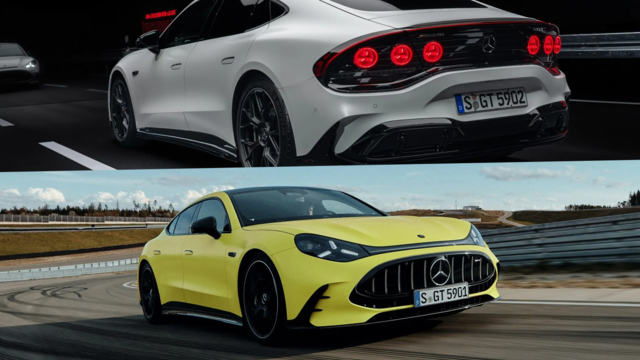
EQE SUV Section?


MBWorld Fanatic!


Joined: Nov 2013
Posts: 1,030
Likes: 492
From: Louisville, KY
2023 EQE350 4MATIC, 2023 EQE 350 4MATIC SUV, 2015 E250 BlueTEC 4MATIC, 1995 E300 Diesel

Newbie
Joined: Nov 2023
Posts: 4
Likes: 2
911S, MME, X3
Greta news.
I like the size of the MME but the ride is horrible and dealing with Ford, is well, dealing with Ford. I’ve probably owned over 30 BMW’s but their EVs are either too small or front ugly.
I am hoping that most bugs are gone from the new EQE 350s
I really want the Macan EV but with their software problems and another 4 month delay the car won’t be out until sometime around mid 2025.
the one thing I don’t like on the MB is that CarPlay nav does not show in the instrument cluster in front of the steering wheel like the BMW and Ford.
they are offering me some decent discounts at the moment, hopefully I can get more and then get rid of the MME.
thanks again
I like the size of the MME but the ride is horrible and dealing with Ford, is well, dealing with Ford. I’ve probably owned over 30 BMW’s but their EVs are either too small or front ugly.
I am hoping that most bugs are gone from the new EQE 350s
I really want the Macan EV but with their software problems and another 4 month delay the car won’t be out until sometime around mid 2025.
the one thing I don’t like on the MB is that CarPlay nav does not show in the instrument cluster in front of the steering wheel like the BMW and Ford.
they are offering me some decent discounts at the moment, hopefully I can get more and then get rid of the MME.
thanks again
MBWorld Fanatic!
Joined: Jan 2014
Posts: 1,055
Likes: 355
From: USA - Minnesota
2014 GL350 / 2026 BMW iX iDrive60
FWIW, here’s my EQB with the older MBUX NTG6 software:





Junior Member
Joined: Aug 2023
Posts: 36
Likes: 10
From: Ohio & South Carolina
EQE SUV 350 4Matic and 2024 Tesla MX LR
Most of my feedback centers around EQE Sedan. It's a 350V4. The EPA ratings are very, very conservative. The car easily exceeds it. The range forecast depends on two things: driving style and temperature. I've seen mine literally change its forecast as the temperature changes. As I have a '23 sedan, it doesn't have heat pump, so it's a bit less efficient in heating the cabin than any EQE SUV, as they all have heat pumps. But, it still has a waste heat loop, and despite lacking the heat pump, it still keeps quite a bit of its range in the cold temps. Though I like to give the accelerator a good push from time to time, or during a merge, I tend to drive very conservatively. My projected and "max" ranges are always identical. The car has a measurement for what it thinks you will get vs the theoretical max, and because I go easy on the throttle and use no-regen mode (allows coasting before favoring regen on brake pedal), it always ends up being the maximum theoretical range according to the car. All that's to say that while on a best-case day, I'll see a range forecast of about 354 miles (again, a 4Matic car). The actual is probably closer to 320-330, though I've never taken it up on the actual range. The battery has a ~90.6 kWh battery, and on efficient days with road trips I'm getting 3.5 to 3.6 mi/kWh, so it stands to reason I could reach 326 miles. Still, that's far higher than the 270 or so miles EPA rating.

MBWorld Fanatic!
Joined: Nov 2013
Posts: 1,030
Likes: 492
From: Louisville, KY
2023 EQE350 4MATIC, 2023 EQE 350 4MATIC SUV, 2015 E250 BlueTEC 4MATIC, 1995 E300 Diesel
1. When you let go of the accelerator, it doesn't begin regen. Instead, you coast. This is more efficient, because you're using 100% of your built-up kinetic energy to move, minus friction losses in the system. Of course, you have wind resistance, but I'm excluding that as it affects both regen and coasting. So, I coast as far as makes sense, and then:
2. Use the brake pedal. When in "no recuperation" mode, the first 80% of brake travel does not engage the service brake. This is actually different than in "normal" and "maximum recuperation" modes, where any regen, whether pedal off or any brake pedal application, is also accompanied by service brakes. As an example, in "normal", if you let off the accelerator and begin to regen, the car also applies 9% service brakes.
2a. "normal" and "maximum" modes do provide a pretty linear brake pedal feel. This is why the service brakes are blended in. They feel the most "normal", while the feeling of "no recuperation" is a bit different because it relies exclusively on regen for the first 75-80% of the brake pedal travel. (It applies about 1%, sometimes 2% service brakes in this case, until more braking is needed).
3. If you regen instead of coasting, you're only recovering a fraction of your kinetic energy back to the battery, including losses. I don't think there are any EVs out there that can recover more than 40-50% of the kinetic energy, and it's dependent on the state of charge.
So, in summary, yes, I'm using a lot of regen. In fact, I'm almost exclusively using regen, except for the last few feet/MPH of travel where the service brakes kick in. But I do coast quite a bit, which is more efficient than draining my built-up kinetic energy and recovering a fraction of it back to the battery. Hope the logic makes sense!

Senior Member
Joined: Jul 2012
Posts: 411
Likes: 103
535
Indeed! I did not say that I wasn't using regen - just that I'm using the "no recuperation" mode. This does several things.
1. When you let go of the accelerator, it doesn't begin regen. Instead, you coast. This is more efficient, because you're using 100% of your built-up kinetic energy to move, minus friction losses in the system. Of course, you have wind resistance, but I'm excluding that as it affects both regen and coasting. So, I coast as far as makes sense, and then:
2. Use the brake pedal. When in "no recuperation" mode, the first 80% of brake travel does not engage the service brake. This is actually different than in "normal" and "maximum recuperation" modes, where any regen, whether pedal off or any brake pedal application, is also accompanied by service brakes. As an example, in "normal", if you let off the accelerator and begin to regen, the car also applies 9% service brakes.
2a. "normal" and "maximum" modes do provide a pretty linear brake pedal feel. This is why the service brakes are blended in. They feel the most "normal", while the feeling of "no recuperation" is a bit different because it relies exclusively on regen for the first 75-80% of the brake pedal travel. (It applies about 1%, sometimes 2% service brakes in this case, until more braking is needed).
3. If you regen instead of coasting, you're only recovering a fraction of your kinetic energy back to the battery, including losses. I don't think there are any EVs out there that can recover more than 40-50% of the kinetic energy, and it's dependent on the state of charge.
1. When you let go of the accelerator, it doesn't begin regen. Instead, you coast. This is more efficient, because you're using 100% of your built-up kinetic energy to move, minus friction losses in the system. Of course, you have wind resistance, but I'm excluding that as it affects both regen and coasting. So, I coast as far as makes sense, and then:
2. Use the brake pedal. When in "no recuperation" mode, the first 80% of brake travel does not engage the service brake. This is actually different than in "normal" and "maximum recuperation" modes, where any regen, whether pedal off or any brake pedal application, is also accompanied by service brakes. As an example, in "normal", if you let off the accelerator and begin to regen, the car also applies 9% service brakes.
2a. "normal" and "maximum" modes do provide a pretty linear brake pedal feel. This is why the service brakes are blended in. They feel the most "normal", while the feeling of "no recuperation" is a bit different because it relies exclusively on regen for the first 75-80% of the brake pedal travel. (It applies about 1%, sometimes 2% service brakes in this case, until more braking is needed).
3. If you regen instead of coasting, you're only recovering a fraction of your kinetic energy back to the battery, including losses. I don't think there are any EVs out there that can recover more than 40-50% of the kinetic energy, and it's dependent on the state of charge.
MBWorld Fanatic!
Joined: Nov 2013
Posts: 1,030
Likes: 492
From: Louisville, KY
2023 EQE350 4MATIC, 2023 EQE 350 4MATIC SUV, 2015 E250 BlueTEC 4MATIC, 1995 E300 Diesel