There have been several threads on the forum regarding brake pad wear (and brake job cost!). I picked up a useful tool last weekend at Harbor Freight (SKU #58799), Brake Lining Thickness Gauge. This is a set of 8 thickness gauges that provides a quick and easy way to check your pad wear. The 8 gauges are color coded green (8, 10, 12 mm) "good to go", yellow (4, 5, 6 mm) "start saving for your brake job", and red (2, 3 mm) "don't tailgate anyone".
With a flashlight and a bit of maneuvering, you can get the gauge through the wheel spokes and against the side of the pad between the rotor and brake pad substrate to assess the condition of your pads.
On my 2019 G550, my front pads are just a bit over 10mm and the rear pads are just a bit under 10mm (new thickness is about 12mm) after 19K miles, which IMO is about normal pad wear.
Well worth $13 to keep an eye on your brake pad condition and to keep your dealer's service department honest.
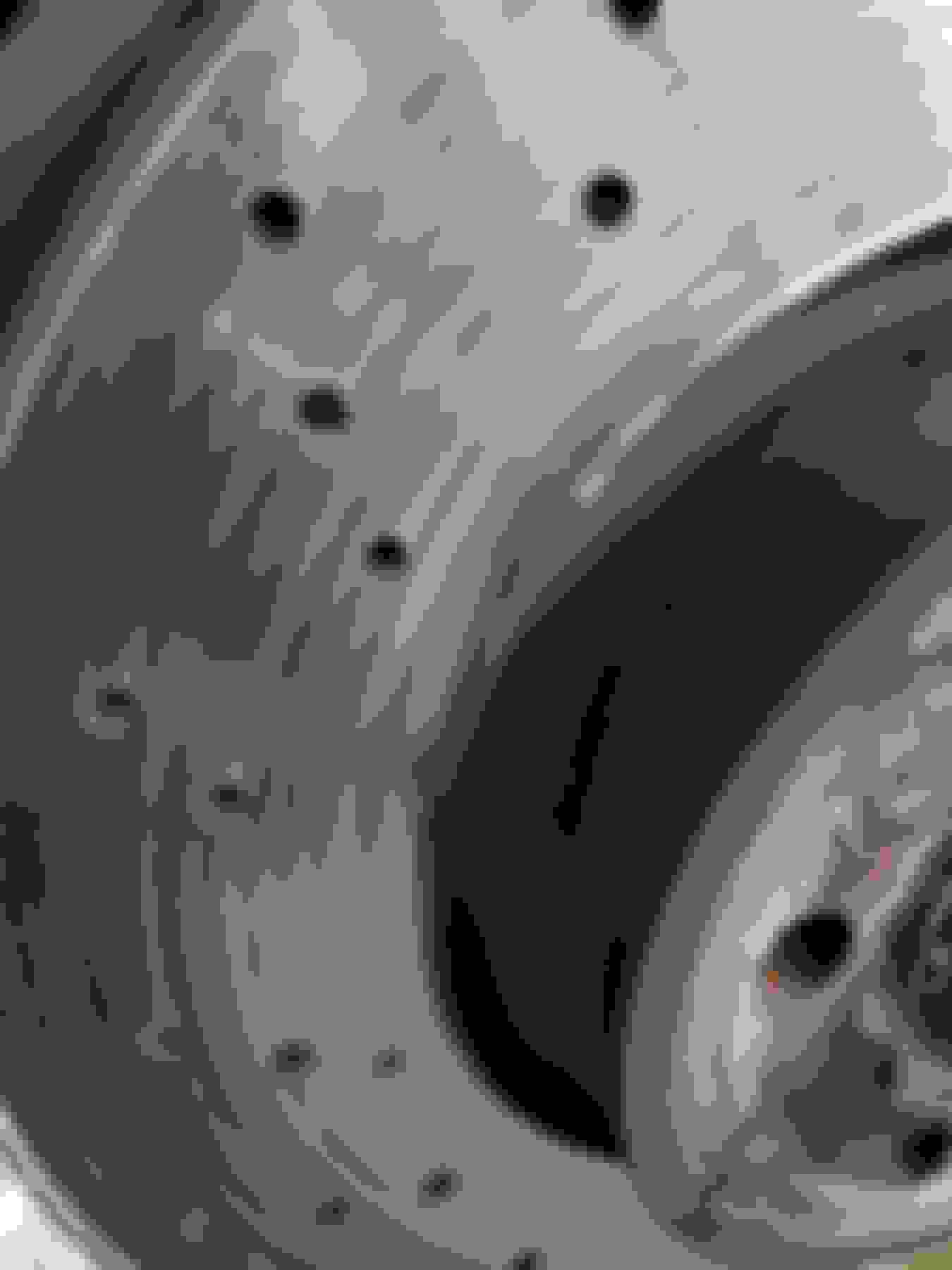
I didn't know these existed, thanks! It has a sensor and you can just look at the rotors to know when they're going out. They start looking beat up like this and squealing a lot near the end well before the sensor even goes off.
you can also visibly inspect the pad if the pad thickness is less than the backing plate it's getting close to being done.
There have been several threads on the forum regarding brake pad wear (and brake job cost!). I picked up a useful tool last weekend at Harbor Freight (SKU #58799), Brake Lining Thickness Gauge. This is a set of 8 thickness gauges that provides a quick and easy way to check your pad wear. The 8 gauges are color coded green (8, 10, 12 mm) "good to go", yellow (4, 5, 6 mm) "start saving for your brake job", and red (2, 3 mm) "don't tailgate anyone".
With a flashlight and a bit of maneuvering, you can get the gauge through the wheel spokes and against the side of the pad between the rotor and brake pad substrate to assess the condition of your pads.
On my 2019 G550, my front pads are just a bit over 10mm and the rear pads are just a bit under 10mm (new thickness is about 12mm) after 19K miles, which IMO is about normal pad wear.
Well worth $13 to keep an eye on your brake pad condition and to keep your dealer's service department honest.
Brake Pad Gauge
Quote:
Originally Posted by ChrisHimself
I didn't know these existed, thanks! It has a sensor and you can just look at the rotors to know when they're going out. They start looking beat up like this and squealing a lot near the end well before the sensor even goes off.
you can also visibly inspect the pad if the pad thickness is less than the backing plate it's getting close to being done.
I believe the rotor themselves also have wear indicators?
There are pad wear sensors -- usually just a wire that eventually wears through when the pad gets down to 3mm or so -- and throws a code and dash indicator. I'm not aware of any wear sensor on any rotor. Rotors have specified thickness when new (for example, 36mm), and a minimum wear/machining thickness (for example, 34.4mm) that can be measured with a caliper micrometer. The rotor photo above appears to have a bit of surface scoring -- you can tell by running your fingernail across it and feeling ridges. Rotors can be machined to remove the scoring as long as the minimum thickness is maintained. Machining is much cheaper than buying a new set of rotors, and restores the surface to optimize braking with new pads. If the rotors are severely warped or scored such that machining isn't possible, then new rotors are required.
There are pad wear sensors -- usually just a wire that eventually wears through when the pad gets down to 3mm or so -- and throws a code and dash indicator. I'm not aware of any wear sensor on any rotor. Rotors have specified thickness when new (for example, 36mm), and a minimum wear/machining thickness (for example, 34.4mm) that can be measured with a caliper micrometer. The rotor photo above appears to have a bit of surface scoring -- you can tell by running your fingernail across it and feeling ridges. Rotors can be machined to remove the scoring as long as the minimum thickness is maintained. Machining is much cheaper than buying a new set of rotors, and restores the surface to optimize braking with new pads. If the rotors are severely warped or scored such that machining isn't possible, then new rotors are required.
Slideshow: A one-of-one U.S.-spec Mercedes-Benz SLR McLaren Roadster became even rarer after a factory-backed transformation at McLaren's headquarters.