When you click on links to various merchants on this site and make a purchase, this can result in this site earning a commission. Affiliate programs and affiliations include, but are not limited to, the eBay Partner Network.
Assuming that all these issues are related to Low-speed pre-ignition (LSPI), I have some opinions.
When one assumes for best maintaining their GLC with the right engine oil (right viscosity and certification), especially with the fact that their vehicle being always serviced at a Mercedes-Benz dealership, it is possible that the owner may have unwittingly contributed to this issue.
For years, Mobil 1 FS oil has been the go-to choice, recommended & used by Mercedes-Benz and approved under 229.5 standards.
However, there has been a problem with Mobil 1 FS 0W-40 or 5W-40 oil, specifically concerning its calcium levels (as with any other oil at that time). This oil has carried the API SN certification for years. API SN certification lacks testing for LSPI and features high calcium levels, which is believed to be the leading cause of LSPI.
The API SP certification, on the other hand, is given only when the oil passes LSPI tests. There is also API SN plus, which also is tested for LSPI, however, there is no API SN PLUS certified Mobil 1 FS.
Undoubtedly, many 2016, 2017, and 2018 model years have been treated with the SN version of Mobil 1 FS oil for years, which has considerably high calcium levels.
Fortunately, Mobil 1 FS has altered its formulation and reduced calcium levels. These changes led to the API SP certification, and we have recently started seeing the SP version on store shelves. It is doubtful that dealers have started using the SP version of this oil yet. Even when purchasing a bottle from a store shelf, it's challenging to distinguish the SN (high calcium) from the SP (low calcium, high magnesium) version unless you specifically look at the description on the back of the bottle.
In my opinion, API SP is how oil industry catching up with the engine technology and its new problems, such as LSPI with turbo DI engines.
Not an expert but HERE's an interesting read on why aviation oils do not contain calcium sulphate. Well, it is due to "deposit induced runaway surface ignition (DIRSI)". Sounds similar, right? Article mentions on a test case where they found out a hole in the piston of the aircraft engine due to DIRSI. Article also says:
"DIRSI is uncommon in auto engines because of liquid cooling, low load operation, and normally low oil consumption. But aircraft engines are more susceptible due to higher combustion chamber surface temperatures with air-cooling, higher oil consumption, and higher loads, especially during takeoff and climb out."
This is true, but can we still say the same thing about auto engines anymore, with the small turbo DI engines that we have?
————-
Another topic I'd like to discuss is an interesting observation I've made recently about my 2018 GLC's behavior in ECO mode. Here are the details and differences between two drive modes - ECO and COMFORT:
COMFORT mode: On a cold engine, when you start driving in "C" mode, the transmission upshifts as early as possible, often reaching 9th gear, especially at highway speeds. This is the expected behavior.
ECO mode: Again, on a cold engine, if you switch to "E" mode and start driving, the transmission does not go beyond 7th gear, maintaining the RPM at or above 2,000. Even at 70 mph, it remains in 7th gear, keeping the RPM above 2,000. This behavior persists until the total drive time reaches 15-20 minutes, at which point the transmission shifts to 8th and 9th gears as usual. However, it takes at least 15 to 20 minutes of continuous highway driving to change this behavior.
My hypothesis is that this behavior with the ECO mode is intentional, with the main goal being to raise the engine oil to its operating temperature and keeping the RPM high while doing that, when the engine/oil is still cold. Engine oil typically reaches its ideal temperature 5-10 minutes after the coolant reaches its operating temperature, possibly requiring a total drive time of 15-20 minutes.
Correct me if I'm wrong, but LSPI tends to occur;
When the engine is cold
RPM is low
And there is load on the engine
Imagine operating your M274 engine on a cold oil, in high gears (8th, 9th gear) with lower RPM. When you intend to accelerate to pass another car on a highway, your vehicle experiences a sudden high load while still operating at low RPMs (in the highest gear). This, in my opinion, is an ideal condition for LSPI to occur.
"E" mode tries to prevent this. I believe LSPI has a less chance of occurring when oil viscosity is low, when on a hot engine. This is due to the fact that the oil scraper piston ring is more effective to sweep the oil when oil is not thick. Studies show that microscopic oil droplets left in combustion chamber is another cause for the unintentional sparks.
The "C" comfort mode, on the other hand, completely disregards these factors and reaches to the highest gears, as quickly as possible (hence "comfort"). Any attempt to raise engine speed will cause a high load, when the engine is on low RPM. This happens even if only a few minutes have passed since the start of the drive, and the engine oil is not yet at the optimal temperature levels. A high chance that majority of GLC owners just drives on the "C" mode.
So, in my opinion, it might be a good idea for any 2016-18 and maybe '19 owners to switch to any 229.5 approved oil, but with only API SP certification. Additionally, driving in ECO mode, at least after cold starts for the next 15-20 minutes, could be beneficial in the long run to overcome this issue. These are in addition to making sure you only use high quality premium fuel 91+ octane.
P.S. Here's a topic LINK where others have observed the same behavior on ECO mode with earlier models. Some people even mention about observing this change after a software update at the dealership. Here's a post where someone mentions experiencing this behavior only after a software update (post #10). Here's another post (post #5) where the person mentions not having the issue on his past 2016 model, but on his 2017. Guessing his 2016 model was not updated with the new firmware or it was not even available, then his 2017 came with or received the update at the dealership.
Did Mercedes-Benz realized the issue somewhere around 2017 and quietly pushed a software attempt to fix it? But if that was the case, why would they do it only for ECO mode?
Last edited by FreeWoRLD; Oct 12, 2023 at 01:38 PM.
Very good observations, I hate when upshifts asap and keeps the higher gear. Its all for saving gas. I usually manually downshift or switch to Sport, Sport keeps lower gear longer above 2K RPM.
oil is one part but most important part in LSPI is gasoline. It MUST be high octane and good quality to keep injectors clean.
SP oil loaded with magnesium, calcium is lower but not that much. The last test is SP oil.
Previous tests for Liqui Moly, Valvoline and OEM MB oil all fails in viscosity. And its just after 3K miles.
Very good observations, I hate when upshifts asap and keeps the higher gear. Its all for saving gas. I usually manually downshift or switch to Sport, Sport keeps lower gear longer above 2K RPM.
oil is one part but most important part in LSPI is gasoline. It MUST be high octane and good quality to keep injectors clean.
SP oil loaded with magnesium, calcium is lower but not that much. The last test is SP oil.
Previous tests for Liqui Moly, Valvoline and OEM MB oil all fails in viscosity. And its just after 3K miles.
Completely agree with you on the gas, indeed. That’s why I used some high PEA cleaner when I purchased the vehicle as used, as I wasn’t sure how it was treated before. I do also plan to use it time to time just for maintenance.
I would recommend considering M1 SP in terms of calcium and mag levels, especially compares to the original formula.
Here’s a virgin oil sample;
And some used ones at 5-6k;
And.. here’s the original Mobil 1 FS formula;
(Calcium level is 3247 in virgin oil sample! This is the stuff that has been used for years..)
source: bitog
Last edited by FreeWoRLD; Oct 12, 2023 at 01:56 PM.
This is scary. So many cases of catastrophic engine failure. It is therefore quite common, based on the responses on this forum...
It would be nice to create a sticky with a tolling, so that we can track the data. Owners of GLCs with catastrophic cylinder crack, can provide some basic info. For example, Model, year, mileage, serviced at Dealer or indy, etc.
I hope that's feasible on this forum. I will look into it.
How many MB sold GLC and C, hundreds thousands.
To be fair, how many cases. We have seeing here 20-50? From this number how would you check if dealer or indy used the right oil, oil interval was too long, and how many owner will admit to using the wrong gas. I own car for 4years, using gas from Shel and Chevron ONLY, if I have to drive extra 10 miles and get it, not a problem for me.
i’ve spent a long time search the same problem on Euro forums, nothing even close.
look how many glc a c for sale in EU and their miles.
I found there was a Poll posted already in this Forum a while back. But not many people replied. GLC engine poll - MBWorld.org Forums
I searched this forum and found around 20-30 cases of GLC failed piston; more than half of them are 2016 models, on average around 50K.
I don't know how many members this forum has. But GLC has sold more than 250K cars in the US from 2016 to 2021.
Therefore, it seems that the piston failure is a relatively small percent of the GLCs sold in the US.
Of course, I realize that the piston crack is a catastrophic failure, and it really sucks for these drivers.
Had vehicle towed to the dealerrship this week, 0 compreaaion on piston 1. My research points to improper fitting wrist pins as the underlying cause. My vehicle has 88000 kms with 14 days left on the warranty. Anxiously awaiting dealer course of action.
Originally Posted by chassis
Sorry to hear of the situation. It's unfortunately somewhat common on the M274 2.0L turbo 4 cylinder. There have been reports of the same failure on C300 and E300. Seems Mercedes has/had a bad piston design, or a run of bad piston quality.
Coming off Freeway, engine light went on then shuddering started, thought it was gas gap loose as its happened before, then i drove about 1/8th of a mile and engine light started blinking I pulled over and shut down the car, checked the gas cap opened the hood looked at everything seemed to be in order. Turned car back on engine light went off and car was driving fine. 3 minutes later the light started flashing and car was shaking had very little power was 1 minute from MB dealer s. limped it in shut it down. I have 63,500k miles on the car, i take meticulous care of the car and change oil and filters every 5k-7k and keep records of all the work. I am out of factory warranty but purchased a warranty through Veritas, the Premier warranty which covers basically everything except a brake pads, windshield wipers ect. I am very concerned reading this forum about the failures of the engine, I did not realize this to be the case I am hoping its just a sparkplug, coil or something that isn't a major repair. The warranty company was recommended by MB when I called to extend so I hope they are ethical as you read through the contract and their are a million ifs an ands for them to get out of honoring the terms.. Once this is repaired I think I'll be moving on from MB, I have to admit I love my GLC 300 its been one of my favorite cars I've owned, but I cant have engine issues like this at 63k miles.
Had vehicle towed to the dealerrship this week, 0 compreaaion on piston 1. My research points to improper fitting wrist pins as the underlying cause. My vehicle has 88000 kms with 14 days left on the warranty. Anxiously awaiting dealer course of action.
Could you post the build date and location of build for your car? The VIN plate in the door sill of the driver's side door should show this. Second line should be the factor and build date in MM/YY
Trying to determine if all the 274 engines have the same problem. I have this engine in my 2018 GLC 300 thanks.
All M274 engines can have piston cracking. All models years and platforms (C, E, GLC) with M274 have seen reported engine failures. All M274 are not guaranteed to have the problem. It’s a dice throw.
Trying to determine if all the 274 engines have the same problem. I have this engine in my 2018 GLC 300 thanks.
IMO I don't think I'd own one without a Service Policy from a reputable Insurance Company (sometimes called an "extended warranty," but it's not a warranty unless it comes from the factory), even though the percentage of failures must be extremely low.
With a Service Policy you are sharing your risk with an insurance company and paying them for their share.
As with any insurance policy, it depends on your risk tolerance.
I wouldn't even want to replace a blower fan out-of-warranty, so my risk tolerance tells me to buy the insurance.
I buy "exclusionary" policies instead of "inclusionary," because they generally cover more stuff.
We have one on our 2019, different engine, but it still has that expensive blower motor / window winder/ AWD system, etc.
She likes to keep her cars a LONG time - at least 15 years.
Service Policy = Peace of Mind.
The other side of that, is it if you are always waiting for the other shoe to drop with your car, you won't enjoy it or use it as you had anticipated.
Its value to you is lower.
I'd just get a Service Policy and drive like the sky is not falling.🙂
Edit: Service Policies on a 10-year-old modern car are probably going to be outrageously priced. I don't think 15 years is in the cards anymore.
Could you post the build date and location of build for your car? The VIN plate in the door sill of the driver's side door should show this. Second line should be the factor and build date in MM/YY
The vehicle is at the dealership so unable to get that right now & they would not supply a loaner so I am carless. The location for engine build was Finland.
Coming off Freeway, engine light went on then shuddering started, thought it was gas gap loose as its happened before, then i drove about 1/8th of a mile and engine light started blinking I pulled over and shut down the car, checked the gas cap opened the hood looked at everything seemed to be in order. Turned car back on engine light went off and car was driving fine. 3 minutes later the light started flashing and car was shaking had very little power was 1 minute from MB dealer s. limped it in shut it down. I have 63,500k miles on the car, i take meticulous care of the car and change oil and filters every 5k-7k and keep records of all the work. I am out of factory warranty but purchased a warranty through Veritas, the Premier warranty which covers basically everything except a brake pads, windshield wipers ect. I am very concerned reading this forum about the failures of the engine, I did not realize this to be the case I am hoping its just a sparkplug, coil or something that isn't a major repair. The warranty company was recommended by MB when I called to extend so I hope they are ethical as you read through the contract and their are a million ifs an ands for them to get out of honoring the terms.. Once this is repaired I think I'll be moving on from MB, I have to admit I love my GLC 300 its been one of my favorite cars I've owned, but I cant have engine issues like this at 63k miles.
I have a few questions:
Did you buy car as new?
Did you always use top tier premium gas 92 and up?
Updated just got a call from the MB service: Piston 1 no compression, possible cracked piston or entire engine replacement, he didnt have an actual estimate ready yet but said between $20k-$30k which sounds absolutely insane considering I've read on this forum between 12k to 18k.... I have a extended warranty but Im not sure how much they will cover and Im sure its not like the manufactures warranty and Ive read through the contract and they have a millions ifs an ands. Anybody have any suggestions or experiences for me to reference.
I bought it used with 8k miles on it from MB was still under factory warranty.
I always put the 91 octane that is recommended which I believe is the highest Octane they sell in CA to my knowledge.
Updated just got a call from the MB service: Piston 1 no compression, possible cracked piston or entire engine replacement, he didnt have an actual estimate ready yet but said between $20k-$30k which sounds absolutely insane considering I've read on this forum between 12k to 18k.... I have a extended warranty but Im not sure how much they will cover and Im sure its not like the manufactures warranty and Ive read through the contract and they have a millions ifs an ands. Anybody have any suggestions or experiences for me to reference.
Exact same as my vehicle, 0 compression on piston 1. Engine is toast. I am the 2nd owner, original owner had purchased extended warranty set to expire next week. Dealer tried the "warranty does not apply" spin even though the control arm replacement had been covered 6 months prior.
It has required persistent effort, constant pressure, assertiveness/aggressiveness and daily trips to the dealer. They do not like to hear contacting media and lawyers is a road you are willing to go down.
The dealer has been stalling and dishonest in their communication. Today I contacted MB Canada and filed a complaint. I will post an update on the outcome.
I did speak with a former MB technician who recommended a replacment engine with a manufacture date from July 2023 onward. Refurbished or repaired would result in a repeat of the same problem.
Here's some info I found while researching this issue, it may help you in your communicatuon with the dealer:
1) A class action has been filed in the US, Jamil vs MB, case #2:22-cv-08130. Plaintiff is represented by the Kalfayan Law Firm, Del Mar, California.
2) The NHTSA-ODI has initiated a defect petition, DP22-02. Stephen Ridella was the Director who initiated it. Notable in his letter to MB, the alleged defect is "incorrectly sized or otherwise unsuitable wrist pins causing mechanical engine damage".
3) There was an XENTRY notificatuon sent to MB service departments on 10-15-2018 about the clattering/rattling noise from the crank assembly of the M274 engine, topic # L103.10-P-060916.
4) Car complaints has a littany of consumers with the same complaint, mostly piston 1 with 0 compression. One customer refers to the M274 engine as the piston cracker.
This is the best vehicle I have ever owned, love the comfort and the ride....ever so disguisted, disheartened and disappointed that MB is not doing right by it's xustomers and issuing a recall!
i had the same issue with my c300 @51k miles and also contacted Mercedes’ and they refused to acknowledge their part in these pistons crack engine failures and it makes sense because if they do then they open the doors to all kinds of lawsuits. So to people who haven’t talked to Mercedes’ customer service yet : don’t waste your time . They won’t help, if you have a great relationship with your service department at the dealer you might get fifty percent off but the repair is over 16k dollars .
would everyone please please make sure you enter a complaint on the NHTSA website and emphasize how this failure was also a traffic safety issue . I sent the NHTSA a physical letter addressed to the administrator - it’s called a defect recall petition . Not many people know about it because the NHTSA doesn’t really mention it much but what it does is it guarantees by federal law that our issue gets investigated within a certain amount of time (believe it was 90 days) and if it is denied they have to give a reason why in the federal register (also by federal law) so it can’t be ignored at this point . I’m pretty much forcing them to investigate or claims at this point and it would be helpful if more of us go on the website and file the safety issue complaint as they will look for people with similar problems . I’m really confident this petition is going to help us out so keep your fingers crossed . I’ll let you guys know if any updates I receive .
Hi- failed M274 engine owner here
I've found the odi defect petition dated Sept. 28, 2022. Are you aware of any followup doc's, ie. Response from MB or progress of their investigation?
Hi- failed M274 engine owner here
I've found the odi defect petition dated Sept. 28, 2022. Are you aware of any followup doc's, ie. Response from MB or progress of their investigation?
Sorry to hear about the engine failure. Which model year is your vehicle?
Completely agree with you on the gas, indeed. That’s why I used some high PEA cleaner when I purchased the vehicle as used, as I wasn’t sure how it was treated before. I do also plan to use it time to time just for maintenance.
I would recommend considering M1 SP in terms of calcium and mag levels, especially compares to the original formula.
Here’s a virgin oil sample;
And some used ones at 5-6k;
And.. here’s the original Mobil 1 FS formula;
(Calcium level is 3247 in virgin oil sample! This is the stuff that has been used for years..)
source: bitog
I think this all looks really great, but, my brain can't comprehend it all.... is there like a type of oil here showing it would work the BEST in our GLCs?
I think this all looks really great, but, my brain can't comprehend it all.... is there like a type of oil here showing it would work the BEST in our GLCs?
Well, we don’t know if the root cause of this issue is LSPI. LSPI events might cause pistons getting cracked. Happens on engines from other manufacturers as well.
Assuming it is or having any relationship directly or indirectly, the easiest action would be to start using Mercedes approved (229.5) oil with API SP certification. These type of oils have less calcium in their formula and are tested for LSPI. I would bet that none of Mercedes dealers have started using SP version of the Mobil 1 FS Euro. I strongly believe that they use the API SN version of the oil (has high calcium and not tested for LSPI).
I’ve chosen Mobil 1 FS 0w-40 but not all of them are API SP. Need to confirm by looking at the back of the bottle and it should show API SP. If not, it will show API SN which is not tested for LSPI and has high calcium. Both have the same exact name and the front of the bottle is the same. There are few other oil brands/types with SP and 229.5 approvals but not many.
Last edited by FreeWoRLD; Oct 18, 2023 at 12:43 PM.
Well, we don’t know if the root cause of this issue is LSPI. LSPI events might cause pistons getting cracked. Happens on engines from other manufacturers as well.
Assuming it is or having any relationship directly or indirectly, the easiest action would be to start using Mercedes approved (229.5) oil with API SP certification. These type of oils have less calcium in their formula and are tested for LSPI. I would bet that none of Mercedes dealers have started using SP version of the Mobil 1 FS Euro. I strongly believe that they use the API SN version of the oil (has high calcium and not tested for LSPI).
I’ve chosen Mobil 1 FS 0w-40 but not all of them are API SP. Need to confirm by looking at the back of the bottle and it should show API SP. If not, it will show API SN which is not tested for LSPI and has high calcium. Both have the same exact name and the front of the bottle is the same. There are few other oil brands/types with SP and 229.5 approvals but not much.
Sure thing. Mine is 2018 GLC 300 early build and I am 71k miles as of today. I’ll make sure to update if I end up with a cracked piston while I am on this oil 😀. And if that happens, that means my hypothesis was totally wrong.
(Marketing obviously but still a good, simplified explanation of LSPI here in THIS link. I have no affiliation to Mobil brand, I don't even care about them. I just use their product.)
Last edited by FreeWoRLD; Oct 18, 2023 at 01:23 PM.
My observations:
1. Use API SP + 229.5 MB Spec oil
2. Use Top tier gas 92 and above
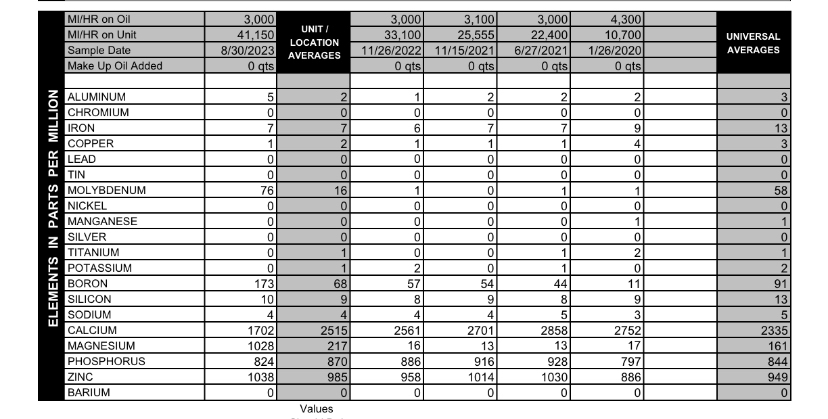
I personally tried multiple brands of 5w-40 MB 229.5
10.700 - Liqui Moly 2332 Leichtlauf High Tech 5W-40 API SN
22.400 - Liqui Moly 2332 Leichtlauf High Tech 5W-40 API SN
25.555 - MB OEM 229.5 Oil 5W-40
33.100 - Valvoline European Vehicle Full Synthetic SAE 5W-40 API SN
41.150 - Pennzoil Platinum Euro Full Synthetic 5W-40 API SP
as you can see all oils but Pennzoil did not so good with viscosity, but Pennzoil did not so good with aluminum.
I'm 1K away from next oil change (running Pennzoil) will do another test to compare,
after it will switch to Castrol EDGE Euro 5W-40 A3/B4 API SP for two runs
Mercedes SLR McLaren 722 S Is Extremely Rare Example Modified by McLaren
Slideshow: A one-of-one U.S.-spec Mercedes-Benz SLR McLaren Roadster became even rarer after a factory-backed transformation at McLaren's headquarters.