When you click on links to various merchants on this site and make a purchase, this can result in this site earning a commission. Affiliate programs and affiliations include, but are not limited to, the eBay Partner Network.
I have a 2005 SL55 with a parasitic leak. As soon as the car is switched off, the current drops from over 3A to approximately 2.5A in a minute and stays at that level indefinitely. Doesn't matter if doors are locked or not.The positive terminal of the consumer battery has two cables, one goes directly to this black box (red circle in the attached figure). I can't see where the other cable goes but must be to the prefuses. The current is approximately 50/50 between these two cables. I understand that the alarm siren is a likely cause. But it's been removed (by the previous owner). The battery is new. It charges quickly and holds a charge well if disconnected from the car. But if I don't disconnect it or charge it, the voltage will drop from over 12.5V to below 5V in less than a day. There is a new audio system. But it's been disconnected and the parasitic leak is still there. A thermal camera showed excessive heat coming from the rear view mirror. It was the light sensor for anti-glare. I suppose this may have been in the order of 100s of milliamps but certainly not amps. Regardless, I disconnected it and the heat went away but the parasitic drain is still present. There is no telephone system. But seems like the SOS system is still active.
Questions: Why is the parasitic leak being split approximately 50/50 between the two cables connected to the positive terminal? Does that indicate there is more than one parasitic leak? What is this connector (with red and green wires). Is it ok for it to be disconnected? What else should I check that could be causing so much parasitic current? Thanks for your help.
Last edited by Scallawalla; Apr 25, 2025 at 02:10 AM.
There are two hots coming off the battery. One goes to the BCM and one to F33 - that's the fuse block you mentioned.
'A new audio system' has me alert. What fat-fingered installer (not you of course!) did what in there?
I would start by disconnecting those feeds from the hot and see what happens. Then start pulling fuses to all the modules in turn and watch the current drain. See the pdf above for all the feeds but it will be quicker to start with all the pre-fuse blocks.
At 2.5 amps staying steady after shutdown, that’s way too high and definitely points to a major consumer module stuck awake, not a normal background draw. On these R230s one half of the feed goes to the rear pre-fuse block (F33) and the other goes toward the front, feeding things like the SAMs and the BCM (Battery Control Module).
Yes, it sounds like you have two or more parasitic leaks assuming each of the two main power wires is drawing 1.25 Amps or so.
The F33 prefuse block just in front of the battery primarily feeds the fuse block behind the passenger (right side) seat. Removing fuses from there might help you find the leak. Note there is a large horizontal fuse which is hard to see under the obvious vertical fuses. The small 7.5 Amp fuse in the F33 goes to the EIS circuits.
The other big battery cable connects to the BCM but also continues to the front F32 prefuses, which unfortunately are a pain to access. They then connect to the front fuse boxes, the engine cooling fan, the A/C/Heater blower motor and EIS.
A huge concern is always the BCM because they seem to fail over time, can start draining the batteries, and in worst case catch on fire. Therefore, I suggest following the posts here and YouTube videos on how to protect the BCM with fuses. This also then lets you remove your added BCM fuses to see if the BCM has a significant current drain.
Last the alternator connects through F52, which is also next to F32 deep under the passenger footwell. If you suspect the alternator is causing a leak, generally easier to disconnect its big lead (after disconnecting batteries). The engine cooling fan is trivial to disconnect to test for leakage.
I have personally chased parasitic leaks several times and have yet to get it below about 150 mA which is enough to drain the rear battery in two weeks. But 2.5 Amps indicates multiple big drains.
Have you sat in the car long enough to notice if anything stays on? Like the heater motor?
Tom, thanks for your continuing help. Looking at my notes from several months ago, IIRC, I had 76mA drain with everything but the front and rear pre-fuses disconnected; that is all fuses removed from all fuse boxes, alternator disconnected, engine fan disconnected, BCM disconnected via my added fuses, and even SBC disconnected. And always waiting 30+ minutes before making measurements. That leaves only the EIS, heater motor and the capacitor at F32; I though I earlier tested the capacitor.
Connecting the SBC increased it to 93 mA. Connecting rear SAM to 119mA, connecting front right SAM stayed at 119mA, connecting BCM stayed at 119mA, connecting front left SAM increased to 130mA.
I later had a chance to disconnect the EIS module, but I don't understand my quick notes; likely nothing changed. The drain is not always the same, it changes a bit over time. I generally don't lock the car when in the garage.
Anyway, its not a big deal now and I simply plug the car in if it hasn't been driven in a week. Come next winter, I will work on it again.
I have stayed in the car after shutting it down to verify that nothing noticeable is staying on (for example, heater or lights).
Until I can find the parasitic leak(s), I can leave it on a charger at all times. My 1.25A and 4.3A chargers don't keep up with the 2.5A parasitic leak but my 20A charger has no problem. Maybe I'm just overly concerned, but it doesn't seem safe to have 2.5A going through the car when it is off and parked in the garage for long periods of time. Hence, I would like to disconnect the battery. Of course, I will lose code history. But I can leave the battery connected for a few days if I need to see a code history. My concern is that after the battery is disconnected, the car may take several days for some programs to go through an initialization phase. But, if I disconnect the battery every day, the car may never have enough time to go through the initialization phase?
I have often disconnected the rear battery while working on something electrical. (I experiment a lot to learn every more about these cars.)
When ready to drive, I just connect the battery, start the car and drive off. Maybe others have different experienced, but everything immediately works.
IIRC, I had 76mA drain with everything but the front and rear pre-fuses disconnected...
Did you lock the car to take measurements? The car has to be locked to reach quiescent state.
It doesn't seem safe to have 2.5A going through the car when it is off and parked in the garage for long periods of time.
That is a lot of current - the equivalent of having an old 30W filament bulb on all the time - think about how much heat that radiates! You need to fix this.
Hence, I would like to disconnect the battery. Of course, I will lose code history.
No you won't lose anything. Don't worry - stored codes stay stored. All you have to do is reset the windows and drive the car to reset the ESC (or turn the wheel lock to lock).
All you have to do is reset the windows and drive the car to reset the ESC (or turn the wheel lock to lock).
Thanks. Good to know. I read that in the manual. But I heard that the car also learns driving patterns. For example, if you have a history of accelerating slowly/quickly, the transmission module will learn that in order to shift at lower/higher RPMs accordingly. When I asked Google AI if this car adjusts shifting according to driving patterns, here is the reply: "... the 2005 Mercedes-Benz SL55's transmission does learn and adapt to the driver's driving style. It's not a "learning" in the AI sense, but it does adjust shift points and behavior based on how the driver accelerates, brakes, and uses the throttle. This allows the transmission to optimize shifts for different driving conditions and personal preferences."
Perhaps this applies to some models but not this one (2005 SL55)?
Last edited by Scallawalla; May 2, 2025 at 07:43 PM.
I don't know about that either but I had this procedure copied away if it helps:
Reset transmission:
1. Turn the key to the on (not start) position
2. Press the pedal to the floor and hold for five seconds
3. Turn the key to the "off" position (don't remove the key), then release the pedal
4. Wait at least two minutes for ECU to reset
***
I always disconnect my battery as I store the car inside.
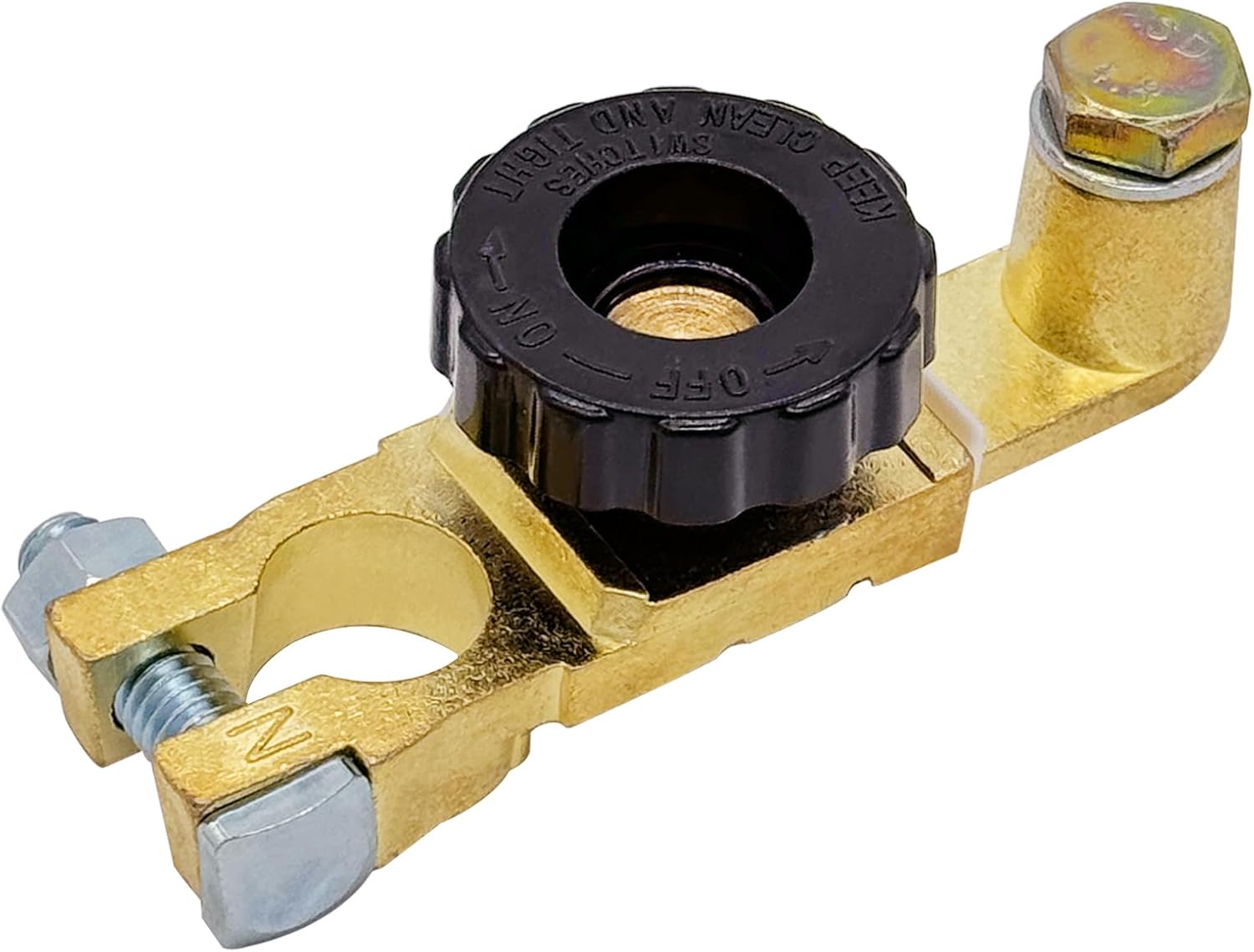
That's good news. Saves me a lot of problems and worry. Presently I am using a wrench to disconnect the negative battery cable. But, the location makes it an awkward process. I just bought this battery disconnect switch to make it faster and easier. But you still have to open the trunk and remove the floor to turn it on/off. Ideally, it would be remote control, so there is no need to open the trunk. But all of the remote control car battery disconnects have the same/similar remote control, which users say is unreliable. That defeats the purpose because it's all about reliability. If there is a reliable remote control version, I'd use it. But for now, it's the mechanical disconnect for me.
Last edited by Scallawalla; May 2, 2025 at 11:48 PM.
I have a stubby socket wrench with a 10mm socket handy. I just hold the floor up with my left hand while I disconnect or reconnect the negative terminal with my other hand.
Any kind of "remote control" is going to draw power by itself, kind of defeating the purpose. And unlikely to be as reliable as needed.
You simply cannot beat the quick disconnect for storing your car. It takes less than a minute to dis/connect... and how long to dis/connect that charger, roll up the leads and put the extension cord away?
Not that it's a competition but everyone knows now about the BCM fires and that's a real issue.
Here's my sequence:
Take what you need out of the car (sunglasses for when you take out your other convertible), close the doors, raise the windows and lock the car.
Open the boot and put a cloth over the lock latch pin on the body so the boot won't latch shut.
Disconnect the battery. From this point on you can't open the doors. Front battery is guaranteed isolated with rear disconnected.
********
Now come back in a month and the battery is gonna be OK. Reset the windows by holding both switches up for several seconds and drive off - this will reset the ESP too.
I received the disconnect switch today and installed it. It's the perfect size. The terminal that attaches to the car's negative cable is right angle, which is perfect to keep it's length just right for this car. The other variation of this one - with a straight terminal vs right angle - protrudes out to the side a bit more making it just a tad too long for this car. Glad I got this one. Another couple nice features of this disconnect is that it's short enough to fit under the floor and it needs no additional hardware or cables. It's the least expensive one and perhaps the most reliable because of its simplicity (less is more when it comes to reliability), and in my opinion, the best one for this car.
Reset the windows by holding both switches up for several seconds and drive off - this will reset the ESP too.
Glad I don't have to turn the steering wheel lock to lock each time. That would be a minor hassle but worse, it would look hacky to any passenger in the car
.
I wonder if anyone has used this type of remote control disconnect switch. I like the remote control for the convenience of not having to open the trunk. But my concern is that it seems that it is a normally open relay. That means it fails open and you could lose the electronic brakes. In the unlikely event that it fails while driving and you lose power/electronic brakes, you'd still have hydraulic brakes to limp off the road. But I'm not convinced the convenience is worth the risk (if it is indeed normally open).
Last edited by Scallawalla; May 9, 2025 at 02:08 PM.
I see it advertised on Amazon. It has 13% 1-star reviews with most of them saying the car shut off while driving or wouldn't start again. Just keep it simple like you have now.
I read those negative Amazon reviews. Yet, everyone reviewing them elsewhere loves them. That makes me think that the Amazon reviews may be fake. Regardless, there seems to be a fundamental problem. The manufacturer specifies that the switch automatically opens at battery voltage less than 11.8V in order to save the battery from discharging any further. That indicates that it needs power for the contacts to be closed, which indicates that is a normally open relay. Hence, if it fails, it fails open, which leaves you without power. For that reason alone, I have to pass on it.
I am working on a customers car that has this on but its an 560sec. As far as working its working great. But a friendly advice i wouldn't try to disconnect a battery on a more modern car nor have this or the manual one on. Every time you disconnect and reconnect the battery you are giving the car a chance to damage a module. My 06 G500 sat for about 6 month and i jumped it it was fine few weeks later it died again this time around when i jumped the car it wiped out the module that controls the rear lights. So from now on even my older cars they are all on 1amp tender.
If you have a multimeter at home i can try to help you find the drain if you want.
Last edited by drivelineharut; May 10, 2025 at 05:56 PM.
There are no issues disconnecting and reconnecting the battery repeatedly on the R230. Reset the windows and drive off; that's all there is to it.
Agreed. I have disconnected the rear battery about 40+ times and both batteries 20+ times in just the 3 years I have had the car. I disconnect both batteries anytime I disconnect modules or other significant work. At most I have to reset the windows. @drivelineharut mentioned that he had to repeatedly jump start his car. Actually modern cars are generally not supposed to be jump started. Our MBs have a sticker on the rear battery stating not to jump start.
Granted, I and my repair shop staff routinely jump start new cars without issues. Perhaps the high quality jump boxes are safer than older methods.
Agreed. I have disconnected the rear battery about 40+ times and both batteries 20+ times in just the 3 years I have had the car. I disconnect both batteries anytime I disconnect modules or other significant work. At most I have to reset the windows. @drivelineharut mentioned that he had to repeatedly jump start his car. Actually modern cars are generally not supposed to be jump started. Our MBs have a sticker on the rear battery stating not to jump start.
Granted, I and my repair shop staff routinely jump start new cars without issues. Perhaps the high quality jump boxes are safer than older methods.
I bet the front starter battery would be a better place to jump start another car. The rear battery is used to supply energy to accessories. So, the demands of using it to jumpstart might overload it or something. However, I just would not jumpstart with either battery because of BCM fire possibilities.
Supercaps are the way to jump a car. Understand what current is and you understand why supercaps are so effective. Current is the speed of electron flow. A discharged battery usually has plenty of charge but it's unable to move that charge to the starter motor fast enough. Enter the supercap. It absorbs the charge from the dead battery slowly (several minutes) and transfers that same charge to the starter circuit instantaneously when you turn the key.
The best part of the supercap is that it is passive. Unlike conventional battery chargers you don't have to keep it charged or have to replace it. Get a good one and it should last a lifetime.
Mercedes SLR McLaren 722 S Is Extremely Rare Example Modified by McLaren
Slideshow: A one-of-one U.S.-spec Mercedes-Benz SLR McLaren Roadster became even rarer after a factory-backed transformation at McLaren's headquarters.