



Which pulley size makes which hp gain?

MBWorld Fanatic!


Joined: Dec 2009
Posts: 1,046
Likes: 28
From: SOCAL
2004 E55
I'm laughing here reading Jangys retarded post's on Lag. Folks there is NO lag on a mechanically driven positive displacement supercharger. The larger the pulley the LOWER the rpm on the crank needed to make the same RPM on the supercharger with a smaller crank pulley.
Like most of Jangys tech "Info" his model is incorrect
Like most of Jangys tech "Info" his model is incorrect

Super Member
Joined: Apr 2009
Posts: 552
Likes: 11
From: Chicago suburbs
2004 E55 AMG
There is definitely no lag. The only downside to a 180mm pulley(besides heat) is that the S/C engagement is much more pronounced on the street. However, as soon as it's engaged it's making more boost than stock. There is no way around it, unless something is slipping, or the tuner screwed up and the bypass valve isn't closing quickly enough. These clutches are either on or off. That is why the whole car jerks when it engages, because it's instant. If there is slippage, something is wrong. Adding 2 lbs of rotational mass(if that) to a rotating assembly that probably weighs more than 100 pounds(crank + internals + torque converter) is negligable. If these cars didn't have clutches I don't think we'd be having this conversation.

Former Vendor of MBWorld
Joined: May 2009
Posts: 2,305
Likes: 93
From: Valley of the Sun, Arizona
C63, SL55, E55, CLS55, ML63, C55
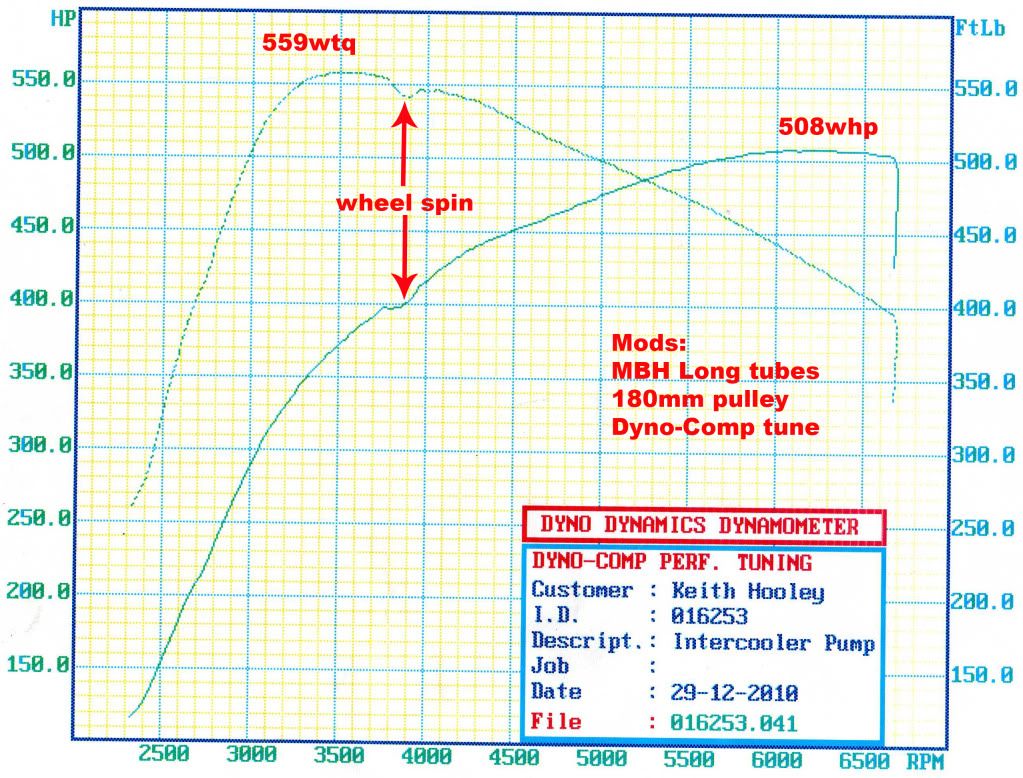
My brother who has a CLS55 just has the same mods as me except he has a MBH heat exchanger. Both of us are still running the OEM I/C pump, however both of ours failed during testing. SO re just replaced them with a new OEM pump. He made less torque than me, but that most likly due to to driveline differences between the CLS and the SL.
As to this thing about lag.. Thats not even a term that exists with a 55k.

Member

Joined: Aug 2010
Posts: 209
Likes: 2
E55 AMG
Hooleyboy , so I guess that means the 180mm put tremendous pressure on the IC pump considering both you and your brother had failure while trying to run the 180 pulley, do you fear issues with longevity in regards to your new pump or any other components give what you experienced? Do you feel the pump failure was heat or pressure related? Also the pump you replaced was it the same part number as the one you had in your vehicle or the revised MB P/N 000 500 03 86 Bosch P/N 0 392 022 010(unless you had the revised pump already) Thanks so much again for your help and advise
Member
Joined: Aug 2010
Posts: 209
Likes: 2
E55 AMG
is it possible that members are using the incorrect terminology, but refering to something that may deter people from purchasing a 180 or larger pulley. Maybe they are feeling traction trying to kick in because the boost comes in at such a low rpm which would essentialy be a lag in take off? or rougher super charger clutch engagement, tune to help with bypass valve engagement or maybe tune to help programmed throttle delay (ie torque management) and torque convertor stall speed. perfect time to intergrate quaifee diff?? Sorry if my input is useless, just given some un educated guesses. Maybe a slipping belt? Did the rpms increase during this "lag" that would be the clutch. Some even say this "lag" could be drive by wire related.....I dont know but it would be nice if maybe it could be explained a bit more thoroughly and refrain from using the word "lag" unless by all means that what you truly believe it is, and maybe together we can come up with a resolution to solve this proble if it exsist so the 180mm pullies and larger can be used effectively without this said problem that some are saying exsist, maybe everyone has it but not everyone identifies it as "lag". Sorry for babaling on I hope members come up with some juicy discussions, you guys are all overflowing with unbelieveable amounts of knowledge, I truly admire it.
Last edited by AMGV855; Jan 16, 2011 at 03:09 PM. Reason: font
Former Vendor of MBWorld
Joined: May 2009
Posts: 2,305
Likes: 93
From: Valley of the Sun, Arizona
C63, SL55, E55, CLS55, ML63, C55
Hooleyboy , so I guess that means the 180mm put tremendous pressure on the IC pump considering both you and your brother had failure while trying to run the 180 pulley, do you fear issues with longevity in regards to your new pump or any other components give what you experienced? Do you feel the pump failure was heat or pressure related? Also the pump you replaced was it the same part number as the one you had in your vehicle or the revised MB P/N 000 500 03 86 Bosch P/N 0 392 022 010(unless you had the revised pump already) Thanks so much again for your help and advise
My old pump looked like it came out of a old WWII tank that was sitting in a field since the 1940's. It was in bad shape. Here is another kicker. I bought a new pump from the dealer and it was bad right out of the box. So I had to go back to the dealer and get yet another pump. It was a total pain.
It always seem with people running OEM pumps, that a pump issue is exposed on the dyno. Most likely becuase you are actually looking at IAT's. Also note: on some cars with bad OEM pumps its not uncommon when the pump dies to take the relay with it as well. A simple volt meter will tell you if the relay is bad too. STAR DAS can also help by turning on the I/C pump. However if it doesn't turn on you know you have an issue. It seemed like my old pump was trying to do something. After removing the overflow line on the I/C circuit we had no flow.
Member
Joined: Aug 2010
Posts: 209
Likes: 2
E55 AMG
Hooleyboy,Wow talk about a pain, that must have been frustrating. Sorry to hear that about the pumps, I guess you had your headers on first, so you dont really know how it affected the boost? I know you dynod your car , but have you run any 1/4 times? Does the supercharger engagement seem alot harsher with the 180 pulley?
Former Vendor of MBWorld
Joined: May 2009
Posts: 2,305
Likes: 93
From: Valley of the Sun, Arizona
C63, SL55, E55, CLS55, ML63, C55
Hooleyboy,Wow talk about a pain, that must have been frustrating. Sorry to hear that about the pumps, I guess you had your headers on first, so you dont really know how it affected the boost? I know you dynod your car , but have you run any 1/4 times? Does the supercharger engagement seem alot harsher with the 180 pulley?
It was a little frustrating, only becuase I had just strapped the car on the dyno. It was the end of the day so I couldnt run and get a new pump. Then first thing in the morning I got the new pump installed, only to find out that one was dead. So I had to uninstall it. I was a pain, but soemtimes you just run into that stuff.I don't think the engagement seems harsher, but the car rips at all RPM's
MB World Stories
The Best of Mercedes & AMG

6 Mercedes Models That Did NOT Age Well (But Are Somehow Still Cool)
Verdad Gallardo
Manual Mercedes? 6 Times Sindelfingen Let Drivers Have All The Fun
Verdad Gallardo
Mercedes SLR McLaren 722 S Is Extremely Rare Example Modified by McLaren
Verdad Gallardo
8 Classic Boxy Mercedes Designs That Have Aged Like Fine Wine
Verdad Gallardo
Flawlessly Restored Mercedes 190E Evo II Heads to Auction
Verdad Gallardo
Electric Mercedes C-Class Unveiled: 11 Things You Need to Know
Verdad Gallardo
Mercedes EQS Gets A Major Update: Everything You Need to Know
Verdad Gallardo
5 Underrated Mercedes-Benz Models That Don't Get the Love They Deserve
Verdad Gallardo
Mercedes 300D Has Pushed Well Past 1 Million Miles and It Ain't Stopping
Verdad Gallardo
Member
Joined: Aug 2010
Posts: 209
Likes: 2
E55 AMG
Sweeet!! thats what im talking about, better rip at all rpms after all the aggrevation. Im glad it worked out for you. Hey out of curiosity I know you do Long Tube headers, but what about shorties? If not is there a certain way you would direct me? Thanks for all your feedback my friend,
180mm pulley FTW
180mm pulley FTW
Member
Joined: Aug 2010
Posts: 209
Likes: 2
E55 AMG
Hooleyboy, I had a quick question about your pulley. You said you have a 180mm ASP pulley, is that the Eurocharged ASP or directly from ASP and did you research both before purchase any advice, Thanks again youre the best

MBWorld Fanatic!
Joined: May 2009
Posts: 1,484
Likes: 13
From: Abu Dhabi
C218 CLS63TT PP Edition1, W213 E63S

MBWorld Fanatic!
Joined: Apr 2009
Posts: 1,582
Likes: 1
From: Lafayette, IN
2008 ML63 2009 SL63 2010 Alpha 7 GTR

MBWorld Fanatic!
Joined: Feb 2009
Posts: 6,897
Likes: 85
From: Central WI (BFE)
SL55, ML500 & Acura TL

MBWorld Fanatic!
Joined: Apr 2009
Posts: 1,582
Likes: 1
From: Lafayette, IN
2008 ML63 2009 SL63 2010 Alpha 7 GTR

MBWorld Fanatic!
Joined: Feb 2007
Posts: 1,010
Likes: 0
From: Phoenix by way of Texas
2003 E55 AMG


MBWorld Fanatic!
Joined: Oct 2009
Posts: 1,097
Likes: 1
From: Queen Creek AZ
2004 E55 AMG
I've had my 180mm pulley on for a month now (see sig) and having come from stock there can be a bit of a jerk/jump especially at lower RPM's if you're just putting along in lower gears.
I drive 100 miles every day to and from work and I find it to be no big deal especially since I leave my car in "C" mode mostly. When I put it in "S" mode where the shifts are more aggressive it can get annoying but in C mode I barely even notice it.
I'm very happy with the pulley and tune and with the upgraded HE I've taken steps to keep the heat in check.
My $.02.
Alex
I drive 100 miles every day to and from work and I find it to be no big deal especially since I leave my car in "C" mode mostly. When I put it in "S" mode where the shifts are more aggressive it can get annoying but in C mode I barely even notice it.
I'm very happy with the pulley and tune and with the upgraded HE I've taken steps to keep the heat in check.
My $.02.
Alex
MBWorld Fanatic!
Joined: May 2009
Posts: 1,484
Likes: 13
From: Abu Dhabi
C218 CLS63TT PP Edition1, W213 E63S
2 cars i saw.
one is E that has 190mm crank pulley and 86mm S/C pulley.
the other is SL that has 180mm crank and also 86mm S/C pulley.
the SL in the drag was trapping 210km 12.6 with very bad traction in 60ft about 2.3
while the E was having some brake issues in the drag race so he had to pull off.
they also have upgraded H/E, IC pump.
MBWorld Fanatic!
Joined: May 2009
Posts: 1,484
Likes: 13
From: Abu Dhabi
C218 CLS63TT PP Edition1, W213 E63S
in my city, its rare to race from dig because there are only 7 traffic lights .

mostly from rolling between roundabouts. lol

which the 55 is insane on 2 - 3 gears
well mine is
 coz if i hit it from dig, u can feel that it pulls your head back when 2nd gear ingage although i gave it WOT from 1st.
MBWorld Fanatic!


Joined: Jul 2005
Posts: 3,175
Likes: 19
From: London, UK
No longer stock '06 E55, A3 3.2 Quattro, GLE 400d, R107 280SL, Golf Polo
Guys we seem to be forgetting the S/C is a machine than needs power to run. The faster you run it the more power you need, and this is not a linear relationship either. You need proportionately more power the faster you spin the S/C. Its got nothing to do with the pulleys rotational mass or size.
So when a 180mm engages, what seems like lag is actually the S/C sucking power before it has had a chance to boost to replace the power drain. On smaller pulleys this is less evident. So this is not "lag" in the traditional sense, but a power drain none the less. I know the SLR S/C needs over 100hp to run at max rpm. Added to this you have an efficiency window on the S/C - you cannot just spin it faster and faster and expect to make proportionately more power. There is an opperating window where its most efficient and I would say 180mm is pretty much close to maxing out power and efficiency in all respects.
Also big pulleys need a tune, smaller pulleys could probably get away without one as the boost increase will be within the oem maps ability to manage the moderate boost increase, but they too will benefit from a remap obviously.
Also other effects come into it like belt slip (more prone the bigger the pulley)... etc etc so there is no hard and fast rule, as can be seen by similar very powerfull cars running pulleys from 168 to 185. Bigger pulleys will have less max power duration than smaller pulleys, as the heat generation is worse, but give bigger torque jump... short blasts ? 180 is gr8, 1 mile + I reckon 170-5 max ...
On an aside, keep in mind if we can generate the kind of boost the S/C produces via turbos efficiently we automatically are 100hp better off due to the S/C parasytic losses being eliminated, obviously there is no free lunch and the turbo back pressure and drive will eat into this a bit but there is ALLOT of power on the table on a turbo alternative.... and it may be more drivable with boost coming on a bit later and smoother, when traction has been established.
So when a 180mm engages, what seems like lag is actually the S/C sucking power before it has had a chance to boost to replace the power drain. On smaller pulleys this is less evident. So this is not "lag" in the traditional sense, but a power drain none the less. I know the SLR S/C needs over 100hp to run at max rpm. Added to this you have an efficiency window on the S/C - you cannot just spin it faster and faster and expect to make proportionately more power. There is an opperating window where its most efficient and I would say 180mm is pretty much close to maxing out power and efficiency in all respects.
Also big pulleys need a tune, smaller pulleys could probably get away without one as the boost increase will be within the oem maps ability to manage the moderate boost increase, but they too will benefit from a remap obviously.
Also other effects come into it like belt slip (more prone the bigger the pulley)... etc etc so there is no hard and fast rule, as can be seen by similar very powerfull cars running pulleys from 168 to 185. Bigger pulleys will have less max power duration than smaller pulleys, as the heat generation is worse, but give bigger torque jump... short blasts ? 180 is gr8, 1 mile + I reckon 170-5 max ...
On an aside, keep in mind if we can generate the kind of boost the S/C produces via turbos efficiently we automatically are 100hp better off due to the S/C parasytic losses being eliminated, obviously there is no free lunch and the turbo back pressure and drive will eat into this a bit but there is ALLOT of power on the table on a turbo alternative.... and it may be more drivable with boost coming on a bit later and smoother, when traction has been established.
Last edited by stevebez; Jan 24, 2011 at 07:14 AM.
Member
Joined: Aug 2010
Posts: 209
Likes: 2
E55 AMG
How is 180mm the max??
Added to this you have an efficiency window on the S/C - you cannot just spin it faster and faster and expect to make proportionately more power. There is an opperating window where its most efficient and I would say 180mm is pretty much close to maxing out power and efficiency in all respects.
Why are some people seeing more power with even larger? 185mm 190mm 205mm
I am not arguing and I believe what you are saying I may have even come to believe it is even smaller than 180mm that is maxing out the power and effecientcy, after some of my own reading.
Can the threshold of the boost be increased so that it does not bleed off excess boost, prior to utilizing the actual cappability of what is being produced? Is this part of a Ecu remap?
Member
Joined: Aug 2010
Posts: 209
Likes: 2
E55 AMG
your last question is more complicate but again, you can find alot of info through search.
Summing up, first thing you must have an accurate view at this chart.

Let's try to do the homework together :
with Stock pulley we are at about 62% efficiency, with the blower running at about 10K rpms (at engine redline) and a discharge air temp of 100+ degrees C.
Max allowed blower rpm is declared at 13,500rpms, with a max pressure of 2.2 times the natural pressure. therefore it is 2.2-1 = 1.2BAR
we know that Stock SC pulley is about 91mm;
- stock crankpulley is 151
therefore Ratio is 151/91 = 1.659 ratio
.. meaning that at engine redline of 6500, the blower will run at 10,784rpms
the result you are looking for should be 13500/6500= 2.07 ratio
therefore the theoretical max crank pulley is 2.07x91= 188mm
and you get 1.2BARs of boost.
obviously, it depends on where your engine limiter is at ! ... a 7000rpm engine limiter would allow a maximum of 175mm crank pulley
but, keep in mind there is a reverse relationship between efficiency and boost level, as the graph and common sense suggest ..
personally I prefer to obtain the power more from inside the engine than from outside (the blower)
.. but this is only a matter of tastes ..I like so much high revving engines
Summing up, first thing you must have an accurate view at this chart.

Let's try to do the homework together :
with Stock pulley we are at about 62% efficiency, with the blower running at about 10K rpms (at engine redline) and a discharge air temp of 100+ degrees C.
Max allowed blower rpm is declared at 13,500rpms, with a max pressure of 2.2 times the natural pressure. therefore it is 2.2-1 = 1.2BAR
we know that Stock SC pulley is about 91mm;
- stock crankpulley is 151
therefore Ratio is 151/91 = 1.659 ratio
.. meaning that at engine redline of 6500, the blower will run at 10,784rpms
the result you are looking for should be 13500/6500= 2.07 ratio
therefore the theoretical max crank pulley is 2.07x91= 188mm
and you get 1.2BARs of boost.
obviously, it depends on where your engine limiter is at ! ... a 7000rpm engine limiter would allow a maximum of 175mm crank pulley
but, keep in mind there is a reverse relationship between efficiency and boost level, as the graph and common sense suggest ..
personally I prefer to obtain the power more from inside the engine than from outside (the blower)
.. but this is only a matter of tastes ..I like so much high revving engines
MBWorld Fanatic!
Joined: Jul 2005
Posts: 3,175
Likes: 19
From: London, UK
No longer stock '06 E55, A3 3.2 Quattro, GLE 400d, R107 280SL, Golf Polo
Wow missed that map!!! Very usefull info.
Working out the optimum size is pretty hard work and as dyno showed from the map and calcs 188mm would be an extreme to provide longevity on the S/C.... but then we are ignoring the efficiency decline as spin rates increase...and 8000rpm seems to be the efficiency peak of the S/C unless I am interpreting the map incorrectly.
It would be interesting to overlay the diff pulley sizes over that map - if you can even see another layer of data on that chart!
If I had to do it again I probably would go for a 175mm... I think what is important is at what engine rpm you hit peak s/c efficiency and that efficiency does not tail off too much at max rpm... whats telling to me is the volumetric efficiency above 11k rpm grows much slower.
It would be very handy to document all this data and be able to view it against different axes...
Working out the optimum size is pretty hard work and as dyno showed from the map and calcs 188mm would be an extreme to provide longevity on the S/C.... but then we are ignoring the efficiency decline as spin rates increase...and 8000rpm seems to be the efficiency peak of the S/C unless I am interpreting the map incorrectly.
It would be interesting to overlay the diff pulley sizes over that map - if you can even see another layer of data on that chart!
If I had to do it again I probably would go for a 175mm... I think what is important is at what engine rpm you hit peak s/c efficiency and that efficiency does not tail off too much at max rpm... whats telling to me is the volumetric efficiency above 11k rpm grows much slower.
It would be very handy to document all this data and be able to view it against different axes...


