





B.I.P makes big power in the TEXAS heat

Super Member
Joined: Jan 2007
Posts: 617
Likes: 1
From: San Diego
MB
Open element air cleaners don't seem to hinder the performance of all those turbo inline sixes (supras for example). The car is intercooled and if the AITs are too high then the intercooler isn't sufficient. Looks like this car is equipped with a separate reservoir.

Super Member
Joined: Oct 2012
Posts: 637
Likes: 40
From: Keller
clk63, cls55, ml63, (w210) E55
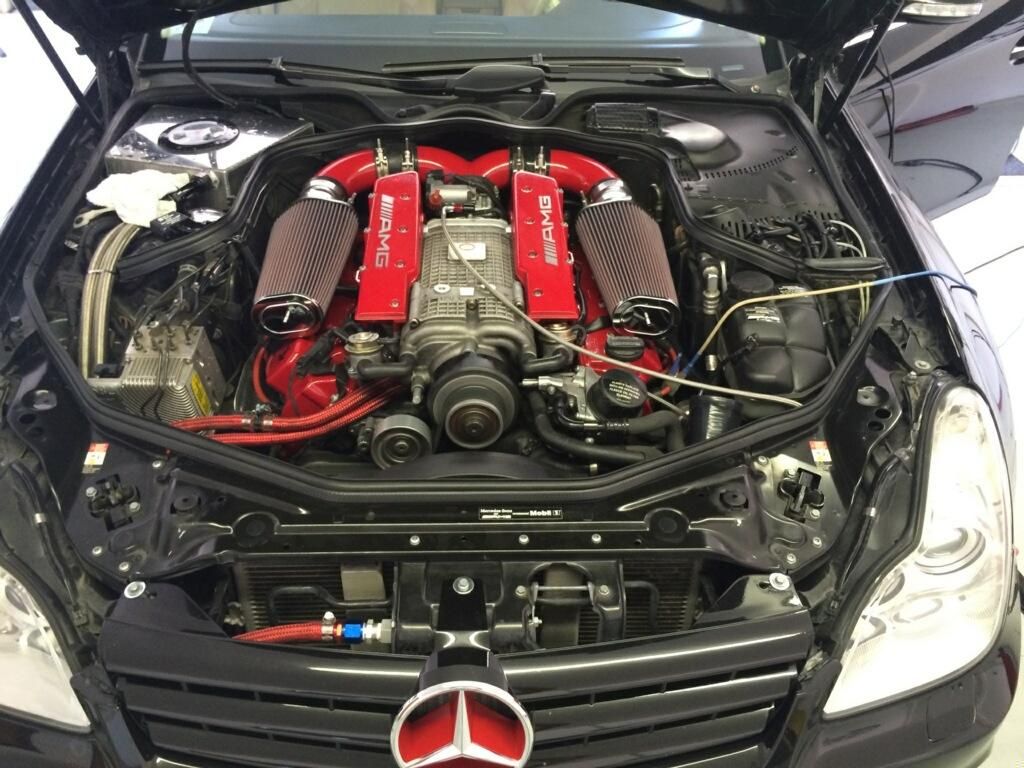
I installed a second heat exchanger that sits behind the Mercedes star. All intercooler lines are replaced with 10AN braided hose for a better flow than the angled aluminum factory tubes. Engine valley is thermo blanket lined as the intercooler has three layers of thermo tape.
Super Member
Joined: Oct 2012
Posts: 637
Likes: 40
From: Keller
clk63, cls55, ml63, (w210) E55
Super Member
Joined: Oct 2012
Posts: 637
Likes: 40
From: Keller
clk63, cls55, ml63, (w210) E55
Thank you, sir.
Dallas Performance's dynojet would not let us load up the engine like you can on other type of dynos. Tony had to try different roll ons to get it. My torque readings are low because of it. Supercharger engagement at low rpms?
The dyno kept crashing on us. 2 or 3 runs were not even recorded. Towards the end of the runs the engine was hot as hell due to heat soak.....@3:00 pm in Texas heat. This was a room with a dyno.....there was NO flow of air other than the fan.
The dyno kept crashing on us. 2 or 3 runs were not even recorded. Towards the end of the runs the engine was hot as hell due to heat soak.....@3:00 pm in Texas heat. This was a room with a dyno.....there was NO flow of air other than the fan.
MBWorld Fanatic!

Joined: Dec 2006
Posts: 1,124
Likes: 32
From: Florida-Germany-New York
2004 E55,1969 300SEL6.3,2011 ML350 BlueTec Diesel,2005 ML400 CDI
Will still be an issue but the meth will help mask the heat and reduce detonation. If the intakes were drawing cold air, the car would make more power much like it did on the dyno with the hood open. Drawing in hot air from the engine bay kills power. It should not even be a discussion.


MBWorld Fanatic!
Joined: Feb 2004
Posts: 9,155
Likes: 20
From: Southern, CA.
V12-Biturbo
The Meth negates 100 deg ambient heat.. But shut the hood & that dyno would drop 30+ whp.. W/filters being set so far back and resting ontop broiling engine this type of intake is worse than the Scorpions on the v12's after hood shuts those IAT's will go thru the roof after 5 min of heatsoak w/hood closed the meth will barely make a dent at that point..
Upon closer study, notice the airfilters have metal end caps blocking ANY small amount of fresh air the oem holes would deliver at high speeds from the front, with hood closed the only airflow will be gathered on the top and right/left sides of the filters ie front blocked, and the bottoms are blocked by scorching valve covers. Hot air rises and the hood is going to be an inch or two away from top of filters etc.. Good luck on that..
Upon closer study, notice the airfilters have metal end caps blocking ANY small amount of fresh air the oem holes would deliver at high speeds from the front, with hood closed the only airflow will be gathered on the top and right/left sides of the filters ie front blocked, and the bottoms are blocked by scorching valve covers. Hot air rises and the hood is going to be an inch or two away from top of filters etc.. Good luck on that..
Last edited by Thericker; Aug 16, 2014 at 10:25 PM.
MB World Stories
The Best of Mercedes & AMG

Manual Mercedes? 6 Times Sindelfingen Let Drivers Have All The Fun
Verdad Gallardo
Mercedes SLR McLaren 722 S Is Extremely Rare Example Modified by McLaren
Verdad Gallardo
8 Classic Boxy Mercedes Designs That Have Aged Like Fine Wine
Verdad Gallardo
Flawlessly Restored Mercedes 190E Evo II Heads to Auction
Verdad Gallardo
Electric Mercedes C-Class Unveiled: 11 Things You Need to Know
Verdad Gallardo
Mercedes EQS Gets A Major Update: Everything You Need to Know
Verdad Gallardo
5 Underrated Mercedes-Benz Models That Don't Get the Love They Deserve
Verdad Gallardo
Mercedes 300D Has Pushed Well Past 1 Million Miles and It Ain't Stopping
Verdad Gallardo
10 Most Reliable Mercedes-Benz Models You Can Buy Used
Verdad Gallardo
MBWorld Fanatic!


Joined: Aug 2003
Posts: 8,882
Likes: 1,212
From: In my garage
E55, GLS450, GL63, GLE350
A 30 whp drop is conservative. I think it would be more like 50 to 60 whp when the hood is closed and it starts to heatsoak. General rule of thumb, if my memory serves me correctly, is a 1% drop in hp for every 10 degrees above ambiant. The other issue is the blower is trying to compress air that will already be double that of ambiant air so it will not be nearly as effective. The air already heats up from compressing it so if it is already hot it won't compress nearly as much as if it were cooler.
You would be much better running a 4" line off that first coupling to the front and run the air filters in front of the radiator so it gets cool air. If you did that, the car would be much more consistent and much less likely to heat soak in the first few minutes of operation on a hot day. There are some good examples of this on the CL and SL AMG forum.
You would be much better running a 4" line off that first coupling to the front and run the air filters in front of the radiator so it gets cool air. If you did that, the car would be much more consistent and much less likely to heat soak in the first few minutes of operation on a hot day. There are some good examples of this on the CL and SL AMG forum.

Super Member
Joined: Apr 2012
Posts: 887
Likes: 2
From: Northern California
2004 E55 AMG; 1991 Previa
The Meth negates 100 deg ambient heat.. But shut the hood & that dyno would drop 30+ whp.. W/filters being set so far back and resting ontop broiling engine this type of intake is worse than the Scorpions on the v12's after hood shuts those IAT's will go thru the roof after 5 min of heatsoak w/hood closed the meth will barely make a dent at that point..
Upon closer study, notice the airfilters have metal end caps blocking ANY small amount of fresh air the oem holes would deliver at high speeds from the front, with hood closed the only airflow will be gathered on the top and right/left sides of the filters ie front blocked, and the bottoms are blocked by scorching valve covers. Hot air rises and the hood is going to be an inch or two away from top of filters etc.. Good luck on that..
Upon closer study, notice the airfilters have metal end caps blocking ANY small amount of fresh air the oem holes would deliver at high speeds from the front, with hood closed the only airflow will be gathered on the top and right/left sides of the filters ie front blocked, and the bottoms are blocked by scorching valve covers. Hot air rises and the hood is going to be an inch or two away from top of filters etc.. Good luck on that..
A 30 whp drop is conservative. I think it would be more like 50 to 60 whp when the hood is closed and it starts to heatsoak. General rule of thumb, if my memory serves me correctly, is a 1% drop in hp for every 10 degrees above ambiant. The other issue is the blower is trying to compress air that will already be double that of ambiant air so it will not be nearly as effective. The air already heats up from compressing it so if it is already hot it won't compress nearly as much as if it were cooler.
You would be much better running a 4" line off that first coupling to the front and run the air filters in front of the radiator so it gets cool air. If you did that, the car would be much more consistent and much less likely to heat soak in the first few minutes of operation on a hot day. There are some good examples of this on the CL and SL AMG forum.
You would be much better running a 4" line off that first coupling to the front and run the air filters in front of the radiator so it gets cool air. If you did that, the car would be much more consistent and much less likely to heat soak in the first few minutes of operation on a hot day. There are some good examples of this on the CL and SL AMG forum.
Now on a 100* day ALL cars will have issues running well so the temperature is irrelevant since we all have to overcome that. The fact that he put that much power down in the heat says all we need to know. I would like to see another car put down that much power in 100* weather. Also remember OPs runs was with NOT ideal temperatures, HIGH strain on the cooling system and engine temps through the roof. Just imagine what hes going to be running when its 60* outside.
Now heat soak is another factor for again ALL 55K platforms and you can see he's got some crazy cooling system setup (please elaborate OP). But until heat soak happens 4-5 runs maybe 10 on the setup, he's going to be whooping your *** down the track.
EDIT: also most drag racing happens at night, not during 100* temps. So the 30-40* drop in temp will negate the 'closed ended intakes' and allow him to close his hood and still run well. LMAO at that one.
Last edited by biggking; Aug 17, 2014 at 01:27 AM.
MBWorld Fanatic!
Joined: Feb 2004
Posts: 9,155
Likes: 20
From: Southern, CA.
V12-Biturbo
A 30 whp drop is conservative. I think it would be more like 50 to 60 whp when the hood is closed and it starts to heatsoak. General rule of thumb, if my memory serves me correctly, is a 1% drop in hp for every 10 degrees above ambiant. The other issue is the blower is trying to compress air that will already be double that of ambiant air so it will not be nearly as effective. The air already heats up from compressing it so if it is already hot it won't compress nearly as much as if it were cooler.
You would be much better running a 4" line off that first coupling to the front and run the air filters in front of the radiator so it gets cool air. If you did that, the car would be much more consistent and much less likely to heat soak in the first few minutes of operation on a hot day. There are some good examples of this on the CL and SL AMG forum.
You would be much better running a 4" line off that first coupling to the front and run the air filters in front of the radiator so it gets cool air. If you did that, the car would be much more consistent and much less likely to heat soak in the first few minutes of operation on a hot day. There are some good examples of this on the CL and SL AMG forum.
Yeah I agree, toss those useless airfilters w/metal end caps & run some 3"-4" piping out to oem holes and fit smaller cones off radiator behind grill
MBWorld Fanatic!
Joined: Feb 2004
Posts: 9,155
Likes: 20
From: Southern, CA.
V12-Biturbo
It does not matter what the temperature of the air INTO the motor is (at least not too much). You have to understand that the SC creates more heat when it works (more physics) and that you only need to worry about the air temperatures AFTER the SC, which is where the meth comes in. It is ideal to scoop cold air in but the affects of 3-5* difference in ambient temps makes almost NO difference once it goes into the SC. 100* ambient temps vs 70* ambient temps is a 30% difference so yes there will be some variation of power of course.
Now on a 100* day ALL cars will have issues running well so the temperature is irrelevant since we all have to overcome that. The fact that he put that much power down in the heat says all we need to know. I would like to see another car put down that much power in 100* weather. Also remember OPs runs was with NOT ideal temperatures, HIGH strain on the cooling system and engine temps through the roof. Just imagine what hes going to be running when its 60* outside.
Now heat soak is another factor for again ALL 55K platforms and you can see he's got some crazy cooling system setup (please elaborate OP). But until heat soak happens 4-5 runs maybe 10 on the setup, he's going to be whooping your *** down the track.
EDIT: also most drag racing happens at night, not during 100* temps. So the 30-40* drop in temp will negate the 'closed ended intakes' and allow him to close his hood and still run well. LMAO at that one.
Now on a 100* day ALL cars will have issues running well so the temperature is irrelevant since we all have to overcome that. The fact that he put that much power down in the heat says all we need to know. I would like to see another car put down that much power in 100* weather. Also remember OPs runs was with NOT ideal temperatures, HIGH strain on the cooling system and engine temps through the roof. Just imagine what hes going to be running when its 60* outside.
Now heat soak is another factor for again ALL 55K platforms and you can see he's got some crazy cooling system setup (please elaborate OP). But until heat soak happens 4-5 runs maybe 10 on the setup, he's going to be whooping your *** down the track.
EDIT: also most drag racing happens at night, not during 100* temps. So the 30-40* drop in temp will negate the 'closed ended intakes' and allow him to close his hood and still run well. LMAO at that one.
The intake will kill his power when hoods shut period.. The ONLY thing that'll make that intake work would be to ditch the Meth & spray Nitrous to cool the IAT's down..
Last edited by Thericker; Aug 17, 2014 at 01:40 AM.
Super Member
Joined: Apr 2012
Posts: 887
Likes: 2
From: Northern California
2004 E55 AMG; 1991 Previa
Wrong.. You're forgetting the cars tuned w/ms 109 my good friend URNXT tuned for ms109 on his highly modified sl55 few years back he added exactly 25-30 whp thru entire curve.. Take away the ms 109 & shut the hood and redyno in that same heat w/pump gas & that car would be hard pressed to put down 502 whp let alone 602whp
The intake will kill his power when hoods shut period.. The ONLY thing that'll make that intake work would be to ditch the Meth & spray Nitrous to cool the IAT's down..
The intake will kill his power when hoods shut period.. The ONLY thing that'll make that intake work would be to ditch the Meth & spray Nitrous to cool the IAT's down..

MBWorld Fanatic!
Joined: Feb 2004
Posts: 9,155
Likes: 20
From: Southern, CA.
V12-Biturbo
Wow you really know your stuff, what was I thinking PS this build has major motor work done in lieu of the regular bolton mods, making 600 whp w/these added crutches (meth & 109) doesn't mean this is freak by any means..
PS this build has major motor work done in lieu of the regular bolton mods, making 600 whp w/these added crutches (meth & 109) doesn't mean this is freak by any means..
Last edited by Thericker; Aug 17, 2014 at 02:07 AM.
Super Member
Joined: Apr 2012
Posts: 887
Likes: 2
From: Northern California
2004 E55 AMG; 1991 Previa
I agree 100%, I just think it's got a lot of potential if they were able to put down some GREAT numbers at 100*. Sorry if I came across as a dick face know it all. You are right in saying those crutches take it to another level, but what else can we do to get that much power?
Super Member
Joined: Nov 2011
Posts: 789
Likes: 14
2003 E55
How much boost did you see with this pulley config and any issue with it going into limp mode? I had a 175/77 but no ported heads and was seeing 18.6 psi and maxing out the map sensor ended up doing real damage.

MBWorld Fanatic!
Joined: Mar 2011
Posts: 1,879
Likes: 22
From: Orange County, CA.
one car at a time
Do you think a 175/80 combo would be ok (IIRC the map sensor issue is ~17.5 psi) ?


Super Member
Joined: Nov 2011
Posts: 789
Likes: 14
2003 E55
Super Member
Joined: Nov 2011
Posts: 789
Likes: 14
2003 E55
Super Member
Joined: Oct 2012
Posts: 637
Likes: 40
From: Keller
clk63, cls55, ml63, (w210) E55
The Meth negates 100 deg ambient heat.. But shut the hood & that dyno would drop 30+ whp.. W/filters being set so far back and resting ontop broiling engine this type of intake is worse than the Scorpions on the v12's after hood shuts those IAT's will go thru the roof after 5 min of heatsoak w/hood closed the meth will barely make a dent at that point..
Upon closer study, notice the airfilters have metal end caps blocking ANY small amount of fresh air the oem holes would deliver at high speeds from the front, with hood closed the only airflow will be gathered on the top and right/left sides of the filters ie front blocked, and the bottoms are blocked by scorching valve covers. Hot air rises and the hood is going to be an inch or two away from top of filters etc.. Good luck on that..
Upon closer study, notice the airfilters have metal end caps blocking ANY small amount of fresh air the oem holes would deliver at high speeds from the front, with hood closed the only airflow will be gathered on the top and right/left sides of the filters ie front blocked, and the bottoms are blocked by scorching valve covers. Hot air rises and the hood is going to be an inch or two away from top of filters etc.. Good luck on that..
MBWorld Fanatic!
Joined: Aug 2003
Posts: 8,882
Likes: 1,212
From: In my garage
E55, GLS450, GL63, GLE350
No, it really does matter. Kenne Belle's website has a good article on this and why you should dyno with the hood closed to simulate how the car will operate on the street.
http://kennebell.net/KBWebsite/Commo...ureTesting.pdf
AIR TEMPERATURE TESTING
At the end of the day, what really matters is HOW DOES MY SUPERCHARGER KIT PERFORM WHEN I’M IN BOOST? DOES IT DELIVER THE ADVERTISED HP AND PERFORMANCE? Occasionally, temperature or other test data by an individual may be misleading.
For example: There has been considerable discussions regarding air and water temperatures of supercharger kits. Comparisons are okay if they are accurate. If not, they are just more misinformation circulating on the web.
And, it is not our intent to compare the design and efficiency of any kit or the individual mechanical components that influence air discharge temp. These are the supercharger, inlet tract, intercooler, heat exchanger, pump etc. Optimizing these parts lower the air discharge temps resulting in greater HP and reduced detonation potential. “Hot air” under-hood inlets increase temps and hurt performance by 30-55HP while adding an external real cool air kit does the opposite. One would have to be living in a village to not be aware of these basics- cooler air MAKES MORE HP.
Instead, we hope to point out the testing procedure and criteria we use at Kenne Bell to accurately compare the charge and coolant temps when dyno testing. Disregard any of the following 12 parameters and accuracy is compromised resulting in bogus comparison data. As you will see, it’s easy to skew the data with even the same car, kit, day, ambient and boost.
If any meaningful or accurate data is to be derived from comparing the air discharge temps of supercharger kits on a vehicle, it must be a controlled test with specific test parameters that ELIMINATE THE VARIABLES.
All the below will, and do, affect temperature when tested on a chassis dyno. One “kit” may wrongly appear superior or inferior on the same vehicle because of the simple temp or boost reading error or failure to note a cool air kit upgrade or open vs closed hood change to one kit and not the other.
Also, dyno testing with an open hood vs a vehicle at road speed are two different temp scenarios.
VARIABLES THAT AFFECT COMPARISON TESTING
1) UNDER-HOOD TEMP (HOOD UP VS DOWN)
2) AMBIENT TEMP.
3) ACTUAL BOOST (1 PSI OF BOOST= 10*-15* SC air discharge temps.)
4) RPM, LENGTH OF RUN + GEAR RATIO
5) STARTING AIR TEMP
6) STARTING INTERCOOLER FLUID TEMP.
7) WATER VS. COOLANT RATIO
8) SUPERCHARGER TEMP.
9) INLET RESTRICTION
10) IDLE-RUN-AFTER RUN
11) WHERE THE ACTUAL CHARGE TEMP MEASUREMENT IS TAKEN
12) IMPROPER CIRCULATION (AIR TO WATER)
13) HEAT EXCHANGERS, INTERCOOLERS & PUMPS
1a) FILTER TEMP- The ONLY measurement to use for “engine in” air temp. calculations. Other temp readings under, above or around the dyno or car are wrong. The engine draws air from the filter. Nowhere else matters. Keep in mind this temp. alters HP at 1% per 10* of variation. Also, cooler ambient air makes more boost.
1b) UNDER-HOOD TEMPS (HOOD UP VS DOWN)- Why do dyno operators insist on testing with the hood “up?” That isn’t the way the cars are driven. CLOSE THE HOOD- unless you want false air data. Under-hood temps. reach 200* vs 70* or ambient outside air. If the filter (inlet source) is located under the hood, then the dyno run should be conducted the same way hood closed. Why is that so difficult to grasp for so many? What are they afraid of? Yes, the hot under-hood air will reduce HP, increase the detonation threshold, lower boost, alter supercharger efficiency and elevate engine and exhaust temps. Not good, but it is what it is- hotter air.
It’s why everyone uses scoops and not mini sized grill cracks to supply the 750-1500 cu.ft. of cool air flow required by the engine. And why the Camaro utilizes an air scoop in the grill. They are looking for cool outside air for their filter box. Close the hood with an “open” under-hood filter and watch your kits power drop 55HP! See “Kenne Bell 30HP Advantage” for comparisons.
Fact: Very little cool air finds it’s way through those little 50 CFM grill openings. Yes, some outside air mixes with all that hot air from the radiator, engine, headers etc. but it is all ingested via the filter into your engine.
Finally, under-hood shrouds and seals do virtually nothing. Once eliminated, this common but huge test misstep (we’ve seen up to 55 HP and 100* with hood “up” vs. “down”) the rest is common sense testing and the air and water data will support meaningful accurate results. All Kenne Bell kits mount the filter outside the engine bay where temps are cooler and consistent at any vehicle position or speed. The dyno fan will simulate vehicle high speed and under-hood air flow.
So, no exceptions. Locate the ambient temp sensor at the filter whether it be under-hood (hood down) or behind the front bumper. Begin test at the same temp or data is junk.
2) AMBIENT TEMP- Cool outside the engine bay air is what also cools the fluid in the heat exchanger. Cooler air= cooler water= cooler supercharger air into the intercooler= cooler air charge to engine= more boost= higher HP. So, ambient air temp should be the same as it influences all the other components. 20* higher ambient raises intercooler air and water temps. It
does matter.
3) ACTUAL BOOST- Boost makes HP, but it produces heat. There’s no free ride. Twin Screw positive displacement, and centrifugal superchargers generate approximately 10* of charge temp per PSI. Starting run design temps are approx. 10* per PSI + Inlet temp. Example: 90* ambient +
90* (9 PSI) = min air charge temp 180* before intercooler. Roots style are higher. Be sure “actual” boost is the same. Don’t just assume all 9 PSI kits develop exactly the same boost. The intercooler system (air to water or air to air) is typically 50-75% efficient depending on numerous kit design variables. To accurately compare kits, boost cannot vary.
4) RPM, LENGTH OF RUN & GEAR RATIO- The higher the RPM, read end or trans. gears the longer the dyno run and the greater the final temp. Everything heats up with time until there is stabilization. Use the same vehicle to insure accuracy.
5) STARTING INTERCOOLER WATER TEMP- If the intercooler water ( it cools the air) is 20* hotter at the “start” of the run, the “finish” will be hotter. Start temps must be identical for accurate comparisons. Intercooler “start” water and air temps can vary from ambient 70* to 200* depending on idle time. Now, at what temp do you “start” the run? Get the picture?
6) STARTING INLET AIR TEMP- Same here. Obviously, a hotter filter at the beginning of a run results in higher supercharger discharge temps. A 30-50* variance is common. Start test at same filter air temp. or the tests are useless. NOTE: Under-hood filters are difficult to test because engine bay temps increase (heat soak) with time when idling from ambient to 200*.
Open the hood and let cooler dyno room external air blow in and the test are skewed.
7) WATER VS. COOLANT- Since no liquid cools better than water, 100% water is best. 50/50 is not as efficient in cooling. 90/10 is better. Try placing ice cubes in a pot of coolant. Ice 32* and coolant 50* between the ice cubes. Engine coolant “resists” lower temperatures and freezing. Run the same mix when testing if your goal is an accurate comparison.
8) SUPERCHARGER TEMP (HEAT SOAKING)- Obviously, heat soaked components can heat the air passing through them. For example: We use a thermal laser gun to quickly measure supercharger case temp. If the supercharger is covered (never on our design priority list) with a manifold, intercooler or plastic engine cover, it obviously runs hotter. Then there’s the heat transfer from the engine. However, for test comparisons, the temps. of the supercharger and other metal or plastic pieces in a particular kit “are what they are.” Also consider the type of supercharger and the pressure ratio. Centrifugals run cooler at idle because they are not compressing air (boost) like the positive displacement superchargers. No heat of compression- no boost. Less boost at low and mid range- less heat. Boost IS heat. The twin screw can run higher pressure ratios of 2.1 (15 psi) vs 1.4 (6 psi) so, of course the “idle” temps are higher. Again, you look at the higher efficiency and boost of a 15-30 psi Twin Screw and the benefits. Higher IAT’s
are unavoidable.
9) INLET RESTRICTION- NEVER compare 2 kits with inlet tracts ( filter, meter, tubing, throttle body etc.) that vary in restriction/efficiency. If one inlet is larger and enjoys less restriction to air flow to the supercharger, then the supercharger is not required to work as hard. Like sucking coke through a straw vs. a straw half pinched off. The upside of a larger inlet tract
is the supercharger uses less HP to suck in the air and subsequently runs cooler AND develops more boost. Supercharging efficiency, boost and inlet temps will all be better but DIFFERENT.
10) IDLE/RUN-AFTER RUN- Idle temp. will be highest before a run. Let it cool to the test temp. and make the run in the same gear, car, boost, trans. and RPM. Check the data at the same peak RPM as everything heats up after getting off the throttle.
11) WHERE THE ACTUAL CHARGE TEMP MEASUREMENTS IS TAKEN- This is
probably the most important part of the measurement process. Equally important is the sensor being used is properly calibrated. Different air temp sensors can be calibrated differently and if the person testing is not aware of this, all data will be useless. Transfer functions are different for some push in type sensors vs screw in type and vs shielded/unshielded sensors. The most accurate and fastest response air temperature sensors are the unshielded type. Never compare shielded sensors against unshielded.
Given that the a) sensor types are the same (unshielded) and b) the transfer functions are correct, then c) placement of the sensor is critical. Let’s make sure we are not using a sensor that is located upstream of the supercharger on one system and then downstream on the other. Believe it
or not this mistake has been made before. Whenever temperature readings are only a few degrees above ambient under boost, always suspect the sensor is either a)located upstream (before) the supercharger as is the case in many applications if a new sensor has not been relocated from the factory location to the discharge side of the intercooler, or b) sensor is incorrectly calibrated or c) sensor is of the shielded type. Ever wonder why there are sensor “relocation kits?” was it the wrong location? Big problem when the Camaro and other Ford kits were introduced.
12) IMPROPER CIRCULATION (AIR TO WATER)- Always compare systems that have proper water circulation. A common error when seeing high discharge air temps is not to insure there is adequate flow in the system. In any new installation it is very easy to have air pockets that hinder/stop circulation of the liquid (cooling media). Even the best designed system can produce high charge temperatures if proper purging of the intercooler system has not been performed. Blockage of airflow to the heat exchanger from debris, bumper cover, etc. can also have a drastic effect. There has to be sufficient airflow across the heat exchanger to drop the charge temperature.
13) HEAT EXCHANGERS, INTERCOOLERS & PUMPS- At Kenne Bell we test numerous configurations and sizes, including our competitions heat exchangers, intercoolers and pumps.
HEAT EXCHANGERS
We double or stack heat exchangers and check various frontal locations for air flow velocity (in and out), cooling and heat soaking.
Example: A larger surface area HE mounted in front of a radiator may seem like a great idea but it has distinct shortcomings.
1) RESTRICTION- Who can deny that it is a big restriction to the radiators air flow and
ENGINE COOLING. The engine WILL run HOTTER!
2) TEMP- Do you really believe 70* ambient blowing through a 130* of HE water will cool a radiator better than the 70* air? Oops!
That’s how Kenne Bell develops and tests product. Again, it’s all about the overall design at WOT and the HP the supercharger kit produces in boost. No one can deny they make plenty of HP with room to grow.
What we often think is the same is the same but it’s different.
If analyzing supercharger kits by the same or competing manufacturers, it is important to refer to the above 13 test variables and make the necessary adjustments to guarantee boost temperatures, run length, inlet, restriction, temps measurement location is identical- and the hood is CLOSED, like you drive the car.
There’s a saying on the Kenne Bell dyno that an OEM engineer left us- “One of the real dangers in running a test is you are bound to get data”.
We hope the information is helpful.
http://kennebell.net/KBWebsite/Commo...ureTesting.pdf
AIR TEMPERATURE TESTING
At the end of the day, what really matters is HOW DOES MY SUPERCHARGER KIT PERFORM WHEN I’M IN BOOST? DOES IT DELIVER THE ADVERTISED HP AND PERFORMANCE? Occasionally, temperature or other test data by an individual may be misleading.
For example: There has been considerable discussions regarding air and water temperatures of supercharger kits. Comparisons are okay if they are accurate. If not, they are just more misinformation circulating on the web.
And, it is not our intent to compare the design and efficiency of any kit or the individual mechanical components that influence air discharge temp. These are the supercharger, inlet tract, intercooler, heat exchanger, pump etc. Optimizing these parts lower the air discharge temps resulting in greater HP and reduced detonation potential. “Hot air” under-hood inlets increase temps and hurt performance by 30-55HP while adding an external real cool air kit does the opposite. One would have to be living in a village to not be aware of these basics- cooler air MAKES MORE HP.
Instead, we hope to point out the testing procedure and criteria we use at Kenne Bell to accurately compare the charge and coolant temps when dyno testing. Disregard any of the following 12 parameters and accuracy is compromised resulting in bogus comparison data. As you will see, it’s easy to skew the data with even the same car, kit, day, ambient and boost.
If any meaningful or accurate data is to be derived from comparing the air discharge temps of supercharger kits on a vehicle, it must be a controlled test with specific test parameters that ELIMINATE THE VARIABLES.
All the below will, and do, affect temperature when tested on a chassis dyno. One “kit” may wrongly appear superior or inferior on the same vehicle because of the simple temp or boost reading error or failure to note a cool air kit upgrade or open vs closed hood change to one kit and not the other.
Also, dyno testing with an open hood vs a vehicle at road speed are two different temp scenarios.
VARIABLES THAT AFFECT COMPARISON TESTING
1) UNDER-HOOD TEMP (HOOD UP VS DOWN)
2) AMBIENT TEMP.
3) ACTUAL BOOST (1 PSI OF BOOST= 10*-15* SC air discharge temps.)
4) RPM, LENGTH OF RUN + GEAR RATIO
5) STARTING AIR TEMP
6) STARTING INTERCOOLER FLUID TEMP.
7) WATER VS. COOLANT RATIO
8) SUPERCHARGER TEMP.
9) INLET RESTRICTION
10) IDLE-RUN-AFTER RUN
11) WHERE THE ACTUAL CHARGE TEMP MEASUREMENT IS TAKEN
12) IMPROPER CIRCULATION (AIR TO WATER)
13) HEAT EXCHANGERS, INTERCOOLERS & PUMPS
1a) FILTER TEMP- The ONLY measurement to use for “engine in” air temp. calculations. Other temp readings under, above or around the dyno or car are wrong. The engine draws air from the filter. Nowhere else matters. Keep in mind this temp. alters HP at 1% per 10* of variation. Also, cooler ambient air makes more boost.
1b) UNDER-HOOD TEMPS (HOOD UP VS DOWN)- Why do dyno operators insist on testing with the hood “up?” That isn’t the way the cars are driven. CLOSE THE HOOD- unless you want false air data. Under-hood temps. reach 200* vs 70* or ambient outside air. If the filter (inlet source) is located under the hood, then the dyno run should be conducted the same way hood closed. Why is that so difficult to grasp for so many? What are they afraid of? Yes, the hot under-hood air will reduce HP, increase the detonation threshold, lower boost, alter supercharger efficiency and elevate engine and exhaust temps. Not good, but it is what it is- hotter air.
It’s why everyone uses scoops and not mini sized grill cracks to supply the 750-1500 cu.ft. of cool air flow required by the engine. And why the Camaro utilizes an air scoop in the grill. They are looking for cool outside air for their filter box. Close the hood with an “open” under-hood filter and watch your kits power drop 55HP! See “Kenne Bell 30HP Advantage” for comparisons.
Fact: Very little cool air finds it’s way through those little 50 CFM grill openings. Yes, some outside air mixes with all that hot air from the radiator, engine, headers etc. but it is all ingested via the filter into your engine.
Finally, under-hood shrouds and seals do virtually nothing. Once eliminated, this common but huge test misstep (we’ve seen up to 55 HP and 100* with hood “up” vs. “down”) the rest is common sense testing and the air and water data will support meaningful accurate results. All Kenne Bell kits mount the filter outside the engine bay where temps are cooler and consistent at any vehicle position or speed. The dyno fan will simulate vehicle high speed and under-hood air flow.
So, no exceptions. Locate the ambient temp sensor at the filter whether it be under-hood (hood down) or behind the front bumper. Begin test at the same temp or data is junk.
2) AMBIENT TEMP- Cool outside the engine bay air is what also cools the fluid in the heat exchanger. Cooler air= cooler water= cooler supercharger air into the intercooler= cooler air charge to engine= more boost= higher HP. So, ambient air temp should be the same as it influences all the other components. 20* higher ambient raises intercooler air and water temps. It
does matter.
3) ACTUAL BOOST- Boost makes HP, but it produces heat. There’s no free ride. Twin Screw positive displacement, and centrifugal superchargers generate approximately 10* of charge temp per PSI. Starting run design temps are approx. 10* per PSI + Inlet temp. Example: 90* ambient +
90* (9 PSI) = min air charge temp 180* before intercooler. Roots style are higher. Be sure “actual” boost is the same. Don’t just assume all 9 PSI kits develop exactly the same boost. The intercooler system (air to water or air to air) is typically 50-75% efficient depending on numerous kit design variables. To accurately compare kits, boost cannot vary.
4) RPM, LENGTH OF RUN & GEAR RATIO- The higher the RPM, read end or trans. gears the longer the dyno run and the greater the final temp. Everything heats up with time until there is stabilization. Use the same vehicle to insure accuracy.
5) STARTING INTERCOOLER WATER TEMP- If the intercooler water ( it cools the air) is 20* hotter at the “start” of the run, the “finish” will be hotter. Start temps must be identical for accurate comparisons. Intercooler “start” water and air temps can vary from ambient 70* to 200* depending on idle time. Now, at what temp do you “start” the run? Get the picture?
6) STARTING INLET AIR TEMP- Same here. Obviously, a hotter filter at the beginning of a run results in higher supercharger discharge temps. A 30-50* variance is common. Start test at same filter air temp. or the tests are useless. NOTE: Under-hood filters are difficult to test because engine bay temps increase (heat soak) with time when idling from ambient to 200*.
Open the hood and let cooler dyno room external air blow in and the test are skewed.
7) WATER VS. COOLANT- Since no liquid cools better than water, 100% water is best. 50/50 is not as efficient in cooling. 90/10 is better. Try placing ice cubes in a pot of coolant. Ice 32* and coolant 50* between the ice cubes. Engine coolant “resists” lower temperatures and freezing. Run the same mix when testing if your goal is an accurate comparison.
8) SUPERCHARGER TEMP (HEAT SOAKING)- Obviously, heat soaked components can heat the air passing through them. For example: We use a thermal laser gun to quickly measure supercharger case temp. If the supercharger is covered (never on our design priority list) with a manifold, intercooler or plastic engine cover, it obviously runs hotter. Then there’s the heat transfer from the engine. However, for test comparisons, the temps. of the supercharger and other metal or plastic pieces in a particular kit “are what they are.” Also consider the type of supercharger and the pressure ratio. Centrifugals run cooler at idle because they are not compressing air (boost) like the positive displacement superchargers. No heat of compression- no boost. Less boost at low and mid range- less heat. Boost IS heat. The twin screw can run higher pressure ratios of 2.1 (15 psi) vs 1.4 (6 psi) so, of course the “idle” temps are higher. Again, you look at the higher efficiency and boost of a 15-30 psi Twin Screw and the benefits. Higher IAT’s
are unavoidable.
9) INLET RESTRICTION- NEVER compare 2 kits with inlet tracts ( filter, meter, tubing, throttle body etc.) that vary in restriction/efficiency. If one inlet is larger and enjoys less restriction to air flow to the supercharger, then the supercharger is not required to work as hard. Like sucking coke through a straw vs. a straw half pinched off. The upside of a larger inlet tract
is the supercharger uses less HP to suck in the air and subsequently runs cooler AND develops more boost. Supercharging efficiency, boost and inlet temps will all be better but DIFFERENT.
10) IDLE/RUN-AFTER RUN- Idle temp. will be highest before a run. Let it cool to the test temp. and make the run in the same gear, car, boost, trans. and RPM. Check the data at the same peak RPM as everything heats up after getting off the throttle.
11) WHERE THE ACTUAL CHARGE TEMP MEASUREMENTS IS TAKEN- This is
probably the most important part of the measurement process. Equally important is the sensor being used is properly calibrated. Different air temp sensors can be calibrated differently and if the person testing is not aware of this, all data will be useless. Transfer functions are different for some push in type sensors vs screw in type and vs shielded/unshielded sensors. The most accurate and fastest response air temperature sensors are the unshielded type. Never compare shielded sensors against unshielded.
Given that the a) sensor types are the same (unshielded) and b) the transfer functions are correct, then c) placement of the sensor is critical. Let’s make sure we are not using a sensor that is located upstream of the supercharger on one system and then downstream on the other. Believe it
or not this mistake has been made before. Whenever temperature readings are only a few degrees above ambient under boost, always suspect the sensor is either a)located upstream (before) the supercharger as is the case in many applications if a new sensor has not been relocated from the factory location to the discharge side of the intercooler, or b) sensor is incorrectly calibrated or c) sensor is of the shielded type. Ever wonder why there are sensor “relocation kits?” was it the wrong location? Big problem when the Camaro and other Ford kits were introduced.
12) IMPROPER CIRCULATION (AIR TO WATER)- Always compare systems that have proper water circulation. A common error when seeing high discharge air temps is not to insure there is adequate flow in the system. In any new installation it is very easy to have air pockets that hinder/stop circulation of the liquid (cooling media). Even the best designed system can produce high charge temperatures if proper purging of the intercooler system has not been performed. Blockage of airflow to the heat exchanger from debris, bumper cover, etc. can also have a drastic effect. There has to be sufficient airflow across the heat exchanger to drop the charge temperature.
13) HEAT EXCHANGERS, INTERCOOLERS & PUMPS- At Kenne Bell we test numerous configurations and sizes, including our competitions heat exchangers, intercoolers and pumps.
HEAT EXCHANGERS
We double or stack heat exchangers and check various frontal locations for air flow velocity (in and out), cooling and heat soaking.
Example: A larger surface area HE mounted in front of a radiator may seem like a great idea but it has distinct shortcomings.
1) RESTRICTION- Who can deny that it is a big restriction to the radiators air flow and
ENGINE COOLING. The engine WILL run HOTTER!
2) TEMP- Do you really believe 70* ambient blowing through a 130* of HE water will cool a radiator better than the 70* air? Oops!
INTERCOOLERS
Thinner intercoolers flow more air and enjoy less boost loss because the core is less resistant to laminar air flow. Thicker cores flow less air, kill more boost but do a better job of cooling. HOWEVER, THE LOWER BOOST WILL REDUCE HP by 15-20 HP/ psi loss. Yes, the supercharger boost and speed can be increased.PUMPS
Unfortunately, the supercharger will now consume more engine HP to blow the additional through the thicker more restrictive core. Excess water flow/ speed through the HE doesn’t allow sufficient time for the water to remain in the core and cool. Insufficient flow/speed keeps the water in the HE too long resulting in excess heating.CONCLUSION
When we develop this package, temps and flow (air and water) are measured both “in” and “out” of the HE, IC, radiator and pumps in addition to the all important filter temp. That’s how Kenne Bell develops and tests product. Again, it’s all about the overall design at WOT and the HP the supercharger kit produces in boost. No one can deny they make plenty of HP with room to grow.
What we often think is the same is the same but it’s different.
If analyzing supercharger kits by the same or competing manufacturers, it is important to refer to the above 13 test variables and make the necessary adjustments to guarantee boost temperatures, run length, inlet, restriction, temps measurement location is identical- and the hood is CLOSED, like you drive the car.
There’s a saying on the Kenne Bell dyno that an OEM engineer left us- “One of the real dangers in running a test is you are bound to get data”.
We hope the information is helpful.
Last edited by BlownV8; Aug 17, 2014 at 12:27 PM.
Super Member
Joined: Oct 2012
Posts: 637
Likes: 40
From: Keller
clk63, cls55, ml63, (w210) E55
Who closes the hood while dynoing? Who actually leaves the air filters on while dynoing? Who actually does dyno in 100 temps? Who's dynoing with 109 compared to Q16? Is my car a freak of power? No. But she is capable of more power if I followed some others methods to dynoing.
Off the record. You and I have had words years ago. Not much has changed. You were the dude that lied about what car you had. S500 or S55? Ring a bell? lol
Last edited by EREBUS; Aug 17, 2014 at 04:04 PM. Reason: I forgot "is"

MBWorld Fanatic!
Joined: Oct 2011
Posts: 2,279
Likes: 27
From: A to the Z (the state)
'06 E55
Now I'm in for two things... this beatdown, and more info on that cooling system.
Is your intercooler modified? Have you removed that engine blanket from the underside of the hood?
Is your intercooler modified? Have you removed that engine blanket from the underside of the hood?


