



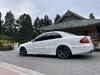

2007 E63

MBWorld Fanatic!


Joined: Apr 2009
Posts: 6,024
Likes: 532
From: Alexandria, VA
07 E63 AMG, 10 C63 AMG, 07 E63 Designo, 07 E350, 09 C300, 07 C230
I can tell you that head bolt failures are real, but it's a very percentage compared to the amount of M156 engines produced. No one can predict when it will or will not happen. It's a crap shoot.
So, you can either pay now, which is cheap insurance knowing that you will not experience any future failures, or you can pay later which can be costly, if you blow a head gasket, or have a catastrophic engine damage.
I will say this, if your planning on keeping your vehicle for many years to come, I would pull the trigger and have it done. It's cheap insurance. If not, then just remember that there are thousands of M156 engine out there without the newly revised head bolts.
So, you can either pay now, which is cheap insurance knowing that you will not experience any future failures, or you can pay later which can be costly, if you blow a head gasket, or have a catastrophic engine damage.
I will say this, if your planning on keeping your vehicle for many years to come, I would pull the trigger and have it done. It's cheap insurance. If not, then just remember that there are thousands of M156 engine out there without the newly revised head bolts.

Super Member

Joined: Dec 2006
Posts: 972
Likes: 191
From: Atlanta
W222 AMG S63
@CQHall , i can tell you're a glass half full kind of guy...
just because YOU haven't experienced it doesn't mean it isn't true or doesn't exist.
just because YOU haven't experienced it doesn't mean it isn't true or doesn't exist.
I work with numbers for a living and I trust those.
I never said it doesn't happen. I'm looking for failure rates.
Super Member
Joined: Dec 2006
Posts: 972
Likes: 191
From: Atlanta
W222 AMG S63
Regarding numbers, here's an example:
Audi currently has an issue with their 4.0L TT motors that are used in several cars (A8, S8, S6, S7, etc...). It has a design flaw where there is a screen that's designed to keep large particles in the oil from getting into the turbos as they are being lubricated. The problem is that the screen is too small and it simply gets gummed up and eventually starves the turbos of oil causing them to fail causing a $10K repair. The screen is about the size of a nickel but it's deeeeep inside of the engine. Audi was aware of this as they had several revisions of that part and a service bulletin. But, no recall (of course).
TSB: https://static.nhtsa.gov/odi/tsbs/20...53123-9999.pdf
Forum chatter:
https://www.audizine.com/forum/showt...own-Turbo-Poll
NTHSA response: https://static.nhtsa.gov/odi/inv/202...009-83219P.pdf
And....Recall: https://www.autoevolution.com/news/a...er-185179.html
That's what I mean by wanting numbers.
Audi currently has an issue with their 4.0L TT motors that are used in several cars (A8, S8, S6, S7, etc...). It has a design flaw where there is a screen that's designed to keep large particles in the oil from getting into the turbos as they are being lubricated. The problem is that the screen is too small and it simply gets gummed up and eventually starves the turbos of oil causing them to fail causing a $10K repair. The screen is about the size of a nickel but it's deeeeep inside of the engine. Audi was aware of this as they had several revisions of that part and a service bulletin. But, no recall (of course).
TSB: https://static.nhtsa.gov/odi/tsbs/20...53123-9999.pdf
Forum chatter:
https://www.audizine.com/forum/showt...own-Turbo-Poll
NTHSA response: https://static.nhtsa.gov/odi/inv/202...009-83219P.pdf
And....Recall: https://www.autoevolution.com/news/a...er-185179.html
That's what I mean by wanting numbers.

MBWorld Fanatic!

Joined: Dec 2005
Posts: 4,059
Likes: 342
From: NJ
2009 SL63 AMG
Unfortunately, failure rates were not formally tracked on this issue. Even if Mercedes issued a recall, it would be for everything manufactured before the correction was implemented ~2011.
In any case, what value is there in any predictive modeling on the likelihood of a component that is known to be defective (and superseded as a direct result of that defect) to fail?
If you take a step back and understand the nature of why the original head bolts fail, you'll understand that all engines with the defective ones have a very high risk of failing well-before the usable life of the engine is exhausted.
Regarding numbers, here's an example:
Audi currently has an issue with their 4.0L TT motors that are used in several cars (A8, S8, S6, S7, etc...). It has a design flaw where there is a screen that's designed to keep large particles in the oil from getting into the turbos as they are being lubricated. The problem is that the screen is too small and it simply gets gummed up and eventually starves the turbos of oil causing them to fail causing a $10K repair. The screen is about the size of a nickel but it's deeeeep inside of the engine. Audi was aware of this as they had several revisions of that part and a service bulletin. But, no recall (of course).
TSB: https://static.nhtsa.gov/odi/tsbs/20...53123-9999.pdf
Forum chatter:
https://www.audizine.com/forum/showt...own-Turbo-Poll
NTHSA response: https://static.nhtsa.gov/odi/inv/202...009-83219P.pdf
And....Recall: https://www.autoevolution.com/news/a...er-185179.html
That's what I mean by wanting numbers.
Audi currently has an issue with their 4.0L TT motors that are used in several cars (A8, S8, S6, S7, etc...). It has a design flaw where there is a screen that's designed to keep large particles in the oil from getting into the turbos as they are being lubricated. The problem is that the screen is too small and it simply gets gummed up and eventually starves the turbos of oil causing them to fail causing a $10K repair. The screen is about the size of a nickel but it's deeeeep inside of the engine. Audi was aware of this as they had several revisions of that part and a service bulletin. But, no recall (of course).
TSB: https://static.nhtsa.gov/odi/tsbs/20...53123-9999.pdf
Forum chatter:
https://www.audizine.com/forum/showt...own-Turbo-Poll
NTHSA response: https://static.nhtsa.gov/odi/inv/202...009-83219P.pdf
And....Recall: https://www.autoevolution.com/news/a...er-185179.html
That's what I mean by wanting numbers.
All of the affected vehicles were produced between the 2013 and 2017 model years. Audi states that 4.0-liter V8 vehicles manufactured after March 30th, 2017, feature an improved oil strainer with a larger mesh width. More to the point, we’re dealing with 90 µm compared to the previous 30 µm.
No fewer than 26,053 cars have to be repaired, starting with the S7, S7, and S8. The A8 is also listed, together with the RS 7. Audi dealerships in the U.S. will replace the oil strainer and perform an oil change, free of charge, starting May 20th. Customer notifications are due on or before May 20th.
No fewer than 26,053 cars have to be repaired, starting with the S7, S7, and S8. The A8 is also listed, together with the RS 7. Audi dealerships in the U.S. will replace the oil strainer and perform an oil change, free of charge, starting May 20th. Customer notifications are due on or before May 20th.
Applying your example to the head bolt issue, any M156 with an engine serial number below 156983 60 060658 is using the original head bolts that have two defects (one design and one manufacturing) and are at risk. If you really want to know the volume of engines built in this range, you can look up and aggregate production numbers of M156-cars from 2007 to early-2011.
Super Member
Joined: Dec 2006
Posts: 972
Likes: 191
From: Atlanta
W222 AMG S63
You're attempting to dismiss the real world experiences of many on a subject matter that was already put to rest by MB-AMG a long time ago.
Unfortunately, failure rates were not formally tracked on this issue. Even if Mercedes issued a recall, it would be for everything manufactured before the correction was implemented ~2011.
In any case, what value is there in any predictive modeling on the likelihood of a component that is known to be defective (and superseded as a direct result of that defect) to fail?
If you take a step back and understand the nature of why the original head bolts fail, you'll understand that all engines with the defective ones have a very high risk of failing well-before the usable life of the engine is exhausted.
Okay. The recall refers to impacted range, not failure rate.
https://mbworld.org/forums/c63-amg-w...y-2011s-2.html
Applying your example to the head bolt issue, any M156 with an engine serial number below 156983 60 060658 is using the original head bolts that have two defects (one design and one manufacturing) and are at risk. If you really want to know the volume of engines built in this range, you can look up and aggregate production numbers of M156-cars from 2007 to early-2011.
Unfortunately, failure rates were not formally tracked on this issue. Even if Mercedes issued a recall, it would be for everything manufactured before the correction was implemented ~2011.
In any case, what value is there in any predictive modeling on the likelihood of a component that is known to be defective (and superseded as a direct result of that defect) to fail?
If you take a step back and understand the nature of why the original head bolts fail, you'll understand that all engines with the defective ones have a very high risk of failing well-before the usable life of the engine is exhausted.
Okay. The recall refers to impacted range, not failure rate.
https://mbworld.org/forums/c63-amg-w...y-2011s-2.html
Applying your example to the head bolt issue, any M156 with an engine serial number below 156983 60 060658 is using the original head bolts that have two defects (one design and one manufacturing) and are at risk. If you really want to know the volume of engines built in this range, you can look up and aggregate production numbers of M156-cars from 2007 to early-2011.
2: The failure rate (albeit a sample of forum users) is in the poll linked above.
3: You are operating under the assumption that I don't know why the head bolts fail. Hell, I can draw the diagram of the problem.
4: Yes. My car engine's serial number is so early that it's in the affected range. I've been aware of that since I got the car. And I assumed as much when I bought a 2008.
So, my opinion is, indeed, informed.
MBWorld Fanatic!
Joined: Dec 2005
Posts: 4,059
Likes: 342
From: NJ
2009 SL63 AMG
1: Quote where I dismissed someone's personal experience with this issue.
2: The failure rate (albeit a sample of forum users) is in the poll linked above.
3: You are operating under the assumption that I don't know why the head bolts fail. Hell, I can draw the diagram of the problem.
4: Yes. My car engine's serial number is so early that it's in the affected range. I've been aware of that since I got the car. And I assumed as much when I bought a 2008.
So, my opinion is, indeed, informed.
2: The failure rate (albeit a sample of forum users) is in the poll linked above.
3: You are operating under the assumption that I don't know why the head bolts fail. Hell, I can draw the diagram of the problem.
4: Yes. My car engine's serial number is so early that it's in the affected range. I've been aware of that since I got the car. And I assumed as much when I bought a 2008.
So, my opinion is, indeed, informed.
2. That's technically not a failure rate...but if it helps, all the better.
3. Cool, draw it. If you truly understand why then you wouldn't need the NHTSA to confirm the matter for you.
4. Good that you're aware. How many miles when you bought it vs. now? If you're not the original owner, ever check if they were replaced already?
Your opinion is incomplete, due to fixating on the numbers "because you trust them" and not factoring in the context.
I repeat my earlier question: What value is there in any predictive modeling on the likelihood of a component that is known to be defective (and superseded as a direct result of that defect) to fail?
Last edited by HLG600; Feb 22, 2023 at 10:59 PM.

Super Member

Joined: Apr 2007
Posts: 749
Likes: 8
From: The Bay. We Fresh.
2008 W211 E63
Yup. Best sounding car, especially with resonators removed. I get complements all the time.
That said OP:
Be prepared to drop 5K for the suspension if that's not done already. Oil leak is probably valve cover gaskets. That's the only leak I ever had.
Replaced headbolts while I was in there too for peace of mind, but the originals looked fine.
Drive Belt failed at exactly 100K.
I've bent 3 aftermarket 19in rims so far.
Other than that it mostly been maintenance from when I bought it at 58k to where it is now at 120K.
I'm going to end up driving this thing into the ground. Can't imagine selling it.
The car is expensive AF to maintain but I'm still constantly getting people giving me a thumbs up or rolling down window to give me complement. Its worth even more to me now as I can write off most of my repair costs, but it was worth it even when I couldn't as W2 worker.
That said OP:
Be prepared to drop 5K for the suspension if that's not done already. Oil leak is probably valve cover gaskets. That's the only leak I ever had.
Replaced headbolts while I was in there too for peace of mind, but the originals looked fine.
Drive Belt failed at exactly 100K.
I've bent 3 aftermarket 19in rims so far.
Other than that it mostly been maintenance from when I bought it at 58k to where it is now at 120K.
I'm going to end up driving this thing into the ground. Can't imagine selling it.
The car is expensive AF to maintain but I'm still constantly getting people giving me a thumbs up or rolling down window to give me complement. Its worth even more to me now as I can write off most of my repair costs, but it was worth it even when I couldn't as W2 worker.
MB World Stories
The Best of Mercedes & AMG

Dubai Tuner Gives the Mercedes G-Class An Entirely New Look
Verdad Gallardo
Six Gift Ideas Your AMG Loving Dad or Grad Will Cherish

7 Craziest Things AMG Gas Ever Built
Verdad Gallardo
New Electric Mercedes-AMG GT 4-Door Coupe Unveiled: 10 Things You Need to Know
Verdad Gallardo
6 Mercedes Models That Did NOT Age Well (But Are Somehow Still Cool)
Verdad Gallardo
Manual Mercedes? 6 Times Sindelfingen Let Drivers Have All The Fun
Verdad Gallardo
Mercedes SLR McLaren 722 S Is Extremely Rare Example Modified by McLaren
Verdad Gallardo
8 Classic Boxy Mercedes Designs That Have Aged Like Fine Wine
Verdad Gallardo


