



Best way to tell if c/o's will rub the tire?

Thread Starter
MBWorld Fanatic!
Joined: Nov 2003
Posts: 4,278
Likes: 0
From: Fresno, CA
'09 A4 S Line
Best way to tell if c/o's will rub the tire?
Bottom line: I want to drop the front of my car lower and want to avoid any potential rubbing issues.
Other than blindly guessing then testing it out and listening for rubbing noises when you drive, is there a best practice for determining whether the coils will rub the front tires? Some people say that you can jack the car up, then stick a piece of paper/cardboard/etc. between the wheel/tire and the suspension, but I'd think this isn't an accurate representation of how the wheel/tire sits in relation to the suspension when the springs are compressed after you set it back down. I've heard others say you can turn the wheel all the way to one side, then look behind the wheel to see how much space you have between the wheel/tire and suspension, but I'm not sure if this is accurate either since our wheels tilt to the outside when turned to provide a better turning radius. Some are able to hear or feel the rubbing during a quick test drive, while I know others who have taken their wheels off after a while to find out they had been rubbing and never noticed. I also know another guy who was driving along and smelled burning rubber, but by the time he could do anything about it, his tire already blew. Hopefully someone has insight they can share.
Other than blindly guessing then testing it out and listening for rubbing noises when you drive, is there a best practice for determining whether the coils will rub the front tires? Some people say that you can jack the car up, then stick a piece of paper/cardboard/etc. between the wheel/tire and the suspension, but I'd think this isn't an accurate representation of how the wheel/tire sits in relation to the suspension when the springs are compressed after you set it back down. I've heard others say you can turn the wheel all the way to one side, then look behind the wheel to see how much space you have between the wheel/tire and suspension, but I'm not sure if this is accurate either since our wheels tilt to the outside when turned to provide a better turning radius. Some are able to hear or feel the rubbing during a quick test drive, while I know others who have taken their wheels off after a while to find out they had been rubbing and never noticed. I also know another guy who was driving along and smelled burning rubber, but by the time he could do anything about it, his tire already blew. Hopefully someone has insight they can share.

MBWorld Fanatic!
Joined: May 2005
Posts: 2,006
Likes: 0
From: East Bay, CA
is SOLD
this actually happened to me because i wanted to be so damn low. i lowered my car too much in the front and smelled burning rubber from the tires rubbing against the coil. i also heard the actual inner lip of the wheel rubbing against the strut when making u-turns. i felt this when i first lowered it. you should notice it right away. if you smell anything or feel/hear anything then raise it a turn or two asap. i learned the hard way.
Thread Starter
MBWorld Fanatic!
Joined: Nov 2003
Posts: 4,278
Likes: 0
From: Fresno, CA
'09 A4 S Line
this actually happened to me because i wanted to be so damn low. i lowered my car too much in the front and smelled burning rubber from the tires rubbing against the coil. i also heard the actual inner lip of the wheel rubbing against the strut when making u-turns. i felt this when i first lowered it. you should notice it right away. if you smell anything or feel/hear anything then raise it a turn or two asap. i learned the hard way.
Thread Starter
MBWorld Fanatic!
Joined: Nov 2003
Posts: 4,278
Likes: 0
From: Fresno, CA
'09 A4 S Line
Hmmm. You sure the wheels won't camber in more towards the strut/spring once the car is set back on the ground? Also, you say the space between the tire and strut does not change, but what about the space between the tire and the spring. I know the larger coils that are closer to the top will compress toward the tire once it is set back on the ground, so wouldn't I still have to worry about the space between the tire and the springs?

MBWorld Fanatic!
Joined: Jun 2005
Posts: 2,441
Likes: 0
..
Hmmm. You sure the wheels won't camber in more towards the strut/spring once the car is set back on the ground? Also, you say the space between the tire and strut does not change, but what about the space between the tire and the spring. I know the larger coils that are closer to the top will compress toward the tire once it is set back on the ground, so wouldn't I still have to worry about the space between the tire and the springs?

MBWorld Fanatic!
Joined: Nov 2001
Posts: 1,289
Likes: 3
From: OC
C32
How does the space between the tire and the spring change regardless of whether the car is on the ground or jacked up? The only moveable piece is the spring itself and that will only effect how far the tire will go into the wheelwell. Granted with coilovers you can screw the lower spring retainer down too far and it will contact the tire.
Trending Topics
MBWorld Fanatic!
Joined: Nov 2001
Posts: 1,289
Likes: 3
From: OC
C32
Hmmm. You sure the wheels won't camber in more towards the strut/spring once the car is set back on the ground? Also, you say the space between the tire and strut does not change, but what about the space between the tire and the spring. I know the larger coils that are closer to the top will compress toward the tire once it is set back on the ground, so wouldn't I still have to worry about the space between the tire and the springs?
MB World Stories
The Best of Mercedes & AMG

Manual Mercedes? 6 Times Sindelfingen Let Drivers Have All The Fun
Verdad Gallardo
Mercedes SLR McLaren 722 S Is Extremely Rare Example Modified by McLaren
Verdad Gallardo
8 Classic Boxy Mercedes Designs That Have Aged Like Fine Wine
Verdad Gallardo
Flawlessly Restored Mercedes 190E Evo II Heads to Auction
Verdad Gallardo
Electric Mercedes C-Class Unveiled: 11 Things You Need to Know
Verdad Gallardo
Mercedes EQS Gets A Major Update: Everything You Need to Know
Verdad Gallardo
5 Underrated Mercedes-Benz Models That Don't Get the Love They Deserve
Verdad Gallardo
Mercedes 300D Has Pushed Well Past 1 Million Miles and It Ain't Stopping
Verdad Gallardo
10 Most Reliable Mercedes-Benz Models You Can Buy Used
Verdad Gallardo
MBWorld Fanatic!
Joined: Jun 2005
Posts: 2,441
Likes: 0
..
How does the space between the tire and the spring change regardless of whether the car is on the ground or jacked up? The only moveable piece is the spring itself and that will only effect how far the tire will go into the wheelwell. Granted with coilovers you can screw the lower spring retainer down too far and it will contact the tire.
I'm taking it that you're not very familiar with coilovers? When the car is off the ground the springs are FULLY uncompressed widening the gap between the tires and coils. Reference the picture below. The car is off the ground with my stock 18" AMG wheels. Once on the ground the tire moves further upward and will contact the wider spring coils if compressed far enough.


Super Moderator


Joined: Jul 2003
Posts: 22,057
Likes: 972
From: MBworld
bone stock E55 AMG
my installer told me the clearance will not get any closer when driving on the roads... mine was rubbing also... it was fixed with 2mm spacers... if u look from under the car, i think there is about 1mm clearance... i heard no rubbing even when driviing on bumpy roads so far... i call is precision tuning... 
MBWorld Fanatic!
Joined: Jun 2005
Posts: 2,441
Likes: 0
..
my installer told me the clearance will not get any closer when driving on the roads... mine was rubbing also... it was fixed with 2mm spacers... if u look from under the car, i think there is about 1mm clearance... i heard no rubbing even when driviing on bumpy roads so far... i call is precision tuning...

Super Member
Joined: Jul 2005
Posts: 619
Likes: 2
/////AMG
Easy... just raise the car and spin the wheel. It the wheel/tire rotates freely then you're fine. And to do a double check, slide a piece of paper between the CO and wheel/tire. If it goes through, you're fine... if not then you need to raise it.
Super Member
Joined: Jul 2005
Posts: 619
Likes: 2
/////AMG
I'm taking it that you're not very familiar with coilovers? When the car is off the ground the springs are FULLY uncompressed widening the gap between the tires and coils. Reference the picture below. The car is off the ground with my stock 18" AMG wheels. Once on the ground the tire moves further upward and will contact the wider spring coils if compressed far enough.
I must disagree with you. From what i know, the suspension and wheel act together as one. If you turn really hard, everything else will turn with it. Same with upward and downward movement. I wouldn't worry about anything once the wheel/tire spins FREELY when the car is raised. I'm pretty sure i'm right.
Thread Starter
MBWorld Fanatic!
Joined: Nov 2003
Posts: 4,278
Likes: 0
From: Fresno, CA
'09 A4 S Line
I must disagree with you. From what i know, the suspension and wheel act together as one. If you turn really hard, everything else will turn with it. Same with upward and downward movement. I wouldn't worry about anything once the wheel/tire spins FREELY when the car is raised. I'm pretty sure i'm right.
MBWorld Fanatic!
Joined: Jun 2005
Posts: 2,441
Likes: 0
..
I must disagree with you. From what i know, the suspension and wheel act together as one. If you turn really hard, everything else will turn with it. Same with upward and downward movement. I wouldn't worry about anything once the wheel/tire spins FREELY when the car is raised. I'm pretty sure i'm right.
This is Neal's car
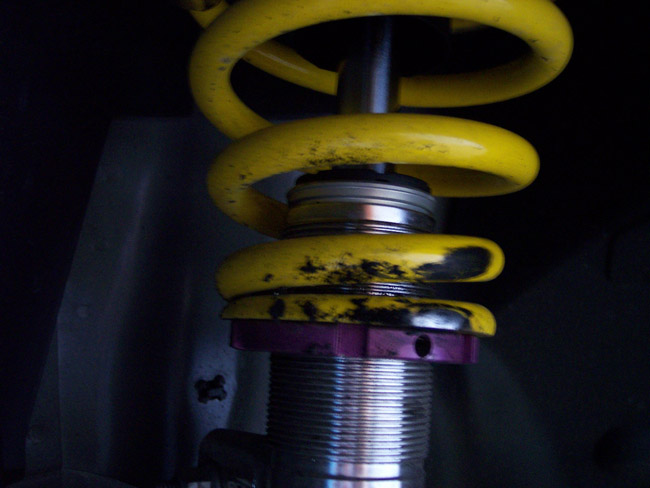
THis is the result of setting my car on the ground with my stock wheels. In the previous pic you'll see that it doesn't touch while in the air. Now that we're on the ground the wheel moves upward causing contact. Same thing happens when you drive and hit a bump. It goes even further up. I didn't even drive the car in the pic below. Imagine what would happen if i did.

Last edited by sdsilverm3; Sep 20, 2006 at 03:53 AM.
Super Member
Joined: Jul 2005
Posts: 619
Likes: 2
/////AMG
I disagree. The STOCK suspension acts as one not coilovers. You are correct that the clearance doesn't change when turning but hitting bumps is a different story. You don't have that luxury of having the spring seat sitting above the tire (like they do with the stocks) with the coilovers. When the coilovers compress the tire/wheel gets closer to the wider spring coils on top. The spring coils on the stock suspension are not exposed like the coilovers. I have pictures to prove it.
This is Neal's car
THis is the result of setting my car on the ground with my stock wheels. In the previous pic you'll see that it doesn't touch while in the air. Now that we're on the ground the wheel moves upward causing contact. Same thing happens when you drive and hit a bump. It goes even further up. I didn't even drive the car in the pic below. Imagine what would happen if i did.
This is Neal's car
THis is the result of setting my car on the ground with my stock wheels. In the previous pic you'll see that it doesn't touch while in the air. Now that we're on the ground the wheel moves upward causing contact. Same thing happens when you drive and hit a bump. It goes even further up. I didn't even drive the car in the pic below. Imagine what would happen if i did.
MBWorld Fanatic!
Joined: Jun 2005
Posts: 2,441
Likes: 0
..
I understand what you mean, but that doesn't make sense. Correct me if I'm wrong, but if the wheel moves upward, doesn't the Coilover moves up as well due to the shocks? So far i haven't had any problems with my Tein CO going on bumps or accidentally running over deep pot holes (with the exception of blown tires due to low profiles and cheap Falken tires).
I haven't really had issues with my coilovers and aftermarket wheels until recently. I saw some rub marks on my passenger side spring coils. Nothing extreme though.

MBWorld Fanatic!
Joined: Feb 2005
Posts: 1,155
Likes: 0
From: Jakarta
1996 MB E320 & 2010 Nissan Elgrand
Guys,
I've been having rubbing issues lately Front and Rear with my Tein Basic COs.For the fronts, I found many chipping marks on my inner lip.My wheel rubs against the perch/coil?Should I raise it/put 5 mm spacers ( I have spare spacers)?ET of my front wheels is 35.If I put 5 mm spacers, I will have ET 30(corect me if I'm wrong).Will my tires rub against my outer fender?
For the rears,everytime I hit big bumps,my rear wheels/tires rubbed against something.From the sound of it, it sounded like steel rubbed against steel,really SCARY sound.Anyone has any ideas?All I can think off,maybe, my inner lip rubs against my shock?is it possible?My original ET for my rear wheels is 38.I put 3 mm spacers,so now it's ET 35?!
TIA
I've been having rubbing issues lately Front and Rear with my Tein Basic COs.For the fronts, I found many chipping marks on my inner lip.My wheel rubs against the perch/coil?Should I raise it/put 5 mm spacers ( I have spare spacers)?ET of my front wheels is 35.If I put 5 mm spacers, I will have ET 30(corect me if I'm wrong).Will my tires rub against my outer fender?
For the rears,everytime I hit big bumps,my rear wheels/tires rubbed against something.From the sound of it, it sounded like steel rubbed against steel,really SCARY sound.Anyone has any ideas?All I can think off,maybe, my inner lip rubs against my shock?is it possible?My original ET for my rear wheels is 38.I put 3 mm spacers,so now it's ET 35?!
TIA
Thread Starter
MBWorld Fanatic!
Joined: Nov 2003
Posts: 4,278
Likes: 0
From: Fresno, CA
'09 A4 S Line

MBWorld Fanatic!
Joined: Jul 2006
Posts: 1,255
Likes: 0
From: SF East Bay
"Double Stuff" SOLD | Nor*Cals "Pesky Audi"
with all this in question, im curious about camber. im getting my 18's on 235/40 series [now on the 3rd week and a day, lol], but im thinkin if ill be okay, compress/decompress as well as camber, to drop down a click or two.
MBWorld Fanatic!
Joined: Jun 2005
Posts: 2,441
Likes: 0
..


Super Member
Joined: Nov 2005
Posts: 651
Likes: 0
From: N.Y
BMW 135i


