


Any Mercedes Alignment Experts Here?

Thread Starter
MBWorld Fanatic!

Joined: Mar 2009
Posts: 2,136
Likes: 6
From: GA
2016 Chevrolet SS, 2006 Cadillac STS-V
Any Mercedes Alignment Experts Here?
I have a small problem with the alignment on my car. I knew my car needed an alignment before I bought it, but we don't all the extras to do alignments on German cars. I realized after I bought my car that it was involved in some sort of crash (not really sure how bad) in the right front. Because of that and the way it drives, I knew it needed more than just a toe adjustment. I put the car up on our alignment rack just to check it last Saturday. The rear looks decent enough, the left front looks really good (-0.5* camber, 10.1* caster), but the right side (where the crash was) is way out. I have -2* of camber and 9.5* of caster. I'm not sure what the specs are for the caster since out machine wouldn't show it for some reason. I'm going to put the adjustment bolts in myself and then drive the car to the dealer for the alignment. When I went to buy the bolts, my service advisor told me that they may only be able to get the camber back up a degree if they adjust caster and camber on that side. So obviously something else is wrong. I'm starting to think maybe one of the control arms is bent or something. I don't think anything major is tweaked since the left side camber is almost perfect. What do you think?

Super Moderator
Joined: Jul 2006
Posts: 3,365
Likes: 12
From: Orange County, CA
GMC - Miata - Trek - P-Car
<---- definitely not an expert.
You have access to your own alignment rack? Nice!
I’ve played with camber, caster, and toe literally dozens of times to help improve directional stability, response, and cornering adhesion/balance throughout its modification journey - all while trying to optimize tire life. It’s inevitably a compromise that leaves me feeling not unlike a dog chasing his too-short tail.
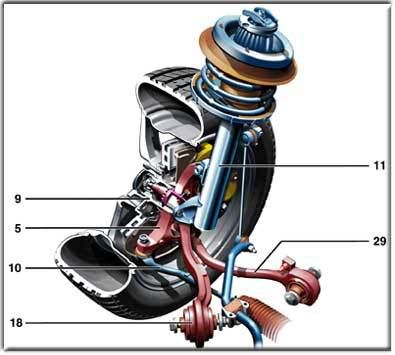
MB’s adjustment bolt (A 000 330 00 18, ~$10) can be installed at the bushing mounts of not only the cross/thrust strut (#29), but also the tensile/torque strut (#18) to effect camber and caster adjustments. Our MacPherson strut design does not readily facilitate correction at its upper mount/bushing. Although the adjustment bolts’ range is rather limited, if the alignment parameters cannot be adjusted within specification – or to your preferred settings – then the arms themselves, unibody mounts, or steering knuckle may have indeed suffered damage during the PO’s shunt.
Yours no doubt feels funky with its left-to-right angles differing as they do. Toe is to be set as close as possible to 0.00 with the wheel spreader installed. Ensure the rack is centered in order to preclude skewing Ackerman. Camber should be just slightly negative. Caster ought to typically read between 10 and 11 degrees dependant upon, of course, front and rear ride heights. Perhaps more important than the absolute caster settings is achieving no more than ~1/2 degree variation between the LF and RF. If your alignment is in the ballpark after visiting the dealership but it continues to pull, increasing its negative camber and positive caster on the side it’s pulling toward will serve to help alleviate the condition. Doing the opposite to the opposite side may also prove worthwhile, should doing so be deemed necessary.
You already know all that. Good luck.
You have access to your own alignment rack? Nice!
I’ve played with camber, caster, and toe literally dozens of times to help improve directional stability, response, and cornering adhesion/balance throughout its modification journey - all while trying to optimize tire life. It’s inevitably a compromise that leaves me feeling not unlike a dog chasing his too-short tail.
MB’s adjustment bolt (A 000 330 00 18, ~$10) can be installed at the bushing mounts of not only the cross/thrust strut (#29), but also the tensile/torque strut (#18) to effect camber and caster adjustments. Our MacPherson strut design does not readily facilitate correction at its upper mount/bushing. Although the adjustment bolts’ range is rather limited, if the alignment parameters cannot be adjusted within specification – or to your preferred settings – then the arms themselves, unibody mounts, or steering knuckle may have indeed suffered damage during the PO’s shunt.
Yours no doubt feels funky with its left-to-right angles differing as they do. Toe is to be set as close as possible to 0.00 with the wheel spreader installed. Ensure the rack is centered in order to preclude skewing Ackerman. Camber should be just slightly negative. Caster ought to typically read between 10 and 11 degrees dependant upon, of course, front and rear ride heights. Perhaps more important than the absolute caster settings is achieving no more than ~1/2 degree variation between the LF and RF. If your alignment is in the ballpark after visiting the dealership but it continues to pull, increasing its negative camber and positive caster on the side it’s pulling toward will serve to help alleviate the condition. Doing the opposite to the opposite side may also prove worthwhile, should doing so be deemed necessary.
You already know all that. Good luck.
Last edited by splinter; Oct 6, 2010 at 07:01 AM.

Senior Member
Joined: Dec 2008
Posts: 360
Likes: 0
a g
I have a small problem with the alignment on my car. I knew my car needed an alignment before I bought it, but we don't all the extras to do alignments on German cars. I realized after I bought my car that it was involved in some sort of crash (not really sure how bad) in the right front. Because of that and the way it drives, I knew it needed more than just a toe adjustment. I put the car up on our alignment rack just to check it last Saturday. The rear looks decent enough, the left front looks really good (-0.5* camber, 10.1* caster), but the right side (where the crash was) is way out. I have -2* of camber and 9.5* of caster. I'm not sure what the specs are for the caster since out machine wouldn't show it for some reason. I'm going to put the adjustment bolts in myself and then drive the car to the dealer for the alignment. When I went to buy the bolts, my service advisor told me that they may only be able to get the camber back up a degree if they adjust caster and camber on that side. So obviously something else is wrong. I'm starting to think maybe one of the control arms is bent or something. I don't think anything major is tweaked since the left side camber is almost perfect. What do you think?
What year and model is your particular C?
Thread Starter
MBWorld Fanatic!
Joined: Mar 2009
Posts: 2,136
Likes: 6
From: GA
2016 Chevrolet SS, 2006 Cadillac STS-V
I'm not actually aligning the car myself. I work for a Chevy dealer so we do not have the toe press bar, the weights for the inside of the car, and the alignment machine says this car my have some sensors that may need to be reset during an alignment (sort of like the Cobalts and Malibus with electric power steering). I just put it on the rack to get an idea of where it was. I went ahead and bought all 4 adjustment bolts, they said they would charge me $110 for the alignment and that would include caster/camber adjustment IF the bolts were already installed (if not installed, they would charge $50 per bolt kit installed).
Super Moderator
Joined: Jul 2006
Posts: 3,365
Likes: 12
From: Orange County, CA
GMC - Miata - Trek - P-Car
Sorta figured a member using 91RS was familiar with GM hardware. Tweaked my ’87 IROC with all of the 1LE suspension and brake goodies during my wasted youth. Still haven’t grown out of it…just faster.
Ensure the dealership’s technician replicates the car’s typical load. It’s SOP so you’ll likely have no worries there. The spreader merely applies a 110 Nm load to take up some the bushings' slack and replicate dynamic loading. Insist upon before and after alignment readings from your SA as part of your work order settlement paperwork. Should drive straight and true. If it doesn’t, update your thread so we can give it another go.
There’s no reason you can’t do it yourself on your rack - if it’s okay with the boss.
Ensure the dealership’s technician replicates the car’s typical load. It’s SOP so you’ll likely have no worries there. The spreader merely applies a 110 Nm load to take up some the bushings' slack and replicate dynamic loading. Insist upon before and after alignment readings from your SA as part of your work order settlement paperwork. Should drive straight and true. If it doesn’t, update your thread so we can give it another go.
There’s no reason you can’t do it yourself on your rack - if it’s okay with the boss.
Thread Starter
MBWorld Fanatic!
Joined: Mar 2009
Posts: 2,136
Likes: 6
From: GA
2016 Chevrolet SS, 2006 Cadillac STS-V
Yep, my first car was a 1991 Camaro RS. Spent a ton of money and time on it, sold it for the down payment for the Benz. Are you sure the alignment will turn out properly without the weights and pressbar? Do you know if this car has anything that needs to be reset with STAR after an alignment is performed?
Super Moderator
Joined: Jul 2006
Posts: 3,365
Likes: 12
From: Orange County, CA
GMC - Miata - Trek - P-Car
Yes.
Ask a colleague who’s on break to plop himself in the driver’s seat while you’re ascertaining the readings. Sandbags or suitably weighty containers will also suffice. I use a Quickgrip spreader to mimic MB’s pricey tool. Failing that, 1/32 inch toe-in on each front wheel (1/16 inch total) will get you very close to the actual 0 desired specification.
No STAR-DAS equipment required since the alignment tasks are purely mechanical, i.e., no electronics involved. Possible exception would be the ESP’s steering angle sensor. Twist the ignition key to only its first position to unlock the steering column while you’re verifying caster. You’ll have no trouble at all. Should it by chance trigger an error message in the MFD upon completion, simple resynchronization instructions are in the DIY sticky at the top of the page. Spot on alignments are relatively straightforward. However, they can’t be rushed - even under ideal circumstances. They’re merely another instance where a conscientious man doing the work is far more critical to a proper result than the equipment being utilized.
Save the costly dealership visits for those repairs beyond your core competencies.
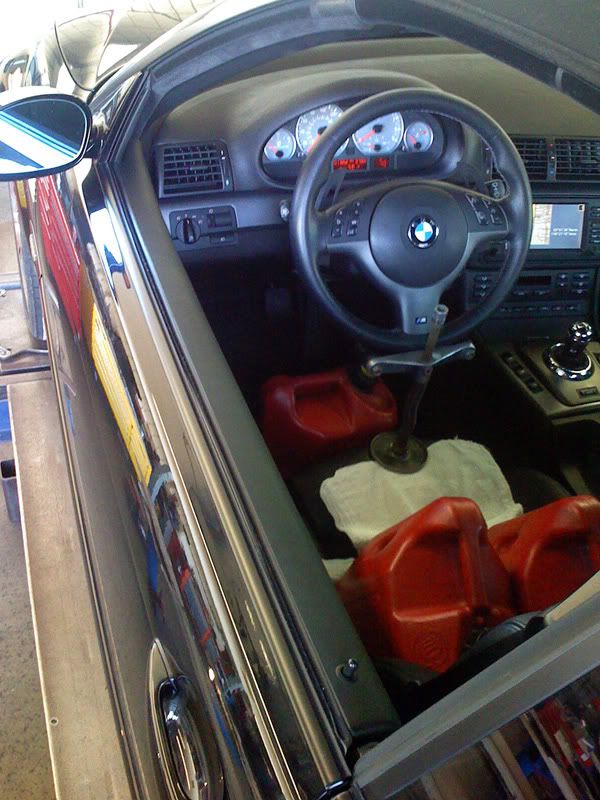
photo credit nlpamg
Ask a colleague who’s on break to plop himself in the driver’s seat while you’re ascertaining the readings. Sandbags or suitably weighty containers will also suffice. I use a Quickgrip spreader to mimic MB’s pricey tool. Failing that, 1/32 inch toe-in on each front wheel (1/16 inch total) will get you very close to the actual 0 desired specification.
No STAR-DAS equipment required since the alignment tasks are purely mechanical, i.e., no electronics involved. Possible exception would be the ESP’s steering angle sensor. Twist the ignition key to only its first position to unlock the steering column while you’re verifying caster. You’ll have no trouble at all. Should it by chance trigger an error message in the MFD upon completion, simple resynchronization instructions are in the DIY sticky at the top of the page. Spot on alignments are relatively straightforward. However, they can’t be rushed - even under ideal circumstances. They’re merely another instance where a conscientious man doing the work is far more critical to a proper result than the equipment being utilized.
Save the costly dealership visits for those repairs beyond your core competencies.
photo credit nlpamg
Trending Topics
Senior Member


Joined: Nov 2007
Posts: 432
Likes: 64
From: Delray Beach, Fl
GLC SUV 350e Verde Silver Metallic
Splinter,
At some point in time I'll need an alignment (05 E CDI). Since I am at the mercy of the local MB dealer vs Goodyear, etc. or a local mechanic that works on MB. Who would be the better choice? Don't know if the local mechanic has equipment in house or not.
One of reason I ask is that over the years, once I had an alignment done it seems that I need one done fairly regularly. Maybe it is because I used whoever advertised the lowest $!
I also noticed that you said that bolts should be replaced. Is that because they have stretched and wouldn't hold a torque? I can not remember any alignment that I had done where they replaced bolts. (I have been driving for 50+ years so maybe the memory isn't that clear)
At some point in time I'll need an alignment (05 E CDI). Since I am at the mercy of the local MB dealer vs Goodyear, etc. or a local mechanic that works on MB. Who would be the better choice? Don't know if the local mechanic has equipment in house or not.
One of reason I ask is that over the years, once I had an alignment done it seems that I need one done fairly regularly. Maybe it is because I used whoever advertised the lowest $!
I also noticed that you said that bolts should be replaced. Is that because they have stretched and wouldn't hold a torque? I can not remember any alignment that I had done where they replaced bolts. (I have been driving for 50+ years so maybe the memory isn't that clear)
MB World Stories
The Best of Mercedes & AMG

New Electric Mercedes-AMG GT 4-Door Coupe Unveiled: 10 Things You Need to Know
Verdad Gallardo
6 Mercedes Models That Did NOT Age Well (But Are Somehow Still Cool)
Verdad Gallardo
Manual Mercedes? 6 Times Sindelfingen Let Drivers Have All The Fun
Verdad Gallardo
Mercedes SLR McLaren 722 S Is Extremely Rare Example Modified by McLaren
Verdad Gallardo
8 Classic Boxy Mercedes Designs That Have Aged Like Fine Wine
Verdad Gallardo
Flawlessly Restored Mercedes 190E Evo II Heads to Auction
Verdad Gallardo
Electric Mercedes C-Class Unveiled: 11 Things You Need to Know
Verdad Gallardo
Mercedes EQS Gets A Major Update: Everything You Need to Know
Verdad Gallardo
5 Underrated Mercedes-Benz Models That Don't Get the Love They Deserve
Verdad Gallardo
Thread Starter
MBWorld Fanatic!
Joined: Mar 2009
Posts: 2,136
Likes: 6
From: GA
2016 Chevrolet SS, 2006 Cadillac STS-V
Alright, I suppose it definately won't help to at least give it a try first! Basically, I'm just trying to get everything to spec so when I'm done and I sit in the car it's perfect, correct? What length Quickgrip do you have? Do you just put it on either side of the knuckle where the tie rod is and tighten it a bit? The adjustment bolts look like they can only go in at three different positions? And I cannot rotate and bolt once it's in that position? I have to take the load off the suspension, and then put the bolt in one of the positions, then take measurements again?
Last edited by 91RS; Apr 26, 2009 at 09:11 AM.

MBWorld Fanatic!
Joined: Nov 2001
Posts: 1,289
Likes: 3
From: OC
C32
If I can align my W203 in my garage with sticks and strings you can certainly do it on a Chevy alignment rack. All that other crap about loading the car with sandbags is nonsense. How often is a car driven with that exact amount of sandbag weight.
Thread Starter
MBWorld Fanatic!
Joined: Mar 2009
Posts: 2,136
Likes: 6
From: GA
2016 Chevrolet SS, 2006 Cadillac STS-V
I know I can align it without all that stuff, I just want it to be right. My new wheels should be here tomorrow, but I still have to buy spacers and lugs so I won't be aligning the car until I put the new wheels on. Maybe this Saturday if the spacers come in time.

Super Moderator

Joined: Jun 2008
Posts: 19,942
Likes: 192
From: Llandudno, Cape Town, South Africa
late 2009 CLK 350 Coupe Elegance, '65 Jaguar S Type wires
Please Remember - To properly set up a LHD car from published you require to run 1 degree more castor on the RHS to the LHS. The reverse applies to RHD cars. This offsets road camber & ensures the car tracks straight hands off. Merc had a bulletin out on this but most don't know about it. It has been drummed into all the alignment shops in South Africa
Here is a RHD Typical - you need to be opposite. Easier to understand than inclination comments kindly posted by splinter

Here is a RHD Typical - you need to be opposite. Easier to understand than inclination comments kindly posted by splinter
Last edited by Glyn M Ruck; Apr 26, 2009 at 05:12 PM.
Super Moderator
Joined: Jul 2006
Posts: 3,365
Likes: 12
From: Orange County, CA
GMC - Miata - Trek - P-Car
DESAL-
I’d trust a MB dealer to do an accurate job long before allowing a chain store’s monkey to fiddle with it. No disrespect intended to upstanding monkeys. The replacement bolts merely facilitate caster and camber adjustments, whereas the original hardware allows for none. Excellent choice on your CDI E.
Zeppelin-
it’s ~220 pounds more accurate than it otherwise might be. Sorta corner balanced, too. Cargo and passengers be damned.
91RS-
just get it close and you’ll be fine.
Glyn-
virtually anything is easier to understand than my posts.
I’d trust a MB dealer to do an accurate job long before allowing a chain store’s monkey to fiddle with it. No disrespect intended to upstanding monkeys. The replacement bolts merely facilitate caster and camber adjustments, whereas the original hardware allows for none. Excellent choice on your CDI E.
Zeppelin-
it’s ~220 pounds more accurate than it otherwise might be. Sorta corner balanced, too. Cargo and passengers be damned.
91RS-
just get it close and you’ll be fine.
Glyn-
virtually anything is easier to understand than my posts.
Super Moderator
Joined: Jun 2008
Posts: 19,942
Likes: 192
From: Llandudno, Cape Town, South Africa
late 2009 CLK 350 Coupe Elegance, '65 Jaguar S Type wires
Not at all Sir - Your posts are at an extremely competent level. You might notice how frequently I steal shamelessly - you would say, plagiarise  from your posts to help others. I get quite a kick when you steal some of my data to help. Isn't that what this forum is all about
from your posts to help others. I get quite a kick when you steal some of my data to help. Isn't that what this forum is all about

Newbie
Joined: Apr 2009
Posts: 1
Likes: 0
From: Sandton South Africa
BMW E46 2003
Repl to 91RS
Hi, regarding your alignment problem on your 203. Just because you have a negative camber reading on the r/side does not mean that the the control arm is bent. If the control arm is bent there would be a discrepancy in the SAI reading. The problem is more likely that the shock is very slightly bent. If the shock is still in good working condition, you need not replace it. What you can do is file the hole where the shock fits onto the knuckle (the top hole), making it slightly bigger and in this way, you will be able to obtain more adjustment on the camber. I sincerely hope that I have helped you.
Last edited by motomags; Apr 27, 2009 at 11:56 AM. Reason: Spelling/ grammer
Super Moderator
Joined: Jun 2008
Posts: 19,942
Likes: 192
From: Llandudno, Cape Town, South Africa
late 2009 CLK 350 Coupe Elegance, '65 Jaguar S Type wires
Also make sure your camber & castor bushes are in good condition or you are wasting time & effort. Castor bushes are a known weakness on these cars & have been redesigned.

Almost a Member!
Joined: Jun 2008
Posts: 29
Likes: 0
2005 c230
If you have a bent wheel this thread is useless. Your new wheels may mitigate the possibility of error, but the Benz dealer should use a head that attaches to the center of the wheel through the 5 little holes between the lugs (if you have factory wheels). If your new wheels do not have these holes, the dealer may have difficulty doing your alignment.
Its also a good idea to have about half a tank of gas when it goes on the rack.
I always look for something about half my weight to put in the drivers seat. This splits the differance when you have a passenger.
I do not know the specs for a 203, but 10.1 caster sounds like a lot. IIRC, about 7.5 left and 6.5 right was the ballpark on other Benz models(220,210 etc.).
I have known some of the best chassis guys to work in the franchise places. The dealer is usually safe, but the right guy who knows his equipment can be found in some unsuspecting places.
I use strings and corner-scales - its arguably the best method.
good luck.
Its also a good idea to have about half a tank of gas when it goes on the rack.
I always look for something about half my weight to put in the drivers seat. This splits the differance when you have a passenger.
I do not know the specs for a 203, but 10.1 caster sounds like a lot. IIRC, about 7.5 left and 6.5 right was the ballpark on other Benz models(220,210 etc.).
I have known some of the best chassis guys to work in the franchise places. The dealer is usually safe, but the right guy who knows his equipment can be found in some unsuspecting places.
I use strings and corner-scales - its arguably the best method.
good luck.
Thread Starter
MBWorld Fanatic!
Joined: Mar 2009
Posts: 2,136
Likes: 6
From: GA
2016 Chevrolet SS, 2006 Cadillac STS-V
Super Moderator
Joined: Jun 2008
Posts: 19,942
Likes: 192
From: Llandudno, Cape Town, South Africa
late 2009 CLK 350 Coupe Elegance, '65 Jaguar S Type wires
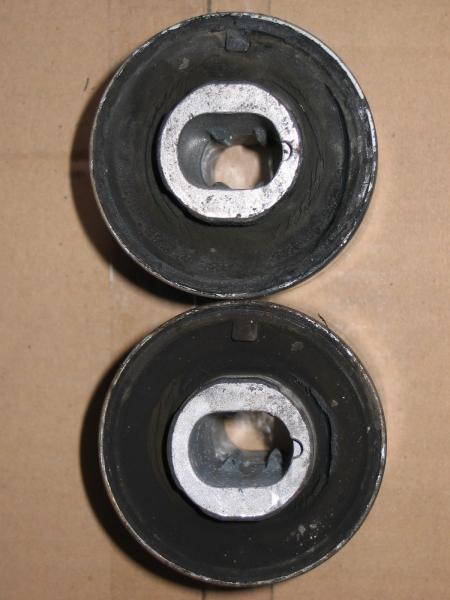
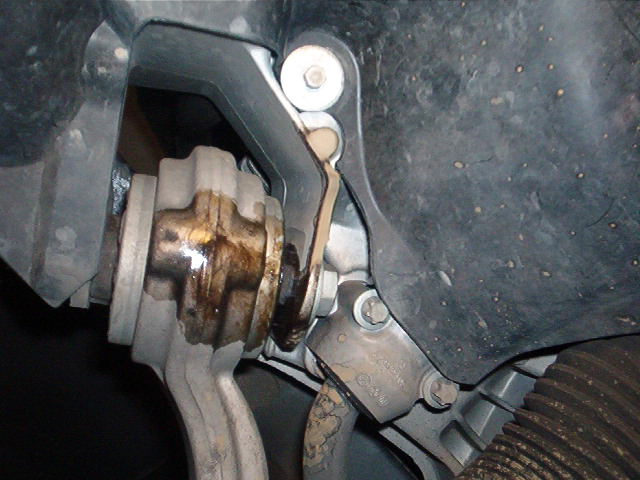
Look for cracks as in this picture & on the castor bushes look for silicone leaks.
https://mbworld.org/forums/attachmen...h-bulletin.pdf
https://mbworld.org/forums/attachmen...h-bulletin.pdf
Super Moderator
Joined: Jun 2008
Posts: 19,942
Likes: 192
From: Llandudno, Cape Town, South Africa
late 2009 CLK 350 Coupe Elegance, '65 Jaguar S Type wires
Ignore the VIN range - applies to all W203s. Benz replaced mine FOC under the service plan. Those in the pics had done 27,000 miles & the cracks opened up wide under load on the hoist but had not leaked yet. The pic of the leakers was not from my car.
Last edited by Glyn M Ruck; Apr 28, 2009 at 04:48 AM.
Super Moderator
Joined: Jun 2008
Posts: 19,942
Likes: 192
From: Llandudno, Cape Town, South Africa
late 2009 CLK 350 Coupe Elegance, '65 Jaguar S Type wires
Still got Warrantee - good news! Make Benz replace them if they have deteriorated. If you are in the VIN range it makes it easier to argue - Stick the bulletin under their nose.


