



Solved my lack of low end power

Thread Starter
MBWorld Fanatic!
Joined: Feb 2009
Posts: 5,537
Likes: 8
2006 C350 Sport 6MT
Solved my lack of low end power
Hey Guys,
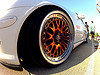
I think I solved my lack of low end power. The painting of the volks have been put on a hold until I change out my bushing and finish suspension work. I put my stock wheels on and today was the first day I gave it a pedal to the metal from a stop. I feel a significant difference.
I figured out my stock diameter is 24.7 and the aftermarket wheel diamater is
25.3 = .6 inches. I mean half an inch should be a significant difference to feel right?
I believe they are both the same weight...if not very close.
Only way to figure out is Irwindale. Whose coming to Irwindale next Thursday??
I think I solved my lack of low end power. The painting of the volks have been put on a hold until I change out my bushing and finish suspension work. I put my stock wheels on and today was the first day I gave it a pedal to the metal from a stop. I feel a significant difference.
I figured out my stock diameter is 24.7 and the aftermarket wheel diamater is
25.3 = .6 inches. I mean half an inch should be a significant difference to feel right?
I believe they are both the same weight...if not very close.
Only way to figure out is Irwindale. Whose coming to Irwindale next Thursday??
MBWorld Fanatic!
Joined: Feb 2009
Posts: 5,054
Likes: 11
From: fort worth, tx
06 C230 SS 6spd
But your aftermarket are wider right? Youre using more power to get all the wheels to rotate, you have more contact area to move.
Little experiment, place one finger a counter and push it, it's pretty easy to move it forward right? now put all your fingers on the counter and try doing the same thing, it takes more effort to move it. Its the same with your wheels. Didnt feel like thinking of a better experiment to do lol
Little experiment, place one finger a counter and push it, it's pretty easy to move it forward right? now put all your fingers on the counter and try doing the same thing, it takes more effort to move it. Its the same with your wheels. Didnt feel like thinking of a better experiment to do lol
MBWorld Fanatic!
Joined: Feb 2009
Posts: 5,054
Likes: 11
From: fort worth, tx
06 C230 SS 6spd
its all about rolling resistance. i felt the same when I had my cls wheels to my new wheels. Car feels like it accelerates better. They're just as wide but my circumfence is lower and my tires are not as wide.
Thread Starter
MBWorld Fanatic!
Joined: Feb 2009
Posts: 5,537
Likes: 8
2006 C350 Sport 6MT
Damn, I feel bad for milkman (C230 NA) who has a straightpipe with 19x9.5 running 285/30/19!!! or was is 275 eighter way. No wonder he complains about power. He's got those SL wheels too so I'm sure their pretty heavy too.
MBWorld Fanatic!
Joined: Feb 2009
Posts: 5,054
Likes: 11
From: fort worth, tx
06 C230 SS 6spd
yeah factory wheels are pretty heavy. I'm glad my new wheels are forged. Depending on the car maker they use different companies to do their wheels. On subaru they use enkei for the factory wheels then go up to bbs for the sti models.

MBWorld Fanatic!
Joined: Sep 2006
Posts: 2,697
Likes: 0
From: DC/VA
CL203
Hey Karo,
I don't think that 0.6in more is causing the lack of power you're feeling....
GIVEN:
Inertia Resistance (IR):

where:
IR = inertia resistance [N]
m = car mass + equivalent mass of rotating parts [kg]
a = car acceleration [m/s2]
mcar = car mass [kg]
meq = equivalent mass of rotating parts [kg]
= [ Iw (1/rw)^2 + Ip hf (if /rw)^2 + Ie ht (if ig / rw)^2]
where:
Iw = polar moment of inertia of wheels and axles ≈ 2.7 [kg m2]
Ip = polar moment of inertia of propeller shaft ≈ 0.05 [kg m2]
Ie = polar moment of inertia of engine ≈ 0.2 [kg/m2] + polar moment of inertia of flywheel and clutch ≈ 0.5 [kg m2]
hf = mechanical efficiency of final drive
ht = mechanical efficiency of transmission system (hg x hf)
ig = gearbox reduction ratio [ig1 or ig2 or ………….]
if = final drive reduction ratio
rw = tire radius [m]
* ( + ), (+) with the car in acceleration. {tractive resistance}
(-) with the car in deceleration. {tractive effort}
----
if the wheels actually do weigh the same...
and if rw increases by 0.6in
aftermarket - stock --> (25.3 - 24.7 = 0.6in)
(or 25.3/24.7*100 = 2.43% increase)
then the equivalent mass of rotating parts actually decreases with (1/rw)^2
meq = [ Iw (1/rw)^2 + Ip hf (if /rw)^2 + Ie ht (if ig / rw)^2]
= (1/rw)^2 [Iw + Ip hf (if)^2) + Ie ht (if ig)^2)]
as rw increases, (1/rw)^2 decreases
after some math, it goes down by 4.69%
therefore, you actually have less rotational inertia or resistance from the wheels by almost 5%
unless i totally goofed something
I don't think that 0.6in more is causing the lack of power you're feeling....
GIVEN:
Inertia Resistance (IR):
where:
IR = inertia resistance [N]
m = car mass + equivalent mass of rotating parts [kg]
a = car acceleration [m/s2]
mcar = car mass [kg]
meq = equivalent mass of rotating parts [kg]
= [ Iw (1/rw)^2 + Ip hf (if /rw)^2 + Ie ht (if ig / rw)^2]
where:
Iw = polar moment of inertia of wheels and axles ≈ 2.7 [kg m2]
Ip = polar moment of inertia of propeller shaft ≈ 0.05 [kg m2]
Ie = polar moment of inertia of engine ≈ 0.2 [kg/m2] + polar moment of inertia of flywheel and clutch ≈ 0.5 [kg m2]
hf = mechanical efficiency of final drive
ht = mechanical efficiency of transmission system (hg x hf)
ig = gearbox reduction ratio [ig1 or ig2 or ………….]
if = final drive reduction ratio
rw = tire radius [m]
* ( + ), (+) with the car in acceleration. {tractive resistance}
(-) with the car in deceleration. {tractive effort}
----
if the wheels actually do weigh the same...
and if rw increases by 0.6in
aftermarket - stock --> (25.3 - 24.7 = 0.6in)
(or 25.3/24.7*100 = 2.43% increase)
then the equivalent mass of rotating parts actually decreases with (1/rw)^2
meq = [ Iw (1/rw)^2 + Ip hf (if /rw)^2 + Ie ht (if ig / rw)^2]
= (1/rw)^2 [Iw + Ip hf (if)^2) + Ie ht (if ig)^2)]
as rw increases, (1/rw)^2 decreases
after some math, it goes down by 4.69%
therefore, you actually have less rotational inertia or resistance from the wheels by almost 5%
unless i totally goofed something
Last edited by Midnight Koop; Feb 10, 2011 at 03:10 PM.
Trending Topics
MB World Stories
The Best of Mercedes & AMG

Manual Mercedes? 6 Times Sindelfingen Let Drivers Have All The Fun
Verdad Gallardo
Mercedes SLR McLaren 722 S Is Extremely Rare Example Modified by McLaren
Verdad Gallardo
8 Classic Boxy Mercedes Designs That Have Aged Like Fine Wine
Verdad Gallardo
Flawlessly Restored Mercedes 190E Evo II Heads to Auction
Verdad Gallardo
Electric Mercedes C-Class Unveiled: 11 Things You Need to Know
Verdad Gallardo
Mercedes EQS Gets A Major Update: Everything You Need to Know
Verdad Gallardo
5 Underrated Mercedes-Benz Models That Don't Get the Love They Deserve
Verdad Gallardo
Mercedes 300D Has Pushed Well Past 1 Million Miles and It Ain't Stopping
Verdad Gallardo
10 Most Reliable Mercedes-Benz Models You Can Buy Used
Verdad Gallardo
Thread Starter
MBWorld Fanatic!
Joined: Feb 2009
Posts: 5,537
Likes: 8
2006 C350 Sport 6MT
Thanks for all the input guys.
Are you sure you didn't come up with the E=MC2?? 
So what you're saying is I'm feeling a placebo effect?
Hey Karo,
I don't think that 0.6in more is causing the lack of power you're feeling....
GIVEN:
Inertia Resistance (IR):
where:
IR = inertia resistance [N]
m = car mass + equivalent mass of rotating parts [kg]
a = car acceleration [m/s2]
mcar = car mass [kg]
meq = equivalent mass of rotating parts [kg]
= [ Iw (1/rw)^2 + Ip hf (if /rw)^2 + Ie ht (if ig / rw)^2]
where:
Iw = polar moment of inertia of wheels and axles ≈ 2.7 [kg m2]
Ip = polar moment of inertia of propeller shaft ≈ 0.05 [kg m2]
Ie = polar moment of inertia of engine ≈ 0.2 [kg/m2] + polar moment of inertia of flywheel and clutch ≈ 0.5 [kg m2]
hf = mechanical efficiency of final drive
ht = mechanical efficiency of transmission system (hg x hf)
ig = gearbox reduction ratio [ig1 or ig2 or ………….]
if = final drive reduction ratio
rw = tire radius [m]
* ( + ), (+) with the car in acceleration. {tractive resistance}
(-) with the car in deceleration. {tractive effort}
----
if the wheels actually do weigh the same...
and if rw increases by 0.6in
aftermarket - stock --> (25.3 - 24.7 = 0.6in)
(or 25.3/24.7*100 = 2.43% increase)
then the equivalent mass of rotating parts actually decreases with (1/rw)^2
meq = [ Iw (1/rw)^2 + Ip hf (if /rw)^2 + Ie ht (if ig / rw)^2]
= (1/rw)^2 [Iw + Ip hf (if)^2) + Ie ht (if ig)^2)]
as rw increases, (1/rw)^2 decreases
after some math, it goes down by 4.69%
therefore, you actually have less rotational inertia or resistance from the wheels by almost %5
unless i totally goofed something
I don't think that 0.6in more is causing the lack of power you're feeling....
GIVEN:
Inertia Resistance (IR):
where:
IR = inertia resistance [N]
m = car mass + equivalent mass of rotating parts [kg]
a = car acceleration [m/s2]
mcar = car mass [kg]
meq = equivalent mass of rotating parts [kg]
= [ Iw (1/rw)^2 + Ip hf (if /rw)^2 + Ie ht (if ig / rw)^2]
where:
Iw = polar moment of inertia of wheels and axles ≈ 2.7 [kg m2]
Ip = polar moment of inertia of propeller shaft ≈ 0.05 [kg m2]
Ie = polar moment of inertia of engine ≈ 0.2 [kg/m2] + polar moment of inertia of flywheel and clutch ≈ 0.5 [kg m2]
hf = mechanical efficiency of final drive
ht = mechanical efficiency of transmission system (hg x hf)
ig = gearbox reduction ratio [ig1 or ig2 or ………….]
if = final drive reduction ratio
rw = tire radius [m]
* ( + ), (+) with the car in acceleration. {tractive resistance}
(-) with the car in deceleration. {tractive effort}
----
if the wheels actually do weigh the same...
and if rw increases by 0.6in
aftermarket - stock --> (25.3 - 24.7 = 0.6in)
(or 25.3/24.7*100 = 2.43% increase)
then the equivalent mass of rotating parts actually decreases with (1/rw)^2
meq = [ Iw (1/rw)^2 + Ip hf (if /rw)^2 + Ie ht (if ig / rw)^2]
= (1/rw)^2 [Iw + Ip hf (if)^2) + Ie ht (if ig)^2)]
as rw increases, (1/rw)^2 decreases
after some math, it goes down by 4.69%
therefore, you actually have less rotational inertia or resistance from the wheels by almost %5
unless i totally goofed something
So what you're saying is I'm feeling a placebo effect?

MBWorld Fanatic!
Joined: Sep 2006
Posts: 2,697
Likes: 0
From: DC/VA
CL203
do you know the exact weight of both wheels (stock and aftermarket)?
Senior Member
Joined: Oct 2007
Posts: 260
Likes: 0
From: Los Angeles
05 C230 Kompressor



Super Member

Joined: Aug 2007
Posts: 876
Likes: 81
From: Phoenix AZ & Cayucos CA
’27 AMG SL55(ordered), ‘23 EQS 580 SUV, ‘19 AMG E53 Cpe, ‘48 Willys Jeepster
I'm more of the belief that the rolling diameter change mostly affected your net gear ratios. A smaller tire gives you an effectively lower gear ratio.
I'd work out the change numerically, but my head still hurts from that inertia bit above.
I'd work out the change numerically, but my head still hurts from that inertia bit above.

Super Moderator
Joined: Jul 2006
Posts: 3,365
Likes: 12
From: Orange County, CA
GMC - Miata - Trek - P-Car
MBWorld Fanatic!
Joined: Sep 2006
Posts: 2,697
Likes: 0
From: DC/VA
CL203
i think if gear ratio and tire diameter were correlated, then they wouldn't be listed as independent variables in the formula...
Last edited by Midnight Koop; Feb 11, 2011 at 07:40 AM.
Super Member
Joined: Aug 2007
Posts: 876
Likes: 81
From: Phoenix AZ & Cayucos CA
’27 AMG SL55(ordered), ‘23 EQS 580 SUV, ‘19 AMG E53 Cpe, ‘48 Willys Jeepster
I'm too lazy to work out the numbers so I found this link instead.
http://www.ausfish.com.au/vforum/arc.../t-148715.html
http://www.ausfish.com.au/vforum/arc.../t-148715.html


Thread Starter
MBWorld Fanatic!
Joined: Feb 2009
Posts: 5,537
Likes: 8
2006 C350 Sport 6MT
Hey Splinter, that's next week.
No not Kleemann, OBX . Over 6 months and they are still great. Definitely a Kleemann replica. I would recommend them....actually I have and many w204 guys have asked me about them. I think people keep their OBX headers down low because of the brand
OK, so the aftermarket wheels (not weighed but lifted to compare) feel a little heavier.
Only way to really know is at the race track.
No not Kleemann, OBX
. Over 6 months and they are still great. Definitely a Kleemann replica. I would recommend them....actually I have and many w204 guys have asked me about them. I think people keep their OBX headers down low because of the brand OK, so the aftermarket wheels (not weighed but lifted to compare) feel a little heavier.
Only way to really know is at the race track.


