




***Calling all exhaust experts***

MBWorld Fanatic!


Joined: Apr 2006
Posts: 1,101
Likes: 40
From: Bay Area, CA
98 C43, 15 Alfa 4C LE, 18 Tesla Model 3 DM Perf, 08 Duc S1000, 02 Duc 998, 98 Duc 748, 01 Miata
Actually, I have managed the development of an exhaust, granted on a much smaller engine. I've actually gone to school and learned a thing or two about the physics behind it. Dual or single does not matter nearly as much as matching the pipe size and layout with the engine. You can put on a dual 3" and gain a little power at the peak but lose a lot of power down low. The area under the power curve has a lot more to do with how fast a car is, not the peak output. I'm not saying you won't gain power from a dual exhaust, you may very well. But to throw out the general statement that a dual exhaust is the way to go is not based in fact. A single exhaust may in fact make just as much or more power and be much lighter at the same time.
If your claim is valid, then why is there not a distinct horsepower difference between a 2005 and 2004 CLK55? Why has Lamborghini combined the exhaust of their two banks into one muffler? You guys are free to spend your money how you please. I'm just telling you that you are adding weight for no good reason. If you don't care, so be it. But it really doesn't bother me what some guys who drop their car off at a shop and call it modding think.
If your claim is valid, then why is there not a distinct horsepower difference between a 2005 and 2004 CLK55? Why has Lamborghini combined the exhaust of their two banks into one muffler? You guys are free to spend your money how you please. I'm just telling you that you are adding weight for no good reason. If you don't care, so be it. But it really doesn't bother me what some guys who drop their car off at a shop and call it modding think.
Last edited by ECTurboGSX; Sep 4, 2011 at 10:52 PM.
MBWorld Fanatic!
Joined: May 2005
Posts: 2,494
Likes: 17
From: REHOBOTH BEACH DE
88-300CE TWIN TURBO, 99-C43, 05-G55K, 71-280SL, 94-E320 CAB, 08 CLK63 BLACK SERIES
Actually, I have managed the development of an exhaust, granted on a much smaller engine. I've actually gone to school and learned a thing or two about the physics behind it.
If your claim is valid, then why is there not a distinct horsepower difference between a 2005 and 2004 CLK55? Why has Lamborghini combined the exhaust of their two banks into one muffler? You guys are free to spend your money how you please. I'm just telling you that you are adding weight for no good reason. If you don't care, so be it. But it really doesn't bother me what some guys who drop their car off at a shop and call it modding think.
If your claim is valid, then why is there not a distinct horsepower difference between a 2005 and 2004 CLK55? Why has Lamborghini combined the exhaust of their two banks into one muffler? You guys are free to spend your money how you please. I'm just telling you that you are adding weight for no good reason. If you don't care, so be it. But it really doesn't bother me what some guys who drop their car off at a shop and call it modding think.
Carbon steel versus stainless versus aluminum versus titanium vs carbon fiber ???
You must of learned in school that weight is dependent on the material and wall thickness of the exhaust tubing ???
Have you ever weighed an OEM cat and compared it to a spun metal cat....???
Weight difference between cast iron and tubular headers ???
What Lambo are you speaking of ???
Does a Lambo only have one cat ???
Why add an "X" pipe to a Gallardo if it's not a dual exhaust ???
Combining down pipes into one muffler still does not a single exhaust make....
A single exhaust by definition is when the downpipes eventually merge into a "y" and then into the cat/resonator/muffler etc...
My claims are more then valid as you have yet, with all of your education, to provide any empirical data to the contrary.
You just keep on challenging to obtain an education on that which you obvious don't understand.
As far as "But it really doesn't bother me what some guys who drop their car off at a shop and call it modding think" , does that mean modding is only acceptable if it's DIY ?????
And who really cares about your opinion that has been fraught with erroneous statements !!!
What have you ever owned that has been built to full race specs and what is your " hands on " experience with tuned exhausts ????
You've worked on "much smaller engines" so what does your knowledge of physics tell you about larger V6/V8/V10...????
Stop challenging and start backing up your beliefs

Ed A.
P.S.
Why no "distinct horsepower" difference between a 2005 CLK55 or a 2004 CLK55....
So back to you .."is it the same engine" ???
If it is there will be no power differences as the subject that we discuss "exhuast sytems" have no impact on the BHP of an engine which is measured on an engine stand/dyno.
Put it on a chassis dyno and you may see a difference !!!
You are really grasping at straws and showing how little you truly know with the comparison of the CLK55...


Thread Starter
MBWorld Fanatic!
Joined: Apr 2010
Posts: 4,437
Likes: 43
From: PDX
1999 C43, 2008 P30 E63, 2014 SQ5, 2024 Model Y Performance
Actually, I have managed the development of an exhaust, granted on a much smaller engine. I've actually gone to school and learned a thing or two about the physics behind it. Dual or single does not matter nearly as much as matching the pipe size and layout with the engine. You can put on a dual 3" and gain a little power at the peak but lose a lot of power down low. The area under the power curve has a lot more to do with how fast a car is, not the peak output. I'm not saying you won't gain power from a dual exhaust, you may very well. But to throw out the general statement that a dual exhaust is the way to go is not based in fact. A single exhaust may in fact make just as much or more power and be much lighter at the same time.
If your claim is valid, then why is there not a distinct horsepower difference between a 2005 and 2004 CLK55? Why has Lamborghini combined the exhaust of their two banks into one muffler? You guys are free to spend your money how you please. I'm just telling you that you are adding weight for no good reason. If you don't care, so be it. But it really doesn't bother me what some guys who drop their car off at a shop and call it modding think.
If your claim is valid, then why is there not a distinct horsepower difference between a 2005 and 2004 CLK55? Why has Lamborghini combined the exhaust of their two banks into one muffler? You guys are free to spend your money how you please. I'm just telling you that you are adding weight for no good reason. If you don't care, so be it. But it really doesn't bother me what some guys who drop their car off at a shop and call it modding think.
I guess because I take my car into experts to have the job done correctly its not modding
mod·i·fi·ca·tion
noun \ˌmä-də-fə-ˈkā-shən\
Definition of MODIFICATION
1: the limiting of a statement : qualification
2: 1mode 6a
3 a : the making of a limited change in something; also : the result of such a change b : a change in an organism caused by environmental factors
4: a limitation or qualification of the meaning of a word by another word, by an affix, or by internal change
I don't see where it states that a modification needs to be performed by some designated person to be considered a mod but I wish we could all be Mcgyvers like you ECTurboGSX so our alterations would be considered mods in the eyes of the mod police

MBWorld Fanatic!
Joined: May 2005
Posts: 2,494
Likes: 17
From: REHOBOTH BEACH DE
88-300CE TWIN TURBO, 99-C43, 05-G55K, 71-280SL, 94-E320 CAB, 08 CLK63 BLACK SERIES

Hell when I was young in the sixties I built race engines but as we hopefully grow we have more responsibilities to family, business and society that leaves us with not much time to do major projects...
I always calculate a value on my time and it usually is higher then what an expert shop would charge to work on my cars...
I don't do any mods blindly as I know what result I want....
Nothing wrong with having a shop do a job once and correct instead of the "on the job training" that most young guys attempt and end up with something that is not always correct....
MBWorld Fanatic!
Joined: Apr 2006
Posts: 1,101
Likes: 40
From: Bay Area, CA
98 C43, 15 Alfa 4C LE, 18 Tesla Model 3 DM Perf, 08 Duc S1000, 02 Duc 998, 98 Duc 748, 01 Miata
Oh man, where to begin? I apologize for the delay, I knew this would take some time.
This reminds me of some saying about pots and kettles and black. You're only "data" is that manufacturers put dual exhausts on their performance models. Now I can't say that I've climbed under every car, but the importance of the style of dual exhaust set-ups is evident in almost every car lot you go to. Almost every Hyundai model appears to have a faux dual exhaust (again, haven't crawled on the ground, but I assume it is a Y-pipe off of a single pipe). The Mercedes C300 appears to have a dual exhaust. Do you think Mercedes chose to do that because it was necessary to achieve their output goal or because that style is what sells? However, let me continue and try to respond to some of your statements and questions.
First off, let me say that I may have misinterpreted 503's original intent as I took the post as being about the best exhaust set up for performance versus what may have been intended to be the best exhaust set up for peak output. That is important to me because I take performance to include both weight and power output. Adding extra weight that doesn't buy you horsepower is negating performance in my opinion. So that one is on me, my bad.
First off, some basics on exhaust design. An engine is an air pump at its very core. All air pumps have efficiency curves. Automakers try to overcome these curves by varying factors in the pump such as variable intake length runners, variable cam timing, etc. However, as you make changes to an engine that impact airflow, you shift this curve around. Peak efficiency is reflected by the peak torque. That is why some hybrid cars run a gasoline engine at a constant RPM to charge the battery, because the engine is most efficient at that RPM. That is also the theory behind CVT's as they use a constantly variable transmission to allow the engine to run at its peak efficiency as much as possible. So as you make changes to the exhaust, you impact this curve, some times in good ways and some times in bad ways.
In terms of exhaust flow, as you change the manner in which it flows, you can change a factor in the air pump and change the efficiency curve. In general, a higher exhaust velocity benefits torque production. Moving exhaust gasses out of the engine quickly allow for the engine to operate at a higher efficiency. Lets look at mass flow:
I think we can all agree that there is nothing magical put into the mix inside an engine. So, unless you have blow by, everything that comes out of your exhaust is the same air that went into your intake and fuel that went through your injectors. Together, these make their path through your engine and become your exhaust. At a given engine speed and throttle position, your engine will have a relatively constant mass flow rate (it pulses, but that becomes less of an issue as you move down the exhaust path and the pressure waves merge. Also, as an engine has more cylinders, these waves are closer together in the portion of the exhaust after the collectors).
So if you have a given mass flow rate in terms of pounds per minute of exhaust flowing out of your engine, which is better? Bigger piping or smaller piping? The answer is.... it depends. As I said earlier, maximizing exhaust velocity is the key to making power. Your engine will be pumping a lot more air at high RPM than it will at a lower RPM. So if you look at low RPM where the flow rate is low, you need a smaller piping diameter to keep exhaust gasses from losing pressure compared to the atmospheric pressure and thus losing the pressure differential that impacts velocity. If you look at higher RPM, then the engine is flowing more air and you now need to worry about being a restriction and go with a larger diameter piping to have the highest velocity. If you go too large, you will have a dramatically slower flow at lower RPM's and lose torque where torque is key. Also, if the tubing is too large and you lose velocity, the exhaust gasses will cool prior to leaving the exhaust. Cooler gas has less energy, and according to the Ideal Gas Law (PV=nRT), as temperature is reduced and volume is kept constant, pressure is reduced, thereby reducing the pressure differential between the exhaust gasses and atmospheric pressure, which slows the exhaust gasses down. Cooler air is denser air as well, which means that the engine has to work harder to expel that air. So matching the exhaust to the output (and therefore air flow) is key to developing the most usable torque and power curve. See the first attachment below.
As you generate more power, you will generate more airflow. So lets say you plan on running a 5.4L with a Kleemann blower on it, which we'll estimate at 500 crank horsepower. I would say that the chart is a little conservative, so you could run a single 3" pipe or twin 2.25" pipes.
For an example, I'll use Borla Stainless Steel tubing in 16 gauge, which is 0.065" wall stock. This type of stainless steel has a density of 0.29 pounds per cubic inch. 16 gauge 2.25" tubing has a cross sectional area of 0.446 square inches, giving 16 gauge 2.25" tubing a weight of 1.55 pounds per foot of tubing. 16 gauge 3.0" pipe has a cross sectional area of 0.6 square inches, giving 16 gauge 3.0" tubing a weight of 2.09 pounds per foot of tubing. Assuming it takes 6 feet of piping to make it from the cats to the muffler, your 6 feet of 3" tubing would weigh roughly 12.5 pounds. Your 12 feet (dual exhaust) of 2.25" tubing would weigh 18.6 pounds. So you've added 6 pounds in tubing by going with a dual exhaust. Now if you have two mufflers at 20 pounds a piece instead of one, you're looking at a weight gain of 26 pounds, not including additional hangers and hardware. Will a dual exhaust make more horsepower than a properly sized single? Different theories on that, but I would say no. So in terms of the addition of weight and its impact on performance, that is the main driver in me saying no to a dual exhaust.
Which brings me to the next big draw back to a dual exhaust... packaging. If you can find the space to package a dual exhaust under a C43, then I encourage to go for it just for the sake of overcoming a challenge. If that doesn't make sense, go lie on the ground under your C43 and imagine out the routing of a dual exhaust that doesn't involve it dragging on the ground. I've stared at it, so I would gladly give kudos to someone who pulled that off.
So now let me answer some of the lovely discourse we've had going here:
Well, for the sake of this discussion, one would probably use the same material whether it was dual or single, see above.
The Aventador, Lamborghini's new 700 hp monster. I'm sure the paths are not the same for both banks through the muffler. However, having one muffler instead of two sure does keep the weight down... Same thing in some of the exhaust systems for the 911 GT3 and GT3 RS. Granted some don't have mufflers at all. However, I will say that a dual exhaust makes a lot more sense in a rear/mid engined car as you do not have the longer distance over which to carry piping that isn't needed. If they are truly kept separate than it would take more piping to merge them into one.
If you join into a "Y" then into cats, silencers, resonators, mufflers , whatever you want to call the exhaust components then it's not a dual exhaust.
So to sum up, commingling of exhaust gases do not define the type of exhaust.
Two in and two out of any component= dual exhaust
Two in and one out = single exhaust.
I'm not sure if your two statements even mesh. However, assuming they do and combining into one muffler does not imply single exhaust, then we have dual exhaust on the C43 from the factory and are good to go. We have separate cats for each bank, so are we dual?
Nor have you. Just "AMG does it".
Let me use an example here. You're headed out on a fishing trip and decide to ask around for advice on the best lure. You have two friends, one who goes fishing on the weekends and brings home a modest catch of flounder (or insert your fish of choice here). The other friend eats swordfish every night, but he buys it at the store. Is the one with the expensive swordfish steaks going to offer you better advice about catching fish because he has a freezer full or swordfish or the guy who has a flounder filet or two that he caught himself?
Owned? Been built? I own a house, that doesn't make me a carpenter, electrician, plumber, etc. However, my "hands on" experience is that the C43 is the first vehicle I've owned that I haven't done extensive exhaust work on. However, I'm sure you can search back and see that I did build up my center section that eliminated the resonator on the C43.
Physics applies regardless of engine size. Actually, on smaller engines, it plays a much bigger role as losing a horsepower is a much bigger percentage of the overall output.
Actually, believe it or not, I've managed to convince a multi-billion dollar company that I know what I'm talking about and they pay me to do this stuff. It sounds crazy to me too!!
One could ask you to do the same.
You're showing your age here old man. SAE J1349 was adopted in 1972 that called for net power to be measured on an engine stand but with accessories and exhaust. Hence why when you have discussions of dyno measurements at the wheels, you hear "drivetrain loss" and not "drivetrain, alternator, power steering, and exhaust loss". To give another example, the newer Porsche Cayman R has a gain at the crank of 10 hp over the standard Cayman S. That is attributed to a new exhaust system and revised tuning. That would imply that manufacturers do in fact take the exhaust system into account when rating power output. So, back to you. If a dual is so much better than a single, why does the 2005 CLK55 have the same output rating as the 2004 CLK55? The same could be asked of the CLK63 cabriolet and the coupe (non-BS) that was offered overseas. Did Mercedes marketing miss the ball?
503, first off, I appreciate what you've been doing with the modifications and dyno runs. It has been very informative. So while my comment may make me look like an azz, you came into this thread with the following statement:
And now you've followed that up with trying to debate each comment I've posted. I was trying to help you out. You do not need to spend the money on an extra muffler and piping and go through the pain of trying to get it to fit to reach your performance goals. As I said earlier, if you like the style of it, then go for it. But you could run headers, dual cats, and Y it down into a 3.0" pipe back to a single 3.0" muffler and it is going to be a long time before that is the kink in your system.
And in regards to Macgyver, it isn't doing that if you have the right tools and know what you are doing. I made all of those 'mistakes' quite a while ago. I'm sure I'll make more in the future, but for now, everything has been done right and by me. In reality, that is the only way you really know it was done right.
Good luck with your exhaust project, I eagerly anticipate the results. I'll share mine when I make it down to that on the project list.
First off, let me say that I may have misinterpreted 503's original intent as I took the post as being about the best exhaust set up for performance versus what may have been intended to be the best exhaust set up for peak output. That is important to me because I take performance to include both weight and power output. Adding extra weight that doesn't buy you horsepower is negating performance in my opinion. So that one is on me, my bad.
First off, some basics on exhaust design. An engine is an air pump at its very core. All air pumps have efficiency curves. Automakers try to overcome these curves by varying factors in the pump such as variable intake length runners, variable cam timing, etc. However, as you make changes to an engine that impact airflow, you shift this curve around. Peak efficiency is reflected by the peak torque. That is why some hybrid cars run a gasoline engine at a constant RPM to charge the battery, because the engine is most efficient at that RPM. That is also the theory behind CVT's as they use a constantly variable transmission to allow the engine to run at its peak efficiency as much as possible. So as you make changes to the exhaust, you impact this curve, some times in good ways and some times in bad ways.
In terms of exhaust flow, as you change the manner in which it flows, you can change a factor in the air pump and change the efficiency curve. In general, a higher exhaust velocity benefits torque production. Moving exhaust gasses out of the engine quickly allow for the engine to operate at a higher efficiency. Lets look at mass flow:
I think we can all agree that there is nothing magical put into the mix inside an engine. So, unless you have blow by, everything that comes out of your exhaust is the same air that went into your intake and fuel that went through your injectors. Together, these make their path through your engine and become your exhaust. At a given engine speed and throttle position, your engine will have a relatively constant mass flow rate (it pulses, but that becomes less of an issue as you move down the exhaust path and the pressure waves merge. Also, as an engine has more cylinders, these waves are closer together in the portion of the exhaust after the collectors).
So if you have a given mass flow rate in terms of pounds per minute of exhaust flowing out of your engine, which is better? Bigger piping or smaller piping? The answer is.... it depends. As I said earlier, maximizing exhaust velocity is the key to making power. Your engine will be pumping a lot more air at high RPM than it will at a lower RPM. So if you look at low RPM where the flow rate is low, you need a smaller piping diameter to keep exhaust gasses from losing pressure compared to the atmospheric pressure and thus losing the pressure differential that impacts velocity. If you look at higher RPM, then the engine is flowing more air and you now need to worry about being a restriction and go with a larger diameter piping to have the highest velocity. If you go too large, you will have a dramatically slower flow at lower RPM's and lose torque where torque is key. Also, if the tubing is too large and you lose velocity, the exhaust gasses will cool prior to leaving the exhaust. Cooler gas has less energy, and according to the Ideal Gas Law (PV=nRT), as temperature is reduced and volume is kept constant, pressure is reduced, thereby reducing the pressure differential between the exhaust gasses and atmospheric pressure, which slows the exhaust gasses down. Cooler air is denser air as well, which means that the engine has to work harder to expel that air. So matching the exhaust to the output (and therefore air flow) is key to developing the most usable torque and power curve. See the first attachment below.
As you generate more power, you will generate more airflow. So lets say you plan on running a 5.4L with a Kleemann blower on it, which we'll estimate at 500 crank horsepower. I would say that the chart is a little conservative, so you could run a single 3" pipe or twin 2.25" pipes.
For an example, I'll use Borla Stainless Steel tubing in 16 gauge, which is 0.065" wall stock. This type of stainless steel has a density of 0.29 pounds per cubic inch. 16 gauge 2.25" tubing has a cross sectional area of 0.446 square inches, giving 16 gauge 2.25" tubing a weight of 1.55 pounds per foot of tubing. 16 gauge 3.0" pipe has a cross sectional area of 0.6 square inches, giving 16 gauge 3.0" tubing a weight of 2.09 pounds per foot of tubing. Assuming it takes 6 feet of piping to make it from the cats to the muffler, your 6 feet of 3" tubing would weigh roughly 12.5 pounds. Your 12 feet (dual exhaust) of 2.25" tubing would weigh 18.6 pounds. So you've added 6 pounds in tubing by going with a dual exhaust. Now if you have two mufflers at 20 pounds a piece instead of one, you're looking at a weight gain of 26 pounds, not including additional hangers and hardware. Will a dual exhaust make more horsepower than a properly sized single? Different theories on that, but I would say no. So in terms of the addition of weight and its impact on performance, that is the main driver in me saying no to a dual exhaust.
Which brings me to the next big draw back to a dual exhaust... packaging. If you can find the space to package a dual exhaust under a C43, then I encourage to go for it just for the sake of overcoming a challenge. If that doesn't make sense, go lie on the ground under your C43 and imagine out the routing of a dual exhaust that doesn't involve it dragging on the ground. I've stared at it, so I would gladly give kudos to someone who pulled that off.
So now let me answer some of the lovely discourse we've had going here:
If you join into a "Y" then into cats, silencers, resonators, mufflers , whatever you want to call the exhaust components then it's not a dual exhaust.
So to sum up, commingling of exhaust gases do not define the type of exhaust.
Two in and two out of any component= dual exhaust
Two in and one out = single exhaust.
One could ask you to do the same.
Why no "distinct horsepower" difference between a 2005 CLK55 or a 2004 CLK55....
So back to you .."is it the same engine" ???
If it is there will be no power differences as the subject that we discuss "exhuast sytems" have no impact on the BHP of an engine which is measured on an engine stand/dyno.
Put it on a chassis dyno and you may see a difference !!!
You are really grasping at straws and showing how little you truly know with the comparison of the CLK55...
So back to you .."is it the same engine" ???
If it is there will be no power differences as the subject that we discuss "exhuast sytems" have no impact on the BHP of an engine which is measured on an engine stand/dyno.
Put it on a chassis dyno and you may see a difference !!!
You are really grasping at straws and showing how little you truly know with the comparison of the CLK55...
And in regards to Macgyver, it isn't doing that if you have the right tools and know what you are doing. I made all of those 'mistakes' quite a while ago. I'm sure I'll make more in the future, but for now, everything has been done right and by me. In reality, that is the only way you really know it was done right.
Good luck with your exhaust project, I eagerly anticipate the results. I'll share mine when I make it down to that on the project list.
Last edited by ECTurboGSX; Sep 11, 2011 at 11:45 PM.
MBWorld Fanatic!
Joined: May 2005
Posts: 2,494
Likes: 17
From: REHOBOTH BEACH DE
88-300CE TWIN TURBO, 99-C43, 05-G55K, 71-280SL, 94-E320 CAB, 08 CLK63 BLACK SERIES
You've owned one car in your life, have formal education and quote chapter and verse on your learned "theory"...nothing like one who has never applied his concepts to a real world performance application !
Show some before and after dyno runs of your V8 exhaust designs !!!
You can't grasp the concept that two pipes in and two pipes out constitute a dual exhaust as the pipes don't merge into a "Y"
Obviously you missed the class the day when V8 firing order and benefits from dual exhausts was explained?
Why not comment on your "real world experience " rather then what you think you know ????
Owning one car in your life and never had any competive motor sport experience which is the ultimate proof of any modifications made to engine or chassis is the only "truth" in this discussion...
Yes I may be showing my age but my age contains over forty five years of owning, modifying and racing various cars from max performance lightweight hemi drag cars to road racing Aston Martin DB vantage spec cars and Jag MK II's to currently owning several very high performance Mercs...and the two most powerful with 500+HP have the dreaded not necessary dual exhausts that you negate by your vast? inexperienced expert theories???
Come back when you have more life experience beyond owning your first car which would make your ricer concepts more credible
Ed A.
P.S...
To your verbose diatribe on exhaust system weight ..
Why not try something in the "real world" that would negate all of your calculations..
Weigh two spun metal high flow cats and two stock cats and see the difference...
Your world of "theory only" and worrying about a few pounds indicates that you truly don't understand the "real" variables that impact daily on overall performance from ambient conditions to amount of fuel in the tank to traction which easily negate the twenty pounds you are concerned about..
Stop reading and start doing which is the only way one truly learns !!!!
Show some before and after dyno runs of your V8 exhaust designs !!!
You can't grasp the concept that two pipes in and two pipes out constitute a dual exhaust as the pipes don't merge into a "Y"
Obviously you missed the class the day when V8 firing order and benefits from dual exhausts was explained?
Why not comment on your "real world experience " rather then what you think you know ????
Owning one car in your life and never had any competive motor sport experience which is the ultimate proof of any modifications made to engine or chassis is the only "truth" in this discussion...
Yes I may be showing my age but my age contains over forty five years of owning, modifying and racing various cars from max performance lightweight hemi drag cars to road racing Aston Martin DB vantage spec cars and Jag MK II's to currently owning several very high performance Mercs...and the two most powerful with 500+HP have the dreaded not necessary dual exhausts that you negate by your vast? inexperienced expert theories???
Come back when you have more life experience beyond owning your first car which would make your ricer concepts more credible
Ed A.
P.S...
To your verbose diatribe on exhaust system weight ..
Why not try something in the "real world" that would negate all of your calculations..
Weigh two spun metal high flow cats and two stock cats and see the difference...
Your world of "theory only" and worrying about a few pounds indicates that you truly don't understand the "real" variables that impact daily on overall performance from ambient conditions to amount of fuel in the tank to traction which easily negate the twenty pounds you are concerned about..
Stop reading and start doing which is the only way one truly learns !!!!
Last edited by RBYCC; Sep 12, 2011 at 08:44 AM.

MBWorld Fanatic!

Joined: Mar 2010
Posts: 5,889
Likes: 323
From: Land of mountains, cheese, chocolate and watches
12' W204 C63 AMG coupe "T-Rex", 12' W451 Smart Fortwo Pulse (99' W202 C43 AMG + Ultima Can-Am sold)
Oh dear, I hope we are not soon obliged wearing helmets if a shooting match starts 
MB World Stories
The Best of Mercedes & AMG

Manual Mercedes? 6 Times Sindelfingen Let Drivers Have All The Fun
Verdad Gallardo
Mercedes SLR McLaren 722 S Is Extremely Rare Example Modified by McLaren
Verdad Gallardo
8 Classic Boxy Mercedes Designs That Have Aged Like Fine Wine
Verdad Gallardo
Flawlessly Restored Mercedes 190E Evo II Heads to Auction
Verdad Gallardo
Electric Mercedes C-Class Unveiled: 11 Things You Need to Know
Verdad Gallardo
Mercedes EQS Gets A Major Update: Everything You Need to Know
Verdad Gallardo
5 Underrated Mercedes-Benz Models That Don't Get the Love They Deserve
Verdad Gallardo
Mercedes 300D Has Pushed Well Past 1 Million Miles and It Ain't Stopping
Verdad Gallardo
10 Most Reliable Mercedes-Benz Models You Can Buy Used
Verdad Gallardo
MBWorld Fanatic!

Joined: Mar 2004
Posts: 2,073
Likes: 27
From: North NJ
2002 C32 AMG, 2013 GLK 350/4, 2015 E63S AMG Wagon
RBYCC, cool it. You are behaving like a juvenile. Who are you to tell this guy to come back when ...... Did you forget the last time you were talking out of your a$$?
And for the ECTurboGSX. You lost me with your fishing thing. You have a point about the looks of the dual mufflers. But the rest is not that simple as you describe. I'll keep it short and simple. In most cars dual exhasut will not amount to much. But look at the drag racers. Did you see any with a Y-pipe? As far as my qualifications, I stayed at the Holliday Inn Express last nigh.
And for the ECTurboGSX. You lost me with your fishing thing. You have a point about the looks of the dual mufflers. But the rest is not that simple as you describe. I'll keep it short and simple. In most cars dual exhasut will not amount to much. But look at the drag racers. Did you see any with a Y-pipe? As far as my qualifications, I stayed at the Holliday Inn Express last nigh.
MBWorld Fanatic!
Joined: Apr 2006
Posts: 1,101
Likes: 40
From: Bay Area, CA
98 C43, 15 Alfa 4C LE, 18 Tesla Model 3 DM Perf, 08 Duc S1000, 02 Duc 998, 98 Duc 748, 01 Miata
So basically what you're saying is that I need to grow gray hair and head down to the dealership and buy an SLS and suddenly I will be blessed with the immense knowledge of exhaust systems that you have?
You yourself said that two pipes into one muffler does not imply a single exhaust. I was just asking you to clarify. Does a Y into a muffler make a single exhaust? What if the merging happens inside the muffler? Where is the line for you so that I may better understand.
And obviously you didn't, so please explain.
You suddenly know that I've owned one car in my life? Interesting... however untrue. So again, if I pay a lot of money, and go join a gentlemens' racing club I will suddenly be blessed with knowledge of fluid flow, thermodynamics, and all of this wonderful "truth". I am glad that you've had the opportunity to go out and race those cars, that sounds pretty cool. I do wish that I could do that. However, it does not in any way give one knowledge of exhaust design.
I'm pretty sure we're talking about a 302 horsepower C43. The best solution for a top fuel drag car is not automatically the best solution for a scooter or anything in between. And just to clarify, you had the cars modified, correct? What did you actually do yourself? What "real world" experience do you have with the hands on modification of an automobile?
You ask for numbers, I give you numbers. Now that is wrong? Ok, I'll go weigh a race cat versus a stock cat. Then what? That makes a dual exhaust better? So now 27 pounds is nothing to worry about? 27 pounds here and 27 pounds there makes for a nice weight reduction. You are so all over the board, must be that age thing again.
The point of the fish example is that just because someone has a nice collection of the finest fish cuts in the world sitting in their freezer, it does not make that person an expert at actually catching fish. If someone has a garage full of Lamborghini's and Ferrari's and so on because they are an expert at investing or a top notch surgeon, that makes them good at their job but that does not automatically make them an expert on automotive engineering and design. If it were that easy, the world would not need engineers. Hell, I had surgery two years back. I paid for it, so I'm pretty much an expert surgeon, right. Is that a little less cloudy?
Why not comment on your "real world experience " rather then what you think you know ????
Owning one car in your life and never had any competive motor sport experience which is the ultimate proof of any modifications made to engine or chassis is the only "truth" in this discussion...
Owning one car in your life and never had any competive motor sport experience which is the ultimate proof of any modifications made to engine or chassis is the only "truth" in this discussion...
Yes I may be showing my age but my age contains over forty five years of owning, modifying and racing various cars from max performance lightweight hemi drag cars to road racing Aston Martin DB vantage spec cars and Jag MK II's to currently owning several very high performance Mercs...and the two most powerful with 500+HP have the dreaded not necessary dual exhausts that you negate by your vast? inexperienced expert theories???
To your verbose diatribe on exhaust system weight ..
Why not try something in the "real world" that would negate all of your calculations..
Weigh two spun metal high flow cats and two stock cats and see the difference...
Your world of "theory only" and worrying about a few pounds indicates that you truly don't understand the "real" variables that impact daily on overall performance from ambient conditions to amount of fuel in the tank to traction which easily negate the twenty pounds you are concerned about..
Stop reading and start doing which is the only way one truly learns !!!!
Why not try something in the "real world" that would negate all of your calculations..
Weigh two spun metal high flow cats and two stock cats and see the difference...
Your world of "theory only" and worrying about a few pounds indicates that you truly don't understand the "real" variables that impact daily on overall performance from ambient conditions to amount of fuel in the tank to traction which easily negate the twenty pounds you are concerned about..
Stop reading and start doing which is the only way one truly learns !!!!
The point of the fish example is that just because someone has a nice collection of the finest fish cuts in the world sitting in their freezer, it does not make that person an expert at actually catching fish. If someone has a garage full of Lamborghini's and Ferrari's and so on because they are an expert at investing or a top notch surgeon, that makes them good at their job but that does not automatically make them an expert on automotive engineering and design. If it were that easy, the world would not need engineers. Hell, I had surgery two years back. I paid for it, so I'm pretty much an expert surgeon, right. Is that a little less cloudy?
MBWorld Fanatic!
Joined: May 2005
Posts: 2,494
Likes: 17
From: REHOBOTH BEACH DE
88-300CE TWIN TURBO, 99-C43, 05-G55K, 71-280SL, 94-E320 CAB, 08 CLK63 BLACK SERIES
A bit like maturing and gaining common sense !!
My guess is that you were born in the mid eighties and grew up in a period of vehicles built not for performance but to meet emissions standards.
Even now there a very few large displacement V8's that were predominant in the sixties and seventies.
You lack knowledge in historical Mercedes V8's from the 6.3L in the 300SEL to the early 4.5L of the 280SE.
The majority right up to the 126 chassis had the inefficient power draining, heavy ( by your theory ) dual exhausts !
Again very obvious that you don't understand the uneven firing nature of V8's

You yourself said that two pipes into one muffler does not imply a single exhaust. I was just asking you to clarify. Does a Y into a muffler make a single exhaust? What if the merging happens inside the muffler? Where is the line for you so that I may better understand.
And obviously you didn't, so please explain.
And obviously you didn't, so please explain.

Again common sense...a "y" is a convergent point that turns to into one.
Two pipes entering a "device' and two pipes exiting does not convergence make !!!
Cut open a two in and two out muffler and you will better understand.
Similarly an "X" or "Y" pipe does not make a single exhaust as it does not converge into one, it just provides a path for better scavenging of opposite cylinder banks.
You suddenly know that I've owned one car in my life? Interesting... however untrue. So again, if I pay a lot of money, and go join a gentlemens' racing club I will suddenly be blessed with knowledge of fluid flow, thermodynamics, and all of this wonderful "truth". I am glad that you've had the opportunity to go out and race those cars, that sounds pretty cool. I do wish that I could do that. However, it does not in any way give one knowledge of exhaust design.
I commented that you've only owned one car with a V8 which is the subject at hand.
All the theory and education in the world means nothing unless you've applied and experienced what you've learned..
A bit like .. "Those Who Can, Do; Those Who Can't, Teach."
This is who you currently are....
So please expound on your knowledge of exhaust design on small/medium/ large displacement high power V8's
I'm pretty sure we're talking about a 302 horsepower C43. The best solution for a top fuel drag car is not automatically the best solution for a scooter or anything in between. And just to clarify, you had the cars modified, correct? What did you actually do yourself? What "real world" experience do you have with the hands on modification of an automobile?
The OP is modifying his 302HP C43 so he hopefully will be making more power then stock. Hence my comments on an appropriate exhaust system that would compliment tubular exhaust headers.
My real world experience goes back to flat head Ford V8's then to OHV Ford's then to max wedge and hemi Mopar engines. even experience on small block Mopars.
That included engine building and exhaust fabrication...
Then on to 4.0L Aston Martin Vantage spec I6 and 3.8L Jag I6.
I was more then competive when I was younger and ran in pro circuits in drag and SVRA in road racing.
Currently own a modified twin turbo M103-12V and modded G55K and CLK63 Black Series...
Do I do my own work now...minimal, because my time is more valuable then what it costs to pay for mods.
Sooooo please more on your extensive CV on modding high performance V8's
You ask for numbers, I give you numbers. Now that is wrong? Ok, I'll go weigh a race cat versus a stock cat. Then what? That makes a dual exhaust better? So now 27 pounds is nothing to worry about? 27 pounds here and 27 pounds there makes for a nice weight reduction. You are so all over the board, must be that age thing again.
Twenty seven pounds reduction would be significant if it was unsprung weight/mass but on the chassis it amounts to a little over four gallons of gas...
Not much of a variance for a 3300+ lb street car...
You keep on repeating yourself without proving your point that a dual exhaust on a V8 is detrimental to performance.
I guess your calculations differ from an exhaust manufacturer ???
http://www.flowmastermufflers.com/index.php?page=54
The point of the fish example is that just because someone has a nice collection of the finest fish cuts in the world sitting in their freezer, it does not make that person an expert at actually catching fish. If someone has a garage full of Lamborghini's and Ferrari's and so on because they are an expert at investing or a top notch surgeon, that makes them good at their job but that does not automatically make them an expert on automotive engineering and design. If it were that easy, the world would not need engineers. Hell, I had surgery two years back. I paid for it, so I'm pretty much an expert surgeon, right. Is that a little less cloudy?
Hence logic, common sense and only speaking of that which I have first hand experience...obviously your real world experience is lagging behind your engineering training...eventually it will catch up..
Easier to learn by listening then by only challenging...
you know that in the real world you don't get paid by what you've learned in school but more to what you have achieved !!!
Do some research on the subject matter and you will be enlightened and see the error of your ways...just start with the uneven firing nature that is inherent in most V8's
MBWorld Fanatic!
Joined: May 2005
Posts: 2,494
Likes: 17
From: REHOBOTH BEACH DE
88-300CE TWIN TURBO, 99-C43, 05-G55K, 71-280SL, 94-E320 CAB, 08 CLK63 BLACK SERIES
RBYCC, cool it. You are behaving like a juvenile. Who are you to tell this guy to come back when ...... Did you forget the last time you were talking out of your a$$?
And for the ECTurboGSX. You lost me with your fishing thing. You have a point about the looks of the dual mufflers. But the rest is not that simple as you describe. I'll keep it short and simple. In most cars dual exhasut will not amount to much. But look at the drag racers. Did you see any with a Y-pipe? As far as my qualifications, I stayed at the Holliday Inn Express last nigh.
And for the ECTurboGSX. You lost me with your fishing thing. You have a point about the looks of the dual mufflers. But the rest is not that simple as you describe. I'll keep it short and simple. In most cars dual exhasut will not amount to much. But look at the drag racers. Did you see any with a Y-pipe? As far as my qualifications, I stayed at the Holliday Inn Express last nigh.
The young man's comments to the OP and myself was the starting point:
There is not going to be a benefit to dual exhaust unless you are pushing enough air that a readily available pipe size won't be big enough
If you don't care, so be it. But it really doesn't bother me what some guys who drop their car off at a shop and call it modding think.
There are very few absolutes in performance engines...
I don't know what you do in your life or how old you are but at my age I've learned that to be successful in all aspects of life one needs to listen before they instantly challenge which is what the young man fails to do..
Last edited by RBYCC; Sep 12, 2011 at 01:53 PM.

Member
Joined: May 2007
Posts: 119
Likes: 0
From: Dallas
'99 C43
Exhaust systems are one of the coolest parts of any car...and all of this passion just proves it. This point has not been lost on Ford, who has just put one of the coolest production exhausts on a car ever.
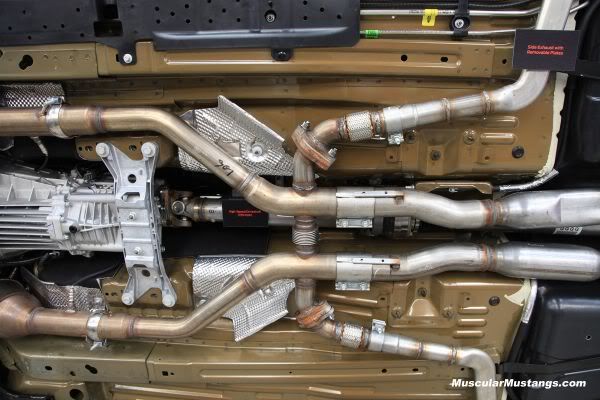
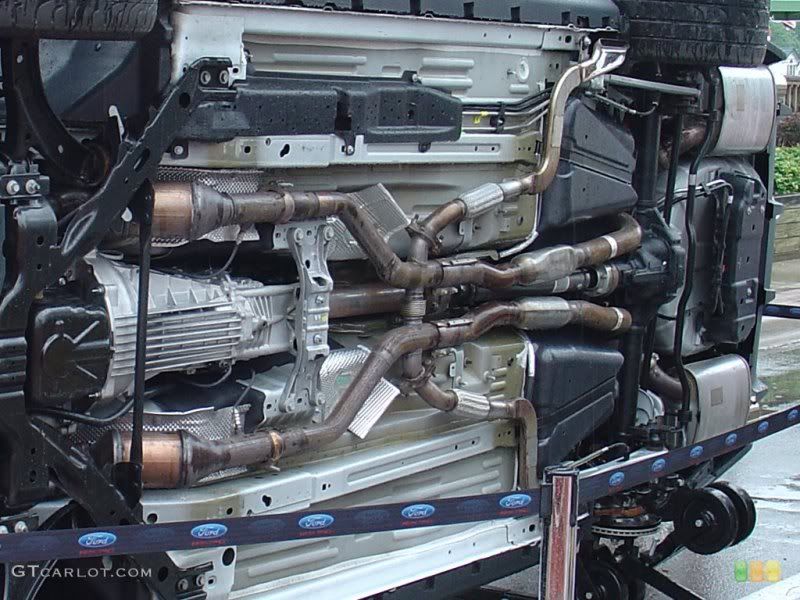
Here's what they say about it:
The new 2012 Mustang Boss 302 features a unique Quad exhaust system never before seen in a production Mustang that exudes an unmistakable exhaust note. When building the quad exhaust system Ford engineers had to consider three variables: legal noise restrictions; backpressure, and ground clearance. With a free flowing exhaust already in place on a base 2011 Mustang GT, engineers quickly realized backpressure would not be an issue and as a result tuning the exhaust for a Boss specific sound would not be hard at all.
The quad exhaust system features four exit points, two at the rear of the vehicle and two on either side of the vehicle just ahead of the rear wheel opening. The exhaust flows from the headers down through an exhaust crossover where they split off in the two directions. The exhaust that is sent to either side of the vehicle goes through a set of metal discs that act as tuning elements before they exit the side. In all honesty the side pipes do not flow that much exhaust but they do provide substantial exhaust sound. The less restricted exhaust continues on to the rear of the vehicle where it exits.
“We added the attenuation discs to meet legal regulations, but we knew buyers might operate these cars in situations where noise regulations weren’t an issue,” Carney said. “The disc is removable and includes a spacer plate sized to match aftermarket exhaust dump valves. If an owner wants to add a set of electric valves, they just undo two bolts on either side; the disc and spacer slide out and the valve will slide right in. And the side pipes are tuned so that drivers can run wide-open and the sound levels are comfortable – very aggressive but livable for an all-day track outing.”
Here's what they say about it:
The new 2012 Mustang Boss 302 features a unique Quad exhaust system never before seen in a production Mustang that exudes an unmistakable exhaust note. When building the quad exhaust system Ford engineers had to consider three variables: legal noise restrictions; backpressure, and ground clearance. With a free flowing exhaust already in place on a base 2011 Mustang GT, engineers quickly realized backpressure would not be an issue and as a result tuning the exhaust for a Boss specific sound would not be hard at all.
The quad exhaust system features four exit points, two at the rear of the vehicle and two on either side of the vehicle just ahead of the rear wheel opening. The exhaust flows from the headers down through an exhaust crossover where they split off in the two directions. The exhaust that is sent to either side of the vehicle goes through a set of metal discs that act as tuning elements before they exit the side. In all honesty the side pipes do not flow that much exhaust but they do provide substantial exhaust sound. The less restricted exhaust continues on to the rear of the vehicle where it exits.
“We added the attenuation discs to meet legal regulations, but we knew buyers might operate these cars in situations where noise regulations weren’t an issue,” Carney said. “The disc is removable and includes a spacer plate sized to match aftermarket exhaust dump valves. If an owner wants to add a set of electric valves, they just undo two bolts on either side; the disc and spacer slide out and the valve will slide right in. And the side pipes are tuned so that drivers can run wide-open and the sound levels are comfortable – very aggressive but livable for an all-day track outing.”
Member
Joined: May 2007
Posts: 119
Likes: 0
From: Dallas
'99 C43
Which brings me to the next big draw back to a dual exhaust... packaging. If you can find the space to package a dual exhaust under a C43, then I encourage to go for it just for the sake of overcoming a challenge. If that doesn't make sense, go lie on the ground under your C43 and imagine out the routing of a dual exhaust that doesn't involve it dragging on the ground. I've stared at it, so I would gladly give kudos to someone who pulled that off.
It would miss on the ultimate visual impact of the dual tips on each side of the car like the C63, but it would still be awesome.
Oval tubing is readily available to keep ground clearance for those side exits. Check out spintech.
MBWorld Fanatic!
Joined: May 2005
Posts: 2,494
Likes: 17
From: REHOBOTH BEACH DE
88-300CE TWIN TURBO, 99-C43, 05-G55K, 71-280SL, 94-E320 CAB, 08 CLK63 BLACK SERIES
Merc has used side pipes less the rear exhaust on every AMG G-Wagen...
It gives a Nascar sound to the 5.4L NA or Kompressor engine


