







Dyno Comparison: Stock/Tuned '09 C63 vs Stock/Tuned '13 C63 P31

Thread Starter
Senior Member


Joined: Mar 2007
Posts: 471
Likes: 19
CLK63 AMG Black Series
Dyno Comparison: Stock/Tuned '09 C63 vs Stock/Tuned '13 C63 P31
I picked up a Eurocharged tune recently and wanted to see how much impact it has on my stock 2013 C63 P31 (only mod is secondary cat delete). I specifically opted for a V5 tune instead of a V7 because of personal preference.
To make things interesting, I also have the dyno files from my old 2009 C63 (also only had secondary cat delete) that had a V4 tune.
Same exact dyno, different cars, but same exact mods.
Quick shoutout to European Auto Source in Anaheim for helping me with this 'experiment' with their dynojet.
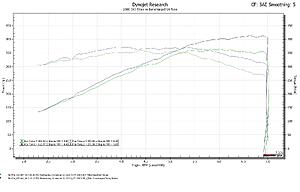
First dyno is my old 09 C63 stock vs Eurocharged V4 tune
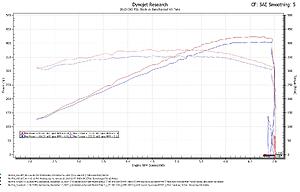
Next dyno is my '13 C63 P31 stock vs Eurocharged V5 tune
Lastly is all four dynos together...
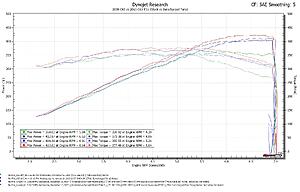
Final numbers are...
2009 C63 stock: 364/360
2009 C63 tuned: 413/371
2013 C63 P31 stock: 404/355
2013 C63 P31 tuned: 423/377
All in all, the numbers are as expected but its nice to finally see how all four compare on paper.
To make things interesting, I also have the dyno files from my old 2009 C63 (also only had secondary cat delete) that had a V4 tune.
Same exact dyno, different cars, but same exact mods.
Quick shoutout to European Auto Source in Anaheim for helping me with this 'experiment' with their dynojet.
First dyno is my old 09 C63 stock vs Eurocharged V4 tune

Next dyno is my '13 C63 P31 stock vs Eurocharged V5 tune

Lastly is all four dynos together...

Final numbers are...
2009 C63 stock: 364/360
2009 C63 tuned: 413/371
2013 C63 P31 stock: 404/355
2013 C63 P31 tuned: 423/377
All in all, the numbers are as expected but its nice to finally see how all four compare on paper.

Super Member
Joined: Apr 2017
Posts: 549
Likes: 85
2012 Mercedes C63 AMG S
I like the cleanliness of all these curves:
- SAE correction factor used (versus STD which would have inflated the results)
- SAE correction factor seems to be 0,99 for all 4 curves if I am reading the charts properly, so no weird distortions due to non-typical temperatures, barometric pressures, or humidity.
- Also pretty much what I would expect to see - no strange or unicorn results.
Nicely done.
Jim G
- SAE correction factor used (versus STD which would have inflated the results)
- SAE correction factor seems to be 0,99 for all 4 curves if I am reading the charts properly, so no weird distortions due to non-typical temperatures, barometric pressures, or humidity.
- Also pretty much what I would expect to see - no strange or unicorn results.
Nicely done.
Jim G
Thread Starter
Senior Member
Joined: Mar 2007
Posts: 471
Likes: 19
CLK63 AMG Black Series
I like the cleanliness of all these curves:
- SAE correction factor used (versus STD which would have inflated the results)
- SAE correction factor seems to be 0,99 for all 4 curves if I am reading the charts properly, so no weird distortions due to non-typical temperatures, barometric pressures, or humidity.
- Also pretty much what I would expect to see - no strange or unicorn results.
Nicely done.
Jim G
- SAE correction factor used (versus STD which would have inflated the results)
- SAE correction factor seems to be 0,99 for all 4 curves if I am reading the charts properly, so no weird distortions due to non-typical temperatures, barometric pressures, or humidity.
- Also pretty much what I would expect to see - no strange or unicorn results.
Nicely done.
Jim G
~20whp gain. Contact eurocharged and they might have some leftover units available at holiday pricing. V5 has a few benefits besides power. Most notably is the transmission blip.
Super Member
Joined: Apr 2017
Posts: 549
Likes: 85
2012 Mercedes C63 AMG S
For example, with the stock P31 tune, the power at the rear wheels doesn't hit 400 hp until 6100 rpm.
With the V5 tune, it hits 400 at 5600 rpm.
The engine appears to rev limit at about 7000 rpm (even though the P31 kit apparently enables revving to about 7200).
So, the rpm range in which the power meets or exceeds 400 rwhp has stretched from 900 rpm to 1400 rpm - an increase of 56% in the width of the powerband inw hich power at the wheels exceeds 400 rwhp.
This is a VERY significant benefit in acceleration scenarios.
This is because high performance engines always have a peakier powerband than more pedestrain engines, so you have to keep them in the rpm band in which they make good power. What hampers that effort is the need to keep the engine in that powerband via transmission gear shifting. When the engine hits the rev limit, you HAVE to shift to the next gear. But, that normally drops the rpm quite a bit - even with a 7-speed transmission - to an rpm where the power is normally notably lower. And, even with the short shift times of our C63 transmissions when in "S", or even better in "M", there is a brief interruption in power delivery.
You also have to shift DOWN more often when a powerband is narrower, in order to keep the power up.
By stretching the width of the powerband, you reduce the number of times you need to shift, AND you reduce the magnitude of the power drop when you do so on an upshift.
Furthermore, you have to put "small" power increases like this in perspective with other performance increasing features in the P31 and other packages. For example, the lighter wheels and lighter brakes reduce rotational inertia a small, but notable, amount, which improves acceleration AND handling.
The C63, like so many other high performance cars "picks up a bit here and bit there" and all the bits added together make for a transformed driving experience.
Intence clearly knows this stuff. And to his credit, he is not seduced by the more aggressive V7 tune which also unfortunately appears to stress the durability of the clutch pack in the transmission, and he particularly likes the exhaust burble of the V5 on downshift rev matching.
Hard to quarrel with any of that.
Jim G

Member


Joined: Apr 2017
Posts: 183
Likes: 34
S/C C63
Intence clearly knows this stuff. And to his credit, he is not seduced by the more aggressive V7 tune which also unfortunately appears to stress the durability of the clutch pack in the transmission, and he particularly likes the exhaust burble of the V5 on downshift rev matching.
Hard to quarrel with any of that.
Jim G
Hard to quarrel with any of that.
Jim G
Trending Topics
Thread Starter
Senior Member
Joined: Mar 2007
Posts: 471
Likes: 19
CLK63 AMG Black Series
It is actually a gain of "only" 19.1 rear wheel hp (423.63 - 404.56). BUT, don't look at just the absolute peak power. look at what it has done to the powerband.
For example, with the stock P31 tune, the power at the rear wheels doesn't hit 400 hp until 6100 rpm.
With the V5 tune, it hits 400 at 5600 rpm.
The engine appears to rev limit at about 7000 rpm (even though the P31 kit apparently enables revving to about 7200).
So, the rpm range in which the power meets or exceeds 400 rwhp has stretched from 900 rpm to 1400 rpm - an increase of 56% in the width of the powerband inw hich power at the wheels exceeds 400 rwhp.
This is a VERY significant benefit in acceleration scenarios.
This is because high performance engines always have a peakier powerband than more pedestrain engines, so you have to keep them in the rpm band in which they make good power. What hampers that effort is the need to keep the engine in that powerband via transmission gear shifting. When the engine hits the rev limit, you HAVE to shift to the next gear. But, that normally drops the rpm quite a bit - even with a 7-speed transmission - to an rpm where the power is normally notably lower. And, even with the short shift times of our C63 transmissions when in "S", or even better in "M", there is a brief interruption in power delivery.
You also have to shift DOWN more often when a powerband is narrower, in order to keep the power up.
By stretching the width of the powerband, you reduce the number of times you need to shift, AND you reduce the magnitude of the power drop when you do so on an upshift.
Furthermore, you have to put "small" power increases like this in perspective with other performance increasing features in the P31 and other packages. For example, the lighter wheels and lighter brakes reduce rotational inertia a small, but notable, amount, which improves acceleration AND handling.
The C63, like so many other high performance cars "picks up a bit here and bit there" and all the bits added together make for a transformed driving experience.
Intence clearly knows this stuff. And to his credit, he is not seduced by the more aggressive V7 tune which also unfortunately appears to stress the durability of the clutch pack in the transmission, and he particularly likes the exhaust burble of the V5 on downshift rev matching.
Hard to quarrel with any of that.
Jim G
For example, with the stock P31 tune, the power at the rear wheels doesn't hit 400 hp until 6100 rpm.
With the V5 tune, it hits 400 at 5600 rpm.
The engine appears to rev limit at about 7000 rpm (even though the P31 kit apparently enables revving to about 7200).
So, the rpm range in which the power meets or exceeds 400 rwhp has stretched from 900 rpm to 1400 rpm - an increase of 56% in the width of the powerband inw hich power at the wheels exceeds 400 rwhp.
This is a VERY significant benefit in acceleration scenarios.
This is because high performance engines always have a peakier powerband than more pedestrain engines, so you have to keep them in the rpm band in which they make good power. What hampers that effort is the need to keep the engine in that powerband via transmission gear shifting. When the engine hits the rev limit, you HAVE to shift to the next gear. But, that normally drops the rpm quite a bit - even with a 7-speed transmission - to an rpm where the power is normally notably lower. And, even with the short shift times of our C63 transmissions when in "S", or even better in "M", there is a brief interruption in power delivery.
You also have to shift DOWN more often when a powerband is narrower, in order to keep the power up.
By stretching the width of the powerband, you reduce the number of times you need to shift, AND you reduce the magnitude of the power drop when you do so on an upshift.
Furthermore, you have to put "small" power increases like this in perspective with other performance increasing features in the P31 and other packages. For example, the lighter wheels and lighter brakes reduce rotational inertia a small, but notable, amount, which improves acceleration AND handling.
The C63, like so many other high performance cars "picks up a bit here and bit there" and all the bits added together make for a transformed driving experience.
Intence clearly knows this stuff. And to his credit, he is not seduced by the more aggressive V7 tune which also unfortunately appears to stress the durability of the clutch pack in the transmission, and he particularly likes the exhaust burble of the V5 on downshift rev matching.
Hard to quarrel with any of that.
Jim G
MB World Stories
The Best of Mercedes & AMG

Manual Mercedes? 6 Times Sindelfingen Let Drivers Have All The Fun
Verdad Gallardo
Mercedes SLR McLaren 722 S Is Extremely Rare Example Modified by McLaren
Verdad Gallardo
8 Classic Boxy Mercedes Designs That Have Aged Like Fine Wine
Verdad Gallardo
Flawlessly Restored Mercedes 190E Evo II Heads to Auction
Verdad Gallardo
Electric Mercedes C-Class Unveiled: 11 Things You Need to Know
Verdad Gallardo
Mercedes EQS Gets A Major Update: Everything You Need to Know
Verdad Gallardo
5 Underrated Mercedes-Benz Models That Don't Get the Love They Deserve
Verdad Gallardo
Mercedes 300D Has Pushed Well Past 1 Million Miles and It Ain't Stopping
Verdad Gallardo
10 Most Reliable Mercedes-Benz Models You Can Buy Used
Verdad Gallardo
Super Member
Joined: Apr 2017
Posts: 549
Likes: 85
2012 Mercedes C63 AMG S
In fairness, no. No one has confirmed this scientifically. But take a look at the threads on this forum that discuss transmission slip problems, look at the tunes those cars are running, and draw your OWN conclusions, as I have done.
Jim G
Jim G

MBWorld Fanatic!
Joined: Jun 2008
Posts: 8,074
Likes: 2,867
From: Los Angeles
2012 P31 C63 Coupe Trackrat, 2019 GLE63S Coupe Beast


Senior Member
Joined: Jul 2017
Posts: 385
Likes: 47
C63 p31 coupe, Clk550 cab, M3 coupe, LS430, 750LI
Makes sense, didn't notice a big jump from stock+row+are to that+v6 tune. Well besides the meaner downshifts and the "surge" from 1st to 2nd which caught me off guard at first. Now I look forward to it.
Super Member
Joined: Apr 2017
Posts: 549
Likes: 85
2012 Mercedes C63 AMG S
That's true. hat's why I said it has not been scientifically shown, at least yet. But think about it. Sharper upshifts put higher peak loads on clutch plates. More aggressive downshifting puts higher inertia loads on clutches. How sharp and how aggressive can you go before it shows up as notably shorter parts lifetimes? And, who do you think has the better qualified resources and testing budgets to determine what is ok and what is over the line: Mercedes or a small tuner shop?
There's also a big difference in consequential costs in repairing an MB transmission versus say a GM transmission. I was able to handle the repair cost of a GM transmission when I destroyed one. Not so sure about whetehr I am willing to pay for rebuilding an MB tranny.
Jim G
There's also a big difference in consequential costs in repairing an MB transmission versus say a GM transmission. I was able to handle the repair cost of a GM transmission when I destroyed one. Not so sure about whetehr I am willing to pay for rebuilding an MB tranny.
Jim G
MBWorld Fanatic!
Joined: Jun 2008
Posts: 8,074
Likes: 2,867
From: Los Angeles
2012 P31 C63 Coupe Trackrat, 2019 GLE63S Coupe Beast
I have had the Weistec upgraded VB/TCU on for the past 2yrs, and that actually, mechanically, shifts hard. There is much more strain on the clutch packs. Hell, guys are running Stage 2 superchargers with no clutch pack issues. An ECU tune is not putting so much strain on the trans to cause slipping. And an ECU tune does nothing to alter anything trans-related, the up/downshifts are not “sharper”. All this talk is make believe nonsense.
Last edited by BLKROKT; Dec 14, 2017 at 08:34 PM.
MBWorld Fanatic!


Joined: Aug 2011
Posts: 5,351
Likes: 1,677
From: Kitchener, ON
2010 C63 AMG
There's also a big difference in consequential costs in repairing an MB transmission versus say a GM transmission. I was able to handle the repair cost of a GM transmission when I destroyed one. Not so sure about whetehr I am willing to pay for rebuilding an MB tranny.
Jim G
Jim G
https://www.amsperformance.com/cart/...-upgrade.html/
It's also not a difficult job to swap them out.
Super Member
Joined: Apr 2017
Posts: 549
Likes: 85
2012 Mercedes C63 AMG S
I have had the Weistec upgraded VB/TCU on for the past 2yrs, and that actually, mechanically, shifts hard. There is much more strain on the clutch packs. Hell, guys are running Stage 2 superchargers with no clutch pack issues. An ECU tune is not putting so much strain on the trans to cause slipping. And an ECU tune does nothing to alter anything trans-related, the up/downshifts are not “sharper”. All this talk is make believe nonsense.
Jim G


MBWorld Fanatic!
Joined: Aug 2011
Posts: 5,351
Likes: 1,677
From: Kitchener, ON
2010 C63 AMG
Maybe ask that question over there --> https://mbworld.org/forums/c63-c63s-amg-215/

MBWorld Fanatic!
Joined: Jun 2013
Posts: 1,814
Likes: 152
From: 'Merica
'04 E55 (Gone but not forgotten), '13 C63 P31 (RIP), another '13 C63 PP
Maybe ask that question over there --> https://mbworld.org/forums/c63-c63s-amg-215/


