



 Wait for the downshifts

 after that result.


More Dyno results...
Thread Starter
Member
Joined: Jan 2015
Posts: 115
Likes: 3
C63 W205 Edition 1
More Dyno results...
I've got some new numbers! Although, on the HP numbers...
Unfortunately, we could not get an ignition pulse so we could not get a proper rpm reading for the torque calculation. I'd like to say thanks to Renntech florida for calling my back and helping me out, but it still wouldn't work for us!!!
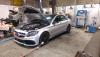
It was a bit of a cold day up here, and we are at a higher elevation than sea level in Alberta, Canada. But the results were great! I've attached a picture while waiting for the shop to send me the files.
Did a three pulls, one in race, one in Sport+ and one in comfort... was just curious to see if I would get a different result (the car is stock at the moment). Looks like the race mode gave me the biggest numbers @ 515WHP! Although, I do hear that dynojets read a bit higher...
For a comparison, my friend ran his M3 and i will post his results shortly. With his tune and downpipes he made 472hp.
Unfortunately, we could not get an ignition pulse so we could not get a proper rpm reading for the torque calculation. I'd like to say thanks to Renntech florida for calling my back and helping me out, but it still wouldn't work for us!!!
It was a bit of a cold day up here, and we are at a higher elevation than sea level in Alberta, Canada. But the results were great! I've attached a picture while waiting for the shop to send me the files.
Did a three pulls, one in race, one in Sport+ and one in comfort... was just curious to see if I would get a different result (the car is stock at the moment). Looks like the race mode gave me the biggest numbers @ 515WHP! Although, I do hear that dynojets read a bit higher...
For a comparison, my friend ran his M3 and i will post his results shortly. With his tune and downpipes he made 472hp.

MBWorld Fanatic!


Joined: Oct 2011
Posts: 2,380
Likes: 73
C204 C250-CDI
Interesting, definitely higher number readout from a dyno jet.
Your results above confirm what some other tuners have also stated in that a stock AMG M177 is a lot more powerful than a tuned BMW S55
Your results above confirm what some other tuners have also stated in that a stock AMG M177 is a lot more powerful than a tuned BMW S55
MBWorld Fanatic!
Joined: Oct 2011
Posts: 2,380
Likes: 73
C204 C250-CDI
Absolutely awesome thanks for sharing
Seriously no offense to the BMW community but these new M's sound so terrible it's shocking to the ears, that one on the dyno sounded like my old washing machine on the spin dry cycle ie. totally revolting
By comparison the AMG sounds so good anyone could watch and listen to that all day long over over again
Seriously no offense to the BMW community but these new M's sound so terrible it's shocking to the ears, that one on the dyno sounded like my old washing machine on the spin dry cycle ie. totally revolting
By comparison the AMG sounds so good anyone could watch and listen to that all day long over over again
Thread Starter
Member
Joined: Jan 2015
Posts: 115
Likes: 3
C63 W205 Edition 1
When I drive the car, it does seem to have a little more jam in race mode than all other modes... I did have the car switch into dynomometer mode as well.
I will have to ask the AMG technician about the ignition pulse wire next time I bring the car in for service and maybe go for another couple pulls.
Trending Topics

MBWorld Fanatic!
Joined: Feb 2013
Posts: 1,635
Likes: 25
From: NJ
17 C63 S Coupe
So sick!! I am putting mine on the dyno soon! A Dynojet to Mustang Dyno can vary 10%-12% higher. Meaning on a Mustang Dyno you could would put out about 452 RWHP. Now, we have seen cars on here, put out 480 RWHP. What octane fuel were you running?
A Dynojet to Mustang Dyno can vary 10%-12% higher. Meaning on a Mustang Dyno you could would put out about 452 RWHP. Now, we have seen cars on here, put out 480 RWHP. What octane fuel were you running?
MB World Stories
The Best of Mercedes & AMG

Manual Mercedes? 6 Times Sindelfingen Let Drivers Have All The Fun
Verdad Gallardo
Mercedes SLR McLaren 722 S Is Extremely Rare Example Modified by McLaren
Verdad Gallardo
8 Classic Boxy Mercedes Designs That Have Aged Like Fine Wine
Verdad Gallardo
Flawlessly Restored Mercedes 190E Evo II Heads to Auction
Verdad Gallardo
Electric Mercedes C-Class Unveiled: 11 Things You Need to Know
Verdad Gallardo
Mercedes EQS Gets A Major Update: Everything You Need to Know
Verdad Gallardo
5 Underrated Mercedes-Benz Models That Don't Get the Love They Deserve
Verdad Gallardo
Mercedes 300D Has Pushed Well Past 1 Million Miles and It Ain't Stopping
Verdad Gallardo
10 Most Reliable Mercedes-Benz Models You Can Buy Used
Verdad Gallardo
Thread Starter
Member
Joined: Jan 2015
Posts: 115
Likes: 3
C63 W205 Edition 1


MBWorld Fanatic!
Joined: Dec 2002
Posts: 1,669
Likes: 63
From: Montana/Alberta
C63 BS, GLA45
The reason it reads so high is because in Calgary at 3700ft, if you apply atmospheric correction, it applies a 12-16% correction depending on the weather conditions. While that's accurate to gauge what power a NA car makes at sea level, it exaggerates what a turbo car makes because the ecu lets the engine make up the power from our thinner air by allowing it to boost at the same absolute pressure as sea level (if the turbo is big enough to do so).
It's a dyno queen trick I used back in the day to exaggerate how much hp I could make tuning turbo Hondas here.
Ask AG Haute to print out the uncorrected data for both cars and you'll have a better idea of what power the car is putting down at the wheels compared to others that don't use this trick.
It's a dyno queen trick I used back in the day to exaggerate how much hp I could make tuning turbo Hondas here.
Ask AG Haute to print out the uncorrected data for both cars and you'll have a better idea of what power the car is putting down at the wheels compared to others that don't use this trick.

MBWorld Fanatic!
Joined: Nov 2009
Posts: 3,589
Likes: 68
From: Texas
C63 507 AMG DA Car #19
rage.... wow and I always thought I had the edge dyno-ing my queen at sea-level LOL.....
the tuning industry is a sketchy one.... no time slips no proof of anything these days.
Thanks for sharing what I already suspected about tuners.
the tuning industry is a sketchy one.... no time slips no proof of anything these days.
Thanks for sharing what I already suspected about tuners.

Super Member
Joined: Jun 2015
Posts: 643
Likes: 92
From: Houston, TX
'15 C63S
The reason it reads so high is because in Calgary at 3700ft, if you apply atmospheric correction, it applies a 12-16% correction depending on the weather conditions. While that's accurate to gauge what power a NA car makes at sea level, it exaggerates what a turbo car makes because the ecu lets the engine make up the power from our thinner air by allowing it to boost at the same absolute pressure as sea level (if the turbo is big enough to do so).
It's a dyno queen trick I used back in the day to exaggerate how much hp I could make tuning turbo Hondas here.
Ask AG Haute to print out the uncorrected data for both cars and you'll have a better idea of what power the car is putting down at the wheels compared to others that don't use this trick.
It's a dyno queen trick I used back in the day to exaggerate how much hp I could make tuning turbo Hondas here.
Ask AG Haute to print out the uncorrected data for both cars and you'll have a better idea of what power the car is putting down at the wheels compared to others that don't use this trick.
Maybe I'll show some naivety here to practical application vs academia theory, but does the ECU calculate boost off of gauge or absolute pressure?
If it's absolute pressure, I can see where you are going. But if it's based on gauge pressure (Gauge = Absolute - Atmospheric), the turbo/ECU wouldn't know anything is different and would just be adding the same amount of boost/pressure regardless of what the atmospheric pressure is.
Use the air pressure in your tire as an example. What you are measuring in gauge pressure, not the actual ("absolute") pressure of the air inside the tire. You measure the air pressure, and the gauge tells you it is 35 psi. Assuming standard conditions (sea level, 77 degrees F), atmospheric pressure outside the tire is 14.7 psi. That means the absolute pressure inside the tire is 49.7 psi (35 + 14.7). In other words, there is 49.7 psi pushing on the inside of the tire and 14.7 psi pushing on the outside of the tire. The net result (gauge pressure) is a 35 psi outward pressure.
Same thing applies to forced induction on your engine. Boost is usually quoted in terms of gauge pressure, so say an engine is running 12 psi of boost. That means the gauge pressure of the intake air is 12 psi, but the absolute pressure on the air is that plus atmospheric pressure (12 psi + 14.7 psi = 26.7 psi).
Which of these pressures is the ECU measuring?
If it's absolute, your intake air pressure would be identical regardless of altitude because the ECU would replace the difference in atmospheric pressure with more gauge pressure (boost). No correction would be needed for altitude and I could see how you'd get a gain from then adding a correction on top of that.
If it's gauge pressure (as every engine seems to be quoted as using in terms of boost), you really aren't gaining anything. Maybe a slight advantage because the boost added is a slightly higher percentage of the atmospheric pressure, but other than that it's prettty much a wash.
Last edited by msd3075; Aug 25, 2015 at 10:34 AM. Reason: Can't add two numbers correctly.....

Senior Member
Joined: May 2012
Posts: 324
Likes: 9
From: Chapel Hill, NC
2015 C63S E1; 2016 C450 AMG
Maybe I'll show some naivety here to practical application vs academia theory, but does the ECU calculate boost off of gauge or absolute pressure?
If it's absolute pressure, I can see where you are going. But if it's based on gauge pressure (Gauge = Absolute - Atmospheric), the turbo/ECU wouldn't know anything is different and would just be adding the same amount of boost/pressure regardless of what the atmospheric pressure is.
Use the air pressure in your tire as an example. What you are measuring in gauge pressure, not the actual ("absolute") pressure of the air inside the tire. You measure the air pressure, and the gauge tells you it is 35 psi. Assuming standard conditions (sea level, 77 degrees F), atmospheric pressure outside the tire is 14.7 psi. That means the absolute pressure inside the tire is 49.7 psi (35 + 14.7). In other words, there is 49.7 psi pushing on the inside of the tire and 14.7 psi pushing on the outside of the tire. The net result (gauge pressure) is a 35 psi outward pressure.
Same thing applies to forced induction on your engine. Boost is usually quoted in terms of gauge pressure, so say an engine is running 12 psi of boost. That means the gauge pressure of the intake air is 12 psi, but the absolute pressure on the air is that plus atmospheric pressure (12 psi + 14.7 psi = 26.7 psi).
Which of these pressures is the ECU measuring?
If it's absolute, your intake air pressure would be identical regardless of altitude because the ECU would replace the difference in atmospheric pressure with more gauge pressure (boost). No correction would be needed for altitude and I could see how you'd get a gain from then adding a correction on top of that.
If it's gauge pressure (as every engine seems to be quoted as using in terms of boost), you really aren't gaining anything. Maybe a slight advantage because the boost added is a slightly higher percentage of the atmospheric pressure, but other than that it's prettty much a wash.
If it's absolute pressure, I can see where you are going. But if it's based on gauge pressure (Gauge = Absolute - Atmospheric), the turbo/ECU wouldn't know anything is different and would just be adding the same amount of boost/pressure regardless of what the atmospheric pressure is.
Use the air pressure in your tire as an example. What you are measuring in gauge pressure, not the actual ("absolute") pressure of the air inside the tire. You measure the air pressure, and the gauge tells you it is 35 psi. Assuming standard conditions (sea level, 77 degrees F), atmospheric pressure outside the tire is 14.7 psi. That means the absolute pressure inside the tire is 49.7 psi (35 + 14.7). In other words, there is 49.7 psi pushing on the inside of the tire and 14.7 psi pushing on the outside of the tire. The net result (gauge pressure) is a 35 psi outward pressure.
Same thing applies to forced induction on your engine. Boost is usually quoted in terms of gauge pressure, so say an engine is running 12 psi of boost. That means the gauge pressure of the intake air is 12 psi, but the absolute pressure on the air is that plus atmospheric pressure (12 psi + 14.7 psi = 26.7 psi).
Which of these pressures is the ECU measuring?
If it's absolute, your intake air pressure would be identical regardless of altitude because the ECU would replace the difference in atmospheric pressure with more gauge pressure (boost). No correction would be needed for altitude and I could see how you'd get a gain from then adding a correction on top of that.
If it's gauge pressure (as every engine seems to be quoted as using in terms of boost), you really aren't gaining anything. Maybe a slight advantage because the boost added is a slightly higher percentage of the atmospheric pressure, but other than that it's prettty much a wash.
The same principle applies with cars. That is why turbo charged cars perform much better at high altitudes than NA cars.
There are limits on how much a given turbo can compress the ambient air so even turbo vehicles suffer some performance loss at higher altitudes. However, the intake system is measuring the amount of oxygen going into the engine, so it can match that with the proper amount of fuel. At higher altitudes, where oxygen density is lower, the turbos will work harder and will, up to their design limits, provide the same amount of oxygen to the engine as at sea level.
Super Member
Joined: Jun 2015
Posts: 643
Likes: 92
From: Houston, TX
'15 C63S
Turbos were originally invented to enable airplanes that used piston engines to fly at higher altitudes by feeding pressurized air into the engine, thereby overcoming the lower density of oxygen molecules in the ambient air.
The same principle applies with cars. That is why turbo charged cars perform much better at high altitudes than NA cars.
There are limits on how much a given turbo can compress the ambient air so even turbo vehicles suffer some performance loss at higher altitudes. However, the intake system is measuring the amount of oxygen going into the engine, so it can match that with the proper amount of fuel. At higher altitudes, where oxygen density is lower, the turbos will work harder and will, up to their design limits, provide the same amount of oxygen to the engine as at sea level.
The same principle applies with cars. That is why turbo charged cars perform much better at high altitudes than NA cars.
There are limits on how much a given turbo can compress the ambient air so even turbo vehicles suffer some performance loss at higher altitudes. However, the intake system is measuring the amount of oxygen going into the engine, so it can match that with the proper amount of fuel. At higher altitudes, where oxygen density is lower, the turbos will work harder and will, up to their design limits, provide the same amount of oxygen to the engine as at sea level.
Trust me, I'm a BSME by degree that knows plenty about the (theoretical) inner workings of forced induction works. You don't want me pulling out the old P-V diagrams from old (and probably outdated) textbooks to put you to sleep with lengthy explanations.....
If that's the case about how the engine supplies boost, it means boost isn't fixed and is then variable based upon altitude. It's make sense then that you'd see little-to-no difference in engine performance due to altitude. I guess I just always assumed boost was a fixed 'gauge pressure' measurement of the increase in intake pressure over atmospheric pressure.
Senior Member
Joined: May 2012
Posts: 324
Likes: 9
From: Chapel Hill, NC
2015 C63S E1; 2016 C450 AMG
Trust me, I'm a BSME by degree that knows plenty about the (theoretical) inner workings of forced induction works. You don't want me pulling out the old P-V diagrams from old (and probably outdated) textbooks to put you to sleep with lengthy explanations.....
If that's the case about how the engine supplies boost, it means boost isn't fixed and is then variable based upon altitude. It's make sense then that you'd see little-to-no difference in engine performance due to altitude. I guess I just always assumed boost was a fixed 'gauge pressure' measurement of the increase in intake pressure over atmospheric pressure.
If that's the case about how the engine supplies boost, it means boost isn't fixed and is then variable based upon altitude. It's make sense then that you'd see little-to-no difference in engine performance due to altitude. I guess I just always assumed boost was a fixed 'gauge pressure' measurement of the increase in intake pressure over atmospheric pressure.
Super Member
Joined: Jun 2015
Posts: 643
Likes: 92
From: Houston, TX
'15 C63S
It does, but you need to know which P you are using to calculate the rest.
And also only for ideal gases. But that's a different topic all together. Please, please, please don't make me pull out my enthalpy tables and start interpolating.......
And also only for ideal gases. But that's a different topic all together. Please, please, please don't make me pull out my enthalpy tables and start interpolating.......
Last edited by msd3075; Aug 25, 2015 at 04:20 PM.
MBWorld Fanatic!
Joined: Dec 2002
Posts: 1,669
Likes: 63
From: Montana/Alberta
C63 BS, GLA45
Modern cars control boost using absolute pressure. In Calgary at 3700ft, a 997 Turbo will destroy a 458 Italia. Not even a fair fight. Older cars that used mechanical boost control would be gauge pressure.
With that being said, and I brought it up earlier, it all depends on the size of the turbo. By the time you get to higher elevations such as Colorado, turbo cars will lose power compared to sea level because it's well past the turbo's limits and can't compress that thin air to the absolute pressure at sea level, but it will still have a huge advantage over an NA engine.
This is also the reason why chip tuning is less effective at altitude. They're generally tuned to maximize what the turbo can push out at sea level, so even going up to 3700ft here it's out of breath and won't gain much over stock.
With that being said, and I brought it up earlier, it all depends on the size of the turbo. By the time you get to higher elevations such as Colorado, turbo cars will lose power compared to sea level because it's well past the turbo's limits and can't compress that thin air to the absolute pressure at sea level, but it will still have a huge advantage over an NA engine.
This is also the reason why chip tuning is less effective at altitude. They're generally tuned to maximize what the turbo can push out at sea level, so even going up to 3700ft here it's out of breath and won't gain much over stock.
Super Member
Joined: Jun 2015
Posts: 643
Likes: 92
From: Houston, TX
'15 C63S
Modern cars control boost using absolute pressure. In Calgary at 3700ft, a 997 Turbo will destroy a 458 Italia. Not even a fair fight. Older cars that used mechanical boost control would be gauge pressure.
With that being said, and I brought it up earlier, it all depends on the size of the turbo. By the time you get to higher elevations such as Colorado, turbo cars will lose power compared to sea level because it's well past the turbo's limits and can't compress that thin air to the absolute pressure at sea level, but it will still have a huge advantage over an NA engine.
This is also the reason why chip tuning is less effective at altitude. They're generally tuned to maximize what the turbo can push out at sea level, so even going up to 3700ft here it's out of breath and won't gain much over stock.
With that being said, and I brought it up earlier, it all depends on the size of the turbo. By the time you get to higher elevations such as Colorado, turbo cars will lose power compared to sea level because it's well past the turbo's limits and can't compress that thin air to the absolute pressure at sea level, but it will still have a huge advantage over an NA engine.
This is also the reason why chip tuning is less effective at altitude. They're generally tuned to maximize what the turbo can push out at sea level, so even going up to 3700ft here it's out of breath and won't gain much over stock.
MBWorld Fanatic!
Joined: Nov 2009
Posts: 3,589
Likes: 68
From: Texas
C63 507 AMG DA Car #19
I believe the turbo outlet pressure will be affected by inlet pressure.
So at sealevel a turbo will generate more boost than at 4000' altitude (all things being equal).
If the ecu controls a blow-off valve, to keep boost below 17psi.... and if the turbo have the excess capacity, then by use of the BOV the ECU can maintain the same 17psi peak boost even at higher elevation.
All speculation since we don't know the architecture of the c63s .... yet.
oh yeah BSME here too. THE engineering degree to get. IMHO.
So at sealevel a turbo will generate more boost than at 4000' altitude (all things being equal).
If the ecu controls a blow-off valve, to keep boost below 17psi.... and if the turbo have the excess capacity, then by use of the BOV the ECU can maintain the same 17psi peak boost even at higher elevation.
All speculation since we don't know the architecture of the c63s .... yet.
oh yeah BSME here too. THE engineering degree to get. IMHO.
Last edited by betrezra; Aug 25, 2015 at 09:51 PM.
Super Member
Joined: Jun 2015
Posts: 643
Likes: 92
From: Houston, TX
'15 C63S
I believe the turbo outlet pressure will be affected by inlet pressure.
So at sealevel a turbo will generate more boost than at 4000' altitude (all things being equal).
If the ecu controls a blow-off valve, to keep boost below 17psi.... and if the turbo have the excess capacity, then by use of the BOV the ECU can maintain the same 17psi peak boost even at higher elevation.
All speculation since we don't know the architecture of the c63s .... yet.
oh yeah BSME here too. THE engineering degree to get. IMHO.
So at sealevel a turbo will generate more boost than at 4000' altitude (all things being equal).
If the ecu controls a blow-off valve, to keep boost below 17psi.... and if the turbo have the excess capacity, then by use of the BOV the ECU can maintain the same 17psi peak boost even at higher elevation.
All speculation since we don't know the architecture of the c63s .... yet.
oh yeah BSME here too. THE engineering degree to get. IMHO.
BSME '06 here. Showing my age, or lack thereof.
All this talk about boost pressures made me want to pull out my old Thermodynamics and Thermo-Fluid Systems textbooks. Made me want to refresh on everything I hadn't looked at in a while. Until I realized I sold all my books back to the book store for beer money....
Thread Starter
Member
Joined: Jan 2015
Posts: 115
Likes: 3
C63 W205 Edition 1
I'm glad all the engineers came out of the wood work... After that post I was about to start doing a whole bunch of research and start breaking it down (BSChemE) thanks for saving me some time.
But for clarity / summarize, I think almost all of you guys are saying the same thing... Almost.
Ultimately a turbocharger is just a centrifugal compressor... There really should not be much change at various altitudes (hence the airplane analogy above), the turbo will always boost to get to a set pressure as called for by the ECU (in gauge). The ECU should always be calling for a consistent pressure (for the most part).
The only time there will be an impact at a higher altitude is if the turbo charger (compressor) is not able to "work" hard enough to generate the amount of pressure the ecu is calling for, meaning you will lose boost and power.
The SAE correction uses a 15% mechanical efficiency factor which really should only pertain to Naturally Aspirated motors. Which is why the readings are so high... The uncorrected numbers are probably more reflective of what the actual power is... I will ask for the uncorrected number. I have a hunch it will be around 480hp.
Naturally aspirated engines because of no compression will see a loss in power because they only see atmospheric pressure... so the density of the air being fed into the motor is lower. Less air density, different air/fuel and less power.
But for clarity / summarize, I think almost all of you guys are saying the same thing... Almost.
Ultimately a turbocharger is just a centrifugal compressor... There really should not be much change at various altitudes (hence the airplane analogy above), the turbo will always boost to get to a set pressure as called for by the ECU (in gauge). The ECU should always be calling for a consistent pressure (for the most part).
The only time there will be an impact at a higher altitude is if the turbo charger (compressor) is not able to "work" hard enough to generate the amount of pressure the ecu is calling for, meaning you will lose boost and power.
The SAE correction uses a 15% mechanical efficiency factor which really should only pertain to Naturally Aspirated motors. Which is why the readings are so high... The uncorrected numbers are probably more reflective of what the actual power is... I will ask for the uncorrected number. I have a hunch it will be around 480hp.
Naturally aspirated engines because of no compression will see a loss in power because they only see atmospheric pressure... so the density of the air being fed into the motor is lower. Less air density, different air/fuel and less power.
MBWorld Fanatic!
Joined: Dec 2002
Posts: 1,669
Likes: 63
From: Montana/Alberta
C63 BS, GLA45
All that matters is you're making more power than the M3.
For the engineers - turbo cars at high altitude, low rpm performance, at least until maximum absolute pressure, suffers from the same power loss as an NA motor. So while we have the same peak power as sea level here, our low rpm performance is quite poor, resulting in a narrower powerband. The knock on effect is that launch control, which is typically setup for sea level powerband, isn't optimal here and we "bog" off the line.
In a couple of years, when AMG starts using hybrid power trains, the electric motors should be able to fill in that gap like in the latest hypercars such as the P1.
For the engineers - turbo cars at high altitude, low rpm performance, at least until maximum absolute pressure, suffers from the same power loss as an NA motor. So while we have the same peak power as sea level here, our low rpm performance is quite poor, resulting in a narrower powerband. The knock on effect is that launch control, which is typically setup for sea level powerband, isn't optimal here and we "bog" off the line.
In a couple of years, when AMG starts using hybrid power trains, the electric motors should be able to fill in that gap like in the latest hypercars such as the P1.
Last edited by rage2; Aug 26, 2015 at 02:20 AM.
MBWorld Fanatic!
Joined: Nov 2009
Posts: 3,589
Likes: 68
From: Texas
C63 507 AMG DA Car #19
Ways to make power with boost over stock:
1. More Boost... to a limit.... you can get out of the eff range of the compressor, OR get too much boost and have pre-ignition... or too much power and split the block or crank.
2. Less Fuel Lean it out.....to a point. We used to tgt AFR of 12.2-12.8 at WOT under full boost in 3rd gear pulls to be safe. There is power above 12.8 AFR.... but how safe?
3. More timing...... to a point.
ALL THREE!
At higher elevation you have less oxygen, and less ambient pressure.... so turbo can try to comprensate for this lack of pressure/O2.
A belt driven centri blower has a fixed step up in boost as related to rpms........ I have some experience playing with reducing inlet restriction of a vortech on a V8..... you can gain 1-3 psi of add'l boost on the outlet of the cent blower JUST by adding a less res power inlet pipe in the fender. I presume this works the same on a turbo car.
The part I'm not totally clear on with the turbo..... is if the exhaust heat/rate of flow affects the rate of boost...... and if this affect changes with elevation.
I'm guessing that part is negiligible.... and the ECU controls boost simply by opening/closing a Waste-Gate valve...... and ECU keeps max boost per a map.... and just dumps extra boost to keep everything happy.
I suspect we will see some DRAMATICALLY improved ET's/Traps/dyno numbers in 30-40deg F weather.......... as you will get all three above:::::: more boost, more O2, more timing (since ecu will not have to pull timing due to HOT air).
Hope all makes sense......
and btw..... did not mean to sound cheaky about BSME being THE degree..... perhaps a bit biased. I'm a bsme in the oil field. Class of 91.. so old old guy here. Will be 47 in sept! Mid-life crisis time!
1. More Boost... to a limit.... you can get out of the eff range of the compressor, OR get too much boost and have pre-ignition... or too much power and split the block or crank.
2. Less Fuel Lean it out.....to a point. We used to tgt AFR of 12.2-12.8 at WOT under full boost in 3rd gear pulls to be safe. There is power above 12.8 AFR.... but how safe?
3. More timing...... to a point.
ALL THREE!
At higher elevation you have less oxygen, and less ambient pressure.... so turbo can try to comprensate for this lack of pressure/O2.
A belt driven centri blower has a fixed step up in boost as related to rpms........ I have some experience playing with reducing inlet restriction of a vortech on a V8..... you can gain 1-3 psi of add'l boost on the outlet of the cent blower JUST by adding a less res power inlet pipe in the fender. I presume this works the same on a turbo car.
The part I'm not totally clear on with the turbo..... is if the exhaust heat/rate of flow affects the rate of boost...... and if this affect changes with elevation.
I'm guessing that part is negiligible.... and the ECU controls boost simply by opening/closing a Waste-Gate valve...... and ECU keeps max boost per a map.... and just dumps extra boost to keep everything happy.
I suspect we will see some DRAMATICALLY improved ET's/Traps/dyno numbers in 30-40deg F weather.......... as you will get all three above:::::: more boost, more O2, more timing (since ecu will not have to pull timing due to HOT air).
Hope all makes sense......
and btw..... did not mean to sound cheaky about BSME being THE degree..... perhaps a bit biased.
I'm a bsme in the oil field. Class of 91.. so old old guy here. Will be 47 in sept! Mid-life crisis time!
Super Member
Joined: Jun 2015
Posts: 643
Likes: 92
From: Houston, TX
'15 C63S
Actually sitting in my hotel room in the middle a damn oil field as we speak. Seminole, TX is such a happenin' place......


