When you click on links to various merchants on this site and make a purchase, this can result in this site earning a commission. Affiliate programs and affiliations include, but are not limited to, the eBay Partner Network.
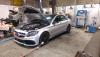
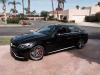
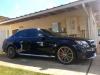
I ran my C63 Edition 1 on a friend's Mustang Dyno today.
And look here at the results:
495 ft-lb of torque<br/>426 hp
Assuming 15% parasitic loss, this equates to 582 ft-lb of torque and 502 hp. The hp is nearly spot on with MB's rating while the torque is a lot more. We only did two runs so there may be more to be had as both increased quite a bit from the first run. Has anyone else run theirs? It would be interesting to see how they compare.
I ran my C63 Edition 1 on a friend's Mustang Dyno today.
And look here at the results:
495 ft-lb of torque<br/>426 hp
Assuming 15% parasitic loss, this equates to 582 ft-lb of torque and 502 hp. The hp is nearly spot on with MB's rating while the torque is a lot more. We only did two runs so there may be more to be had as both increased quite a bit from the first run. Has anyone else run theirs? It would be interesting to see how they compare.
Thanks to Reno Speed Lab for the Dyno run.
Kurt
Did you have the car in race mode? Race mode has an extra 15+ horse than all the other modes...
Congrats on the ED1 looks good. I'm planning a dyno on my car as well. You plan on doing any additional mods?
There are a few types of dynos not sure where mustang dynos stand in comparison to others. What were the conditions for the run? (Temp, humidity, miles on your car)
Can you provide better pics of the dyno sheet the power curve and where it drops off is really key to understanding your cars power
Congrats on the ED1 looks good. I'm planning a dyno on my car as well. You plan on doing any additional mods?
There are a few types of dynos not sure where mustang dynos stand in comparison to others. What were the conditions for the run? (Temp, humidity, miles on your car)
Can you provide better pics of the dyno sheet the power curve and where it drops off is really key to understanding your cars power
I am in Reno, NV so we approximately at 4,800 ft above sea level. The temp was around 48F and the humidity was probably less than 20%. The numbers shown are corrected for all of these parameters. I will post the full sheet shortly.
According to the shop, Mustang dynos are very conservative as compared to other brands. I have no experience with that so I could not comment on it one way or another.
As for additional mods, I am not planning on anything more than better brakes (see my other post on this forum regarding destroying the factory brakes at the track last summer) for now. I may do a tune in a year or two. Oh, I will also try to fit larger wheels and tires soon too.
Yes, it was in race mode. I have not heard of the extra hp in this mode either.
When you run it on the dyno, try it out.
I ran the car on a Dynojet in 3/4 modes (no comfort) and it makes an extra 15 horse at the wheels. I'm sure it make a higher torque as well, but we could not get an ignition pulse to measure the TQ.
Take a look at the image of the dyno plots at the end of the clip. You'll see "sport" and "race" in the file name. I was mistaken, it is actually 18hp.
I confirmed it as well at an AMG Driving Experience session, with one of the instructors who is pretty active on private lounge.
Assuming 15% parasitic loss, this equates to 582 ft-lb of torque and 502 hp. The hp is nearly spot on with MB's rating while the torque is a lot more. We only did two runs so there may be more to be had as both increased quite a bit from the first run. Has anyone else run theirs? It would be interesting to see how they compare.
Thanks to Reno Speed Lab for the Dyno run.
Kurt
^^^
Seems some what low from the results I have seen.
Another thread has a Weistec dyno results of a M177.
I have seen about half doz. results posted and all have been between 469 and 479 HP
and most have been in quite hot weather cond.
I don't remember all the dyno types but did note the results.
There has been some discussion and it was thought AMG underrates the HP some.
If you take the 472 Weistec number and use a parasitic loss of 12% it would be 536HP at the crank.
Mustang Dynos read out lower than Dynojets. Up to 15% or so. From my understanding one takes into account weight the other does not. People are fixated on numbers and therefore prefer Dynojets read outs. I've had an evo before this and I've had five pro tunes done on two separate Dynojets on two different octane settings.
No late model production car has 25% or 20% driveline loss....we don't have turbo 400's
To clarify the question, what made people choose 15% (vs. 5, 10, 20, 30% or whatever?). You say no late model production car has 20 or 25% loss... who or how was it determined that previous cars had 20 or 25% loss to begin with? Just trying to understand how these things are come about.
To clarify the question, what made people choose 15% (vs. 5, 10, 20, 30% or whatever?). You say no late model production car has 20 or 25% loss... who or how was it determined that previous cars had 20 or 25% loss to begin with? Just trying to understand how these things are come about.
Because you can literally dyno an engine and thus, the "crank" HP numbers.
When you slap it on a dyno that measures the power to the wheels, you will get less.
This is called drivetrain loss, the loss of HP measured at the crank versus the wheels.
Because you can literally dyno an engine and thus, the "crank" HP numbers.
When you slap it on a dyno that measures the power to the wheels, you will get less.
This is called drivetrain loss, the loss of HP measured at the crank versus the wheels.
Sheesh....i know THAT...
Let me try to reask the question bluntly... Who is the authority that documents by FACT that the drivetrain loss on a C63S is 15% vs some other number? For instance, BMWs historically had a 25% actual drivetrain loss documented by someone dynoing the engine at the crank and then at the wheels for that particular car.
Let me try to reask the question bluntly... Who is the authority that documents by FACT that the drivetrain loss on a C63S is 15% vs some other number? For instance, BMWs historically had a 25% actual drivetrain loss documented by someone dynoing the engine at the crank and then at the wheels for that particular car.
I would like to know this too
I'm waiting to see a crank dyno on same day and same dyno as wheel dyno.... Havent seen one yet
15% is an estimate ... No one knows real factor for w205 c63
I'm waiting to see a crank dyno on same day and same dyno as wheel dyno.... Havent seen one yet
15% is an estimate ... No one knows real factor for w205 c63
Hmmm... darn good point on the crank dyno vs. wheel dyno.
So, who then decided that 15% was a good estimate? Not trying to be a stickler here, but it seem awfully convenient that if I wheel dyno my car at 427hp, I could conveniently say that there must have been a drivetrain loss of 15% since 427 hp = .85 x 503 hp
What, if in reality, the drivetrain loss was actually 25% so my engine was actually at 427 hp = .75 x 569 hp!!!
On the flip side, if drivetrain loss was only 5% then my engine sucks since 427 hp = .95 x 449 hp at the crank.
Hmmm... darn good point on the crank dyno vs. wheel dyno.
So, who then decided that 15% was a good estimate? Not trying to be a stickler here, but it seem awfully convenient that if I wheel dyno my car at 427hp, I could conveniently say that there must have been a drivetrain loss of 15% since 427 hp = .85 x 503 hp
What, if in reality, the drivetrain loss was actually 25% so my engine was actually at 427 hp = .75 x 569 hp!!!
On the flip side, if drivetrain loss was only 5% then my engine sucks since 427 hp = .95 x 449 hp at the crank.
Not trying to offend you or anyone here. I'm just wanting to know what % to use for myself when I dyno my car on the same type of dyno since this % would vary from one dyno manufacturer to another. No one still has come up with a "source" of where this 15% number came from. So it's hearsay until we get a reliable source.
You tested your car on a Mustang Dyno which is similar to Dyno Dynamics... these have been called "heartbreaker" dyno's since they broke owner's hearts who thought they had a lot more power than they actually did. I would argue that your car measured at 426 hp (502 hp at the 15% drivetrain loss that you state) is actually STRONGER than the 502 hp that you think it is. I'm betting that with a 20% to 25% drivetrain loss, your 426 wheel hp is more like 532 to 568 crank hp. Who told you to use 15% on our cars?
Dynojets, for instance, tend to be very optimistic. So if your car measured, for example, 470 hp at the wheels on a Dynojet, would you think your crank hp would be 552 hp since you assumed a 15% loss? Or would you then assume that your drivetrain loss must only be 7% calculated by 470 / 503?
Again, no offense meant to anyone... I'm just trying to get a factual, even semi factual, source to use 15% as the drivetrain loss specifically for our cars on a Mustang/Dyno Dynamics dyno.
Hmmm... darn good point on the crank dyno vs. wheel dyno.
So, who then decided that 15% was a good estimate? Not trying to be a stickler here, but it seem awfully convenient that if I wheel dyno my car at 427hp, I could conveniently say that there must have been a drivetrain loss of 15% since 427 hp = .85 x 503 hp
What, if in reality, the drivetrain loss was actually 25% so my engine was actually at 427 hp = .75 x 569 hp!!!
On the flip side, if drivetrain loss was only 5% then my engine sucks since 427 hp = .95 x 449 hp at the crank.
You measure crank horsepower, let's say at 500 hp. Then you go and measure wheel horsepower on a dyno and it comes back 425. You can manually do some math to figure out drivetrain loss.
Problem is, there is no standardization of wheel dyno's and they all seem to read a bit differently. So there is still that margin of error.
Most cars read somewhere near 20% drivetrain loss, and AWD systems usually experience more drivetrain loss than there single axle counterparts.
The track tells you how fast your car is.
The dyno gives you a baseline so that you can quantitatively measure the improvement of mods that you add.
Dyno your car, add tune, dyno again on same equipment. The numbers themselves aren't what really matter. The delta is what matters.
Mercedes SLR McLaren 722 S Is Extremely Rare Example Modified by McLaren
Slideshow: A one-of-one U.S.-spec Mercedes-Benz SLR McLaren Roadster became even rarer after a factory-backed transformation at McLaren's headquarters.