



02 CL500 Strut Mounts Cracked

Thread Starter
Member


Joined: May 2011
Posts: 235
Likes: 23
From: Southern California
97 Lexus LS400, 04 Mustang, 08 Corvette Z51, 92 Honda Civic Si, 02 CL500, 03 E500
02 CL500 Strut Mounts Cracked
I have an 02 CL500 w/ 97K miles. The previous owner had the dealer replaced many ABC components i.e. hi-pressure hoses, tandem pump, valve blocks, accumulators, etc... so the ABC is working fine, no warning light & car doesn't sag even if I leave it sits for over a month. The problem I'm currently having is the very slight thumping, rumble noise when car is driven, especially on bad roads. This afternoon, I jacked the car up & noticed the strut mounts on both of my front struts appeared to be separated/cracked (see attached photos). I've searched the net but couldn't find the part so would like to know if these strut mounts can be purchased like many other vehicle's strut mounts or are these part of the strut assembly? Please advice. Thanks.

MBWorld Fanatic!


Joined: Nov 2010
Posts: 2,605
Likes: 343
From: Welwyn, Herts, UK
2006 S600
The strut bushes haven't separated, because the strut top and the bush are separate anyway. What's happened is that the bush has sttled and compressed over time, so that there's now play in the mounting.
When the wheel is hanging down, you may see that gap in your pictures. If you remove the road wheel, the suspension arm bushes sometimes apply torsinal tension to the strut, and push it up against the wheel arch mounting, so the strut won't always hang down like that.
The bush clearance is easier to see topside, when the car's on its wheels. There's a much smaller bush that's supposed to hold the main bush in compression, but you can often see a surprising amount of clearance under the bush. You can remove the top nut bush and add a thicker bush to take up the clearance.
This makes a world of difference to the ride - its described in that link.
nick
When the wheel is hanging down, you may see that gap in your pictures. If you remove the road wheel, the suspension arm bushes sometimes apply torsinal tension to the strut, and push it up against the wheel arch mounting, so the strut won't always hang down like that.
The bush clearance is easier to see topside, when the car's on its wheels. There's a much smaller bush that's supposed to hold the main bush in compression, but you can often see a surprising amount of clearance under the bush. You can remove the top nut bush and add a thicker bush to take up the clearance.
This makes a world of difference to the ride - its described in that link.
nick
Thread Starter
Member
Joined: May 2011
Posts: 235
Likes: 23
From: Southern California
97 Lexus LS400, 04 Mustang, 08 Corvette Z51, 92 Honda Civic Si, 02 CL500, 03 E500
Hi Nick,
Does your strut mount look anything like mine when you had it out? I looked at one of your photos & noticed even though it's rusty but the rubber molded inside the cone-shaped strut mount is all in tact. Could it be because it's not being stretched by the weight of the wheel? Anyway, the purpose of the 10 mm thick spacer is used to make up the slack of the old bushing which had been compressed overtime & this 10 mm rubber spacer will go right underneath the flat nut/bushing once I have it removed, correct? Is 10 mm thick enough or do I need to use more than one?
Thanks,
John
Does your strut mount look anything like mine when you had it out? I looked at one of your photos & noticed even though it's rusty but the rubber molded inside the cone-shaped strut mount is all in tact. Could it be because it's not being stretched by the weight of the wheel? Anyway, the purpose of the 10 mm thick spacer is used to make up the slack of the old bushing which had been compressed overtime & this 10 mm rubber spacer will go right underneath the flat nut/bushing once I have it removed, correct? Is 10 mm thick enough or do I need to use more than one?
Thanks,
John
MBWorld Fanatic!
Joined: Nov 2010
Posts: 2,605
Likes: 343
From: Welwyn, Herts, UK
2006 S600
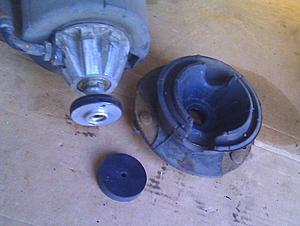
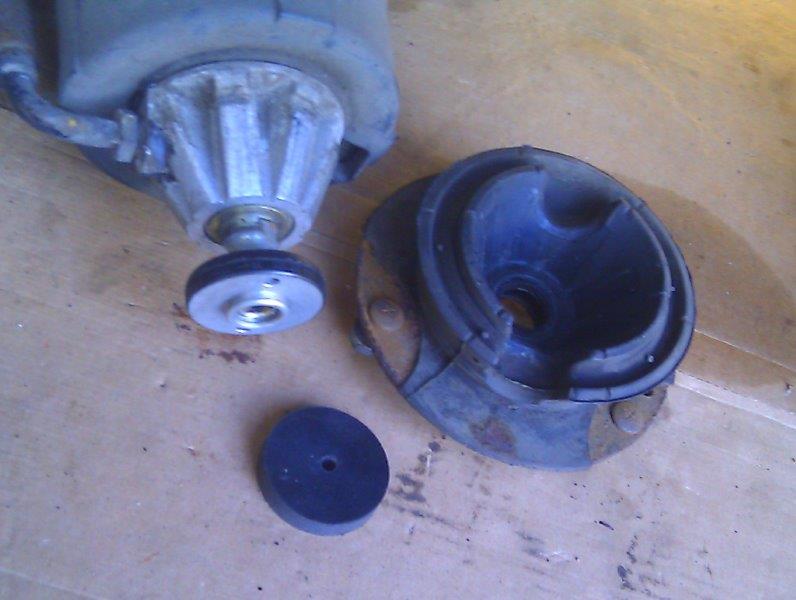
Here's what the top of the bush looks like when its removed from the car (which I don't recommend). The large bush assembly is bolted to the underside of the wheel arch, and the conical top of the strut simply rests inside the bush, taking the weight of the car.
The threaded rod with the electrical connector pokes though the hole in the bush assy and the wheel arch mount.
The small nut bush with the pin spanner holes simply screws onto the top of the rod, and holds it all together. The nut bush stops the strut from dropping through the mounting when the weight is off the wheels. There isn't really anything stopping the strut from dropping, save the elasticity of the upper and lower wishbone bushes.
The most important function of the small nut bush is to keep the main bush in compression when the strut is being shaken up and down by high-frequency bumps. The damper becomes stiff at high frequencies, and the tyres and bushes have to absorb the very short bumps. If its NOT held in compression, the strut top will rapidly move in and out of contact with the main bush, and the damper will no longer be controlling the motion of the wheel, which is undamped at high frequencies.
This doesn't happen at low frequencies - at low speed or over long bumps, as the main bush is always in contact.
Nick
The threaded rod with the electrical connector pokes though the hole in the bush assy and the wheel arch mount.
The small nut bush with the pin spanner holes simply screws onto the top of the rod, and holds it all together. The nut bush stops the strut from dropping through the mounting when the weight is off the wheels. There isn't really anything stopping the strut from dropping, save the elasticity of the upper and lower wishbone bushes.
The most important function of the small nut bush is to keep the main bush in compression when the strut is being shaken up and down by high-frequency bumps. The damper becomes stiff at high frequencies, and the tyres and bushes have to absorb the very short bumps. If its NOT held in compression, the strut top will rapidly move in and out of contact with the main bush, and the damper will no longer be controlling the motion of the wheel, which is undamped at high frequencies.
This doesn't happen at low frequencies - at low speed or over long bumps, as the main bush is always in contact.
Nick
Thread Starter
Member
Joined: May 2011
Posts: 235
Likes: 23
From: Southern California
97 Lexus LS400, 04 Mustang, 08 Corvette Z51, 92 Honda Civic Si, 02 CL500, 03 E500
I understand the stacking order & the functionality of the strut now. Looking at the small nut bushings, I do see a gap of ~ 3/8" on both struts so the struts are floating up & down which explains the thumping noise I was hearing when car is in motion. I've bought a strip of rubber, 10 mm thick. I will make the spacers to fill the gaps once I have the small nut bushings removed. Thanks for your help Nick.
John
John
Trending Topics
Thread Starter
Member
Joined: May 2011
Posts: 235
Likes: 23
From: Southern California
97 Lexus LS400, 04 Mustang, 08 Corvette Z51, 92 Honda Civic Si, 02 CL500, 03 E500
Nick, can you tell me how the hydraulic connector at the cone shaped is connected to the strut? Will the connector moves/spins around when I apply force to remove the flat nut bushing? If the connector is fixed/stationary & only the cone shaped & strut shaft move then I should be able to use the connector as a stopper. I don't think I have to worry too much about damaging the connector or hydraulic line since there isn't much torque at the flat nut bushing anyway. After all, how did the manufacturer torques the flat nut bushing when there's nothing to grab to prevent the shaft from spinning, impact wrench? What do you think?
MB World Stories
The Best of Mercedes & AMG

Manual Mercedes? 6 Times Sindelfingen Let Drivers Have All The Fun
Verdad Gallardo
Mercedes SLR McLaren 722 S Is Extremely Rare Example Modified by McLaren
Verdad Gallardo
8 Classic Boxy Mercedes Designs That Have Aged Like Fine Wine
Verdad Gallardo
Flawlessly Restored Mercedes 190E Evo II Heads to Auction
Verdad Gallardo
Electric Mercedes C-Class Unveiled: 11 Things You Need to Know
Verdad Gallardo
Mercedes EQS Gets A Major Update: Everything You Need to Know
Verdad Gallardo
5 Underrated Mercedes-Benz Models That Don't Get the Love They Deserve
Verdad Gallardo
Mercedes 300D Has Pushed Well Past 1 Million Miles and It Ain't Stopping
Verdad Gallardo
10 Most Reliable Mercedes-Benz Models You Can Buy Used
Verdad Gallardo
MBWorld Fanatic!
Joined: Nov 2010
Posts: 2,605
Likes: 343
From: Welwyn, Herts, UK
2006 S600
Ultimately the hydraulic pipe will foul the slot in the main bush assy, and stop spinning, but you won't want to risk damaging the pipe. I didn't do mine this way - removing the top bush nut in situ is a better way - but I don't a good procedure. You'll have to use your ingenuity I'm afraid. I guess I would put a small wooden wedge against the pipe to try to protect it.
Nick
Nick
Thread Starter
Member
Joined: May 2011
Posts: 235
Likes: 23
From: Southern California
97 Lexus LS400, 04 Mustang, 08 Corvette Z51, 92 Honda Civic Si, 02 CL500, 03 E500
I agree removing "in position" without interfering anything else is ideal, however it will spin when torque is applied to the nut. Perhaps the weight of the car exerted on the strut will prevent it from spinning too much. I'll keep an eye on it when I make an attempt to remove the nut. Thanks.
Thread Starter
Member
Joined: May 2011
Posts: 235
Likes: 23
From: Southern California
97 Lexus LS400, 04 Mustang, 08 Corvette Z51, 92 Honda Civic Si, 02 CL500, 03 E500
Nick, I was able to remove & install the rubber spacers to fill in the gaps under the top strut nuts on all 4 struts. I've bought a few 35mm pin spanners for the job but they were either too weak or too slow which caused the strut shaft to rotate so I've custom-made my own pin spanner & use an impact gun to remove the nuts. There's a notch in the top strut mount where the hydraulic connector sits right in & it acts like a stopper so the impact gun is the best tool for this job. The fronts were easy, however not so for the rears as there's no room due to the back windshield, I had to jack the rear & drop the struts in order to get access to the top nuts. It took me about 4 hours to finish the job, however I'm disappointed to report that the thumping noise's still there. Anyway, car was driven fine as before until a month later when a low output from a faulty battery had caused the car to trigger the ESP, ABC, BAS & ABS messages. I replaced the battery w/ a new one, cleared all the codes & have the ECU re-learned all the settings via the reset procedures but now noticed the driver side is sitting at about 1/2" higher than the passenger side (passenger side is at the right height). The car is also too soft & bouncy when I did a push test at the front & rear bumpers. Car is drive-able w/ zero messages but it still soft & feel like a tuna boat. I've just replaced all 4 ABC accumulators prior to this mod so I don't think the softness & the uneven sitting are caused by the accumulators. They couldn't possibly gone bad this quick. Yesterday, I was thinking perhaps there may be air in system so I flushed the ABC & changed the filter as part of the troubleshooting but no change. I'm now wondering if the gap under the strut nut is caused by the compression of the rubber in the strut mounts due to aging or is it there by design since all 4 of them have gap? How's your car since you put in the rubber spacers? Let me know. Thanks, John
MBWorld Fanatic!
Joined: Nov 2010
Posts: 2,605
Likes: 343
From: Welwyn, Herts, UK
2006 S600
The tuna boat ride is what normally happens when the isolator valves in each valve block are closed. That's a self protection measure when the pumps not working, or something like that.
Do you have any way to read fault codes?
I think you need some more information about what's going on.
Bleeding isn't usually an issue.
Accumulators are responsible for a lot of difficult-to-diagnose faults, but I assume they're not to blame here.
I think it points to the pump or the pressure regulator.
Is your ABC reservoir properly filled up?
Are all the electrical connectors properly re-fitted, with no dirt or contaminants?
Have you tried changing the suspension height while the engine is running? Do it at home. Keep the wheels straight. BE CAREFUL!!!
Inspect all the level sensors and the rods & links carefully.
It suddenly becomes a very complicated car when things start to go wrong, doesn't it? ;-)
Nick
Edit: Did you have the car off the road, jacked up and on stands, with the wheels off, for a long time?
Do you have any way to read fault codes?
I think you need some more information about what's going on.
Bleeding isn't usually an issue.
Accumulators are responsible for a lot of difficult-to-diagnose faults, but I assume they're not to blame here.
I think it points to the pump or the pressure regulator.
Is your ABC reservoir properly filled up?
Are all the electrical connectors properly re-fitted, with no dirt or contaminants?
Have you tried changing the suspension height while the engine is running? Do it at home. Keep the wheels straight. BE CAREFUL!!!
Inspect all the level sensors and the rods & links carefully.
It suddenly becomes a very complicated car when things start to go wrong, doesn't it? ;-)
Nick
Edit: Did you have the car off the road, jacked up and on stands, with the wheels off, for a long time?
Last edited by Welwynnick; Mar 15, 2015 at 05:55 PM.
Thread Starter
Member
Joined: May 2011
Posts: 235
Likes: 23
From: Southern California
97 Lexus LS400, 04 Mustang, 08 Corvette Z51, 92 Honda Civic Si, 02 CL500, 03 E500
The low output voltage from the battery had triggered all these codes & I believe they remain in the ECU which put the car is some lockout mode even after I had gone through a complete reset procedure. What strange to me is the car doesn't behave & handle as well as before but the message is clear with zero messages. An OBDII scanner had reviewed no MIL error codes but it's only for the generic codes so I'll need to take the car in for a Star Diagnostic scan. In regards to the pump, I don't believe it is bad as I was able to complete a flush. Reservoir is at the correct fluid level & I had raised the car up & down many times via the up/down button but no change. I had also looked at both rear height sensors but couldn't tell whether they're faulty or not but if it/they are, I should be getting an error code by now, right?
Not sure what your asking about the car on jack stand with wheels off the ground. Are you thinking about the height sensor(s) being disturbed & in need of re-calibration? I had them both disconnected from the lower control arms when I had to drop the rear struts to install the rubber shims/spacers on top of the strut mounts.
Not sure what your asking about the car on jack stand with wheels off the ground. Are you thinking about the height sensor(s) being disturbed & in need of re-calibration? I had them both disconnected from the lower control arms when I had to drop the rear struts to install the rubber shims/spacers on top of the strut mounts.
MBWorld Fanatic!
Joined: Nov 2010
Posts: 2,605
Likes: 343
From: Welwyn, Herts, UK
2006 S600
My concern was about the level sensors, which are somewhat fragile.
If the suspension does lift up and down, that suggests the ABC system is working normally.
What's the bad handling symptom? Does it roll in corners with ABC Sport selected?
Nick
If the suspension does lift up and down, that suggests the ABC system is working normally.
What's the bad handling symptom? Does it roll in corners with ABC Sport selected?
Nick
Thread Starter
Member
Joined: May 2011
Posts: 235
Likes: 23
From: Southern California
97 Lexus LS400, 04 Mustang, 08 Corvette Z51, 92 Honda Civic Si, 02 CL500, 03 E500
I've looked at the 2 rear height sensors yesterday. They look fine as I don't see any signs of them being damaged. Car is soft & lean quite a bit when I take corner. It wasn't like that at all prior to the power interruption. I believe the power interruption had locked out the some of these functions i.e. ESP, ABC so they need to be cleared & re-calibrated. Car is in the shop this morning. I'll keep you posted.
Thread Starter
Member
Joined: May 2011
Posts: 235
Likes: 23
From: Southern California
97 Lexus LS400, 04 Mustang, 08 Corvette Z51, 92 Honda Civic Si, 02 CL500, 03 E500
I've brought the car to an indie shop a few days ago. They hooked up & ran a diagnostic test via Autologic Mercedes software version (not sure if it's the same as Star Diagnostic) & it came up with 3 pages of fault codes on Electric Transmission Control, ABC, ESP Traction Control & front/rear signal acquisition, ect... The shop cleared all the codes, performed a rodeo, re-set the car height back to specs & kept the car for a few days. So far, none of these codes have popped up again so it appears all these codes were triggered by the low output voltage from the faulty battery. The driver side has come down a little but it's still about 1/2" higher than the passenger side. The shop owner told me he doesn't know why but he said if I can't stand it, he'll make an appointment for me to take the car in to the dealer for an adjustment. I think I will live w/ it. Anway, I'll drive the car for a few weeks then bring it back to the shop for another scan. Hope all goes well.


