


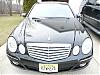


2009 E 350 Sedan

Thread Starter
Newbie
Joined: Apr 2004
Posts: 17
Likes: 0
From: Tennessee
2009 E350 Sport Sedan AMG Package
2009 E 350 Sedan
I am a new 2009 E350 owner I have 2 questions can someone post how to reset the Service indicator? Also I have the sport sedan with the AMG 18 inch rims but different tire sizes on the front and back. From the manual the fronts tires are 8.5 and rear 9.0 is this correct if they are both 18 inch rims? I Can you rotate the tires on this car?
Thanks for your help
Steve
Thanks for your help
Steve

Administrator


Joined: Sep 2002
Posts: 15,770
Likes: 37
From: www.Traben-Trarbach.de
MPG+ ROLFCOPTER
I am a new 2009 E350 owner I have 2 questions can someone post how to reset the Service indicator? Also I have the sport sedan with the AMG 18 inch rims but different tire sizes on the front and back. From the manual the fronts tires are 8.5 and rear 9.0 is this correct if they are both 18 inch rims? I Can you rotate the tires on this car?
Thanks for your help
Steve
Thanks for your help
Steve
Why would you want to put wider wheels/tires in the front and narrower ones in the back?
Administrator
Joined: Sep 2002
Posts: 15,770
Likes: 37
From: www.Traben-Trarbach.de
MPG+ ROLFCOPTER
MBWorld Fanatic!
Joined: Mar 2004
Posts: 5,017
Likes: 16
From: Ft. Lauderdale Area, USA
2015 ML 350
Very simply put, "18 inch" refers to the rim or wheel size (height without tires mounted on them) , or the inner hole diameter of your tires. 8.5 and 9 refers to the width.
There are other tire dimension factors too, such as the profile... low profile/high profile, which refers to the distance from the edge of the rim to the outer edge of the tire, commonly thought of as the "tire wall"... the part with all the writing on it.
Your car has low profile tires, which means you should try to avoid bad pavement/pot holes, as there is not alot of tire there to absorb the bump, and wheel damage can occur.
Since these are not "Race Cars" designed for ultra high performance in day to day driving, the staggered wheel set up (different sizes front to rear) is more "sizzle" than steak, although they do give you a bigger foorprint in the rear. All 4 the same size makes more sense Dollar wise to most drivers. Such is the price of "Sportiness".
There are other tire dimension factors too, such as the profile... low profile/high profile, which refers to the distance from the edge of the rim to the outer edge of the tire, commonly thought of as the "tire wall"... the part with all the writing on it.
Your car has low profile tires, which means you should try to avoid bad pavement/pot holes, as there is not alot of tire there to absorb the bump, and wheel damage can occur.
Since these are not "Race Cars" designed for ultra high performance in day to day driving, the staggered wheel set up (different sizes front to rear) is more "sizzle" than steak, although they do give you a bigger foorprint in the rear. All 4 the same size makes more sense Dollar wise to most drivers. Such is the price of "Sportiness".
Last edited by Barry45RPM; Jul 3, 2009 at 01:01 PM.
MBWorld Fanatic!
Joined: Sep 2008
Posts: 4,336
Likes: 8
Porsche 991S, Cayenne S, 1972 BMW 3.0CS E9 Coupe
Having a wider patch where the drive wheels are will give you better traction. Although the traction really comes from the softer compound that wider tires employ and not so much the contact patch (normal road surfaces are uneven.)
Friction doesn't depend on surface area, but the softer wider tire does relate to a bigger coefficient of friction. Wider tires also have stronger sidewalls which is an added benefit for handling with less body roll.
But, as Barry says, this is in theory and not applicable for most daily drivers with a weaker right foot.
Friction doesn't depend on surface area, but the softer wider tire does relate to a bigger coefficient of friction. Wider tires also have stronger sidewalls which is an added benefit for handling with less body roll.
But, as Barry says, this is in theory and not applicable for most daily drivers with a weaker right foot.

Newbie
Joined: Apr 2007
Posts: 10
Likes: 0
From: Near Toronto
09 E350 4Matic Avant Garde, 07 BMW 335i Cabriolet M-Tech
The purpose of a staggered setup (wider tires at the rear) is to reduces oversteer. It is for high power RWD cars that are prone to torque induced oversteer (rearend stepping out while cornering fast). The extra width in the rear tires makes the rearend harder to slide out.
Trending Topics
MBWorld Fanatic!
Joined: Sep 2008
Posts: 4,336
Likes: 8
Porsche 991S, Cayenne S, 1972 BMW 3.0CS E9 Coupe
It helps reduce oversteer on cars with oversteer (like my C2S; 235/295) However, these cars tend to have an understeer bias as it is, and so in reality a staggered set up doesn't really do a lot in the end. Esp in real world driving with the vehicle in question, which is not a 'high powered' car. Although yes, the theory is correct: faster front tire turn-in and a wider sticky rear to help with any oversteer.
Which is what I was talking about re: traction.
But for an E350, it's really not necessary for the majority of drivers. And it means no rotation with directional tires. On a E63 or M5, it makes more sense.
Which is what I was talking about re: traction.
But for an E350, it's really not necessary for the majority of drivers. And it means no rotation with directional tires. On a E63 or M5, it makes more sense.
MB World Stories
The Best of Mercedes & AMG

8 Oddball Mercedes Ideas That Actually Made it to Production
Verdad Gallardo
Dubai Tuner Gives the Mercedes G-Class An Entirely New Look
Verdad Gallardo
Six Gift Ideas Your AMG Loving Dad or Grad Will Cherish

7 Craziest Things AMG Gas Ever Built
Verdad Gallardo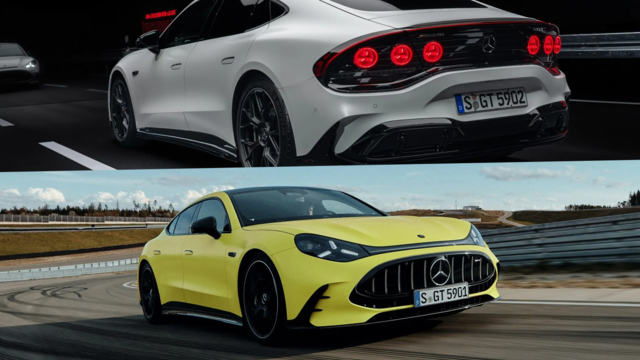
New Electric Mercedes-AMG GT 4-Door Coupe Unveiled: 10 Things You Need to Know
Verdad Gallardo
6 Mercedes Models That Did NOT Age Well (But Are Somehow Still Cool)
Verdad Gallardo
Manual Mercedes? 6 Times Sindelfingen Let Drivers Have All The Fun
Verdad Gallardo
Mercedes SLR McLaren 722 S Is Extremely Rare Example Modified by McLaren
Verdad Gallardo


