






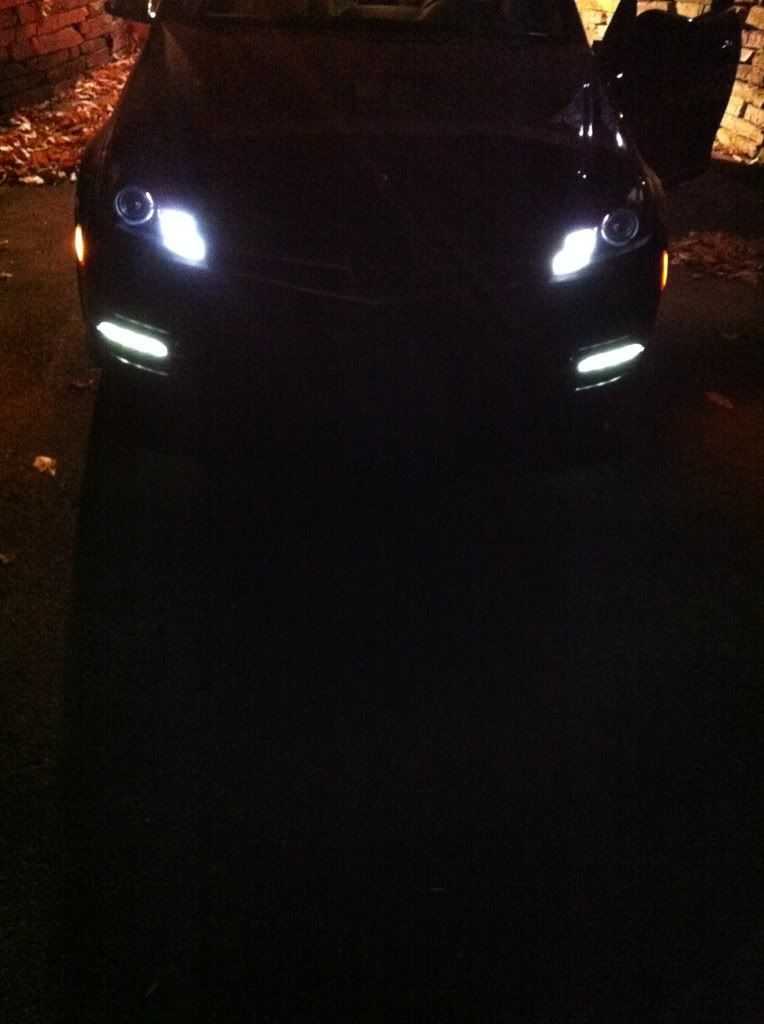
 - should be illegal!?
Straight Bar LED's - BRIGHTER?

Thread Starter
MBWorld Fanatic!


Joined: Jun 2009
Posts: 1,300
Likes: 127
2020 G63, 2021 E450 All-Terrain Wagon
Straight Bar LED's - BRIGHTER?
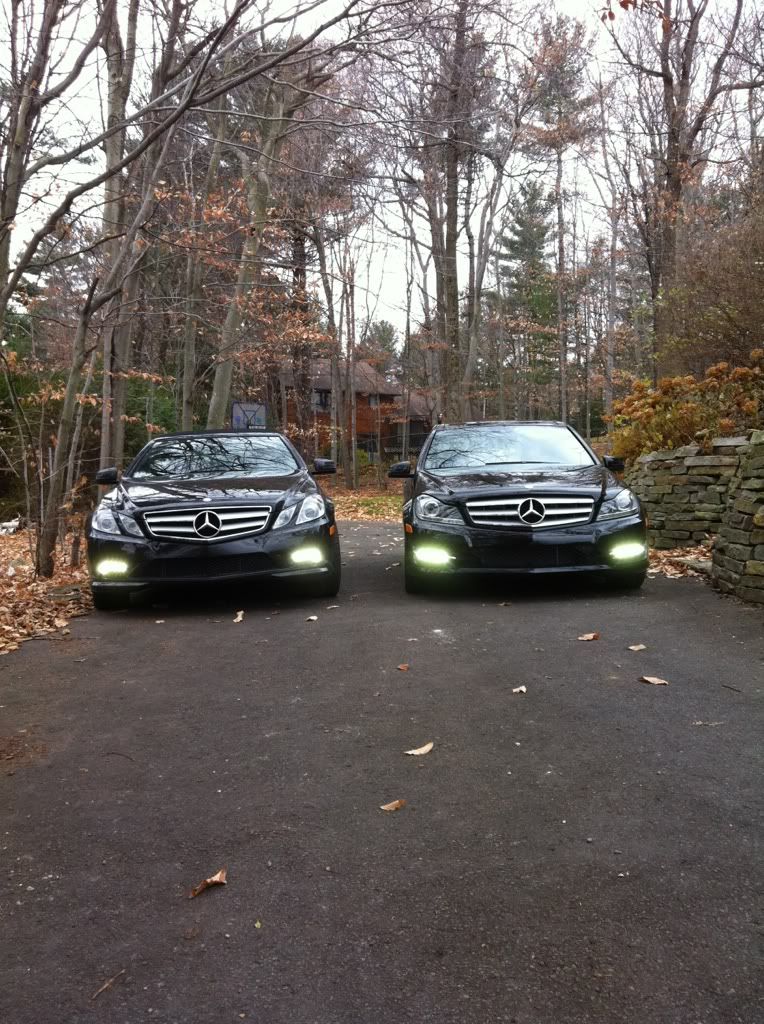
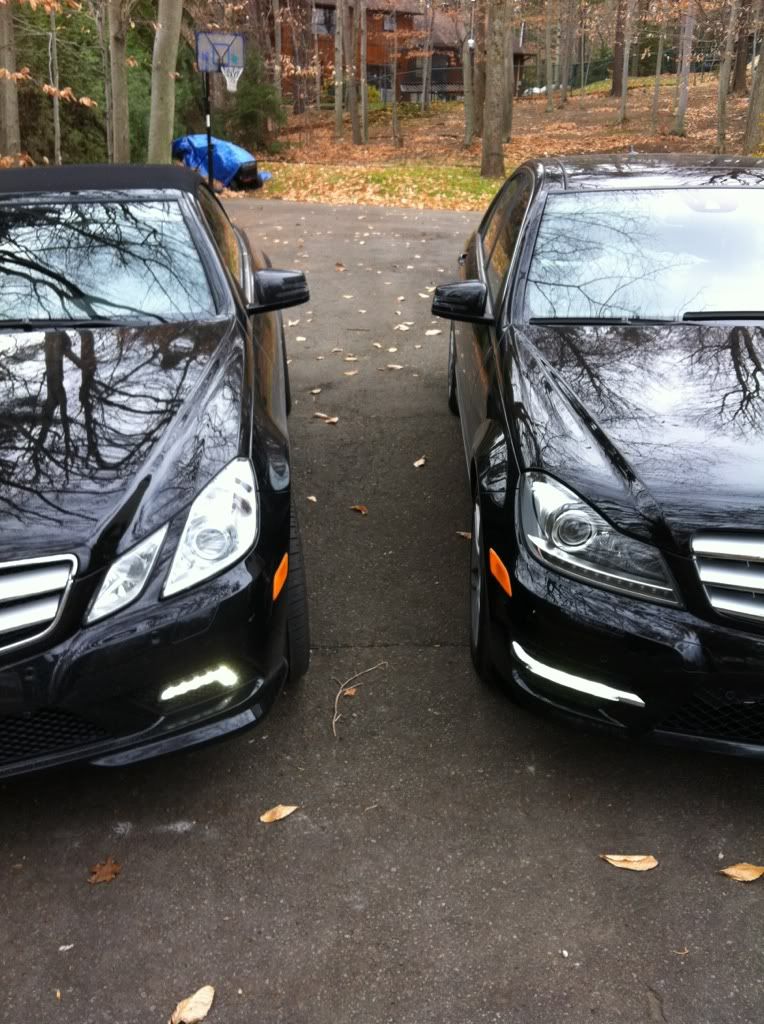
Is it just me or do the 2012 C and 2012 E straight bar LED's have reflectors in them? I got a C250 loaner today and the LED Daytime Running Lamps were bigger and brighter than my hockey sticks! Maybe MB did it for more safety???
Out Of Control!!
Joined: Jun 2008
Posts: 10,557
Likes: 24
From: Earth
Porsche Macan S SportDesign / Ex M-B's: 11 & 10 & 06 E350's, 02 S500
The design is different. The hockey sticks have a clear lens, exposed "points of LED light" look, while the straight bars have a more fuzzy, opaque look, looking like it could be a reflector (can't see the points of light). I think the straight ones are "bigger" though, at least fatter from top to bottom.
I dunno which is brighter, however. I always though the C's LED bars (same unit they're using on the new E's) were a little more yellowy and/or dim looking, but I dunno. Did you see them side-by-side? Would be interesting to see that.
I dunno which is brighter, however. I always though the C's LED bars (same unit they're using on the new E's) were a little more yellowy and/or dim looking, but I dunno. Did you see them side-by-side? Would be interesting to see that.
Out Of Control!!
Joined: Jun 2008
Posts: 10,557
Likes: 24
From: Earth
Porsche Macan S SportDesign / Ex M-B's: 11 & 10 & 06 E350's, 02 S500
Hmm, now that would be interesting. Now you have me curious.
It wouldn't be shocking if they upped the wattage. The 2011 C/E's with halogens already look bad enough with those yellow lights and whiter LED's (but the yellow-y look of the 2011 C LED-bars actually match the halogens better), so it'd be downright goofy for P1 cars with even brighter LED DRL's.
It wouldn't be shocking if they upped the wattage. The 2011 C/E's with halogens already look bad enough with those yellow lights and whiter LED's (but the yellow-y look of the 2011 C LED-bars actually match the halogens better), so it'd be downright goofy for P1 cars with even brighter LED DRL's.
Out Of Control!!
Joined: Jun 2008
Posts: 10,557
Likes: 24
From: Earth
Porsche Macan S SportDesign / Ex M-B's: 11 & 10 & 06 E350's, 02 S500
So the new one looks brighter?
Damn! And I was 100% content on the slanted LED's. Now, I'm still partial to its design, but gotta live with it not being as bright, oh well (how bright do they really need to be.... At least the Xenons are the new 5000K stockers!).
Damn! And I was 100% content on the slanted LED's. Now, I'm still partial to its design, but gotta live with it not being as bright, oh well (how bright do they really need to be.... At least the Xenons are the new 5000K stockers!).
Trending Topics
MB World Stories
The Best of Mercedes & AMG

Manual Mercedes? 6 Times Sindelfingen Let Drivers Have All The Fun
Verdad Gallardo
Mercedes SLR McLaren 722 S Is Extremely Rare Example Modified by McLaren
Verdad Gallardo
8 Classic Boxy Mercedes Designs That Have Aged Like Fine Wine
Verdad Gallardo
Flawlessly Restored Mercedes 190E Evo II Heads to Auction
Verdad Gallardo
Electric Mercedes C-Class Unveiled: 11 Things You Need to Know
Verdad Gallardo
Mercedes EQS Gets A Major Update: Everything You Need to Know
Verdad Gallardo
5 Underrated Mercedes-Benz Models That Don't Get the Love They Deserve
Verdad Gallardo
Mercedes 300D Has Pushed Well Past 1 Million Miles and It Ain't Stopping
Verdad Gallardo
10 Most Reliable Mercedes-Benz Models You Can Buy Used
Verdad Gallardo
MBWorld Fanatic!
Joined: Jun 2009
Posts: 1,800
Likes: 14
1953 300 Adenauer, 1971 300 SEL 6.3, 1975 600, 1978 450 6.9
Huh? The bulbs are 5000k instead of the standard 4300k?
MBWorld Fanatic!
Joined: Jun 2009
Posts: 1,800
Likes: 14
1953 300 Adenauer, 1971 300 SEL 6.3, 1975 600, 1978 450 6.9

Junior Member
Joined: Oct 2011
Posts: 18
Likes: 0
From: Norway
2010 C207, 2011 R172
MBUSA could ditch the orange ones and mount this:
MBWorld Fanatic!
Joined: Jun 2009
Posts: 1,800
Likes: 14
1953 300 Adenauer, 1971 300 SEL 6.3, 1975 600, 1978 450 6.9

Super Member
Joined: May 2008
Posts: 655
Likes: 2
Mercedes e350 BlueTec
Certainly the clear one is legal....you just have to use an orange bulb.
I can't comment about the gray one but depending on it's opacity, a yellow/orange bulb would probably make that legal as well.
I can't comment about the gray one but depending on it's opacity, a yellow/orange bulb would probably make that legal as well.
MBWorld Fanatic!
Joined: Jun 2009
Posts: 1,800
Likes: 14
1953 300 Adenauer, 1971 300 SEL 6.3, 1975 600, 1978 450 6.9
Federal Motor Vehicle Safety Standard 108 requires the sidemarker lighting. The requirement is two-fold - an amber light source emitting light meeting an SAE standard for "amber" AND an amber reflector. The requirements for the rear are identical except that the color has to be red.
Accordingly, while the clear one "might" meet part of the standard when used with an amber bulb (assuming an amber bulb is available that meets the SAE standard for "amber") it clearly
 fails as it does not have an amber reflector.
OTOH, you could glue on some amber reflective tape onto the bumper to meet that requirement and use the clear sidemarker

MBWorld Fanatic!
Joined: Jun 2009
Posts: 1,800
Likes: 14
1953 300 Adenauer, 1971 300 SEL 6.3, 1975 600, 1978 450 6.9
Let me take a second to explain the regs. IIRC, the sidemarker requirement was added in 1968 to address a rash of night time side impact crashes where the drivers "didn't see the other car" or were "unable to determine which way the car was travelling."
Accordingly, since we must legislate to the stupidest amongst us, the amber front, red rear requirement was born.
Why with a reflector? To address those idiots that drive down dark roads at night with their lights off.
While this is a Federal requirement and states cannot waive it, it is the responsibility of states to determine what they will check for during periodic inspections.
Accordingly, there are a few states like PA, that actually check for operational sidemarkers and will fail cars not meeting the requirements.
Other states couldn't care less, but - in theory - a violation is "operating an unsafe vehicle" and the operator could get stopped, ticketed and (again in theory) have his car impounded and towed.
Accordingly, since we must legislate to the stupidest amongst us, the amber front, red rear requirement was born.
Why with a reflector? To address those idiots that drive down dark roads at night with their lights off.
While this is a Federal requirement and states cannot waive it, it is the responsibility of states to determine what they will check for during periodic inspections.
Accordingly, there are a few states like PA, that actually check for operational sidemarkers and will fail cars not meeting the requirements.
Other states couldn't care less, but - in theory - a violation is "operating an unsafe vehicle" and the operator could get stopped, ticketed and (again in theory) have his car impounded and towed.
Out Of Control!!
Joined: Jun 2008
Posts: 10,557
Likes: 24
From: Earth
Porsche Macan S SportDesign / Ex M-B's: 11 & 10 & 06 E350's, 02 S500
Yeah, AFAIK, the post December 2010 build M-B's with HID's get the new 5K HID's with improved projectors. A very notable improvement from the older HID's (I had them on both my 2010 and 2011 E350's). I think they're probably some of the brightest Xenons on the market now (the ones M-B uses).
MBWorld Fanatic!
Joined: Jun 2009
Posts: 1,800
Likes: 14
1953 300 Adenauer, 1971 300 SEL 6.3, 1975 600, 1978 450 6.9
Yeah, AFAIK, the post December 2010 build M-B's with HID's get the new 5K HID's with improved projectors. A very notable improvement from the older HID's (I had them on both my 2010 and 2011 E350's). I think they're probably some of the brightest Xenons on the market now (the ones M-B uses).
Out Of Control!!
Joined: Jun 2008
Posts: 10,557
Likes: 24
From: Earth
Porsche Macan S SportDesign / Ex M-B's: 11 & 10 & 06 E350's, 02 S500
Senior Member
Joined: Dec 2003
Posts: 336
Likes: 19
I have a 2012 E350 (C207) with the straight LED and P2 Package.
From my observation, the housing of the straight LED has a little more complex design -- the LED bulbs sit deeper inside the housing, making the LED not as in-the-eyes when view from an angle (probably is deisgned on purpose, so the LEDs wouldn't blind other drivers in adjacent lanes.)
Also, the lens-cover of the LED housing has a slight diffusing effect, making the LED lighting with a little more sophisticated feel.
At last, in my car with the P2 Package, the straight LED actually changes its intensity depending on the headlamps -- if the headlamps are On, the straight LED would be automatically changed to dimmer intensity (probably also a design-on-purpose, so the LEDs wouldn't be too bright to other drivers at night.)
Again, just my observation.
With best regards,
From my observation, the housing of the straight LED has a little more complex design -- the LED bulbs sit deeper inside the housing, making the LED not as in-the-eyes when view from an angle (probably is deisgned on purpose, so the LEDs wouldn't blind other drivers in adjacent lanes.)
Also, the lens-cover of the LED housing has a slight diffusing effect, making the LED lighting with a little more sophisticated feel.
At last, in my car with the P2 Package, the straight LED actually changes its intensity depending on the headlamps -- if the headlamps are On, the straight LED would be automatically changed to dimmer intensity (probably also a design-on-purpose, so the LEDs wouldn't be too bright to other drivers at night.)
Again, just my observation.
With best regards,
Last edited by axhoaxho; Nov 18, 2011 at 03:42 AM.
MBWorld Fanatic!
Joined: Jun 2009
Posts: 1,800
Likes: 14
1953 300 Adenauer, 1971 300 SEL 6.3, 1975 600, 1978 450 6.9
Numerically, a higher number indicates a "colder" color temp going more into the blue spectrum. As color temps get colder, you actually need more output to get the same number of lumens but the blue tint gives the impression of being brighter - hence the comment in the article
"This light colour is in keeping with normal human perception patterns, and as such conveys an impression of greater brightness to the eyes, thus reducing the strain on the driver,”
I suspect that MB also upped the output of these lamps to meet requiremens as the blue light may fool the brain but it won't fool the machine.
MB appears to be really pushing the envelope on this - extremely interesting stuff.


