




Tire Pressure Questions

Thread Starter
Junior Member
Joined: Jul 2014
Posts: 65
Likes: 2
2014 E250 Bluetec
Tire Pressure Questions
I just noticed for the first time something odd on my tire pressure sticker inside the fuel filler door. Everything makes sense except for the bottom sentence.
"For driving less than 100 mph: - 3psi" I don't quite understand this. I've never driven over 100 mph in my life (in a car, that is!). Am I supposed to use 30/32 instead of 33/35? Who drives a US version Benz over 100?
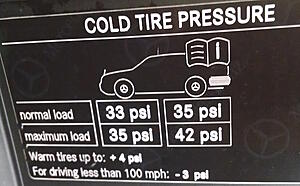
"For driving less than 100 mph: - 3psi" I don't quite understand this. I've never driven over 100 mph in my life (in a car, that is!). Am I supposed to use 30/32 instead of 33/35? Who drives a US version Benz over 100?


Junior Member
Joined: Oct 2013
Posts: 31
Likes: 2
2012 E350 sport suspension; 2014 Lexus RX 350
Very odd indeed. One would expect the cold tire pressure data, as written, to be the norm, which of course is under 100 mph. How does the sticker data compare with the sticker on the driver side door frame.
Thread Starter
Junior Member
Joined: Jul 2014
Posts: 65
Likes: 2
2014 E250 Bluetec
Drivers door jamb only lists the max (35/42). I had been using that for a long time because I only recently noticed the fuel door sticker. (I got great mileage!)

MBWorld Fanatic!
Joined: Nov 2012
Posts: 1,479
Likes: 76
From: Nyack, NY
C300 Sport 4Matic

Thread Starter
Junior Member
Joined: Jul 2014
Posts: 65
Likes: 2
2014 E250 Bluetec
Can anybody chime in on the 100 mph line? I'm really curious now as it seems so odd.
MBWorld Fanatic!
Joined: Nov 2012
Posts: 1,479
Likes: 76
From: Nyack, NY
C300 Sport 4Matic
No, I said I got great mileage using the door figures (35/42). I just lowered to the recommended 33/35 this morning. I'm anxious to see how it affects the mileage. I'm sure I'll take a hit but I'll get a better ride and better tire wear.
Can anybody chime in on the 100 mph line? I'm really curious now as it seems so odd.
Can anybody chime in on the 100 mph line? I'm really curious now as it seems so odd.
Trending Topics
MBWorld Fanatic!


Joined: Mar 2014
Posts: 3,107
Likes: 394
From: West Central Florida
2011 E550 P2 4M Sedan
just checked my 2011 and it does not have a line like yours that refers to dropping pressure for driving over 100mph.
I use the normal load recommendation as my setpoint for cold pressure. Like yours max load recommendation is the same as the driver's door placard. I assumed that was for a fully loaded car and usually it is just me.
While I've driven over 100 mph in my car, it is not for sustained periods of time where I would contemplate making adjustments to the pressure. I just like to test out a car when I first get it to see how it rides at high speed. Normally I keep it within 10 mph of the limit. If you haven't tried it yet, you haven't gotten to enjoy how well these cars ride at high speed.
I use the normal load recommendation as my setpoint for cold pressure. Like yours max load recommendation is the same as the driver's door placard. I assumed that was for a fully loaded car and usually it is just me.
While I've driven over 100 mph in my car, it is not for sustained periods of time where I would contemplate making adjustments to the pressure. I just like to test out a car when I first get it to see how it rides at high speed. Normally I keep it within 10 mph of the limit. If you haven't tried it yet, you haven't gotten to enjoy how well these cars ride at high speed.
MB World Stories
The Best of Mercedes & AMG

Manual Mercedes? 6 Times Sindelfingen Let Drivers Have All The Fun
Verdad Gallardo
Mercedes SLR McLaren 722 S Is Extremely Rare Example Modified by McLaren
Verdad Gallardo
8 Classic Boxy Mercedes Designs That Have Aged Like Fine Wine
Verdad Gallardo
Flawlessly Restored Mercedes 190E Evo II Heads to Auction
Verdad Gallardo
Electric Mercedes C-Class Unveiled: 11 Things You Need to Know
Verdad Gallardo
Mercedes EQS Gets A Major Update: Everything You Need to Know
Verdad Gallardo
5 Underrated Mercedes-Benz Models That Don't Get the Love They Deserve
Verdad Gallardo
Mercedes 300D Has Pushed Well Past 1 Million Miles and It Ain't Stopping
Verdad Gallardo
10 Most Reliable Mercedes-Benz Models You Can Buy Used
Verdad Gallardo
Thread Starter
Junior Member
Joined: Jul 2014
Posts: 65
Likes: 2
2014 E250 Bluetec

Super Member
Joined: Dec 2010
Posts: 746
Likes: 26
None

MBWorld Fanatic!

Joined: Apr 2013
Posts: 1,506
Likes: 66
From: Sidney, BC
2009 SLK55 AMG. & 2022 GLA250 4Matic
My 2011 wagon says 33 and 38 or 35 and 46 at max load but only the warm tire warning. No reference to 100 mph.
I tend to agree with looney 100 (Neat handle by the way. Only in Canada eh?) that they are saying normal pressure for regular driving under 100 mph is 30/32 or 32/39 and the difference is to allow pressure build up for those who regularly cruise at speeds in excess of 100 mph where temperatures will build more pressure.
I tend to agree with looney 100 (Neat handle by the way. Only in Canada eh?) that they are saying normal pressure for regular driving under 100 mph is 30/32 or 32/39 and the difference is to allow pressure build up for those who regularly cruise at speeds in excess of 100 mph where temperatures will build more pressure.
Thread Starter
Junior Member
Joined: Jul 2014
Posts: 65
Likes: 2
2014 E250 Bluetec
The physics make sense. What doesn't make sense is to list driving under 100 as the exception, rather than the norm.

MBWorld Fanatic!


Joined: Nov 2009
Posts: 2,616
Likes: 160
From: Southeastern USA
2010 E350 Luxury Sedan, Engine 272 (V6)
My 2010's fuel door decal just says warm tires up +4 PSI, but doesn't say when or why. There is nothing below that.
Read the entire section in Operator's Manual. Mine says the same thing about one TP for driving over 100 MPH and a different one for under.
MB has the most confusing TP information of any car I have ever owned. There are conflicts between fuel filler door, "B" post decal and Operator's Manual.
Read the entire section in Operator's Manual. Mine says the same thing about one TP for driving over 100 MPH and a different one for under.
MB has the most confusing TP information of any car I have ever owned. There are conflicts between fuel filler door, "B" post decal and Operator's Manual.

MBWorld Fanatic!

Joined: Aug 2004
Posts: 1,367
Likes: 3
From: MA
'24 Porsche Macan


Member
Joined: Feb 2014
Posts: 176
Likes: 1
e350
33F and 35R when the tires are cold and there is minimal load. You can subtract another 3 psi if you don't plan on going above 100 mph, ie 30F and 32R. This is the setting for two people in the car and not exceeding 100 mph. The higher tire pressures are required at top speed but are not as compliant.
MBWorld Fanatic!
Joined: Nov 2012
Posts: 1,479
Likes: 76
From: Nyack, NY
C300 Sport 4Matic
33F and 35R when the tires are cold and there is minimal load. You can subtract another 3 psi if you don't plan on going above 100 mph, ie 30F and 32R. This is the setting for two people in the car and not exceeding 100 mph. The higher tire pressures are required at top speed but are not as compliant.

Senior Member
Joined: Jul 2010
Posts: 269
Likes: 3
2014 W212 E350 4M
One of the reasons for the increased pressure at high speeds is tire tread and sidewall flexing causing a build up of heat.
Always check your TP cold. Use a good pressure gauge. As soon as the TPMS comes on, it won't until you drive a short while, compare it's readings to your measured readings with your gauge. The TP will raise as much as 4 psi per tire when driving.
Adjust your TP according to ambient temperature. TP can vary as much as 1 psi for every 10 degrees F in temperature.
This is my second car with the 245/40 R18 tires. I use 36F/38R especially for highway travel with luggage.
I use and own digital gauges. Most have a plastic nipple and head that goes on the Shraeder tire valve. They tend to break. There is an American manufacturer that sells very good analog dial gauges in different configurations. I bought several from them for my vehicles and as gifts. When I checked them for consistency they read within 1 psi of each other. To me for an analog that's great. The company is Accugage also known as G.H.Meiser in Posen, IL. They have a website. I am not affiliated in any way with them. For $10-20 each they have good equipment. For a couple of dollars more you can buy a rubber bump guard for the gauge which protects it from damage.
Always check your TP cold. Use a good pressure gauge. As soon as the TPMS comes on, it won't until you drive a short while, compare it's readings to your measured readings with your gauge. The TP will raise as much as 4 psi per tire when driving.
Adjust your TP according to ambient temperature. TP can vary as much as 1 psi for every 10 degrees F in temperature.
This is my second car with the 245/40 R18 tires. I use 36F/38R especially for highway travel with luggage.
I use and own digital gauges. Most have a plastic nipple and head that goes on the Shraeder tire valve. They tend to break. There is an American manufacturer that sells very good analog dial gauges in different configurations. I bought several from them for my vehicles and as gifts. When I checked them for consistency they read within 1 psi of each other. To me for an analog that's great. The company is Accugage also known as G.H.Meiser in Posen, IL. They have a website. I am not affiliated in any way with them. For $10-20 each they have good equipment. For a couple of dollars more you can buy a rubber bump guard for the gauge which protects it from damage.
Member
Joined: Feb 2013
Posts: 230
Likes: 5
From: Greenville SC USA
2008 E320 Bluetec (until 11/14), 2001 SLK 320, 2004 Volvo V70, 1972 MGB, 2013 E350
I check the tire pressure with the multifunction display since it shows me all four tires at once. The readout is within one PSI of my gauges. I do use the gauge when adding air though.
Member
Joined: Oct 2005
Posts: 109
Likes: 1
From: The Garden State
2019 Land Rover Discovery 2018 BMW 540ix 2013 Land Rover LR4 2007 Porsche Carrera 4S Cabriolet
I just noticed for the first time something odd on my tire pressure sticker inside the fuel filler door. Everything makes sense except for the bottom sentence.
"For driving less than 100 mph: - 3psi" I don't quite understand this. I've never driven over 100 mph in my life (in a car, that is!). Am I supposed to use 30/32 instead of 33/35? Who drives a US version Benz over 100?

"For driving less than 100 mph: - 3psi" I don't quite understand this. I've never driven over 100 mph in my life (in a car, that is!). Am I supposed to use 30/32 instead of 33/35? Who drives a US version Benz over 100?

MBWorld Fanatic!


Joined: Mar 2014
Posts: 6,397
Likes: 695
From: Northwest Illinois
2014 E350 also restored: 1969 Camaro convertible SS 1957 Chevy Belair 2dr hardtop
I put 34 in front and 38 in rear. If you only put 35 in the rear and it gets cold outside the pressure drops and if it drops more than 2 degrees the light will come on the dash for you to add air. you get a softer ride with not putting the maximum in. Also if you read your owners manual you will see that you are not to go faster than 100 mph for the 1st 1ooo miles. I know I had a hard time keeping it under 100 mph!!! (not Really) These cars are built for speed and they are very smooth when you go over 100 mph.
MBWorld Fanatic!
Joined: Nov 2009
Posts: 2,616
Likes: 160
From: Southeastern USA
2010 E350 Luxury Sedan, Engine 272 (V6)
I have always carried 2 lbs. over manufacturer recommendations for TP. In my "E", I run 35F and 37R, cold. I also measure the tread wear periodically to make sure they are wearing evenly. So far, no problems with the extra 2#, but ride is not as soft. That is true for any car, though.


