When you click on links to various merchants on this site and make a purchase, this can result in this site earning a commission. Affiliate programs and affiliations include, but are not limited to, the eBay Partner Network.
I just noticed the bulge in my tire - has anyone ever seen such a thing on their tires before? What in the world could have caused this? I haven't added air in over a year, so it wasn't from over inflation like a bike tire would do.
I don't know where to begin with this since the dealership usually wants nothing to do with tire warranty related issues, and even if it is covered under warranty what good is one tire on a 4MATIC?
I just noticed this tire builge on a my 2019 E450 Cabriolet after about 27k miles on it. I just noticed this tire builge on a my 2019 E450 Cabriolet after about 27k miles on it.
I am going to take the first guess. The bulge could probably be the rubber being deformed not by something interior but by an external force? I wonder, if the tyre was pressed against something to get the rubber deformed? I also note that the wheel has some scratched marks around the 12 and 1 o'clock positions. Could those marks are related to the same incident?
2019 E 450, 2016 E350 4matic (retired), 2018 Ford Edge Sport, 2008 Porsche Boxster
I had the same thing happened on both of my front tires, 18" wheels, Pirelli Centurator P7 run flats. One tire was losing air, the other tire was not.
I immediately had both replaced, $348 a tire including mounting, balancing and NYS sales tax. Done at local tire shop who was able to get exact MOE tires the next day.
I had about 20,000 miles on the tires, and 2 1/2 years old. Did not bother with any warranty, if any. Just had them replaced as this to me was a safety issue.
All I can figure is that somewhere I hit a pot hole. I have read that RF, because of their stiff sidewalls, may be more prone to bubbles than non RF, but I do not know.
Not a good situation, but for me safety is the highest priority. No way I was going to continue to drive with bubbles.
Just my $.02 and hope this clarifies and/or helps.
I just noticed the bulge in my tire - has anyone ever seen such a thing on their tires before? What in the world could have caused this?
I just noticed this tire bulge on a my 2019 E450 Cabriolet after about 27k miles on it.
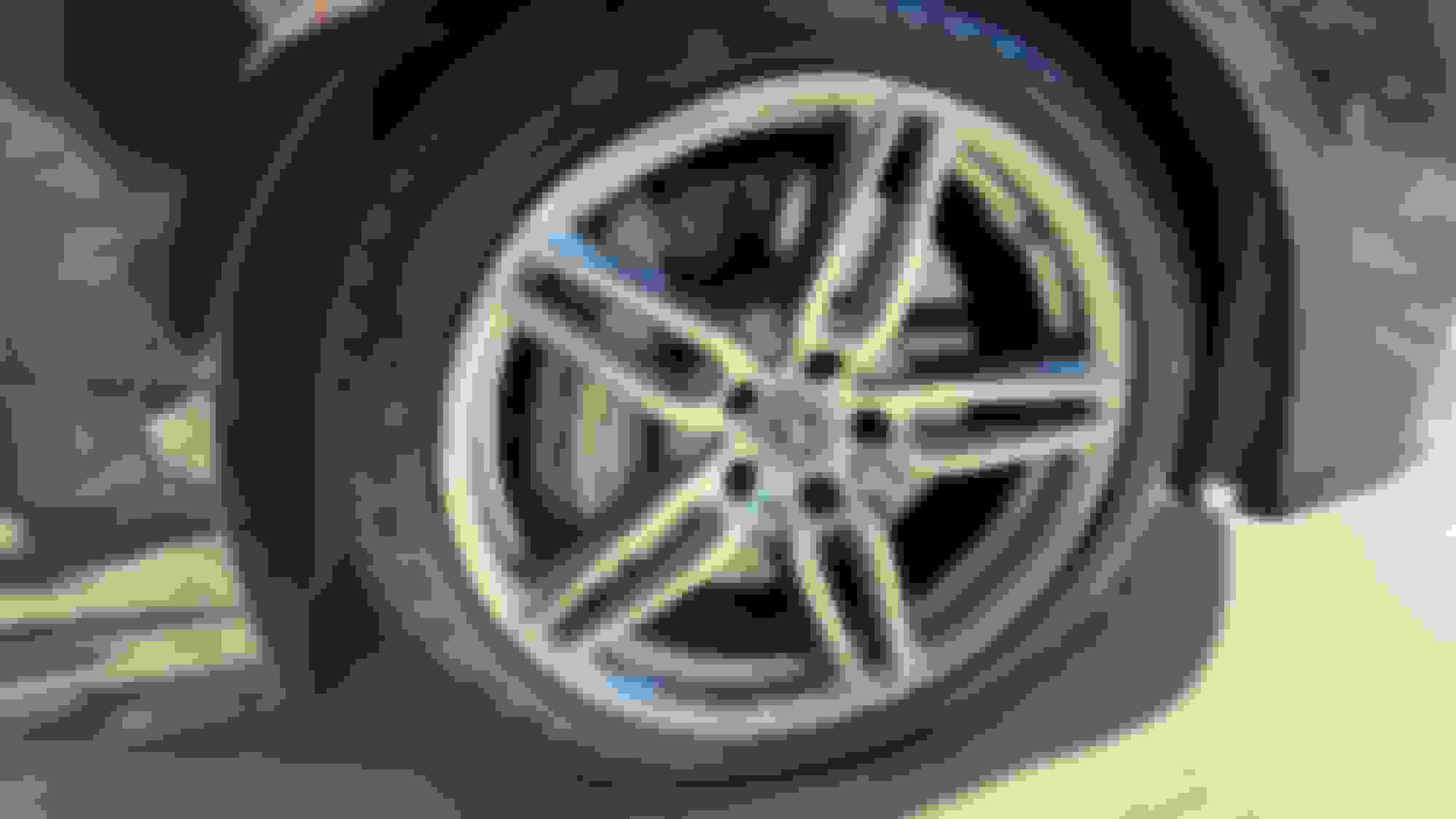
It's beyond obvious to me that the wheel rim is flattened at 11 o'clock (equidistant between the spokes... the star point in the center cap points right at it). The bent rim is obvious in the top photo as well.
A common occurrence in this situation, you've hit something (pothole or curb) and that has bent the wheel, resulting in the bulge in the tire above the flat spot.
You'll need to repair the wheel AND buy a new tire, as tire warranties do not cover accidental tire abuse.
2019 E 450, 2016 E350 4matic (retired), 2018 Ford Edge Sport, 2008 Porsche Boxster
Originally Posted by ronmart
I just noticed the bulge in my tire - has anyone ever seen such a thing on their tires before? What in the world could have caused this? I haven't added air in over a year, so it wasn't from over inflation like a bike tire would do.
I don't know where to begin with this since the dealership usually wants nothing to do with tire warranty related issues, and even if it is covered under warranty what good is one tire on a 4MATIC?
I just noticed this tire builge on a my 2019 E450 Cabriolet after about 27k miles on it. I just noticed this tire builge on a my 2019 E450 Cabriolet after about 27k miles on it.
Just took a closer look at your tire and wheel:
First, I notice 19 inch tire and dented wheel where the bulge is: To my eye, you hit a pot hole, dented the rim which caused the bubble.
I think you are not only looking at a new tire but also a new wheel unless you can have the wheel straightened.
Frankly, with the damage to the wheel, I think you are lucky that you only have a bulge instead of a blowout.
The rim is clearly bent as others have stated. You’ve struck something, a pothole perhaps, that’s dented the rim and caused a tire bulge. It happens. If after straightening the wheel and replacing the tire, you still feel vibrations, then I would probably have the wheel replaced as well as looking at the hubs or bearings to ensure no other damage.
This is where your issue starts. If that's true then you've been driving on underinflated tires for a while, and as others have pointed out you hit a pothole or something. Your wheel is very obviously bent as said. First thing I noticed looking at your picture. Low tire pressure is a big factor in this as the pothole or whatever you hit essentially punched through the tire and had enough force left to bend the wheel, resulting in a damaged tire and wheel. Tires naturally lose air up to 1 psi per month and each +/-10F degrees in temperature change is another +/-1 psi. You need to check your tire pressures at least once a month.
2019 E 450, 2016 E350 4matic (retired), 2018 Ford Edge Sport, 2008 Porsche Boxster
Originally Posted by superswiss
This is where your issue starts. If that's true then you've been driving on underinflated tires for a while, and as others have pointed out you hit a pothole or something. Your wheel is very obviously bent as said. First thing I noticed looking at your picture. Low tire pressure is a big factor in this as the pothole or whatever you hit essentially punched through the tire and had enough force left to bend the wheel, resulting in a damaged tire and wheel. Tires naturally lose air up to 1 psi per month and each +/-10F degrees in temperature change is another +/-1 psi. You need to check your tire pressures at least once a month.
Wheel is visually bent right here.
Thanks for your post: I didn't realize that the OP had not checked his tire pressure in over a year.
This is a big NO - NO.
I live on Long Island and drive to Vermont. When the temps are in the 30's here, I inflate to 35 psi, which is 2+PSI over the recommended. When I am in Vermont and the temps are in the single digits, the PSI drops to 31 which is -2PSI under the recommended.
In the spring as temps rise I let out air to keep my tires at 35 PSI. In the fall the reverse, I add air to bring the PSI up to 35. I have an excellent air compressor. Additionally, each day when I drive, I scroll through to check my PSI. This I do automatically. By monitoring and keeping the pressure at 35 PSI, I will get not only excellent handling and ride but minimum 40,000 miles of tread life. I also have an excellent tire gauge and I have found the Mercedes tire pressure to be within 1 PSI of my tire gauge.
Keeping your tires properly inflated is the easiest thing to do to enhance your ride, gas mileage and tread life and at no cost!
I have the same 19" rim and same size tires on my E300 as the OP, those 19" runflat will get damage easily. I had an pothole incident with another car that has the same size runflats tire, I did not think much of it since the pothole wasnt that big. I went home and noticed the bubble on sidewall and had to replace two tires since they were half way worn. Tire bubbles are usually cause by the separation of the laminate that holds the layers of the tire together. If the layers are separated, they are compromised and cause tire failures at high speed. It is a safety issue in which you should put on high priority.
Same as JTK44, I like to pump up my low profile tires a few extra pounds to protect my rims. With runflat tires, the sidewall is so stiff, the extra few psi doesnt really make that much difference.
Last edited by The G Man; Feb 28, 2022 at 05:01 PM.
As an aside, I have for years gone with nitrogen as the inflating gas for the tires on my cars. Perhaps overkill, but I cannot recall a single incident where I had deviation in tire pressure. Yes, I understand the compositional variance with 'air' and nitrogen, but one thing that I have noticed with the nitrogen in the tires is the temps are just well below where my friends 'air' temps are. So as an old race car guy, which is where I discovered this magic, whatever pressure you decide to run, nitrogen will be of assistance. Using nitrogen inhibits moisture in the tires and seems to provide long term stability with regard to pressure.
2019 E 450, 2016 E350 4matic (retired), 2018 Ford Edge Sport, 2008 Porsche Boxster
Originally Posted by TennesseeZ4
As an aside, I have for years gone with nitrogen as the inflating gas for the tires on my cars. Perhaps overkill, but I cannot recall a single incident where I had deviation in tire pressure. Yes, I understand the compositional variance with 'air' and nitrogen, but one thing that I have noticed with the nitrogen in the tires is the temps are just well below where my friends 'air' temps are. So as an old race car guy, which is where I discovered this magic, whatever pressure you decide to run, nitrogen will be of assistance. Using nitrogen inhibits moisture in the tires and seems to provide long term stability with regard to pressure.
Just did a quick Google search of " Does nitrogen in tires make a difference/"
"Nitrogen-filled tires lost an average of 2.2 psi. The results show that nitrogen does reduce pressure loss, but the reduction was only a 1.3 psi difference from air-filled tires over an entire year."
and
"CR's tests show that using nitrogen is not worth the money or inconvenience"
As an aside, I have for years gone with nitrogen as the inflating gas for the tires on my cars. Perhaps overkill, but I cannot recall a single incident where I had deviation in tire pressure. Yes, I understand the compositional variance with 'air' and nitrogen, but one thing that I have noticed with the nitrogen in the tires is the temps are just well below where my friends 'air' temps are. So as an old race car guy, which is where I discovered this magic, whatever pressure you decide to run, nitrogen will be of assistance. Using nitrogen inhibits moisture in the tires and seems to provide long term stability with regard to pressure.
The benefit of nitrogen and why it's used in racing is because of the more predictable pressure at a given temperature. The issue as you correctly point out is that air absorbs moisture, and the moisture is unpredictable. Nitrogen on the other hand is an inert gas. Nitrogen molecules are also larger than oxygen molecules, so they permeate the tire walls at a slower rate. There are numerous issues with Nitrogen, though. Number 1 is you can't top it off yourself. If you top it off with air, you have to flush it again and that's the other problem. The tire has to be flushed multiple times to get all the air out and truly have pure nitrogen. The nitrogen that most tire shops fill tires with is also produced on site from the surrounding air, and not all equipment truly produces pure nitrogen. In many cases it still has oxygen and moisture in it. It's generally a waste of money. Might be more worth it if you live in a humid climate, but in arid climates it's largely a waste.
Last edited by superswiss; Feb 28, 2022 at 09:15 PM.
As an aside, I have for years gone with nitrogen as the inflating gas for the tires on my cars. Perhaps overkill, but I cannot recall a single incident where I had deviation in tire pressure. Yes, I understand the compositional variance with 'air' and nitrogen, but one thing that I have noticed with the nitrogen in the tires is the temps are just well below where my friends 'air' temps are. So as an old race car guy, which is where I discovered this magic, whatever pressure you decide to run, nitrogen will be of assistance. Using nitrogen inhibits moisture in the tires and seems to provide long term stability with regard to pressure.
Love that designer air, especially the dealers.
Another reason why Race cars drivers use nitrogen in their tires is for safety. Nitrogen, unlike oxygen, will not feed a fire in an accident. The biggest issue with everyday drivers using nitrogen is that they stop doing the monthly tire inspections. I always try to check my tire pressure manually and do a visual inspection of the tires on a monthly basis. In the OP’s case, nitrogen would not have prevent what happened to his wheel and tire.
I'm afraid my comment about not adding air myself got misunderstood on this thread, and that's my fault. What I meant was that I wasn't adding air personally. For years I drove and occasionally tracked a very expensive Porsche 911 C4s with painfully expensive tires, so I watched the pressure carefully to get as much tread life out of them as possible before having to dish out $1800 per tire change (4 tires) for its uncommon size tires. I do have a very high end tire pressure gauge but I also have more faith in the TPMS in my Mercedes than I did my 911. I regularly check the TPMS to see the tire pressure in my Mercedes and if the tires need air, I simply swing by the dealership and let them add air. I do this to avoid the blame game for a situation exactly like this whereby someone can claim I under/over inflated my tires should I ever find myself, as I do now, in an unfortunate situation with my tires.
I hadn't noticed the bent rim until it was higlighted here, but now I know exactly the root cause here. There was a huge pothole that fills with water on Bellevue Way near Main Street in Bellevue, WA and my wife accidentally hit that pot hole which caused this damage. I'm now going to work with the city (don't expect much there) and my insurance company to see if there's a way to get this taken care of via that route.
Thanks for those who chimed in on this and shared their thoughts.
One issue I see with this approach is that by the time you get to your dealership, the tires are warm. Unless they properly compensate for that then your tires will be underinflated as the recommended tire pressures are for cold tires that have cooled down at least 3 hours or have been driven less than a mile. I'm assuming your dealership isn't just around the corner. Also, the TPMS sensors aren't very accurate. They only have a 1 psi resolution and mine generally show higher than the actual pressure in the tire. Not to mention that again, it's only useful while the tires are cold. I use TPMS mainly to gauge if the pressures look roughly ok, or if there's possible a leak, but neve rely on the actual psi it displays.
In my experience the tire pressures are never right when shops adjust them. That's partly because the tires aren't cold when they service the car as said, but also many don't really understand the correct pressures. In the USA, the pressure on the door sticker is not the correct pressure. The proper pressure for different load scenarios are listed on the sticker inside of the fuel door. I always ask them not to touch the tire pressure and I always check and adjust it myself before I even pull out of my garage after the tires had cooled down overnight.
I've had success with pursuing transportation agencies to get compensated for tire/damage. I slight bent a wheel and bubbled the tire driving over raised concrete on a highway ramp. It was during the pandemic and not having driven through there in a while I had forgotten that it was there and didn't see it at dusk. They paid for the wheel repair and new tire, even though I got the tire free under my road hazard coverage. It's definitely worth pursuing.
Last edited by superswiss; Mar 1, 2022 at 02:11 PM.
I am the opposite, instead of telling the dealer to fill my tires, I specifically tell them not to touch it. Those guys just pump them up to their preset psi, which is usually too high.
2019 E 450, 2016 E350 4matic (retired), 2018 Ford Edge Sport, 2008 Porsche Boxster
Originally Posted by The G Man
I am the opposite, instead of telling the dealer to fill my tires, I specifically tell them not to touch it. Those guys just pump them up to their preset psi, which is usually too high.
I agree: After an oil change, if I forget to tell them not to touch the tires, they come back at 40 PSI
As superswiss correctly stated, tire pressure should be done when tires are cold. I usually do mine after sitting overnight.
Just did a quick Google search of " Does nitrogen in tires make a difference/"
"Nitrogen-filled tires lost an average of 2.2 psi. The results show that nitrogen does reduce pressure loss, but the reduction was only a 1.3 psi difference from air-filled tires over an entire year."
and
"CR's tests show that using nitrogen is not worth the money or inconvenience"
Terribly sorry to disagree with the internet of things; however in sharing my real world experience I will just add that in the four + years we have had my wife's Honda Accord Hybrid, which was delivered with nitrogen in the pressure vessels, the pressure has remained constant, and we have just over 38K miles on the car. My R231 never required adjustment for three years after nitrogen was used when I changed to non RFT; same for the past two years with our A238; your experience may differ, however my vehicles seem to enjoy the designo air which they use. Drive on!
2019 E 450, 2016 E350 4matic (retired), 2018 Ford Edge Sport, 2008 Porsche Boxster
Originally Posted by TennesseeZ4
Terribly sorry to disagree with the internet of things; however in sharing my real world experience I will just add that in the four + years we have had my wife's Honda Accord Hybrid, which was delivered with nitrogen in the pressure vessels, the pressure has remained constant, and we have just over 38K miles on the car. My R231 never required adjustment for three years after nitrogen was used when I changed to non RFT; same for the past two years with our A238; your experience may differ, however my vehicles seem to enjoy the designo air which they use. Drive on!
Reminds me of the famous question/line from the film My Cousin Vinny:
"Are we to believe that boiling water soaks into a grit faster. In your kitchen. Then on any place on the face of the earth. I don't know well perhaps the laws of physics cease to exist on your stove."
Terribly sorry to disagree with the internet of things; however in sharing my real world experience I will just add that in the four + years we have had my wife's Honda Accord Hybrid, which was delivered with nitrogen in the pressure vessels, the pressure has remained constant, and we have just over 38K miles on the car. My R231 never required adjustment for three years after nitrogen was used when I changed to non RFT; same for the past two years with our A238; your experience may differ, however my vehicles seem to enjoy the designo air which they use. Drive on!
Does your dealer top off the nitrogen when you go in for service? 4 and half years without leaking any nitrogen and without topping off is pretty remarkable and not the norm for nitrogen filled tires.
Does your dealer top off the nitrogen when you go in for service? 4 and half years without leaking any nitrogen and without topping off is pretty remarkable and not the norm for nitrogen filled tires.
While it may not be the norm, it has been our experience. We garage our cars, live in a four season climate, and use the vehicle for all intended purposes. Perhaps my experience is an enigma, but it is my enigma. Same with my racing cars; I would go an entire season and not adjust pressures, that was in Atlanta with the temp fluctuations which one experiences. Again, not a true scientific treatise, simply my real world experience. As an aside, for those who believe that the Honda cars are maintenance free, we just put the Hybrid in for the 50K service; $1.200. But the mileage at 48 around town is quite nice, albeit somewhat boring.
While it may not be the norm, it has been our experience. We garage our cars, live in a four season climate, and use the vehicle for all intended purposes. Perhaps my experience is an enigma, but it is my enigma. Same with my racing cars; I would go an entire season and not adjust pressures, that was in Atlanta with the temp fluctuations which one experiences. Again, not a true scientific treatise, simply my real world experience. As an aside, for those who believe that the Honda cars are maintenance free, we just put the Hybrid in for the 50K service; $1.200. But the mileage at 48 around town is quite nice, albeit somewhat boring.
are you saying you or your dealer never fill your tires with nitrogen in 4+ years and the tire with designer air is still at the same pressure? Surely your Honda dealer would have check your nitrogen pressure when you went in for the $1200 service.
Mercedes SLR McLaren 722 S Is Extremely Rare Example Modified by McLaren
Slideshow: A one-of-one U.S.-spec Mercedes-Benz SLR McLaren Roadster became even rarer after a factory-backed transformation at McLaren's headquarters.