When you click on links to various merchants on this site and make a purchase, this can result in this site earning a commission. Affiliate programs and affiliations include, but are not limited to, the eBay Partner Network.
I'm all for a healthy debate and critical thinking, but lets not lose sight of the facts. CO2 is in fact a poison. A 4% concentration can be immediately lethal to humans. This is because the lungs can no longer function and extract oxygen from the air and you die of asphyxiation, even though there's still plenty of oxygen in the air. We are far away from a 4% concentration in the atmosphere, but let's not pretend CO2 is healthy to humans at any level.
As the previous poster pointed out, Co2 is crucial for respiration in humans.
Of course I agree that respiration relies on Co2.
That makes Co2 the OPPOSITE of a poison.
The poster before that pointed out concentration levels, and of course, too much of anything can be injurious to humans. Like sunshine. Like pure darkness.
Also, higher levels of Co2 are resulting in the greening of our planet.
Without grains, plants, and other vegetation, humans would certainly suffer, perhaps even perish, and that vegetation requires Co2.
Humans generate Co2, so that vegetation can consume Co2 and produce oxygen, a symbiotic relationship.
So again, I say that those who are trying to demonize Co2, as a poison and as a pollutant, are zealots to a cause that is not based on firm reasoning.
Last edited by MB2timer; Sep 3, 2025 at 08:24 PM.
Reason: Is-are
I'm all for a healthy debate and critical thinking, but lets not lose sight of the facts. CO2 is in fact a poison. A 4% concentration can be immediately lethal to humans. This is because the lungs can no longer function and extract oxygen from the air and you die of asphyxiation, even though there's still plenty of oxygen in the air. We are far away from a 4% concentration in the atmosphere, but let's not pretend CO2 is healthy to humans at any level.
True, I should have clarified that people do just fine in pure oxygen environments at the appropriate pressure, We don't need external CO2 at all, but will generate CO2 internally through metabolic processes that MUST be expelled via the lungs. We will die if there is too much CO2 in the body.
The effects of CO2 on global temperatures is well understood, and we can see in the geologic record how high CO2 corresponds to higher global temperatures. We even have a pretty good idea of the relationship between changes in the amount of CO2 and the changes temperature; hence the predictions of how the current changes in CO2 levels will affect global temperatures. The physics is pretty simple in the end, and confirmed by the geologic record. We have multiple, independent confirmations of how CO2 affects temperature.
True, I should have clarified that people do just fine in pure oxygen environments at the appropriate pressure, We don't need external CO2 at all, but will generate CO2 internally through metabolic processes that MUST be expelled via the lungs. We will die if there is too much CO2 in the body.
The effects of CO2 on global temperatures is well understood, and we can see in the geologic record how high CO2 corresponds to higher global temperatures. We even have a pretty good idea of the relationship between changes in the amount of CO2 and the changes temperature; hence the predictions of how the current changes in CO2 levels will affect global temperatures. The physics is pretty simple in the end, and confirmed by the geologic record. We have multiple, independent confirmations of how CO2 affects temperature.
Actually, no. The data with the longest records show that warming PRECEDES Co2 rise.
Also, without Co2, the chances of hyperventilating (hypocardbia) increase significantly, and will not abate until normal Co2 levels are attained. Co2 is a regulatory gas for respiration.
100% oxygen respiration, at sea level can cause oxygen toxicity, and higher pressures will lead to oxygen toxicity.
This is worth a read, especially considering this data is still present on the NASA website in the current administration. Take a gander at all the tabs on that site (it's a very quick summary) https://climate.nasa.gov/vital-signs/carbon-dioxide/
as McKinsey & Co has found, 46% of US EV owners are likely to switch back to petrol cars for their next vehicle.
92% of EV owners would never buy another ICE car. I just bought my second EV and will no longer even consider buying another ICE car, new or used. They are laughably complex and expensive to own, and so embarrassing to drive, with their pollution, transmission delays, and constant need for maintenance.
What are the current stats for owners of BOTH EVs and ICE vehicles, in terms of which of these vehicles they’ll purchase in their next buying cycle? Our household has both and tho we are new to EV ownership, we have fallen in love with it already. I find myself preferring to drive the EQS (my wife’s car) over my W213 450… I would never have remotely imagined this in my 40+ years of ICE driving!!! Yes I love all of our cars but the EQS has certainly risen to the top of our vehicle lineup and looks to stay on top baring any catastrophic issue with it during ownership.
92% of EV owners would never buy another ICE car. I just bought my second EV and will no longer even consider buying another ICE car, new or used. They are laughably complex and expensive to own, and so embarrassing to drive, with their pollution, transmission delays, and constant need for maintenance.
This pretty much sums it up. I often toy with the idea of another ICE car like a W222 (they are a beautiful car) for example, then I think about all the engine related issues which don't really have the energy to deal with. On the climate impact front, I would rationalize it away by saying I would drive it less than someone else thereby reducing it's carbon impact but then I wouldn't want to drive it at all for that reason. Putting gas into my E-Class anymore just feels kind of primitive and disgusting.
This pretty much sums it up. I often toy with the idea of another ICE car like a W222 (they are a beautiful car) for example, then I think about all the engine related issues which don't really have the energy to deal with. On the climate impact front, I would rationalize it away by saying I would drive it less than someone else thereby reducing it's carbon impact but then I wouldn't want to drive it at all for that reason. Putting gas into my E-Class anymore just feels kind of primitive and disgusting.
Lol...yup. It is funny how much things change after owning an EV. The thought of going to gas stations, standing there usually freezing or cooking, having loud music blared at me from the pump, and standing on diesel stained concrete...no thanks. Regarding another poster who said something about the complexity and inefficiency, I drove my old CL a couple days back, and opened the hood to look for a problem--the heat that poured out! So much waste in the form of heat, even heating up my garage. And of course the incredible complexity of the car, but I guess that is why it is my hobby, for the challenge.
Actually, no. The data with the longest records show that warming PRECEDES Co2 rise.
Also, without Co2, the chances of hyperventilating (hypocardbia) increase significantly, and will not abate until normal Co2 levels are attained. Co2 is a regulatory gas for respiration.
100% oxygen respiration, at sea level can cause oxygen toxicity, and higher pressures will lead to oxygen toxicity.
Earlier studies that exclusively relied on antartica ice cores did suggest that to be the case, however subsequent studies that included more global sampling turned that back around, to
what we see today, which is increasing CO2 preceeds temperature rise, not the other way around.
A lot of evidence points to different conclusions, than the alarmists come to.
Evidence for warming PRECEDING Co2 rise is dismissed even though logically, there must be a preponderance of correlation and causation for that order.
In ice ages, Co2 would be trapped in ice, and not able to diffuse through the atmosphere.
Upon melting of sea ice and glaciers, Co2 would have been released form the ice, as well as the land and waters below.
It is almost common sense, but a good alarmists doesn’t let anything get in the way of a good story.
If the oldest and longest record of temperature versus Co2 levels isn’t convincing, just come up with parameters of a newer and less comprehensive study that appears to contradict it.
Well, let’s look at a more recent study…Kenneth Richard
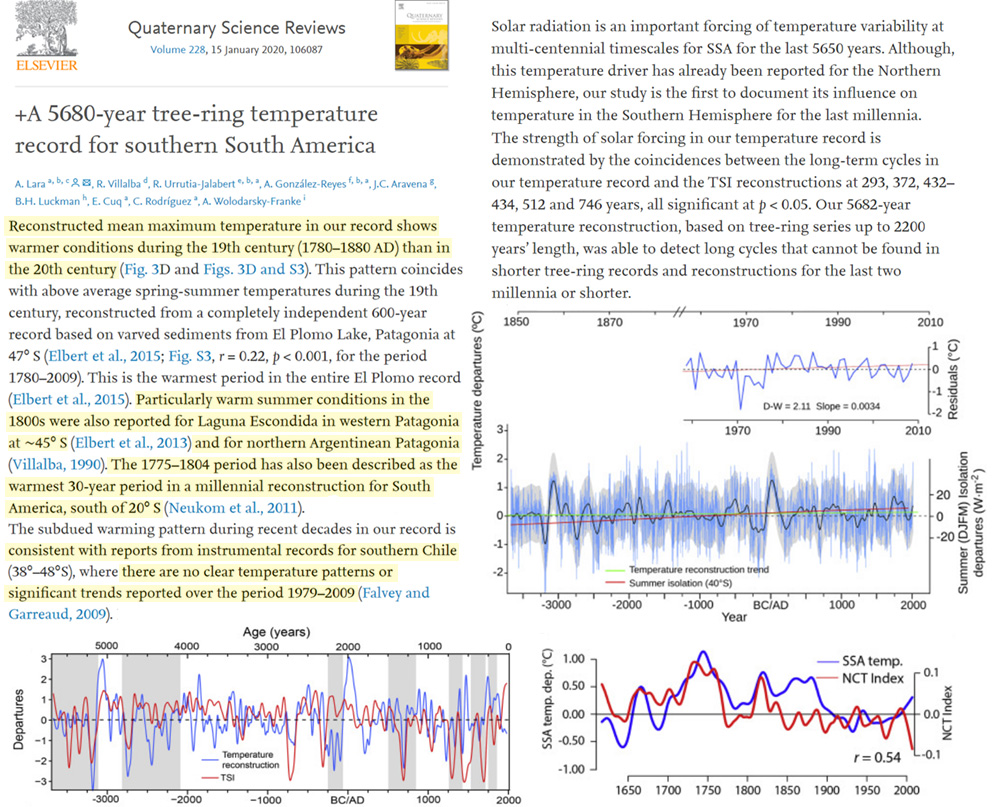
A new 5680-year tree-ring temperature reconstruction for southern South America (Lara et al., 2020) reveals (a) no clear warming trend in recent decades, and (b) the 18th and 19th centuries (and many centennial-scale periods from the last 5680 years) had much warmer temperatures than today.
In addition to finding modern temperature changes in southern South America fall well within the range of natural variability in the context of the last 5680 years, Lara et al. (2020) assess solar forcing to have contributed to climate variations for this region of the Southern Hemisphere.
The authors find CO2 fertilization can explain trees’ improved water use efficiency and tree-ring growth in general; this affects the capacity for tree-rings to be a proxy for long-term temperature variability.
They emphasize this composite tree-ring record is “the longest in the Southern Hemisphere.”
“The most outstanding features in the reconstruction presented here are two major warm periods between 3140–2800 BC and 70 BC – 150 AD (5159–4819 and 2089–1869 years ago, respectively, counted from 2019 to facilitate comparisons with glacier records based on 10Be dated moraines). During these warm periods, no glacier advances have been reported for Patagonia (Aniya, 2013; Kaplan et al., 2016; Strelin et al., 2014, Fig. 5A).”
“Reconstructed mean maximum temperature in our record shows warmer conditions during the 19th century (1780–1880 AD) than in the 20th century (Fig. 3D and Figs. 3D and S3). This pattern coincides with above average spring-summer temperatures during the 19th century, reconstructed from a completely independent 600-year record based on varved sediments from El Plomo Lake, Patagonia at 47° S (Elbert et al., 2015; Fig. S3, r = 0.22, p < 0.001, for the period 1780–2009). This is the warmest period in the entire El Plomo record (Elbert et al., 2015). Particularly warm summer conditions in the 1800s were also reported for Laguna Escondida in western Patagonia at ∼45° S (Elbert et al., 2013) and for northern Argentinean Patagonia (Villalba, 1990). The 1775–1804 period has also been described as the warmest 30-year period in a millennial reconstruction for South America, south of 20° S (Neukom et al., 2011).”
“The subdued warming pattern during recent decades in our record is consistent with reports from instrumental records for southern Chile (38°–48°S), where there are no clear temperature patterns or significant trends reported over the period 1979–2009 (Falvey and Garreaud, 2009).”
Consistent with the patterns documented in this paper, low frequency reconstructed cold temperature anomalies for the NH and periods of minimal solar activity were variable with periods of coincidences and discrepancies during the last 1200 years (Anchukaitis et al., 2017). Changes in large scale NH circulation are thought to provide a possible mechanism for these differences (Anchukaitis et al., 2017). The two major periods with positive anomalies in our reconstruction (3140–2800 BC and 70 BC-150 AD), coincide with positive anomalies of solar irradiance, but the deviations in the TSI are proportionally smaller in the latter period (Fig. 5A).
“A strong CO2 fertilization effect has been the main explanation for the significant increase in water-use efficiency (WUE) reported for Northern Hemisphere temperate and boreal forests over the recent two decades (Keenan et al., 2013).”
“The increasing growth trend and decreasing isotope discrimination in Fitzroya have been attributed to a raise in photosynthetic rates, which has been caused by increased CO2 and/or higher surface radiation, the latter associated with a reduction in cloudiness in a high precipitation area (Urrutia-Jalabert et al., 2015a). In the eastern slope of the northern Patagonian Andes, Argentina, under lower rainfall and cloudiness than in the Chilean western slope, a marked increase in Fitzroya tree-ring growth during the 20th century has also been recorded and attributed to increased CO2 concentration (Lavergne et al., 2018). The coincident Fitzroya growth patterns in two areas of contrasting cloud cover is an additional support for the attribution of CO2 fertilization in this species.”
For good measure, Lara et al., (2020) point out that “a cooling trend has been reported along the Pacific coast (17° – 37° S) of South America for the periods 1979–2006 and 1981–2012 (Falvey and Garreaud, 2009; Hartmann et al., 2013).”
This cooling record is consistent with instrumental records from the dozens of temperature stations all across the central and southern regions of South America which also show cooling/no warming in recent decades (Lansner and Pepke-Pedersen, 2018).
This is a similar deal as the previous study. While the average global temperature is increasing not every spot on the earth is in lock step with that trend. Which is to say local exceptions to the trend don't invalidate the overall trend.
What you are suggesting is impossible. If glow bull warming is true, all the temperatures everywhere must be increasing over time.
If it’s not, then seasonal variation can explain temperature rising and falling in different climates.
Remember, libs went out of their way to label innocuous gases as greenhouse gases.
That makes a direct comparison to a greenhouse a valid one.
What you are suggesting is impossible. If glow bull warming is true, all the temperatures everywhere must be increasing over time.
If it’s not, then seasonal variation can explain temperature rising and falling in different climates.
Remember, libs went out of their way to label innocuous gases as greenhouse gases.
That makes a direct comparison to a greenhouse a valid one.
The temperatures in Chili agree with your contention. You can see a departure from the 100 year trend about 50 years ago. For reference the rate in the last 50 years in line with the global average and over the last 20 like 50% above that.
In terms of libs and greenhouse gases I would assume that some of the libs that you are referring to would be those radical leftists scientists working a Exxon in the 70's.
What I am trying to understand is your animus towards people who embrace the science of greenhouse gases as though you are being harmed by their efforts to attempt limit increases
in atmospheric CO2. I am assuming that you don't have any financial stake in the continued consumption of fossil fuels.
How many of those data sets, or even data points, were established by proxy?
Do you know what a Milankovitch cycle is?
Do you know what the so called green house effect of Co2’s warming limit is?
Did you know that there are atmospheric mechanisms including coriolis effect that these climate projections are not taking into account?
I am not a denier. I am a skeptic. Those on the other side are alarmists, best described as chicken little.
All these destructive events are predicted, but never come true, with the alarmists.
Why is that?
All of it depends on invisible forces, that cannot be controlled, and probably will never be.
Its a trademark of liberal thinking, the unsolvable problem, that must have money thrown at it.
24 EQS 580 4matic sedan Pinnacle trim w/Exec. rear seating pkg.
This is a fascinating and brutal case study in market dynamics. The intellectual sparring here, especially from members like @Wolfman , @jbattan , and @LAZARU5 , has been first-rate. The core question is whether the EQS's value collapse is a rational verdict on the car itself or an irrational panic.
The answer is yes to both. The confusion arises because we're trying to value a 21st-century asset with a 20th-century mindset. The EQS isn't just a car; it's a new type of hybrid asset: a Durable Good fused to a Consumer Electronics Core.
The Durable Good: The chassis, the bank-vault cabin, the suspension. This part is engineered to the same 15+ year standard as an S-Class. When jbattan snags a CPO for 44% of MSRP, he's rationally acquiring a world-class luxury platform.
The Consumer Electronics Core: The battery pack and the processors. This part depreciates on the brutal curve of a laptop. As Wolfman correctly argues, the market is rationally pricing in its rapid obsolescence.
But the car's actual merits are only the kindling. The real story is the inferno of the financial machinery behind the scenes. The catastrophic depreciation isn't a simple market reaction; it's being actively accelerated by a powerful, self-reinforcing Institutional Panic Loop.
Most people see the depreciation as a mystery. The insider view is that it's a machine with three distinct parts, all turning in lockstep to crush the asset's value.
1. The Leasing Arm (The Panic Setter): Mercedes-Benz Financial Services
This is where the first shot is fired. When MBFS sets the lease residuals, they are placing a multi-billion-dollar bet on the car's future value. The absurdly low residuals on the EQS are not a guess; they are a public, legally binding declaration that the manufacturer's own financial arm has zero confidence in the asset's long-term worth. It's the house publicly betting against itself, and that signal becomes the psychological anchor for the entire market.
2. The Dealers (The Amplifiers): The Floorplan Squeeze
That beautiful $140,000 EQS sitting on a dealer's lot isn't a passive asset; it's a bleeding wound. Dealers finance their inventory through a "floorplan," and they are paying interest on that unsold metal every single day. The pressure to stop the financial bleeding on a slow-moving, high-MSRP unit is immense, forcing them to slash prices not just to make a sale, but to make the pain stop. This liquidation floods the market with cheap inventory, amplifying the panic signal set by MBFS.
3. The Wholesale Auctions (The Executioner): The Manheim Report
This is the financial kill box. Every trade-in value is ultimately anchored to the wholesale auction data, specifically the Manheim Market Report (MMR). As the first wave of off-lease and desperate dealer trades hits the auctions, it creates a supply glut that hammers wholesale prices. This wholesale collapse becomes the "ground zero" number that every other dealer in the country uses to justify their painfully low trade-in offers. This is what turns the panic into hard, official data, which in turn reinforces the low residuals, completing the loop.
This is the machinery that explains the brutal, real-world pain @kart11 shared. He wasn't just the victim of a depreciating car; he was caught in the gears of this institutional panic.
But this chaos won't last forever. Markets, even panicked ones, eventually mature. For the mere mortals among us, here's the likely road ahead:
What Happens Next: The Three Stages of Maturity
Stage 1: The Bloodbath (The Next 18-24 Months)
Get ready. The first massive wave of two- and three-year leases is about to hit the auctions. This tsunami of supply will keep CPO prices brutally low and permanently solidify the "never buy new" narrative for first-generation luxury EVs. It will be a great digestion period for the market.
Stage 2: The Stabilization (Years 3-5)
The market will find its footing.
Residuals will Normalize: MBFS will finally have years of hard auction data, allowing them to set more accurate (though still conservative) residuals. The wild guessing will end.
The Tech Plateaus: The jump from a 2026 to a 2029 model will be less dramatic than from 2023 to 2026, slowing the perceived obsolescence of the "electronics core."
The CPO Market Becomes Primary: Just as with the S-Class, the smart money will largely abandon the new luxury EV market and treat 3-year-old CPO units as the true, rational entry point.
Stage 3: The Bifurcation (The Long-Term Reality)
The luxury EV market will permanently split, mirroring another high-tech durable good: the high-end television.
The "Bleeding Edge" Leaser: A small group will always lease the latest flagship for a premium, treating it as a subscription to the newest technology.
The "Savvy Value" Buyer: The vast majority will wait 2-3 years and buy the same flagship model as a CPO for 40-50% of its original cost, getting 95% of the performance for less than half the price.
The confusion in the market isn't just about a car. It's a temporary, violent dislocation caused by a 100-year-old industry trying to value a 21st-century asset with 20th-century tools. The smart money isn't just buying a cheap car; it's shorting a panicked system.
92% of EV owners would never buy another ICE car. I just bought my second EV and will no longer even consider buying another ICE car, new or used. They are laughably complex and expensive to own, and so embarrassing to drive, with their pollution, transmission delays, and constant need for maintenance.
I just got an ID Buzz as a local family hauler. I do wish Mercedes would come out with their fancy VLS sooner. I'm with you, I don't think I'll buy another ICE again. I'll keep my GLE 580 because the luxury interior and E-ABC suspension is still very enjoyable. I'll sell the GLE though once the VLS comes, if it does still. After reading your experience with the GV60, my wife test drove one and enjoyed it more than the EQE and Taycan; she likes small cars. So we are getting a new 2026 GV60 performance next week along with two 40A chargers in the garage.
How many of those data sets, or even data points, were established by proxy?
Do you know what a Milankovitch cycle is?
Do you know what the so called green house effect of Co2’s warming limit is?
Did you know that there are atmospheric mechanisms including coriolis effect that these climate projections are not taking into account?
I am not a denier. I am a skeptic. Those on the other side are alarmists, best described as chicken little.
All these destructive events are predicted, but never come true, with the alarmists.
Why is that?
All of it depends on invisible forces, that cannot be controlled, and probably will never be.
Its a trademark of liberal thinking, the unsolvable problem, that must have money thrown at it.
The time frame of Milankovitch cycles are orders of magnitude longer than the climate change that is now taking place,
"Over the last 150 years, Milankovitch cycles have not changed the amount of solar energy absorbed by Earth very much. In fact, NASA satellite observations show that over the last 40 years, solar radiation has actually decreased somewhat."
Lol...yup. It is funny how much things change after owning an EV. The thought of going to gas stations, standing there usually freezing or cooking, having loud music blared at me from the pump, and standing on diesel stained concrete...no thanks. Regarding another poster who said something about the complexity and inefficiency, I drove my old CL a couple days back, and opened the hood to look for a problem--the heat that poured out! So much waste in the form of heat, even heating up my garage. And of course the incredible complexity of the car, but I guess that is why it is my hobby, for the challenge.
I was quite pleased to park my GLE outside after acquiring the ID Buzz, as it eliminated fumes and the heat buildup in the garage caused by the V8TT. Similarly, I anticipate replacing my wife's ICE vehicle when she receives the GV60.
At this juncture, the only circumstances under which I would consider another ICE vehicle would be for a collector's car or something enjoyable to drive, such as a Miata ND2 or Cayman GT4. While I no longer engage in off-roading as frequently as I once did, that is another situation where I might still opt for an ICE vehicle. Interestingly, the unsold EQs being added to the loaner fleet ultimately prompted me to explore EVs, as my dealer was happy to provide an EQE or EQS loaner while servicing my car. Although we had installed two 40A, 8 gauge wires in the garage for future EVs over a decade ago during a home remodel, we only acquired our first EV a month ago.
The time frame of Milankovitch cycles are orders of magnitude longer than the climate change that is now taking place,
"Over the last 150 years, Milankovitch cycles have not changed the amount of solar energy absorbed by Earth very much. In fact, NASA satellite observations show that over the last 40 years, solar radiation has actually decreased somewhat."
Climate global models do account for Coriolis effects.
There are mechanisms that work together with coriolis effect, that scientists and models do not take into account.
I could have worded my previous statement to be more understood as it was intended.
Just because someone is a skeptic, and challenges conventional wisdom regarding climate, does not threaten alarmists monopoly on climate virtue.
The point of the milankovitch cycle being so long, is, that it has been warmer in the past, therefore these most recent warm cycles cannot be directly attributed in whole or in part to “greenhouse gases” produced by hydrocarbons, and all a fault of man causing glow bull warming.
Mercedes SLR McLaren 722 S Is Extremely Rare Example Modified by McLaren
Slideshow: A one-of-one U.S.-spec Mercedes-Benz SLR McLaren Roadster became even rarer after a factory-backed transformation at McLaren's headquarters.