Well, I bought ONE diverter valve kit, as there were no more available - anywhere.
Having fitted that kit, I looked at the other one a bit closer, and saw the beginnings of a crack in exactly the same place, so I've ordered a second one, and will replace both as a precaution. They're difficult to get at, so I don't want to do it all again.
Nick
Having fitted that kit, I looked at the other one a bit closer, and saw the beginnings of a crack in exactly the same place, so I've ordered a second one, and will replace both as a precaution. They're difficult to get at, so I don't want to do it all again.
Nick
This is what the "good" diverter valve diaphragm looked like. The bad one was cracked right through, and obviously leaking vacuum. This one was heading in the same direction, so fitting a new one was a no-brainer. Its not something I'd like to do on its own though, they're difficult to get to.
DiverterDiaphragm_zps67105146.jpg?t=1405453392
Nick
DiverterDiaphragm_zps67105146.jpg?t=1405453392
Nick

MBWorld Fanatic!
biker349
MBWorld Fanatic!
close
Jan 14, 2023
- Join DateOct 2009
- Posts:1,924
-
iTrader Positive Feedback0
-
iTrader Feedback Score(0)
- Vehicle(s) I drivecl600
-
Likes:4,958
-
Liked:38 Times in 36 Posts
you said there were no more kits available. where did you get the extra one?
My dealer got it. I did try to order two to begin with, but could only get one. I didn't persevere with that at the time.
It was only when I looked closely at the second valve that I realised I really needed a second one, and tried again. It didn't take too long, or cost too much.
BTW, I reassembled the valves with allen bolts, as the hex nut heads are inaccessible to most sockets.
Nick
It was only when I looked closely at the second valve that I realised I really needed a second one, and tried again. It didn't take too long, or cost too much.
BTW, I reassembled the valves with allen bolts, as the hex nut heads are inaccessible to most sockets.
Nick
I just had to post this picture, which I'm very proud of.
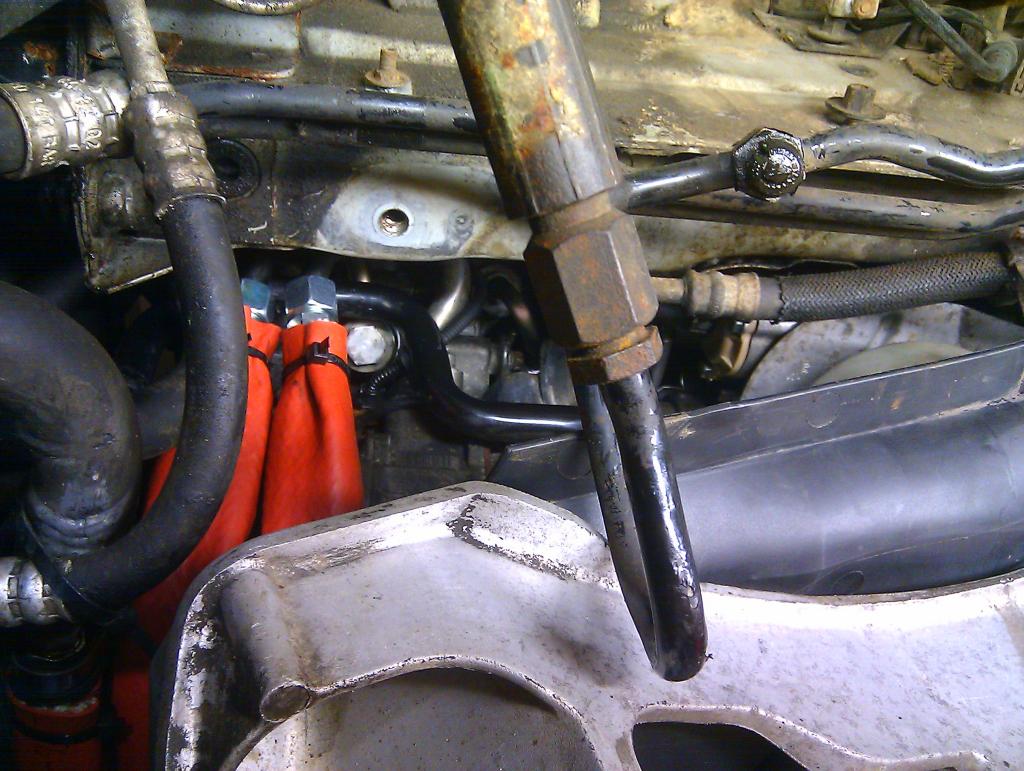
Although I replaced the divertor valves with the turbos out, I did want to see what could be done with less drastic measures. This is a picture of everything in situ, but with the engine resting on stands and the front of the subframe dropped six inches. In this picture, the camera is ponting up at the LHS chassis rail. The subframe is at the bottom and the radiator is just out of the picture to the left. The red hoses are the ABC pump output and pulsation damper pipes - just wrapped with Aeroquip firesleeve. The big 19mm nut immediately to the right is the ABC pump output banjo, which is accessed using a straight socket extension - trivial compared with the usual access.
Look further to the right and you see the LHS divertor valve, which is easily accessible. So that's how you can do it. To drop the subframe, I simply supported the engine sump, removed the four subframe bolts and two motor mount bolts and lowered the front of the subframe down with a trolley jack. The electrical and hydraulic connections to the steering rack are still in place, and there was no need to drain anything to do this. All I did was disconnect the steering column shaft as a precaution, which is an easy one bolt job.
So there you go; all the lower engine ancillaries and pipes are accessible without moving the engine.
Note that I fitted flexible ABC hose sections with compression joints at each end to all the pipes in the engine compartment. This was mostly preventative maintenance, but it means I can replace the hoses in situ - even the ABC output pipe that goes under the engine - that was fully accessible to fit the firesleeve this evening.
Hope that might make things a little easier for other embattled V12TT owners.
Nick
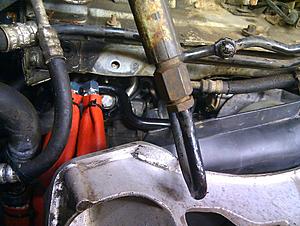
Although I replaced the divertor valves with the turbos out, I did want to see what could be done with less drastic measures. This is a picture of everything in situ, but with the engine resting on stands and the front of the subframe dropped six inches. In this picture, the camera is ponting up at the LHS chassis rail. The subframe is at the bottom and the radiator is just out of the picture to the left. The red hoses are the ABC pump output and pulsation damper pipes - just wrapped with Aeroquip firesleeve. The big 19mm nut immediately to the right is the ABC pump output banjo, which is accessed using a straight socket extension - trivial compared with the usual access.
Look further to the right and you see the LHS divertor valve, which is easily accessible. So that's how you can do it. To drop the subframe, I simply supported the engine sump, removed the four subframe bolts and two motor mount bolts and lowered the front of the subframe down with a trolley jack. The electrical and hydraulic connections to the steering rack are still in place, and there was no need to drain anything to do this. All I did was disconnect the steering column shaft as a precaution, which is an easy one bolt job.
So there you go; all the lower engine ancillaries and pipes are accessible without moving the engine.
Note that I fitted flexible ABC hose sections with compression joints at each end to all the pipes in the engine compartment. This was mostly preventative maintenance, but it means I can replace the hoses in situ - even the ABC output pipe that goes under the engine - that was fully accessible to fit the firesleeve this evening.
Hope that might make things a little easier for other embattled V12TT owners.
Nick

Member
After your replacement of the diverters were there any notable differences in performance? I am currently at 102k miles and I am looking at replacing if not upgrading my diverter valves.
Diverter valves don't affect performance. They just avoid the surge when you snap an open throttle shut.
Nick
Nick

Junior Member
Quote:
Nick
Leaking diaphragm or weak springs will bleed boost ... The turbo will spin faster to compensate which will create higher IAT temperaturesOriginally Posted by Welwynnick
Diverter valves don't affect performance. They just avoid the surge when you snap an open throttle shut. Nick
MB World Stories
The Best of Mercedes & AMG
Explore

Manual Mercedes? 6 Times Sindelfingen Let Drivers Have All The Fun
Verdad Gallardo
Mercedes SLR McLaren 722 S Is Extremely Rare Example Modified by McLaren
Verdad Gallardo
8 Classic Boxy Mercedes Designs That Have Aged Like Fine Wine
Verdad Gallardo
Flawlessly Restored Mercedes 190E Evo II Heads to Auction
Verdad Gallardo
Electric Mercedes C-Class Unveiled: 11 Things You Need to Know
Verdad Gallardo
Mercedes EQS Gets A Major Update: Everything You Need to Know
Verdad Gallardo
5 Underrated Mercedes-Benz Models That Don't Get the Love They Deserve
Verdad Gallardo
Mercedes 300D Has Pushed Well Past 1 Million Miles and It Ain't Stopping
Verdad Gallardo
10 Most Reliable Mercedes-Benz Models You Can Buy Used
Verdad Gallardo

Quote:
There is a chance that a torn diaphragm may cause the valve not to open, rather than creating a leak.Originally Posted by gslse21b
Leaking diaphragm or weak springs will bleed boost ... The turbo will spin faster to compensate which will create higher IAT temperatures
On other cars, the spring holds the valve closed, while vacuum is used to pull the valve open on one side of the diaphragm. Boost from the turbo is on the other side of the diaphragm. When under boost, boost is on both sides of the diaphragm and the spring holds the valve closed.
I imagine this is also how it works on a MB...

Super Member
good info in this thread. thanks.

Junior Member
Quote:
Changing the motor mounts, diverter valves and ABC pipes is trivial at the moment...
Hello sorry to 're open this thread again too. I managed to change engine mounts, and hoses etc using your sub frame drop method, works so well thank you! Did you take the turbos out with subframe dropped too or is that literally an engine out job? Thanks again Alex Originally Posted by Welwynnick
You really don't want to know.Changing the motor mounts, diverter valves and ABC pipes is trivial at the moment...