When you click on links to various merchants on this site and make a purchase, this can result in this site earning a commission. Affiliate programs and affiliations include, but are not limited to, the eBay Partner Network.
misfires when floored combined with the rich fuel trim... seems to say low fuel pressure.
When the engine has poor idle numbers (early timing + lean engine) that cause misfire, higher RPM are similar.
Not sure how, but you are on the money again.
I recorded another trip with the OBD logger and during hard acceleration the fuel trims where in the 11's and 15's. During startup the STFT is also quite high, during regular driving it sits at around 2%, but also likes to move down to -2%. This post confirms our thoughts.
The LTFT is negative most of the times (around -2%~-5%) but when I floor it, the LTFT rises big time (to around 20%) and drops back to 0% after I let go of the throttle
So coming up; fuel filter.
Originally Posted by CaliBenzDriver
Are you familiar with automotive scoping for ignition and injector wave forms? You can tell a great deal by visually comparing cylinders with a cheap pico-scope.
🤞
I am not, I do have access to an proper oscilloscope so that shouldn't be a problem. If you can tell me more I'll be glad to try and learn
the one things that jumps at me is now your trims are no longer near +20: congrats 👍
LT/ST Trims are close to zero but are still too unbalanced ie. dissimilar.
Try to match the fuel trims with the upstream lambda sensors... something's odd.
What is causing that mismatch: mismatched bank response
Before anything else; a think to notice is that I've replaced the MAF sensor (only the sensor) with an NGK 96835 lately. It matches according to the MB part number, so it should work properly
Originally Posted by CaliBenzDriver
the one things that jumps at me is now your trims are no longer near +20: congrats 👍
I haven't replaced the fuel filter yet.
Just thinking out loud here, could it be that because one bank is increasing it's fuel trim, the fuel pressure drops too much causing the other bank to spike the fuel trim?
Originally Posted by CaliBenzDriver
LT/ST Trims are close to zero but are still too unbalanced ie. dissimilar.
Try to match the fuel trims with the upstream lambda sensors... something's odd.
What is causing that mismatch
mismatched bank response
I'm lost, fuel trims are unknown grounds for me.
I just find it strange that the long term fuel trim spikes like that, whilst the short term fuel trim drops.
I'll try to perform a ECU reset tomorrow before my drive.
When it comes to lambda sensor values, I'm having trouble differentiating the regular fluctuations and the incorrect/unwanted values from each other.
Could you help me out with the interpretation of the data?
The fuel trim data is used by the ECU to bias the engine fuel delivery to create the ideal 14:7 air/gas ratio for perfect stoichiometric combustion.
Positive or Negative numbers are used to add or substract gas from the combustion.
Short and long terms: the ECU uses the long term trim to get the short term near zero. Short term is used in response to throttle demands, engine load, temperature for short term changes.
-- An engine not with too much gas left after combustion will get negative LTFT.
-- An engine with a lean burn will earn a positive LTFT.
What measures the overall engine performance is the upstream lambda O2 sensors. The downstream measure the catalytic ability to clean remaining poluants for clean-air purposes.
So we focus only on the primary upstream O2 to diagnose combustion. It provides indications about fuel injectors, spark-plugs, exact advanced timings for injectors and sparks, high voltage coils,...
From that you can understand how everyone tend to interpret and understand things differently when data are combined. Knowing what you are looking for greatly helps you find it!! Compare and look for results that stand out as odd.
With all that in mind, I think you've made great progress with your LT fuel trims balanced near zero away from +20 . You've fixed: bad lambda, bad MAF, mixed plugs, bad coil voltage, vacuum leaks, ...
I would try to compare combustion data with a STABLE rpm's... idle, 1000, 1500 else dynamic STFT blurs everything.
Earlier I mentioned "scoping engines". This is another way to compare cylinders for bad sparks and bad injectors. You can "quickly" compare electrical wave forms to interpret what they mean in terms of combustion work.
Practically you may want to cover all your basics before learning fancier tricks. Scopes are here to stay to help diagnose CAN signals.
missing Fuel response
The above fuel response look very odd. You have 2x throttle bodies, right?
dissimilar lambda response
Again this looks odd, these wave forms should look more similar. The first one is napping, the second is reactive - Both are "upstreams" sensors right?
It looks as if both engine banks are still unbalanced not working in unison.
Last edited by CaliBenzDriver; Apr 20, 2022 at 05:25 PM.
missing Fuel response
The above fuel response look very odd. You have 2x throttle bodies, right?
Nope, I have a single throttle body.
Originally Posted by CaliBenzDriver
dissimilar lambda response
Again this looks odd, these wave forms should look more similar. The first one is napping, the second is reactive - Both are "upstreams" sensors right?
It looks as if both engine banks are still unbalanced not working in unison.
So according to that map you where looking at the downstream sensors of cylinder 4-6 and 10-12.
I'll try to do some STAR lambda diagnosis at idle this evening
I'll check if I didn't accidentally swap some of the wiring of the sensors. I did remember that I was fiddling around with the wiring as it didn't quite fit how it was supposed to fit.
I did read some stories about a bad fuel pressure sensor.
I can imagine that the system would be having a negative trim during cruising and a large positive trim during acceleration when such a sensor is bad
Just made a test drive, everything is working as it should under acceleration. But when I let off the gas, cylinder 7 shuts down. At warmed up idle, everything works as expected, even when revving the engine
I noticed a strange code that I haven't seen before
Cylinder 2 also misfires from time to time.
But cylinder 7, 10 and 12 are the worst (in that order too)
These are the results of the idle lambda test
I've ordered a fuel rails pressure tester, will update you soon.
In the mean time, any thoughts?
Could the lambda code be related to it actually being kapoet, but it stays within specs when it's at operating temperature?
I feel we have made progress here by staying focused. Your ECU is now helping us out with DTC P20A5 that points out: "old-lazy 7-9 O2 sensor" or instead "combustion problem" ??
As always interpret DTC's with a grain of salt.. they seldom accurately point to a bad part. I take this fault as the ECU request to diagnose cyl. 7-9, not replace matching lambda.
Since upstream O2/lambda measure a group of 3 cylinders, you have to guess what the problem could be: ignition issue, injector issue or aged Lambda. Usually you'd want to go ahead and swap parts with neighboring groups to see if problem follows.
If you know these lambda are old originals, you'd start with lambda to limit the busy work not moving good ignition/injection parts.
Forget downstream right now, concentrate only on upstream lambda to diagnose combustions. Your latest lambda graphs reuse the same colors more than once... good luck with all that mixing.
To produce a useful set of graphs for warmed up engine: 1--> UPSTREAM lambda only IDLE.
(not: mixed up/down lambda accelerations)
2--> LTFT only IDLE.
(not: STFT accelerations)
With the above useful charts, we should be able to compare apple-apple to focus on a group of cylinders for improvements, right?
Let's try to fix you known trouble-makers: 07, 10, 12 which land themselves across different groups... what do you already know is wrong with these?
Last edited by CaliBenzDriver; Apr 21, 2022 at 02:21 PM.
feel we have made progress here by staying focused. Your ECU is now helping us out with DTC P20A5 that points out: "old-lazy 7-9 O2 sensor" or instead "combustion problem" ??
As always interpret DTC's with a grain of salt.. they seldom accurately point to a bad part. I take this fault as the ECU request to diagnose cyl. 7-9, not replace matching lambda.
Since upstream O2/lambda measure a group of 3 cylinders, you have to guess what the problem could be: ignition issue, injector issue or aged Lambda. Usually you'd want to go ahead and swap parts with neighboring groups to see if problem follows.
If you know these lambda are old originals, you'd start with lambda to limit the busy work not moving good ignition/injection parts.
I've replaced those upstream lambdas, they are brand spanking new.
Originally Posted by CaliBenzDriver
Forget downstream right now, concentrate only on upstream lambda to diagnose combustions. Your latest lambda graphs reuse the same colors more than once... good luck with all that mixing.
To produce a useful set of graphs for warmed up engine: 1--> UPSTREAM lambda only IDLE.
(not: mixed up/down lambda accelerations)
2--> LTFT only IDLE.
(not: STFT accelerations)
With the above useful charts, we should be able to compare apple-apple to focus on a group of cylinders for improvements, right?
Let's try to fix you known trouble-makers: 07, 10, 12 which land themselves across different groups... what do you already know is wrong with these?
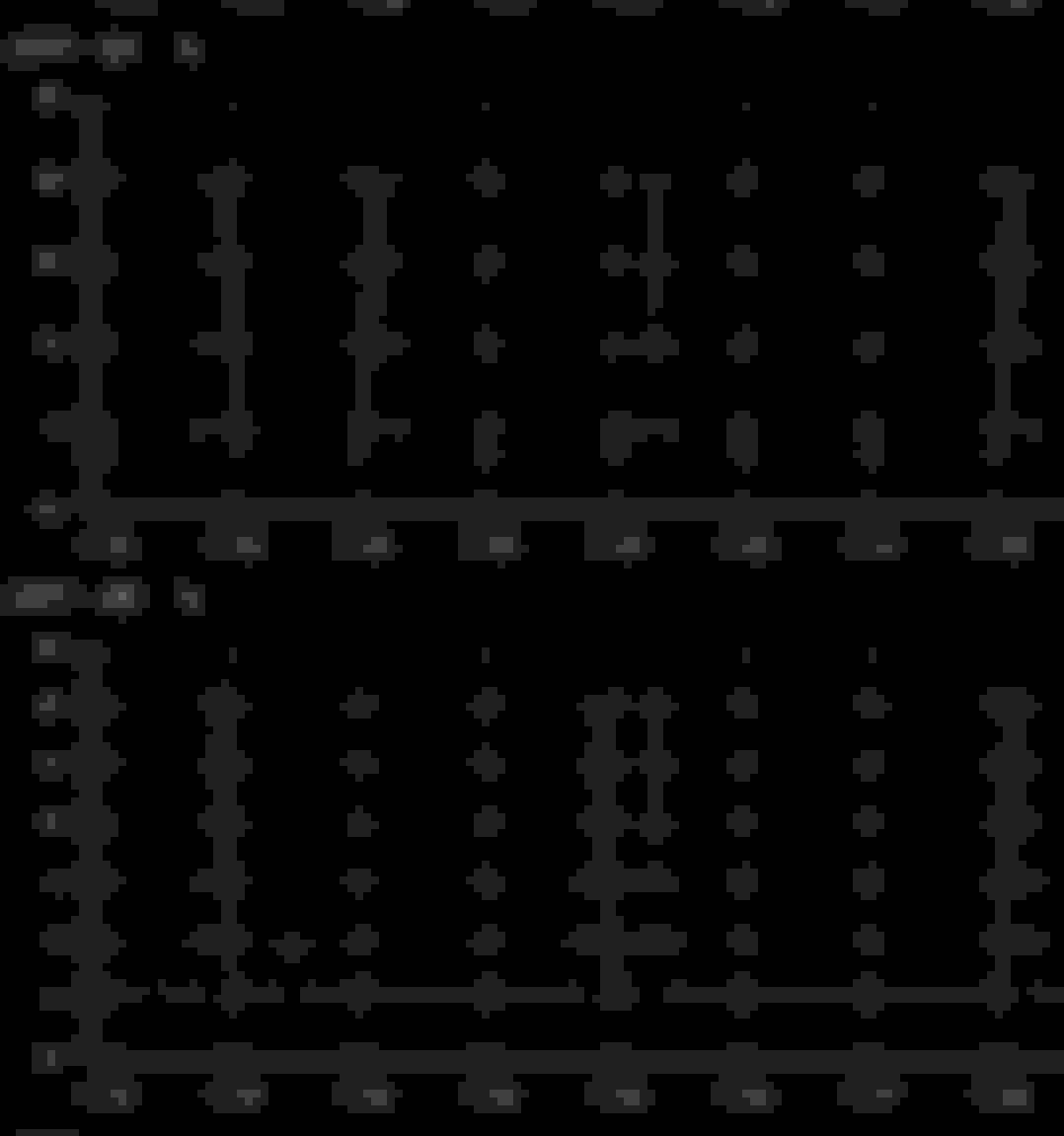
The first graph shows all the sensors on bank 1, cyl 1-3, 4-6.
The second graph is 7-9, 10-12.
The engine was warmed up, it had about 40 minutes to cool down, then I started it and let it idle. The exhaust temp was still at 400 degrees.
Where can I find LTFT in DAS? Under self adaptation, it shows that it can't show that page because cylinder shutoff has been disabled.
Also we must not forget that I still don't know what the fuel rail pressures are
You call the shots but personally I'd concentrate on what the ECU is directly complaining about:
what I understand so far is your active DTC:P20A5 is for a newly replaced lambda.
Therefore :
-- check the lambda heater circuit.
-- check combustions on these cyls.
My best guest here, would be an issue with spark ignition.
You may want to leave the fuel pressure/filter as is while troubleshooting the above spark since your LTFT are back to near zero balance, means the engine is not starved with low fuel supply.... that says "spark" is likely your issue, the subjet title of this thread.
✌️
Last edited by CaliBenzDriver; Apr 21, 2022 at 05:13 PM.
You call the shots but personally I'd concentrate on what the ECU is directly complaining about:
what I understand so far is your active DTC:P20A5 is for a newly replaced lambda.
Therefore :
-- check the lambda heater circuit.
-- check combustions on these cyls.
It was active, after I cleared the code it didn't come back after two WOT runs.
Originally Posted by CaliBenzDriver
My best guest here, would be an issue with spark ignition.
You may want to leave the fuel pressure/filter as is while troubleshooting the above spark since your LTFT are back to near zero balance, means the engine is not starved with low fuel supply.... that says "spark" is likely your issue, the subjet title of this thread.
✌️
I'll go ahead and replace the components inside of the voltage transformer.
The coil pack was shorted at 800 Ohms between the 180V input and GND, so that equals an continous current of 225mA@180V.
The coil pack is brand new by the way, a certified Clark Rupp one is installed now.
Clark also said that a single pack can draw 500mA to 1A under load and that the FET's are capable of *****ting themselves if overloaded, which I assume they have been when the pack was shorted at 800 Ohms to ground. The resistance might have varied at some point.
I do have an 270 Ohm resistor that I could use to test the voltage transformer, it should draw around 0.66A@180V, but I don't want to risc destroying the transformer for now
...
I do have an 270 Ohm resistor that I could use to test the voltage transformer, it should draw around 0.66A@180V, but I don't want to risc destroying the transformer for now
I hope that resistor is a huge one because it will put out about 100 watts of heat.
I like the way you're thinking about bench testing your new ignition parts.
>TEST-LOAD SIZING:
Make sure your resistor-load can handle the heat from the power you throw at it, or quickly test for a short time only not to toast resistor load.
>FET-DRIVER SIZING:
It only take 2seconds to fry under-sized electronics. There is a snake in this design that causes failures.
Hopefully we can figure what kills this fancy ignition: current, voltage, spikes, heat, vibrations ?
1Amp for a driver is an easy job so it likely gets blown by an overvoltage spike.
Here we're dealing with 180V, so FET likely sized around 250 to 300V but when switching ignition coils, you find a famous sharp spike that may reach near a thousand volts: 1KV@2us... a killer!
The coil driver has to be a specialized coil driver duh!
If FET's keep burning, you size them up using the datasheets until you get what works well for your application.
Electronic parts are not priceless, this FET Transistor likely retails for 5 to $10Ea (wholesale 50¢ to $1Ea.)
A resistive load creates no voltage spike, so it is a very friendly and safe load to use for testing. It represent the transformer primary (without any killer voltage spike). Go for it!
Last edited by CaliBenzDriver; Apr 22, 2022 at 10:36 PM.
CaliBenzDriver and Tim687: Could you please tell us what scanners you are using for the useful pictures in this post. I'm particularly interested in how the picture in post #129 was created. I have DAS running, but just barely learning it. I found the O2 voltage display in DAS, but cannot find the LTFT.
Despite new plugs, coils, transformer I'm still getting misfires at WOT (today on 5,6 and 12, but I think it changes). MY simple hand-held scanner showed LTFT of -12 to -15 indicating very rich fueling. I have the OE Tuning tune, which might be the culprit. Clark (of v12icpack.com) told me to reduce my plug gap when running a tune. I'll start a new thread when I can document the LTFT and STFT during WOT. Thanks.
CaliBenzDriver and Tim687: Could you please tell us what scanners you are using for the useful pictures in this post. I'm particularly interested in how the picture in post #129 was created. I have DAS running, but just barely learning it. I found the O2 voltage display in DAS, but cannot find the LTFT.
Despite new plugs, coils, transformer I'm still getting misfires at WOT (today on 5,6 and 12, but I think it changes). MY simple hand-held scanner showed LTFT of -12 to -15 indicating very rich fueling. I have the OE Tuning tune, which might be the culprit. Clark (of v12icpack.com) told me to reduce my plug gap when running a tune. I'll start a new thread when I can document the LTFT and STFT during WOT.
Thanks.
@mrvedit I think you already have the pulse of things 👍
Your LTFT is leaning your rich engine, that cause poor accelerations and lean misfires. What's causing that... process of elimination.
I am old enough that I enjoy better a balanced engine with a solid torque ramp from 1200rpm than having to muscle my way around.
Figure, from a neutral trim it's easy to accelerate with a enriched STFT mixture than fighting the ECU lean mixture during accelerations - right?
I don't know if it's "the tune", a weak coil, a lazy O2-Lambda, a leaky injector or a burned exhaust valve detuning your engine.
@tim687 knows his way around well to doctor this beast of yours.
> Cherry on the cake: TCU is best friend of ECU!
-- When the throttle pedal is hard to manage, the tranny shifts are sloppy, out of time.
-- When the throttle response is solid and the engine output is consistent, the TCU has no problem learning to reproduce perfect shifts.
Last edited by CaliBenzDriver; Apr 23, 2022 at 12:15 AM.
CaliBenzDriver and Tim687: Could you please tell us what scanners you are using for the useful pictures in this post. I'm particularly interested in how the picture in post #129 was created.
I'd recommend checking your fuel pressure at WOT. It might be that some of the sensors inside the car are acting up, causing the pump to run harder than it should
Originally Posted by CaliBenzDriver
@tim687 knows his way around well to doctor this beast of yours.
I like the way you're thinking about bench testing your new ignition parts.
>TEST-LOAD SIZING:
Make sure your resistor-load can handle the heat from the power you throw at it, or quickly test for a short time only not to toast resistor load.
I think the quick test is the one to go, the resistor is quite large (compared to your comon 6.3mm resistor), but I don't think it's able to handle 100W.
Originally Posted by CaliBenzDriver
>FET-DRIVER SIZING:
It only take 2seconds to fry under-sized electronics. There is a snake in this design that causes failures.
Hopefully we can figure what kills this fancy ignition: current, voltage, spikes, heat, vibrations ?
1Amp for a driver is an easy job so it likely gets blown by an overvoltage spike.
Here we're dealing with 180V, so FET likely sized around 250 to 300V but when switching ignition coils, you find a famous sharp spike that may reach near a thousand volts: 1KV@2us... a killer!
The coil driver has to be a specialized coil driver duh!
If FET's keep burning, you size them up using the datasheets until you get what works well for your application.
Electronic parts are not priceless, this FET Transistor likely retails for 5 to $10Ea (wholesale 50¢ to $1Ea.)
A resistive load creates no voltage spike, so it is a very friendly and safe load to use for testing. It represent the transformer primary (without any killer voltage spike). Go for it!
Curiously enough, the original FET's are rated for 200V only, so I've ordered ones that handle 250V (if I recall correctly).
I'm thinking about adding somekind of spark gap/diode clamp, that will be used to dump any voltage spikes, should they occur.
All in all, I've ordered all the FET's, diodes and PWM chips. Costed me around €60,-
The capacitors that I've replaced also costed me around €50,- so it's definitely a cheap fix.
I'd recommend checking your fuel pressure at WOT. It might be that some of the sensors inside the car are acting up, causing the pump to run harder than it should
Thank you for your suggestion on the ELM software. I installed it on my iPhone; while it recommends the ELM327 Bluetooth 4.0 adapter, it also lists the OBDLink MX+ which I have. I hooked it up and am getting to know it.
Peter (BenzNinja) showed me how to view cylinder misfire counts under "Fault codes". That was useful.
I'm going to start a new thread soon, so as to not hijack this one with my own misfire progress.
Thank you for your suggestion on the ELM software. I installed it on my iPhone; while it recommends the ELM327 Bluetooth 4.0 adapter, it also lists the OBDLink MX+ which I have. I hooked it up and am getting to know it.
Peter (BenzNinja) showed me how to view cylinder misfire counts under "Fault codes". That was useful.
I'm going to start a new thread soon, so as to not hijack this one with my own misfire progress.
No worries! I'm glad to share my experiences with you!
Furthermore,
I just wanted to update on the fact that the misfires seem to be the worst when the engine is cold. There is no specific point (that I'm noticing) at which it doesn't misfire anymore upon restart.
I've replaced almost every IC that is on the PCB, except for the PWM controller and one other chip which wasn't in stock.
I did measure the current output with the 270 Ohm resistor. I think the PWM controller shuts itself off, because of the (initial?) current being to high or because of somekind of short-circuit measurement (270 Ohm could be over the 'short-circuit' threshold)
My multimeter showed a max amperage of 0.250mA, but I'm not sure if the sample rate is high enough to properly get the peak current.
After replacing the IC's (mosfets and diodes), the max amperage was 0.490mA, again not sure if the sample rate is high enough.
My car misfired on the first start, but after a restart, lots of blue smoke came out of the exhaust and it started to run properly and I mean proper properly.
My guess, due to the misfires there was gunk buildup (again) which causes the blue smoke. Previously the blue smoke went away after a couple of highway drives.
Moral of the story; test your voltage transformers current output capabilities. It's okay for the output to turn off when you use a low resistance resistor, but the current output should be at least ~490mA, depending on your multimeter's sampling rate, before the controller shuts it off.
For now I'd hope to let the misfires be a thing of the past and continue with the blessingly smooth V12 power output.
Wondering if you can fix your own voltage transformer?
I'm setting up a webshop which includes parts to fix the voltage transformer.
Additional thought; I've got the old version of the transformer, which includes two Schottky diodes, one for each channel. Not sure what they do, but I think they should be the
IR 10TQ045STRL diodes. (IC is labeled 095-0925)
> Output On/Off:
I am so glad to read you have total success within reach.
Preventing your ignition module from cutting off outputs will go a long way towards reliability & V12 Power!
Something in that module goes off the rail and cuts out until reset, right?
> PWM vs. AC/DC:
As far as measuring PWM wave forms... we can not expect our trusty DVM to tell the truth.
These measure AC sinewaves and DC voltages. PWM is a choppy DC based on carrier frequency.
It's fine to guess if output is On or Off with a DVM but not to measure a pulsed voltage.
These numbers to be taken with a big grain of salt....
I got to go troubleshoot my CAN-B signals and learn something in the process!
✌️
Last edited by CaliBenzDriver; May 1, 2022 at 04:10 PM.
Mercedes SLR McLaren 722 S Is Extremely Rare Example Modified by McLaren
Slideshow: A one-of-one U.S.-spec Mercedes-Benz SLR McLaren Roadster became even rarer after a factory-backed transformation at McLaren's headquarters.




























 I think I've overseen the original problem


