When you click on links to various merchants on this site and make a purchase, this can result in this site earning a commission. Affiliate programs and affiliations include, but are not limited to, the eBay Partner Network.
Any electrical gurus interested in determining and repairing faulty BCM?
I have a faulty early 2003 Battery control module that I would like to donate to the cause of anyone with enough electrical background would like to fool with snd see if they can make it work. Like pictures of the other faulty ones, no visual inspection leads to the fault.
There are probably more qualified people on the forum, but I do dabble in electronic repair. With power electronics, the most common failures are with the power transistors and the caps. Caps naturally age and the IGBT's can fail because of heat or have solder issues. I also have some cars with the latest modules, so I can do some comparisons.
Pls show us some pictures of both circuit sides and tell us what is the complaint with the unit and anything specific you know that may help understand the failure mode.
2005 R 230 SL350 (M112 3.7). Sold the 1966 W113 230SL recently
Overheating and setting the car on fire, for one thing (several cases seen in the forums). Any clue would be fantastic. Are you familiar with the functional description of the module (N82/1)?
Last edited by Frederick NL; Jan 21, 2022 at 05:23 PM.
Overheating and setting the car on fire, for one thing (several cases seen in the forums).
Any clue would be fantastic. Are you familiar with the functional description of the module?
+++ Edits: got pic ✅ Is this a SAM, a Prefuse, a Relay, sounds like some circuit board? Do you have P/N or internal pics or a schematic
When high current travel through a resistive connection... it can glow like a cig lighter.
Low voltage cause high current:
(P = U x I) formula spells the trouble with high power device and low voltage: higher current!
I understand this BCM module is famous for causing problems, but WHY/WHAT causes that condition...
Flat battery low voltage
Discharge drain from SAM
Low ALT charge voltage
Poor wiring connections
.....
You need to understand the CAUSE to best fix a problem durably, right?
Let's try to figure WHAT is pushing this module over its limits?
++++Edit: let me read the doc
Last edited by CaliBenzDriver; Jan 22, 2022 at 03:48 AM.
Reason: got pics & doc
Overheating and setting the car on fire, for one thing (several cases seen in the forums).
Any clue would be fantastic. Are you familiar with the functional description of the module (N82/1)?
Now I understand what can help you guys stop replacing this module... coil surge protection
functionalities of "power supply controller' Emergency ... Relay actuation blown hole in CPU packaging!!!
PROBLEM:
When I add up all the above info, I can say 99% chance this circuit gets destroyed by high voltage spikes, not by high currents.
Once critical parts are melted, they present a short circuit path... that's when high current can creates toasty fire conditions.
When you look around a bit for a "smokin' gun" that can create the perfect surge: two power relay coils turn up!
These coils get activated under rare conditions when the main battery voltage is in trouble (One more good reason not to let your battery get low ---> float it!!).
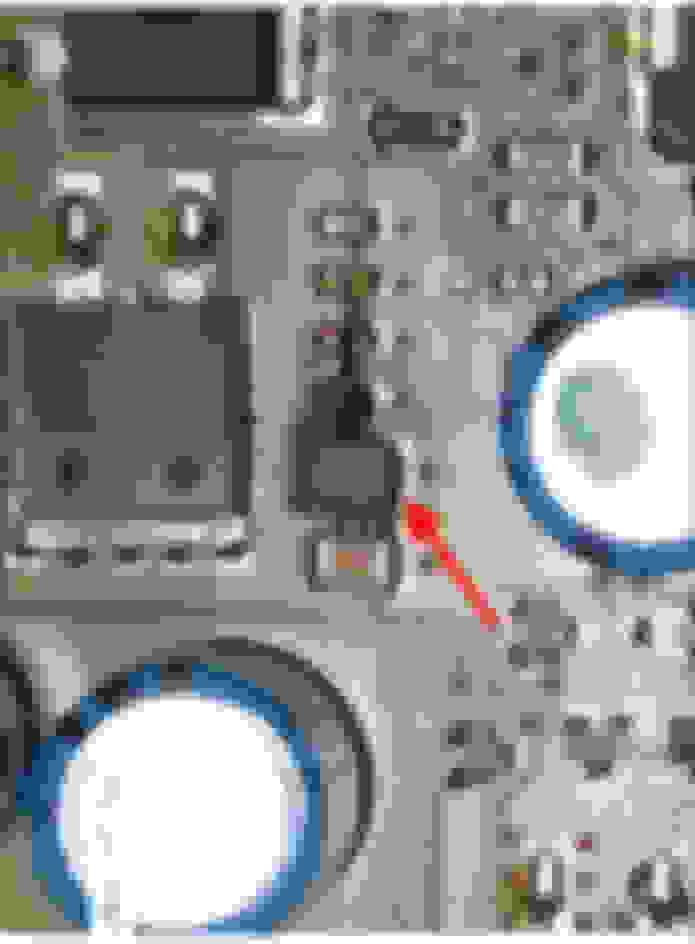
The pics above show how these surges cook everything all the way to the CPU itself. By the time a collection of passive parts are cooked, you can be sure the more fragile active silicon were wasted prior ---> scrap pile
SOLUTIONS:
If I was to prevent this failure, I would work on the 2x relay coil protection.
You know how an "spark plug ignition coil" works, right? Here the relay coil works the same way except we don't want the nasty high voltage spike from it! The energy created needs a place to drain into. Either a backwards diode or a resistor to protect the circuit board. This is called a snubber circuit, look it up.
Chances are the circuit designers already included some form of coil protection but for sure, it ain't good anymore! You got to work on this protection before your good board gets spiked. Have a look and let's see if it can be improved. Perhaps its a "MOV" varistor that gets wasted after couple shots...
Newer cars use a solide state MOSFET relays to do away with these nasty coils... However relays have been okay for the past 100 years when designed around properly.
How about using an automotive small cube type relay to control each big coil from a circuit away from this module feed.
Hope this helps ya
Last edited by CaliBenzDriver; Jan 22, 2022 at 03:59 AM.
2005 R 230 SL350 (M112 3.7). Sold the 1966 W113 230SL recently
Thanks! For a layman like myself sounds plausible enough. Are you saying that a smaller relay by design causes a smaller surge? K57 would remain the same, so couldn't its surge still travel towards/through the BCM?
Thanks! For a layman like myself sounds plausible enough.
1- Are you saying that a smaller relay by design causes a smaller surge?
2- K57 would remain the same,
3- So couldn't its surge still travel towards/through the BCM?
Great, I think you and I understand each other because you're asking the right questions to fix this design issue.
1- Cube relays in between:
Smaller coil, smaller inductance, less powerful spike energy... but still a high voltage surge that need to be dumped.
The smaller relay contacts will then be tasked with switching the K- Coils.
2- K relays:
These stay the same because they do a very special job at switching high battery Amps around. Any big relay will have a big coil and a powerful spike. So keep existing and work their problem.
3- (dV/dT) traveling surge:
The spike wave follows the wire its in. The work spike is used because it is super tall and super short. When you through your best shot at spike you have a chance, I mean use a combination of "best practice" to deal with spike because not I magic thing will make a coil spike disappear. You have to be smart with it.
We are dealing with K coils:
- Physically away from BCM
- Big diode ?
- MOV
- Parallel & serial resistor or RC network
- .....
Like a tsunami burst wave...:
Identify existing coil spike counter measure if any and fix them up to better eat the spike punch.
Spike energy needs to go somewhere, you just need to give it a path to get lost.
Last edited by CaliBenzDriver; Jan 22, 2022 at 02:04 PM.
2005 R 230 SL350 (M112 3.7). Sold the 1966 W113 230SL recently
Re. 3 there will probably never be a 100% galvanic separation between the K-coils and the BCM, right? Seeing they're lurking from the same, one and only, power source...
Re. 3 - There will probably never be a 100% galvanic separation between the K-coils and the BCM, right?
Seeing they're lurking from the same, one and only, power source...
yes, correct, everything is connected in one single 12 volt circuit but with many branches.
Coil spikes are made of high frequency oscillations. This energy does not travel too well in DC circuits. It looses momentum due to wiring impedence.
Practically...layered protection:
You use a long wire protected by a modest 5 to 10Amp fuse (high R) to feed the cube relay contact that command each K-coil. The cube coil power uses the line that was previously commanding each K-relay. By doing that we are inserting a serial resistance to feed each K-coils.
A ceramic capacitor connected near the coil would do well to clamp the spike by charging from it.
A reversed diode is also used frequently in parallel with relays.
The key is to eat the spike energy because you can not just "block it" (it's like stopping a freight train).
All this is nothing new, I am sure there are some excellent published solutions available.
In fact the BCM is built to eat over voltages.... may be it has a form of protection that needs rework.
2005 R 230 SL350 (M112 3.7). Sold the 1966 W113 230SL recently
A fair bit of reading, will read, thanks again. A first glance reminds me off the often heated discussion whether one should use an incandescent bulb as a bridge when (dis)connecting a battery. The text mentions spikes in that realm.
Last edited by Frederick NL; Jan 24, 2022 at 02:32 AM.
This a great thread, it would be amazing to get to a root cause and fix. In the meantime, is anyone in the process of swapping their BCM? I would like to install an access panel/vent so the BCM can be easily inspected by removing the cover. If someone can post the rough measurements that would save me removing the whole trunk liner.
I’ve looked at some pics and I think it would be about a 12”x18” cutout. Not to actually remove it, just to be able to unbolt the cover and periodically inspect the inside. At least that was my thought. Plus, if it started to smell (telltale sign of failure from what I’ve read), the smell would be a little less contained.
yes, correct, everything is connected in one single 12 volt circuit but with many branches.
Coil spikes are made of high frequency oscillations. This energy does not travel too well in DC circuits. It looses momentum due to wiring impedence.
Practically...layered protection:
You use a long wire protected by a modest 5 to 10Amp fuse (high R) to feed the cube relay contact that command each K-coil. The cube coil power uses the line that was previously commanding each K-relay. By doing that we are inserting a serial resistance to feed each K-coils.
A ceramic capacitor connected near the coil would do well to clamp the spike by charging from it.
A reversed diode is also used frequently in parallel with relays.
The key is to eat the spike energy because you can not just "block it" (it's like stopping a freight train).
All this is nothing new, I am sure there are some excellent published solutions available.
In fact the BCM is built to eat over voltages.... may be it has a form of protection that needs rework.
See above URL.... (I could not create a link with it)
So many clever people in here , i saw some before, that had changed alot components in this module. why not make a list with name model numbers of the resistors and parts that should be changed out on this board in module?
And was this modules upgraded when facelift march 2006 models came ? K57 relay on my low km 2007 was corrosion on terminals when replaced this 20 usd part.
I don't think that there was anything specific to the facelift, but there have been several hardware and software revisions over the years. I believe that the last hardware revision was 2011. Probably wouldn't be crazy to replace the caps at maybe a 10 year interval. They are the most prone to aging and loss of capacity in the caps will stress the rest of the board. I will pull one or two in the spring and see how they test.
I don't think that there was anything specific to the facelift, but there have been several hardware and software revisions over the years. I believe that the last hardware revision was 2011. Probably wouldn't be crazy to replace the caps at maybe a 10 year interval. They are the most prone to aging and loss of capacity in the caps will stress the rest of the board. I will pull one or two in the spring and see how they test.
i on picture, is 2 tings listed there, any parts number or some info, so can order this before take out and change them ? And maybe other components?
Mercedes SLR McLaren 722 S Is Extremely Rare Example Modified by McLaren
Slideshow: A one-of-one U.S.-spec Mercedes-Benz SLR McLaren Roadster became even rarer after a factory-backed transformation at McLaren's headquarters.