


Dashdaq-Zeitronix data log setup

Thread Starter
MBWorld Fanatic!
Joined: May 2008
Posts: 3,077
Likes: 2
2006 E55 AMG
I've been playing with ME2.8.1 KLine logging and there are two proprietary data sets that seem useful. They are Knock for all 8 cylinders and Mixture before and after the cats for both banks.
The quickest I can get both data sets out is in about .65 seconds so the sample rate is not going to be stellar. One nice thing is that both the knock and mixture data sets include Load and RPM so at least these two will be time aligned with their respective data pairs.
That external data logger is sure looking good for higher data rates.
The quickest I can get both data sets out is in about .65 seconds so the sample rate is not going to be stellar. One nice thing is that both the knock and mixture data sets include Load and RPM so at least these two will be time aligned with their respective data pairs.
That external data logger is sure looking good for higher data rates.
Please give me your thoughts on any of this. It seems you're very knowledgable on this subject and your input will be appreciated

 !
!Once again here are our plans:
1. AFR (Direct)
2. EGT's (Direct)
3. Boost (Direct)
4. Fuel pressure (direct)
5. RPM and TPS (direct)
6. IAT's (OBDII)
7. Timing (Direct) I wanted to tap into the 4 corners of the cylinder but I don't have enough user inputs) Wouldn't that be great to monitor the timing on 1,4,5, and 8.
8. Knock sensor voltage (direct)
9. Engine temps (OBDII)
Last edited by bassn_07; Sep 17, 2009 at 05:20 PM.
Super Member
Joined: Jun 2009
Posts: 845
Likes: 0
From: San Ramon, CA
A Prius because I'm green
I should have some info this weekend. The install is planned for this Saturday and my tech said it will be done. My tech and Rob from Needswings already started communicating and coming up with a solid game plan.
Please give me your thoughts on any of this. It seems you're very knowledgable on this subject and your input will be appreciated!
Once again here are our plans:
1. AFR (Direct)
2. EGT's (Direct)
3. Boost (Direct)
4. Fuel pressure (direct)
5. RPM and TPS (direct)
6. IAT's (OBDII)
7. Timing (Direct) I wanted to tap into the 4 corners of the cylinder but I don't have enough user inputs) Wouldn't that be great to monitor the timing on 1,4,5, and 8.
8. Knock sensor voltage (direct)
9. Engine temps (OBDII)
Please give me your thoughts on any of this. It seems you're very knowledgable on this subject and your input will be appreciated
!Once again here are our plans:
1. AFR (Direct)
2. EGT's (Direct)
3. Boost (Direct)
4. Fuel pressure (direct)
5. RPM and TPS (direct)
6. IAT's (OBDII)
7. Timing (Direct) I wanted to tap into the 4 corners of the cylinder but I don't have enough user inputs) Wouldn't that be great to monitor the timing on 1,4,5, and 8.
8. Knock sensor voltage (direct)
9. Engine temps (OBDII)
Does that thing tell you what the winning lottery numbers will be directly as well?

Senior Member
Joined: Feb 2009
Posts: 329
Likes: 21
12C P85DL
Two different approaches
It sounds like your path is going to provide some very nice insight as to just what is going on. I look forward to seeing some of the data (if you decide to post it).
My goals are somewhat different in that I am trying to provide tuners with the ability to do remote tuning. A Skype link with the programmer can allow a Tuner in Montana to do an SLR in Saudi J The only thing that is missing is a simple, reliable and consistent way for the Tuner to evaluate the dyno (or street/strip for that matter) pulls. MB proprietary data is slow but does satisfy the consistent requirement along with being simple (logger and programmer are the same tool). It also addresses the gap between the European models of tuning (owner delivers car/ECU to Tuner with expensive tool in Europe whereas in the US companies ship an inexpensive tool to the end customer) by providing a cost effective programmer/logger.
Like everything else in life, it is a compromise because of the slow speed. Luckily there are solutions like the one you are trying for providing data with much better resolution.
My goals are somewhat different in that I am trying to provide tuners with the ability to do remote tuning. A Skype link with the programmer can allow a Tuner in Montana to do an SLR in Saudi J The only thing that is missing is a simple, reliable and consistent way for the Tuner to evaluate the dyno (or street/strip for that matter) pulls. MB proprietary data is slow but does satisfy the consistent requirement along with being simple (logger and programmer are the same tool). It also addresses the gap between the European models of tuning (owner delivers car/ECU to Tuner with expensive tool in Europe whereas in the US companies ship an inexpensive tool to the end customer) by providing a cost effective programmer/logger.
Like everything else in life, it is a compromise because of the slow speed. Luckily there are solutions like the one you are trying for providing data with much better resolution.
Thread Starter
MBWorld Fanatic!
Joined: May 2008
Posts: 3,077
Likes: 2
2006 E55 AMG
It sounds like your path is going to provide some very nice insight as to just what is going on. I look forward to seeing some of the data (if you decide to post it).
My goals are somewhat different in that I am trying to provide tuners with the ability to do remote tuning. A Skype link with the programmer can allow a Tuner in Montana to do an SLR in Saudi J The only thing that is missing is a simple, reliable and consistent way for the Tuner to evaluate the dyno (or street/strip for that matter) pulls. MB proprietary data is slow but does satisfy the consistent requirement along with being simple (logger and programmer are the same tool). It also addresses the gap between the European models of tuning (owner delivers car/ECU to Tuner with expensive tool in Europe whereas in the US companies ship an inexpensive tool to the end customer) by providing a cost effective programmer/logger.
Like everything else in life, it is a compromise because of the slow speed. Luckily there are solutions like the one you are trying for providing data with much better resolution.
My goals are somewhat different in that I am trying to provide tuners with the ability to do remote tuning. A Skype link with the programmer can allow a Tuner in Montana to do an SLR in Saudi J The only thing that is missing is a simple, reliable and consistent way for the Tuner to evaluate the dyno (or street/strip for that matter) pulls. MB proprietary data is slow but does satisfy the consistent requirement along with being simple (logger and programmer are the same tool). It also addresses the gap between the European models of tuning (owner delivers car/ECU to Tuner with expensive tool in Europe whereas in the US companies ship an inexpensive tool to the end customer) by providing a cost effective programmer/logger.
Like everything else in life, it is a compromise because of the slow speed. Luckily there are solutions like the one you are trying for providing data with much better resolution.
This is how we have it setup right now.
1. AFR's (direct)
2. Knock voltage (monitoring both front and back knock sensors using voltage. If my knock sensors pick up any kind of activity we should see a obvious change in voltage)
3. EGT's ( wired up 3 inches from the #1 cylinder)
4. Fuel pressure (right now its showing in volts but I'll speak with Dashdaq about having it converted to psi)
5. Boost (taken off bank 1 surge tanks on the downward pipe before the intercooler y pipe)
6. RPM and TPS
7. IAT's (OBDII)
8. Engine Temps (OBDII)
9. Timing (OBDII)
Senior Member
Joined: Feb 2009
Posts: 329
Likes: 21
12C P85DL
Not sure how the system you are working with determines the relationship between crankshaft position and cylinder firing (timing). If you must, you can always get it from the OBDii just at a slow rate.
As for using the car's lambda sensors, they appear to be narrow band units which are of no real use in doing higher power level tuning You’re on the right track with external equipment.
The only thing that looks like it will be useful from the MB proprietary data set is knock retard per cylinder at somewhere around three samples per second.
As for using the car's lambda sensors, they appear to be narrow band units which are of no real use in doing higher power level tuning
You’re on the right track with external equipment.The only thing that looks like it will be useful from the MB proprietary data set is knock retard per cylinder at somewhere around three samples per second.
Thread Starter
MBWorld Fanatic!
Joined: May 2008
Posts: 3,077
Likes: 2
2006 E55 AMG
Not sure how the system you are working with determines the relationship between crankshaft position and cylinder firing (timing). If you must, you can always get it from the OBDii just at a slow rate.
As for using the car's lambda sensors, they appear to be narrow band units which are of no real use in doing higher power level tuning You’re on the right track with external equipment.
The only thing that looks like it will be useful from the MB proprietary data set is knock retard per cylinder at somewhere around three samples per second.
As for using the car's lambda sensors, they appear to be narrow band units which are of no real use in doing higher power level tuning
You’re on the right track with external equipment.The only thing that looks like it will be useful from the MB proprietary data set is knock retard per cylinder at somewhere around three samples per second.
MB World Stories
The Best of Mercedes & AMG

8 Oddball Mercedes Ideas That Actually Made it to Production
Verdad Gallardo
Dubai Tuner Gives the Mercedes G-Class An Entirely New Look
Verdad Gallardo
Six Gift Ideas Your AMG Loving Dad or Grad Will Cherish

7 Craziest Things AMG Gas Ever Built
Verdad Gallardo
New Electric Mercedes-AMG GT 4-Door Coupe Unveiled: 10 Things You Need to Know
Verdad Gallardo
6 Mercedes Models That Did NOT Age Well (But Are Somehow Still Cool)
Verdad Gallardo
Manual Mercedes? 6 Times Sindelfingen Let Drivers Have All The Fun
Verdad Gallardo
Mercedes SLR McLaren 722 S Is Extremely Rare Example Modified by McLaren
Verdad Gallardo
8 Classic Boxy Mercedes Designs That Have Aged Like Fine Wine
Verdad Gallardo
MBWorld Fanatic!


Joined: Jan 2005
Posts: 4,276
Likes: 28
From: Bay Area
2015 E63S, 2018 E63S
Everything is all wired up and working!!! The only thing my tech had trouble with was trying to pick up the timing. He tried picking it up at the crank sensor but it seems as though it's not going to work. Any suggestions?
This is how we have it setup right now.
1. AFR's (direct)
2. Knock voltage (monitoring both front and back knock sensors using voltage. If my knock sensors pick up any kind of activity we should see a obvious change in voltage)
3. EGT's ( wired up 3 inches from the #1 cylinder)
4. Fuel pressure (right now its showing in volts but I'll speak with Dashdaq about having it converted to psi)
5. Boost (taken off bank 1 surge tanks on the downward pipe before the intercooler y pipe)
6. RPM and TPS
7. IAT's (OBDII)
8. Engine Temps (OBDII)
9. Timing (OBDII)
This is how we have it setup right now.
1. AFR's (direct)
2. Knock voltage (monitoring both front and back knock sensors using voltage. If my knock sensors pick up any kind of activity we should see a obvious change in voltage)
3. EGT's ( wired up 3 inches from the #1 cylinder)
4. Fuel pressure (right now its showing in volts but I'll speak with Dashdaq about having it converted to psi)
5. Boost (taken off bank 1 surge tanks on the downward pipe before the intercooler y pipe)
6. RPM and TPS
7. IAT's (OBDII)
8. Engine Temps (OBDII)
9. Timing (OBDII)
Senior Member
Joined: Feb 2009
Posts: 329
Likes: 21
12C P85DL
I’ve long since shifted out most of what I learned on them (old brain, not a lot of room) but I do recall that the ones I was looking at were frequency based devices. The interface chips had narrow band filters to allow you to “tune” the frequencies of interest then adjustable thresholds for “triggering” knock detect for a given frequency range. Apparently every engine has its own characteristic pre-ignition indicators. Most of the DP engine builders had Bosch come in and tune the knock detect for their particular engine configuration (as my friend did, I believe). The alternative was my breaking out a spectrum analyzer and going to school on the engine in question. It was cheaper to go with Bosch.
In short, the stuff I was looking at did not generate pure voltage out that was proportional to knock so you could not just hook a volt meter up to it and measure knock.
Please do not take the above as absolutes. It has been a LONG time since I looked at knock sensors. There is nothing to say MB is or was using the type of sensors I was looking at. Your data acquisition guys deal with this stuff on a regular basis and will know a lot more about it than I do.
I am a dealer for a data acquisition company but I am not trying to sell their stuff. For technical reference, here is what XYZ has to say about its knock stuff (poor spelling included)-
“To set up a reliable electronic knock control system it is necessary to determine knock levels accurately and differentiate knock from normal engine noise. Most modern engines are fitted with a piezoelectric knock sensor. XYZ’s Knock Modules use these sensors to measure engine noise and detect the knock levels by reducing the influence of background engine noise using a combination of data gating and frequency filtering.
A competent tuner needs to carry out a frequency analysis to determine the target frequency and knock module settings. This is highly specialised work and therefore the XYZ Knock Modules will only be available through authorised dealers that have undertaken specific training”
Senior Member
Joined: Feb 2009
Posts: 329
Likes: 21
12C P85DL
Here is where I am on looking at Ignition Knock Retard as seen by the MB ECU. This was captured at about 1.3 samples per second when combined with recording mixture. I'm removing mixture as it is narrow band information and of no use to me so I should be able to get the logging rate up to somewhere around 3 samples per second.

Junior Member
Joined: Aug 2008
Posts: 55
Likes: 0
From: avon, ohio
'05 E55, '06 300c SRT8
It'll be interesting to see if you get anything useable from the unfiltered knock sensors. I've looked at both raw knock voltage vs knock retard on Chryslers. The knock retard parameter is very valuable but the raw voltage contains too much noise to be of much use. I guess you can draw generalities from what you're seeing but I think the OBD2 knock parameters would be more benefitial even though the update is slower.
It's too bad MB stuck with the ISO protocol until 2008. With CAN you can get 20 - 30x the update rates or more.
Todd
It's too bad MB stuck with the ISO protocol until 2008. With CAN you can get 20 - 30x the update rates or more.
Todd
Thread Starter
MBWorld Fanatic!
Joined: May 2008
Posts: 3,077
Likes: 2
2006 E55 AMG
It'll be interesting to see if you get anything useable from the unfiltered knock sensors. I've looked at both raw knock voltage vs knock retard on Chryslers. The knock retard parameter is very valuable but the raw voltage contains too much noise to be of much use. I guess you can draw generalities from what you're seeing but I think the OBD2 knock parameters would be more benefitial even though the update is slower.
It's too bad MB stuck with the ISO protocol until 2008. With CAN you can get 20 - 30x the update rates or more.
Todd
It's too bad MB stuck with the ISO protocol until 2008. With CAN you can get 20 - 30x the update rates or more.
Todd
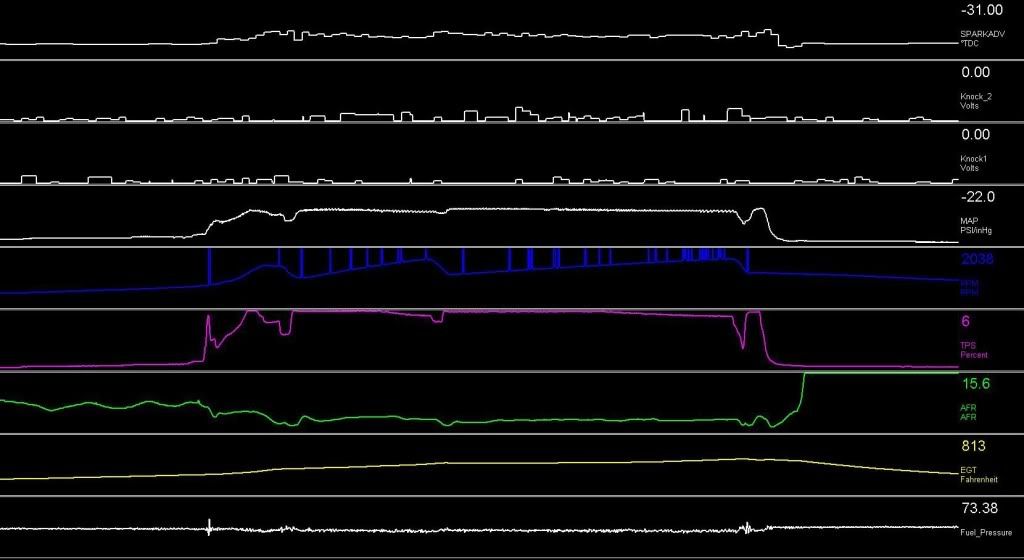
Here's a logged file from a 20-130 run.

Thread Starter
MBWorld Fanatic!
Joined: May 2008
Posts: 3,077
Likes: 2
2006 E55 AMG
I always see negative boost when not under load, but once I apply some throttle I'll see numbers between 10-14 PSI. I've never had to do any type of additional calculations to come up with my boost numbers. If you have any question give Dashdaq a call, their customer support is awesome!!!


