When you click on links to various merchants on this site and make a purchase, this can result in this site earning a commission. Affiliate programs and affiliations include, but are not limited to, the eBay Partner Network.
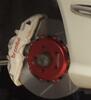
I have a E63 with the red brakes on it now.
I am due soon for front rotors.
I see there are 390mm upgrades, with new rotors and caliper spacers.
I can't seem to find much info on them, but do see they are for C series.
Will they fit E series ? W212 mine is E63S rear wheel drive.
Any suggestions, who may sell them ?
I don't need it for performance. mainly just for looks. car is a daily drive.
I have a E63 with the red brakes on it now.
I am due soon for front rotors.
I see there are 390mm upgrades, with new rotors and caliper spacers.
I can't seem to find much info on them, but do see they are for C series.
Will they fit E series ? W212 mine is E63S rear wheel drive.
Any suggestions, who may sell them ?
I don't need it for performance. mainly just for looks. car is a daily drive.
As said by 1MavRick, Solo Motorsports sells a kit of their custom bracket and Brembo 390mm rotor. You keep using the original caliper and pads. Despite the flatter rotor curvature, it looks like the brake pads do not overhang the rotor edge. If you get it, close-up photos are welcomed.
As said by 1MavRick, Solo Motorsports sells a kit of their custom bracket and Brembo 390mm rotor. You keep using the original caliper and pads. Despite the flatter rotor curvature, it looks like the brake pads do not overhang the rotor edge. If you get it, close-up photos are welcomed.
educate me please. What’s the point of running bigger rotors if you’re going to keep the same size pads? Aren’t the current pads covering the full surface?
The lever is longer (rotor radius), and so it takes less effort to stop the same mass. Primary benefits are better brake modulation, shorter braking distance, and lower temperature (e.g., less fade, cracks). Well, depending on application, you may want higher operating temp. One possible downside is the rim clearance and resulting inability to use smaller/aftermarket rims.
educate me please. What’s the point of running bigger rotors if you’re going to keep the same size pads? Aren’t the current pads covering the full surface?
Bigger rotors allow for better resistance to brake fade as there's more material in the rotor (assuming same thickness) and better brake modulation.
Originally Posted by maxusa
Primary benefits are better brake modulation, shorter braking distance, and lower temperature (e.g., less fade, cracks).
Yes, no, yes.
It's a bit misleading to say you'll get shorter braking distances. You will have shorter stopping distances after 5-10 hard, high speed stops... but for a panic freeway stop, it's marginal and potentially worse. Afterall, you're adding more rotational weight that takes more torque to slow down.
Want shorter stopping distances, get better/stickier tires.
I agree that shorter stopping distance is a function of many factors. You are correct on the misleading bit and grippy tires. To not mention it is omitting an important possible outcome of big brakes under certain conditions. Even the existing OEM 360mm rotors are enough to lock and engage ABS. This means that the brakes can overpower tire/road traction as-is. Of course, if this happens, the braking distance won't be the best no matter the brake size. Therefore, anything that allows the brakes to "ride" the loss of traction as close as possible without losing it is going to contribute to shorter brake distance. Because of less force needed to do the same work and the resulting better modulation with big brakes, the driver can sense the traction boundary more precisely and optimize braking, yes, for shortest brake distance more likely.
I do not want to get lost in theory too much. Agree that grippy tires is a great strategy. Also road condition, tire temperature, rotor/pad temperature, and driver's skill plays a role in achieving the shortest brake distance.
Bigger rotors allow for better resistance to brake fade as there's more material in the rotor (assuming same thickness) and better brake modulation.
Brake fade is from pads overheating. How is that helped by simply increasing the rotor diameter? If the pads didn't change, they are still contacting the same surface patch.
If we increase to 2' rotors somehow but have the oem pads, would that have any benefit? It seems to me it would just hurt things - more weight but the same surface patch. The rotors increasing size slightly is the same thing, but makes it marginally worse instead of much worse, unless the rotor surface is improved in some way.
Last edited by billvp218; Nov 16, 2020 at 09:57 PM.
Brake fade is from pads overheating. How is that helped by simply increasing the rotor diameter? If the pads didn't change, they are still contacting the same surface patch.
Brake fade comes from reduced friction caused by the changing material properties at different operating temps. Two materials participate in braking: rotor material and pad compound. Iron rotors keep fairly stable friction properties at a wider temp range. However, the pad compound maintains optimal friction over a much narrower temp range. There are interesting solutions like carbon ceramic rotors and pads primarily designed for stabilizing their properties over an extended temp range and use profile.
The industry is struggling to develop an affordable pad compound that keeps its properties stable at a wide temp range. By properties I mean things like friction, heat retention/dissipation, integrity, dust, noise. Hence there are pads for different applications; roughly speaking daily driving, performance street, and race/motorsport. There is no affordable solution that spans all 3 applications equally well. It remains a compromise. For example, want predictable performance from start (-40C to +40C)? Then must accept dust, noise, or fade when pushed.
Longer leverage (rotor radius) requires less force to do the same work. Fundamentally it is force applied at a distance. This translates to needing less friction, which is the primary source of rising temps and eventual fade. Also, a larger rotor surface helps heat dissipation. And implied larger amount of rotor material promotes heat absorption by the rotor. Here is the formula to approximate the temp rise after a number of stops:
Plenty of science is involved in designing efficient brakes. I recommend "Brake Design and Safety, 3rd Edition" by Rudolf Limpert.
Originally Posted by billvp218
If we increase to 2' rotors somehow but have the oem pads, would that have any benefit? It seems to me it would just hurt things - more weight but the same surface patch. The rotors increasing size slightly is the same thing, but makes it marginally worse instead of much worse, unless the rotor surface is improved in some way.
Increasing the brake rotor diameter allows for much lesser braking force to achieve the same work of stopping the same mass.
Baseline Scenario: The rotor speed is twice slower than the tire at its effective radius. The tire goes 2 m in one revolution vs. the rotor goes 1 m because its circumference is shorter. The speed ratio r = 2/1 = 2. Then torque requirement is 50 units.
Tb = (10 x 10) / 2 = 50
Larger Rotor Scenario: Same tire. The rotor is twice faster than the tire at its effective radius. The speed ratio r = 2/4 = 0.5. To generate the same torque of 50 units, it takes a quarter of baseline force.
T1 = (2.5 x 10) / 0.5 = 50
This is exaggerated theoretical, just to follow your logic, but the principle still true at a smaller scale. By increasing the rotor from 360mm to 390mm while keeping the tire constant (255/35R19), the rotor circumference grows, and the speed ratio goes from 1.835 to 1.694. This means 7.7% less force requirement at the pads to achieve the same braking compared to the 360mm rotor.
Wow, amazing information here.
To answer everyone's question:
I am extremely happy with the brakes system that is on the car now, but soon they will need changing.
I just want them to be bigger than the guy's next to me !
That's all !
As I mentioned in another thread, it so happens that I am doing the brake rotors/pads now. I looked into the 390mm front rotors, but decided to stay 360mm primarily because of the rim clearance for 18" wheels. One can order the 390mm Brembo rotors locally in the U.S. at competitive prices and free shipping. Otherwise shipping from EU will add $120+ for 60 lbs (28 kg).
Brembo Rotors, Front
p/n 09.9313.33 (Mercedes p/n A2304211212)
390 x 36 mm 2-piece
$698/pair
Custom caliper brackets/adapters are separate. The Epytec parts do not list USA as a shipping destination, but it could be easily worked around for $50 more.
As I mentioned in another thread, it so happens that I am doing the brake rotors/pads now. I looked into the 390mm front rotors, but decided to stay 360mm primarily because of the rim clearance for 18" wheels. One can order the 390mm Brembo rotors locally in the U.S. at competitive prices and free shipping. Otherwise shipping from EU will add $120+ for 60 lbs (28 kg).
Brembo Rotors, Front
p/n 09.9313.33 (Mercedes p/n A2304211212)
390 x 36 mm 2-piece
$698/pair
Custom caliper brackets/adapters are separate. The Epytec parts do not list USA as a shipping destination, but it could be easily worked around for $50 more.
2014+ have a large dust shield behind the rotor, so 18s are a big now for sure.
You are correct, the facelifted W212 has redesigned larger dust shield for the 4MATIC steering knuckle and the optional CCB with 402mm front rotors. The CCB option basically killed the 18" wheels because of inadequate clearance.
EDIT: since this post was written, we concluded that the W212 4MATIC steering knuckle design (rod attachment) prevents the 18" AMG wheel fitment.
You are correct, the facelifted W212 has redesigned larger dust shield for the 4MATIC carrier and the optional CCB with 400mm rotors. The CCB option basically killed the 18" wheels because of inadequate clearance. I speculate that with the standard 360mm AMG rotor/caliper, one can fairly simply fit 18" AMG wheels, which have 420mm clearance at the hub and open wider toward the vehicle. I do not know yet, but it would be great to find the exact size of the facelifted dust shield (front left A2184210120). If someone can measure how much the shield protrudes past the rotor, we can fairly accurately estimate its diameter and fit.
looking at pictures from a few that have done the conversion the 390 rotor doesn’t exceed the dust shield. So I don’t think the conversion would effect the 18” fitment.
my clearance between the stock 19s and the shield is very small. Not sure if 18 would fit. I could be wrong.
yeah same here, they said I can buy the W211 and see if it works. If not I can return it for a refund.
they also said if I buy the W211 and it doesn’t fit I can tell them what adjustments are needed and they can me build a proper one.
Brake fade comes from reduced friction caused by the changing material properties at different operating temps. Two materials participate in braking: rotor material and pad compound. Iron rotors keep fairly stable friction properties at a wider temp range. However, the pad compound maintains optimal friction over a much narrower temp range. There are interesting solutions like carbon ceramic rotors and pads primarily designed for stabilizing their properties over an extended temp range and use profile.
The industry is struggling to develop an affordable pad compound that keeps its properties stable at a wide temp range. By properties I mean things like friction, heat retention/dissipation, integrity, dust, noise. Hence there are pads for different applications; roughly speaking daily driving, performance street, and race/motorsport. There is no affordable solution that spans all 3 applications equally well. It remains a compromise. For example, want predictable performance from start (-40C to +40C)? Then must accept dust, noise, or fade when pushed.
Longer leverage (rotor radius) requires less force to do the same work. Fundamentally it is force applied at a distance. This translates to needing less friction, which is the primary source of rising temps and eventual fade. Also, a larger rotor surface helps heat dissipation. And implied larger amount of rotor material promotes heat absorption by the rotor. Here is the formula to approximate the temp rise after a number of stops:
Plenty of science is involved in designing efficient brakes. I recommend "Brake Design and Safety, 3rd Edition" by Rudolf Limpert.
Increasing the brake rotor diameter allows for much lesser braking force to achieve the same work of stopping the same mass.
Baseline Scenario: The rotor speed is twice slower than the tire at its effective radius. The tire goes 2 m in one revolution vs. the rotor goes 1 m because its circumference is shorter. The speed ratio r = 2/1 = 2. Then torque requirement is 50 units.
Tb = (10 x 10) / 2 = 50
Larger Rotor Scenario: Same tire. The rotor is twice faster than the tire at its effective radius. The speed ratio r = 2/4 = 0.5. To generate the same torque of 50 units, it takes a quarter of baseline force.
T1 = (2.5 x 10) / 0.5 = 50
This is exaggerated theoretical, just to follow your logic, but the principle still true at a smaller scale. By increasing the rotor from 360mm to 390mm while keeping the tire constant (255/35R19), the rotor circumference grows, and the speed ratio goes from 1.835 to 1.694. This means 7.7% less force requirement at the pads to achieve the same braking compared to the 360mm rotor.
Hope this helps.
Just saw this.
The first two likely have an embedded assumption that pad size is appropriately increased with disc/rotor size (same ratio).
For the last formula, do the brackets that come with the kit move the actual pads 15mm higher (to get the 7.7% reduction in force needed)? Or do the brackets keep the pads in the same place, and the bracket is in a different spot just reaching lower? Either one would have the pads completely touching the rotors, but only the former would seem to give any benefit.
Mercedes SLR McLaren 722 S Is Extremely Rare Example Modified by McLaren
Slideshow: A one-of-one U.S.-spec Mercedes-Benz SLR McLaren Roadster became even rarer after a factory-backed transformation at McLaren's headquarters.