



EGR hose on m271

Thread Starter
Senior Member
Joined: Nov 2008
Posts: 461
Likes: 0
From: Orange County, CA
C230 K Coupe (05)
EGR hose on m271
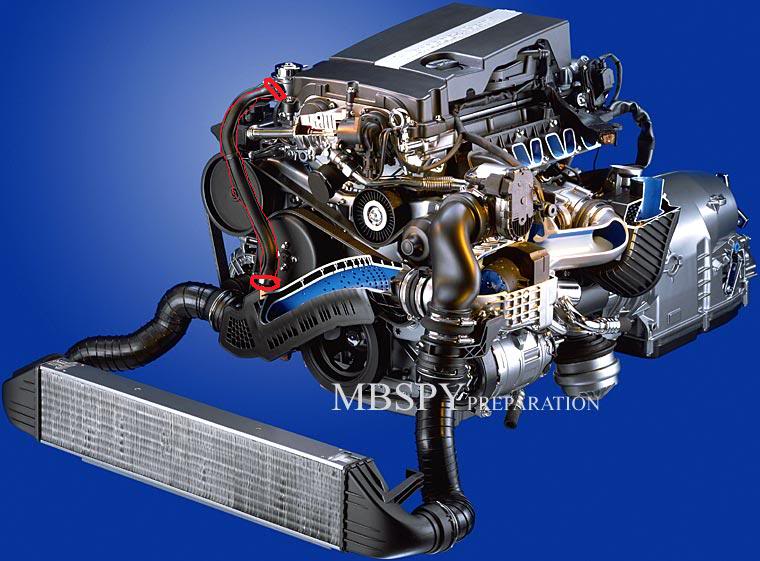
Is that the EGR hose? (red outline) What is it's function? I have googled it already but if some of you guys could help explain it laymen terms and what's its role/importance is in the engine, it would be much appreciated.
TIA


Junior Member
Joined: May 2007
Posts: 55
Likes: 1
C
EGR stands for exhaust gas recirculation. It is used for smog purposes to recirculate bad gas back to engine instead of atmosphere. It is suppose to only go on at idle, and deceleration. If you disconect it would be better, but check engine light will come on.
Thread Starter
Senior Member
Joined: Nov 2008
Posts: 461
Likes: 0
From: Orange County, CA
C230 K Coupe (05)
Thanks for your response. Could you clarify what you mean by better? Like performance wise?
I am asking about this because like you, I am planning on deleting my SC resonator. Everything seems simple enough (i think) except for accounting for the EGR hose (since it will requiring some drilling in the aluminum pipe).
TIA

Super Moderator
Joined: Jul 2006
Posts: 3,365
Likes: 12
From: Orange County, CA
GMC - Miata - Trek - P-Car
Many here are tempted to trot out all the performance for which they’ve already paid.
$0 modifications are fine, so long as their strategy is sound.
The hose you’ve highlighted is supplying filtered ambient air for the secondary air injection (AIR) system. It’s injected into the exhaust manifold -during cold starts and other selected drive cycles- to reduce unburned hydrocarbon tailpipe emissions and aid catalytic converter efficiency. Its effect is akin to fanning the dying embers in a fireplace with bellows. Save for a potentially costly pump replacement, there is absolutely no performance downside.
Your EGR valve is an integral, although independently commanded part (on many RoW M271’s), of the AIR system’s distribution casting. It’s contained within its lower half, below the hose you’ve highlighted. EGR meters a modest portion of inert gases (up to ten percent total volume, although typically far less) during light load cruise operation back into the intake tract in order to reduce peak combustion temperatures and the formation of oxides of nitrogen (NOx). It’s inoperative at closed throttle and WOT.
EGR enables the manufactures’ engineers to specify more aggressive cam timing, compression ratios, and spark advance parameters -while complying with various regulatory edicts- thereby minimizing fuel consumption and reasonably exploiting available performance. Certainly not claiming that they can’t be improved upon, but MB has proven pretty smart about those things as delivered. There is nothing to be gained from circumventing or defeating the EGR system.
Source?
$0 modifications are fine, so long as their strategy is sound.
The hose you’ve highlighted is supplying filtered ambient air for the secondary air injection (AIR) system. It’s injected into the exhaust manifold -during cold starts and other selected drive cycles- to reduce unburned hydrocarbon tailpipe emissions and aid catalytic converter efficiency. Its effect is akin to fanning the dying embers in a fireplace with bellows. Save for a potentially costly pump replacement, there is absolutely no performance downside.
Your EGR valve is an integral, although independently commanded part (on many RoW M271’s), of the AIR system’s distribution casting. It’s contained within its lower half, below the hose you’ve highlighted. EGR meters a modest portion of inert gases (up to ten percent total volume, although typically far less) during light load cruise operation back into the intake tract in order to reduce peak combustion temperatures and the formation of oxides of nitrogen (NOx). It’s inoperative at closed throttle and WOT.
EGR enables the manufactures’ engineers to specify more aggressive cam timing, compression ratios, and spark advance parameters -while complying with various regulatory edicts- thereby minimizing fuel consumption and reasonably exploiting available performance. Certainly not claiming that they can’t be improved upon, but MB has proven pretty smart about those things as delivered. There is nothing to be gained from circumventing or defeating the EGR system.
Source?
Thread Starter
Senior Member
Joined: Nov 2008
Posts: 461
Likes: 0
From: Orange County, CA
C230 K Coupe (05)
Many here are tempted to trot out all the performance for which they’ve already paid.
$0 modifications are fine, so long as their strategy is sound.
The hose you’ve highlighted is supplying filtered ambient air for the secondary air injection (AIR) system. It’s injected into the exhaust manifold -during cold starts and other selected drive cycles- to reduce unburned hydrocarbon tailpipe emissions and aid catalytic converter efficiency. Its effect is akin to fanning the dying embers in a fireplace with bellows. Save for a potentially costly pump replacement, there is absolutely no performance downside.
Your EGR valve is an integral, although independently commanded part (on many RoW M271’s), of the AIR system’s distribution casting. It’s contained within its lower half, below the hose you’ve highlighted. EGR meters a modest portion of inert gases (up to ten percent total volume, although typically far less) during light load cruise operation back into the intake tract in order to reduce peak combustion temperatures and the formation of oxides of nitrogen (NOx). It’s inoperative at closed throttle and WOT.
EGR enables the manufactures’ engineers to specify more aggressive cam timing, compression ratios, and spark advance parameters -while complying with various regulatory edicts- thereby minimizing fuel consumption and reasonably exploiting available performance. Certainly not claiming that they can’t be improved upon, but MB has proven pretty smart about those things as delivered. There is nothing to be gained from circumventing or defeating the EGR system.
Source?
$0 modifications are fine, so long as their strategy is sound.
The hose you’ve highlighted is supplying filtered ambient air for the secondary air injection (AIR) system. It’s injected into the exhaust manifold -during cold starts and other selected drive cycles- to reduce unburned hydrocarbon tailpipe emissions and aid catalytic converter efficiency. Its effect is akin to fanning the dying embers in a fireplace with bellows. Save for a potentially costly pump replacement, there is absolutely no performance downside.
Your EGR valve is an integral, although independently commanded part (on many RoW M271’s), of the AIR system’s distribution casting. It’s contained within its lower half, below the hose you’ve highlighted. EGR meters a modest portion of inert gases (up to ten percent total volume, although typically far less) during light load cruise operation back into the intake tract in order to reduce peak combustion temperatures and the formation of oxides of nitrogen (NOx). It’s inoperative at closed throttle and WOT.
EGR enables the manufactures’ engineers to specify more aggressive cam timing, compression ratios, and spark advance parameters -while complying with various regulatory edicts- thereby minimizing fuel consumption and reasonably exploiting available performance. Certainly not claiming that they can’t be improved upon, but MB has proven pretty smart about those things as delivered. There is nothing to be gained from circumventing or defeating the EGR system.
Source?
Thanks for you great info!

So if I do decide to remove the SC muffler, you are suggesting I make sure that that hose is still connected, right?
Super Moderator
Joined: Jul 2006
Posts: 3,365
Likes: 12
From: Orange County, CA
GMC - Miata - Trek - P-Car
It supplies pressurized air (not “ambient”) to the secondary air system.
Must be noted the M271 has no separate AIR pump as do the C’s other M111, 112, and 272 engines; its supercharger pulls double duty.
I regret the error.
Doesn’t require AN fittings and braided hose –the OE setup certainly didn’t need it when pumping ~ten pounds of boost-
but here’s a functional example of another member having ditched his supercharger's resonator:
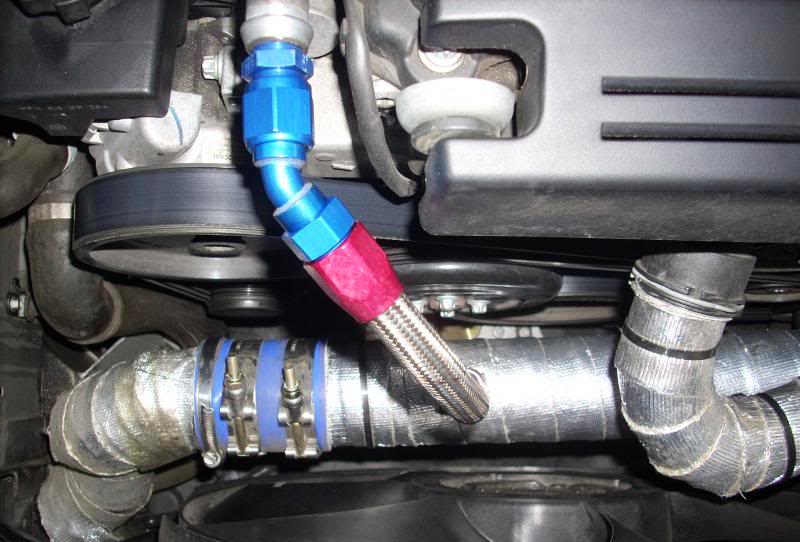
photo credit TEAMREDLINE
Trending Topics
Super Moderator
Joined: Jul 2006
Posts: 3,365
Likes: 12
From: Orange County, CA
GMC - Miata - Trek - P-Car
None of which I'm aware.
Have you decided with what you’re replacing its OE resonator/muffler and junctions?
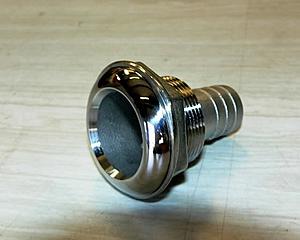
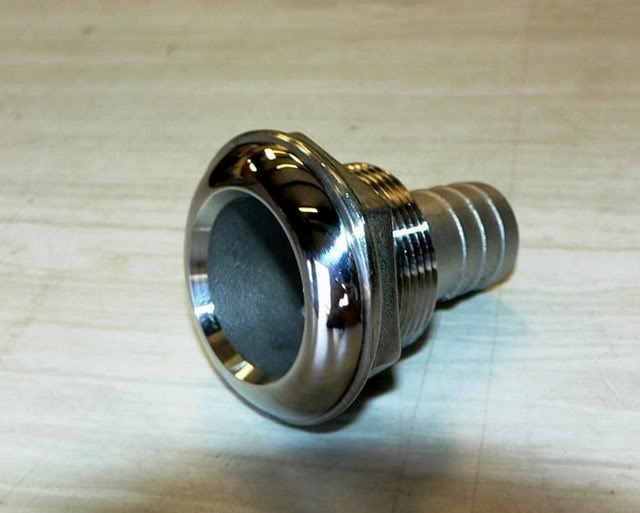
Perhaps you’ll consider using a similar bulkhead fitting (properly sealed and pressure tested) to reconnect the AIR tube:
Have you decided with what you’re replacing its OE resonator/muffler and junctions?
Perhaps you’ll consider using a similar bulkhead fitting (properly sealed and pressure tested) to reconnect the AIR tube:
MB World Stories
The Best of Mercedes & AMG

Manual Mercedes? 6 Times Sindelfingen Let Drivers Have All The Fun
Verdad Gallardo
Mercedes SLR McLaren 722 S Is Extremely Rare Example Modified by McLaren
Verdad Gallardo
8 Classic Boxy Mercedes Designs That Have Aged Like Fine Wine
Verdad Gallardo
Flawlessly Restored Mercedes 190E Evo II Heads to Auction
Verdad Gallardo
Electric Mercedes C-Class Unveiled: 11 Things You Need to Know
Verdad Gallardo
Mercedes EQS Gets A Major Update: Everything You Need to Know
Verdad Gallardo
5 Underrated Mercedes-Benz Models That Don't Get the Love They Deserve
Verdad Gallardo
Mercedes 300D Has Pushed Well Past 1 Million Miles and It Ain't Stopping
Verdad Gallardo
10 Most Reliable Mercedes-Benz Models You Can Buy Used
Verdad Gallardo
Newbie
Joined: Dec 2019
Posts: 3
Likes: 0
03 MB c230 Kompressor sport coupe
I think you mean P0410?
Yes, the hose must remain connected in order to avoid triggering a P0140 CEL.
It supplies pressurized air (not “ambient”) to the secondary air system.
Must be noted the M271 has no separate AIR pump as do the C’s other M111, 112, and 272 engines; its supercharger pulls double duty.
I regret the error.
Doesn’t require AN fittings and braided hose –the OE setup certainly didn’t need it when pumping ~ten pounds of boost-
but here’s a functional example of another member having ditched his supercharger's resonator:
Attachment 408373
photo credit TEAMREDLINE
It supplies pressurized air (not “ambient”) to the secondary air system.
Must be noted the M271 has no separate AIR pump as do the C’s other M111, 112, and 272 engines; its supercharger pulls double duty.
I regret the error.
Doesn’t require AN fittings and braided hose –the OE setup certainly didn’t need it when pumping ~ten pounds of boost-
but here’s a functional example of another member having ditched his supercharger's resonator:
Attachment 408373
photo credit TEAMREDLINE


