




Bubbles in Continental Tires

Thread Starter
Junior Member
Joined: Jun 2006
Posts: 17
Likes: 0
From: Chevy Chase, MD
2012 E350 4Matic
Bubbles in Continental Tires
I lease a 2009 C300 4Matic. I replaced the R/F tire in January of 2009 due to a sidewall bubble. I then replaced the same tire in July of 2010 for the same reason. I had a road hazard claim that reduced the price of the tire by 50%. In February of 2010 I had to replace the L/R tire and the same tire again in November. Now I have bubbles on the sidewall of both front tires. I live in Washington, DC which has its share of potholes. At the same time I have been driving for about 40 years and have never had so many tire problems as I have had with this car. My driving hasn't changed. The car has only 31,000 miles on it. I don't drive much.
I understand that the OEM Continental Tires are low profile. Does this contribute to the issues I have been seeing. I plan to take the car to the dealer tomorrow to replace the two front tires again. Would another brand of tire serve me better?
Finally, my lease is up in August of 2012 and I am not sure I want another C300 if I will continue to face tire issues like these.
I understand that the OEM Continental Tires are low profile. Does this contribute to the issues I have been seeing. I plan to take the car to the dealer tomorrow to replace the two front tires again. Would another brand of tire serve me better?
Finally, my lease is up in August of 2012 and I am not sure I want another C300 if I will continue to face tire issues like these.

MBWorld Fanatic!
Joined: Jan 2009
Posts: 5,113
Likes: 57
From: Southwest USA
Another round of ICE
It's not the car...it's the tires. You could buy another brand of car, and if they source to Conti for OE applications, you could wind up with very similar tires again. The problem is not inherent in low profile tires, but has come up with those Contis. Don't give up on the car...go get a set of Michelin Pilot Sport A/S Plus and experience the difference. Up to this point, the analogy is you've been walking around in a tuxedo, but with flip-flop sandals.
P.S.: Price them out on tirerack.com, and as you are in a hurry, print out the quote and take it to the local Discount Tire or similar near you. They will likely price match, including the shipping charge.
P.S.: Price them out on tirerack.com, and as you are in a hurry, print out the quote and take it to the local Discount Tire or similar near you. They will likely price match, including the shipping charge.
Last edited by Sportstick; Dec 26, 2011 at 03:23 PM.

MBWorld Fanatic!
Joined: Nov 2007
Posts: 2,078
Likes: 4
From: NYC
2012 C300 4Matic
+1 for Sportstick
Those Conti's are unbelievably poor tires.
They really are not road worthy and should not even be legal. I still have them on my new C and absolutely hate them - they don't even have good traction compared to the Good Years that I had on my last C. They're downright dangerous.
We went through 4 of these "tires" on our E class before finally replacing them with actual tires. Disgusting garbage.
Someone please add this as reason #192345 why MBUSAs entire management staff should be promptly fired. ...out of a canon and into the deep sea. I wouldn't put a Continental tire on my wheel barrow.
I wonder if the dealer would play ball if you negotiated your entire lease and then insisted they swap the Contis for actual tires before you would accept the deal? I wish I'd had the foresight to try that myself...
Those Conti's are unbelievably poor tires.
They really are not road worthy and should not even be legal. I still have them on my new C and absolutely hate them - they don't even have good traction compared to the Good Years that I had on my last C. They're downright dangerous.
We went through 4 of these "tires" on our E class before finally replacing them with actual tires. Disgusting garbage.
Someone please add this as reason #192345 why MBUSAs entire management staff should be promptly fired. ...out of a canon and into the deep sea. I wouldn't put a Continental tire on my wheel barrow.
I wonder if the dealer would play ball if you negotiated your entire lease and then insisted they swap the Contis for actual tires before you would accept the deal? I wish I'd had the foresight to try that myself...
Last edited by acr2001; Dec 26, 2011 at 03:58 PM.
MBWorld Fanatic!
Joined: Jan 2009
Posts: 5,113
Likes: 57
From: Southwest USA
Another round of ICE
That is a possible strategy. A BMW dealer was prepared to do that for me on a 3 series when I realized it was hampered by run flats. That almost made the deal work until I learned that those fools also deleted any space to place a minispare that I bought on my own, without using the trunk. That was two days before I bought my C Class.
MBWorld Fanatic!
Joined: Jan 2009
Posts: 5,113
Likes: 57
From: Southwest USA
Another round of ICE
* OK....real tech reason....you want similar levels of traction and handling capability at all four corners. With the Michelins grabbing very well up front in relationship to the Contis, you would be creating a potential oversteer condition, where the front of the car responds to steering input, and the rear starts to slide, unable to keep up with what the Michelins handled easily, especially in the rain. You don't need that kind of an event added to your day.
Trending Topics
MB World Stories
The Best of Mercedes & AMG

Manual Mercedes? 6 Times Sindelfingen Let Drivers Have All The Fun
Verdad Gallardo
Mercedes SLR McLaren 722 S Is Extremely Rare Example Modified by McLaren
Verdad Gallardo
8 Classic Boxy Mercedes Designs That Have Aged Like Fine Wine
Verdad Gallardo
Flawlessly Restored Mercedes 190E Evo II Heads to Auction
Verdad Gallardo
Electric Mercedes C-Class Unveiled: 11 Things You Need to Know
Verdad Gallardo
Mercedes EQS Gets A Major Update: Everything You Need to Know
Verdad Gallardo
5 Underrated Mercedes-Benz Models That Don't Get the Love They Deserve
Verdad Gallardo
Mercedes 300D Has Pushed Well Past 1 Million Miles and It Ain't Stopping
Verdad Gallardo
10 Most Reliable Mercedes-Benz Models You Can Buy Used
Verdad Gallardo
MBWorld Fanatic!
Joined: Oct 2009
Posts: 2,071
Likes: 20
Nissan GT-R BE / '12 Ducati-1199 Panigale S / '12 C300-4M Loaded/GLK350-4M Loaded
A Must Read
^ Yup! 
A must read!...http://www.consumeraffairs.com/tires/continental.html
Have fun.... it gets better as you go down the list....
A must read!...http://www.consumeraffairs.com/tires/continental.html
Have fun.... it gets better as you go down the list....
MBWorld Fanatic!
Joined: Jan 2009
Posts: 5,113
Likes: 57
From: Southwest USA
Another round of ICE
Swap them onto your next new C Class. That way, you will have fresh tires on your lease turn-in and won't get dinged for old tires with insufficient tread remaining. I'm 2.5 years into my Pilot Sports, and they are doing fine, so you are correct, it would be a shame to let them go, and they will be better than whatever comes on your 2012/13 model. Make the swap part of the deal for the next car, with no added cost for labor. They should be pleased to accommodate you.
MBWorld Fanatic!
Joined: Mar 2008
Posts: 3,714
Likes: 56
From: 1 hours drive north of Sydney Australia
2007 W204 220CDI Classic Sedan
In my experience the lower the profile of the tyre, the greater chance of tyre , wheel & early suspension wear/damage.
Fashion has gone beyond common sense.
I will not use tyres less than 55 profile on these cars as the ride becomes compromised.
In your case ,only having the car for another 8 months ,I would buy a couple of know tough cheaper tyres & drive accordingly.
Just another opinion.!!
Fashion has gone beyond common sense.
I will not use tyres less than 55 profile on these cars as the ride becomes compromised.
In your case ,only having the car for another 8 months ,I would buy a couple of know tough cheaper tyres & drive accordingly.
Just another opinion.!!

Senior Member
Joined: Feb 2011
Posts: 465
Likes: 16
C204
I would advise you to inflate the tires more than usual - I usually do 2.9-3.0 bars (the recommended values for full car and top speed). This way, the chance to get bubbles will be much lower. Actually, I have never had any bubbles on my Continental tires... but I also do my best to go easy over the potholes 
Last edited by dol4er; Dec 26, 2011 at 05:33 PM.
MBWorld Fanatic!
Joined: Mar 2008
Posts: 3,714
Likes: 56
From: 1 hours drive north of Sydney Australia
2007 W204 220CDI Classic Sedan
I would advise you to inflate the tires more than usual - I usually do 2.9-3.0 bars (the recommended values for full car and top speed). This way, the chance to get bubbles will be much lower. Actually, I have never had any bubbles on my Continental tires... but I also do my best to go easy over the potholes

Senior Member
Joined: Aug 2008
Posts: 436
Likes: 2
From: British Columbia
2011 E350 4 Matic
^ Yup!
A must read!...http://www.consumeraffairs.com/tires/continental.html
Have fun.... it gets better as you go down the list....
A must read!...http://www.consumeraffairs.com/tires/continental.html
Have fun.... it gets better as you go down the list....
Not sure if it boils down to cost because it sure could ruin their reputation

Junior Member
Joined: Jul 2011
Posts: 48
Likes: 0
C300 sport 4matic
Glancing down the list of complaints, it looks like the issue is largely the ContiProContacts. The Continental DWS and DW tires get excellent reviews and I've seen good reviews of some of their winter performance tires. I switched from the ContiProContact (was hydroplaning all over the place on those death traps) to the DWS and could not be happier with the DWS. I also wonder if the complaints need to be taken with a grain of salt to some extent - the average person has no clue that tires need to be kept inflated properly.
MBWorld Fanatic!
Joined: Mar 2008
Posts: 3,714
Likes: 56
From: 1 hours drive north of Sydney Australia
2007 W204 220CDI Classic Sedan


Member
Joined: Nov 2011
Posts: 153
Likes: 0
From: Toronto, Canada
2008 C300 6speed, 2015 GLK 250 2017 E400 wagon
The Conti's for some W204, are JUNK! If your staggered the front tires go junk fast. Who ever got michelin's your lucky! Even some E-class w212 come with Pro Contact and others Sport Contact 3's Also Junk. Disapointed With Benz's choice of tires. Makes Goodyear RSA (another big oem tire) Look Good.
Last edited by DonjuanOriginal; Dec 28, 2011 at 09:42 PM.


MBWorld Fanatic!


Joined: Jun 2005
Posts: 1,511
Likes: 267
From: Chicago
2025 AMG E 53; 2018 GLC300 4Matic; 2003 360 Modena
Read the reviews on the tires rated at tirerack.com and almost all have a list of compliments and complaints. This post is awfully subjective in that what's being discussed is hitting a pot hole with a low profile tire. The mileage and brand mean nothing - if you're going to whack a nice pot hole with a low profile tire - you're going to bubble the tire and probably bend the rim. Simple as that.
MBWorld Fanatic!
Joined: Oct 2009
Posts: 2,071
Likes: 20
Nissan GT-R BE / '12 Ducati-1199 Panigale S / '12 C300-4M Loaded/GLK350-4M Loaded
The Following Text Is From The Tire-Rack:
Sidewall Bubbles
"Pneumatic tires are made of specialized rubber compounds reinforced by plies of fabric cords and metal wires. While most rubber compounds can be stretched easily, the underlying fabric cords and steel wires actually define the tire's shape by limiting stretching. In order to bond these dissimilar materials, the cords and wires are coated with adhesives and/or rubber before the other components are bonded to them during curing.
A strong bond between these various components is necessary to provide the desired durability. However the strength of the bond can be reduced if 1) any of the components are contaminated during manufacturing (resulting in incomplete bonding), or 2) components are damaged in service due to use while overloaded/underinflated, or by impact with potholes, curbs or other road hazards that pinch the tire between the rim and the road, or simply stretch the rubber beyond the elastic limit of the underlying cords and wires.
Past experience indicates that a sidewall separation/bubble caused by component contamination or incomplete bonding during manufacturing will appear within the first six months of service. Fortunately these separations/bubbles typically appear when they are small in size and before the tire's strength is substantially reduced. However since typical tires roll about 800 times every mile and the air pressure inside the tire is greater than outside, tire separations/bubbles that are unseen or ignored will continue to grow in size, further reduce strength, often generate noise and vibration, and ultimately lead to tire failure as the tire stretches under load (similar to the way that continuously bending a paperclip back and forth will cause it to weaken and break).
However there is one last thing to remember; while a separation/bubble early in a tire's life is usually associated with a manufacturing condition, even a single, significant impact with a deep pothole or sharp curb can cause a new tire and wheel to be damaged.
If the sidewall separation/bubble appears after six months of on-vehicle service, prolonged driving on overloaded/underinflated tires or a road hazard are the most likely causes.
However it may take weeks or months after an impact for a separation/bubble to appear as the damaged or bruised area continues to weaken. Unfortunately the time differential between the impact that caused the initial damage and the delayed appearance of visible evidence often means that the driver has forgotten about the impact that damaged the tire in the first place.
The varieties of possible causes make it necessary to inspect the tire while mounted on the wheel (sometimes the wheel will show impact damage adjacent to the separation/bubble), as well as to dismount the tire and inspect the condition of its innerliner thoroughly. Sometimes it is necessary to return a tire to the manufacturer's inspection center where it can be dissected before the actual cause can be determined.
While taller profile tires can be damaged by the more severe impacts with deeper potholes and sharper curbs, low profile tires mounted on large diameter wheels are the most susceptible to this type of damage. The driver of vehicles equipped with low profile tires should make special efforts to avoid potholes, curbs or other road hazards."
_______________________________________________
Please Note: Okay we all know that we should avoid potholes and running over curbs, but if you live in a huge city, or one that has limited resources to repair its roads, sometimes this is impossible. The key point of this TireRack story is that a tire could be defective when new, that the adhesives weren't properly cured and the tire is prone to damage even with the slightest bump in the road. So it stands to reason that if Conti has had the most complaints about sidewall bubbles than many of their competitors, then they must be doing something wrong.
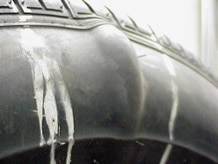
The story below is also from TireRack. What's interesting here is that they clearly explain that if you have a vertical indentation or ridge ( and not a bulge or bubble) that runs from the bead to the tread, that condition is typically made during the manufacturing process and is considered normal. But if you have what's seen in the picture below, (a protrusion) then the tire is DEFECTIVE and should be taken OUT OF SERVICE.
This has happened to me and many of my customers over the years. So TireRack is admitting that brand new mounted tires could indeed be defective right out of the box!
_______________________________________________
 Fig. A: Vertical bulge on sidewall from rim to tread.
Sidewall Indentations, Undulations and Protrusions
"It is not unusual to find subtle indentations in the sidewalls of radial ply tires. Fortunately they are a visual condition that will not affect the performance of the tires.
Sidewall indentations (also referred to as sidewall "undulations") are a common characteristic of tire construction on almost all radial tires. These indentations are more noticeable in larger tires with taller sidewalls, as well as tires that operate at higher inflation pressures.
Tires are reinforced by encasing individual fabric cords (typically polyester or rayon) in rubber. Radial ply tires feature one or more layers of cord (depending on the tire's required strength) that basically run parallel to each other from bead to bead (with each individual cord running up the sidewall, across the tread and down the other sidewall). Because of their "straight across" direction, the overlap where the sidewall cords are lap-spliced may sometimes cause a slight indentation.
When the tire is being cured, it is pressed against its metal mold. However when the tire is mounted on a wheel and inflated to typical air pressures, it is free to naturally expand. These overlapping splices may create slight indentations since the stretching capacity of the lap-splices is slightly less than the rest of the body ply material because the splices are the most reinforced area of the tire's sidewall. Since radial tires feature steel cord reinforcing belts under their treads to keep them flat, indentations only appears on the sidewalls.
However, if protruding bulges, as shown in Fig. A (photo provided by a customer), rather than indentations appear on the sidewall of a recently installed tire, it reveals that there is an undesirable gap between some of the body ply cords inside the tire. The tire should be removed from service and replaced under the tire manufacturer's defects in materials and workmanship warranty.
If a protruding bulge doesn't appear until later in the tire's life, it was usually caused by a road hazard when the cord was injured as the tire struck a pothole, curb or object in the road.
__________________________________________
So based on my many years of experience.. the bottom line is this... tires can be defective, and potholes can make them worse. Another words, they were weak to begin with and were made worse by driving over severe roadways. Better made tires (read as more expensive) will resist road hazard damage better than a cheap tire will. If you see a bulge in the sidewall running from the tread to the bead in a NEW tire, it's defective and needs to be taken out of service immediately.
If you see an indentation in the sidewall of a New Tire (there are no pictures of this, sorry) this is considered normal manufacturing belt overlap.
Hope this helps...
Sidewall Bubbles
"Pneumatic tires are made of specialized rubber compounds reinforced by plies of fabric cords and metal wires. While most rubber compounds can be stretched easily, the underlying fabric cords and steel wires actually define the tire's shape by limiting stretching. In order to bond these dissimilar materials, the cords and wires are coated with adhesives and/or rubber before the other components are bonded to them during curing.
A strong bond between these various components is necessary to provide the desired durability. However the strength of the bond can be reduced if 1) any of the components are contaminated during manufacturing (resulting in incomplete bonding), or 2) components are damaged in service due to use while overloaded/underinflated, or by impact with potholes, curbs or other road hazards that pinch the tire between the rim and the road, or simply stretch the rubber beyond the elastic limit of the underlying cords and wires.
Past experience indicates that a sidewall separation/bubble caused by component contamination or incomplete bonding during manufacturing will appear within the first six months of service. Fortunately these separations/bubbles typically appear when they are small in size and before the tire's strength is substantially reduced. However since typical tires roll about 800 times every mile and the air pressure inside the tire is greater than outside, tire separations/bubbles that are unseen or ignored will continue to grow in size, further reduce strength, often generate noise and vibration, and ultimately lead to tire failure as the tire stretches under load (similar to the way that continuously bending a paperclip back and forth will cause it to weaken and break).
However there is one last thing to remember; while a separation/bubble early in a tire's life is usually associated with a manufacturing condition, even a single, significant impact with a deep pothole or sharp curb can cause a new tire and wheel to be damaged.
If the sidewall separation/bubble appears after six months of on-vehicle service, prolonged driving on overloaded/underinflated tires or a road hazard are the most likely causes.
However it may take weeks or months after an impact for a separation/bubble to appear as the damaged or bruised area continues to weaken. Unfortunately the time differential between the impact that caused the initial damage and the delayed appearance of visible evidence often means that the driver has forgotten about the impact that damaged the tire in the first place.
The varieties of possible causes make it necessary to inspect the tire while mounted on the wheel (sometimes the wheel will show impact damage adjacent to the separation/bubble), as well as to dismount the tire and inspect the condition of its innerliner thoroughly. Sometimes it is necessary to return a tire to the manufacturer's inspection center where it can be dissected before the actual cause can be determined.
While taller profile tires can be damaged by the more severe impacts with deeper potholes and sharper curbs, low profile tires mounted on large diameter wheels are the most susceptible to this type of damage. The driver of vehicles equipped with low profile tires should make special efforts to avoid potholes, curbs or other road hazards."
_______________________________________________
Please Note: Okay we all know that we should avoid potholes and running over curbs, but if you live in a huge city, or one that has limited resources to repair its roads, sometimes this is impossible. The key point of this TireRack story is that a tire could be defective when new, that the adhesives weren't properly cured and the tire is prone to damage even with the slightest bump in the road. So it stands to reason that if Conti has had the most complaints about sidewall bubbles than many of their competitors, then they must be doing something wrong.
The story below is also from TireRack. What's interesting here is that they clearly explain that if you have a vertical indentation or ridge ( and not a bulge or bubble) that runs from the bead to the tread, that condition is typically made during the manufacturing process and is considered normal. But if you have what's seen in the picture below, (a protrusion) then the tire is DEFECTIVE and should be taken OUT OF SERVICE.
This has happened to me and many of my customers over the years. So TireRack is admitting that brand new mounted tires could indeed be defective right out of the box!
_______________________________________________
Fig. A: Vertical bulge on sidewall from rim to tread.Sidewall Indentations, Undulations and Protrusions
"It is not unusual to find subtle indentations in the sidewalls of radial ply tires. Fortunately they are a visual condition that will not affect the performance of the tires.
Sidewall indentations (also referred to as sidewall "undulations") are a common characteristic of tire construction on almost all radial tires. These indentations are more noticeable in larger tires with taller sidewalls, as well as tires that operate at higher inflation pressures.
Tires are reinforced by encasing individual fabric cords (typically polyester or rayon) in rubber. Radial ply tires feature one or more layers of cord (depending on the tire's required strength) that basically run parallel to each other from bead to bead (with each individual cord running up the sidewall, across the tread and down the other sidewall). Because of their "straight across" direction, the overlap where the sidewall cords are lap-spliced may sometimes cause a slight indentation.
When the tire is being cured, it is pressed against its metal mold. However when the tire is mounted on a wheel and inflated to typical air pressures, it is free to naturally expand. These overlapping splices may create slight indentations since the stretching capacity of the lap-splices is slightly less than the rest of the body ply material because the splices are the most reinforced area of the tire's sidewall. Since radial tires feature steel cord reinforcing belts under their treads to keep them flat, indentations only appears on the sidewalls.
However, if protruding bulges, as shown in Fig. A (photo provided by a customer), rather than indentations appear on the sidewall of a recently installed tire, it reveals that there is an undesirable gap between some of the body ply cords inside the tire. The tire should be removed from service and replaced under the tire manufacturer's defects in materials and workmanship warranty.
If a protruding bulge doesn't appear until later in the tire's life, it was usually caused by a road hazard when the cord was injured as the tire struck a pothole, curb or object in the road.
__________________________________________
So based on my many years of experience.. the bottom line is this... tires can be defective, and potholes can make them worse. Another words, they were weak to begin with and were made worse by driving over severe roadways. Better made tires (read as more expensive) will resist road hazard damage better than a cheap tire will. If you see a bulge in the sidewall running from the tread to the bead in a NEW tire, it's defective and needs to be taken out of service immediately.
If you see an indentation in the sidewall of a New Tire (there are no pictures of this, sorry) this is considered normal manufacturing belt overlap.
Hope this helps...
Last edited by MBRedux; Dec 30, 2011 at 01:27 AM.

Newbie
Joined: Aug 2015
Posts: 5
Likes: 0
MB CLS550, MB ML350, LEXUS RX350, LEXUS SC430, LEXUS GX460, LEXUSGX470
Here's my experience. It appears that sidewall bubbles (that is, failures) with Continental Tires (e.g., ProContact, etc.) are a known problem that both MB and Continental ignores. I had a 2012 CLS with about 5000 miles and no rim damage. A very large bubble developed. The dealership curtly denied the claim (claiming "road hazzard"). I explained that normal wear and tear on a car subjects it to cement cracks, pot holes, etc. And here there was no rim damage. I was so irritated, I left the car at the dealership and terminated the lease, bringing an arbitration claim which is now pending against MB. I welcome anyone with bubbles on their Continental Tires to contact me. sfeldman@feldlaw.com.
To make matters worse, I then bought another CLS550 (2015) and the same thing happened at 300 miles. The dealership denied the warranty claim. I amended the arbitration demand to include this matter as well. I checked out the Continental ProContact tire at a couple of tire stores; the response was that Continental tires have known failures on their side walls. Apparently, its construction relative to other tires makes the tire susceptible to bubbles/failures. Where I come from, we call this a manufacturing defect.
The bottom line is both Continental and MB is putting poor products into the market place. I'm back to Lexus for my next car. In twenty years of dealing with Lexus, I've next had such poor service and the failure of the manufacturer to stand behind the product. Autonation/MB Greenway in Houston has convinced me to go elsewhere.
To make matters worse, I then bought another CLS550 (2015) and the same thing happened at 300 miles. The dealership denied the warranty claim. I amended the arbitration demand to include this matter as well. I checked out the Continental ProContact tire at a couple of tire stores; the response was that Continental tires have known failures on their side walls. Apparently, its construction relative to other tires makes the tire susceptible to bubbles/failures. Where I come from, we call this a manufacturing defect.
The bottom line is both Continental and MB is putting poor products into the market place. I'm back to Lexus for my next car. In twenty years of dealing with Lexus, I've next had such poor service and the failure of the manufacturer to stand behind the product. Autonation/MB Greenway in Houston has convinced me to go elsewhere.


