







Rotate Directional Tires Side to side?

Thread Starter
Super Member


Joined: Dec 2007
Posts: 846
Likes: 45
From: ATL
2017 GLS 550
Rotate Directional Tires Side to side?
Just wanted to see if anyone has rotated tires Side to side? I am running directional PS02s, so I know they would have to remounted to run correctly on the opposite side, but I figure it has to help with tire life. my fronts have about 25K miles on them and the outside 3/4 of the tire have tons of tread life left but the inside 1/4 is worn to the belts. I figure next set I put on I will have rotated every 5K. my tire shop only charges me $10/tire to mount and balance. I just wanted to see if there would be any ill affects since the Belts got seated in on the other side.

Newbie
Joined: Jun 2012
Posts: 6
Likes: 0
2005 C55
I think he means running a directional tire the wrong direction. The arrow indicates that the tire should only rotate in a particular direction and by rotating it to the other side of the car, you would increase the chance of failure. I would advise against it but i am by no means an expert.
I purchased my C-55 from a dealer and both front tires were running against the directional arrows.
I purchased my C-55 from a dealer and both front tires were running against the directional arrows.

Member
Joined: Jun 2008
Posts: 154
Likes: 11
From: Phx, AZ
N/A
I cross rotate my front and rear tires every 5k miles, my tires are non-directional and helps increase tire life (especially the rear) and reduces feathering/cupping on the outside edge of the front tires.
I would not recommend using any tires that are down to the belts that's just dangerous.
I would not recommend using any tires that are down to the belts that's just dangerous.
Trending Topics
Thread Starter
Super Member
Joined: Dec 2007
Posts: 846
Likes: 45
From: ATL
2017 GLS 550
Obviously dont rotate tires showing belts that is why i said next set that i put on. Going to have the new ones taken off the rims at 10k miles and have them mounted in correct direction on opposite side.
Last edited by thtguy; Mar 7, 2013 at 10:41 PM.
MB World Stories
The Best of Mercedes & AMG

Manual Mercedes? 6 Times Sindelfingen Let Drivers Have All The Fun
Verdad Gallardo
Mercedes SLR McLaren 722 S Is Extremely Rare Example Modified by McLaren
Verdad Gallardo
8 Classic Boxy Mercedes Designs That Have Aged Like Fine Wine
Verdad Gallardo
Flawlessly Restored Mercedes 190E Evo II Heads to Auction
Verdad Gallardo
Electric Mercedes C-Class Unveiled: 11 Things You Need to Know
Verdad Gallardo
Mercedes EQS Gets A Major Update: Everything You Need to Know
Verdad Gallardo
5 Underrated Mercedes-Benz Models That Don't Get the Love They Deserve
Verdad Gallardo
Mercedes 300D Has Pushed Well Past 1 Million Miles and It Ain't Stopping
Verdad Gallardo
10 Most Reliable Mercedes-Benz Models You Can Buy Used
Verdad Gallardo
Super Member
Joined: Jun 2010
Posts: 771
Likes: 2
'05 C55 AMG
Maybe I'm missing something, but how does rotating tires side to side help at all? Assuming you have a proper alignment, the opposite sides should wear exactly the same..
Last edited by pww; Mar 10, 2013 at 09:05 PM.

MBWorld Fanatic!
Joined: Sep 2008
Posts: 1,660
Likes: 21
From: Orange County
a land yacht.
Super Member
Joined: Jun 2010
Posts: 771
Likes: 2
'05 C55 AMG
Are we speaking pulling the tires off the wheels and placing them on the other side? Or simply pulling off the wheels and tires and swapping sides? If you do the latter, the same portion of the tire is being worn. And if you're not, there's no need to swap sides. You could pull off the tire and mount it the opposite way on the same wheel/side.
Essentially what I'm saying is for rotating side to side to work, you have to pull the tires off the wheels and remount them.
Last edited by pww; Mar 12, 2013 at 05:35 PM.

Super Member
Joined: Aug 2007
Posts: 876
Likes: 81
From: Phoenix AZ & Cayucos CA
’27 AMG SL55(ordered), ‘23 EQS 580 SUV, ‘19 AMG E53 Cpe, ‘48 Willys Jeepster
Our old '88 BMW M5 came originally with directional Pirelli P700 tires. There was a sticker over the spare that said something to the affect that reversing the tread direction would cause a minor loss in performance. Apparently it wasn't fatal.
Member
Joined: Jun 2008
Posts: 154
Likes: 11
From: Phx, AZ
N/A
Because of cars camber set up and staggered wheels you can have one of three things happen being we cant rotate our tires because their staggered.
Assuming factory wheels, staggered, ride height and alignment. (will differ if modified)
1. uneven tire wear - some tires will wear faster
2. cupping - can create road noise
3. feathering - can create road noise
Swapping the tires helps extend the tire life and also reverses the "cupping" or "feathering" effect which creates road noise.
Using Directional Tires (remove tires from rim and swap tires from side to side in correct rotational direction)
Using Non-Directional Tires (swap rims from side to side do not remove tires)
From experience and using this method my tires typically last 30k-40k miles on my Mercedes instead of the typical 10k-15k, I have done this now on 5 sets of tires with repeated proven success in 2 different Mercedes vehicles I've owned.
Rear tires will wear on the inside (especially rear right primary drive wheel) swapping on a regular 5k interval will help extend the tire life and wear the tires more evenly. Swapping reverses the "cupping" or "feathering" effect on non-directional tires.
Front tires wear on the outside edge or sometimes inside edge (usually right front) typically this is the wheel you will notice the most road noise due to "cupping" or "feathering" effect. Swapping reverses the "cupping" or "feathering" effect on non-directional tires.
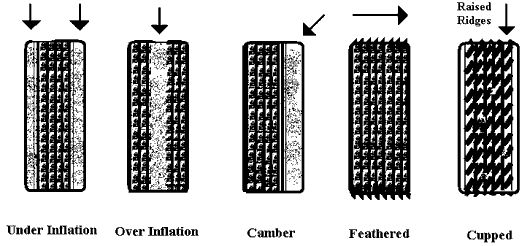
Cupping - Cupping is when tires have indentations in them. Cupping is caused by worse than normal wear, tear and pressure on the surface of the tire that takes small pieces and sections of the tires surface off. The remaining spots are smoothed during driving so they're called "cupping" as opposed to "chipping." Cupping may be referred to by some professionals as "scalloping." Look for indentations and an uneven surface that resembles "scallops" in the tread of the tire, where a driver should expect to see a smooth surface. You also might notice a slight rumbling sound as the vehicle moves. This sound most likely comes from the cupped spots on the tires.

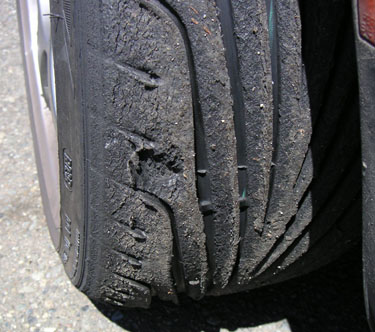
Feathering - Feathered tires can often be detected by the eye, but it's always easier to feel the damage by running your hand over the surface of the tire. Feathering occurs when the tire's tread ribs have rounded edges on one side and sharp ones on the other. One side of the tire is clearly more worn than the other, and the ribs are not as pronounced.
Assuming factory wheels, staggered, ride height and alignment. (will differ if modified)
1. uneven tire wear - some tires will wear faster
2. cupping - can create road noise
3. feathering - can create road noise
Swapping the tires helps extend the tire life and also reverses the "cupping" or "feathering" effect which creates road noise.
Using Directional Tires (remove tires from rim and swap tires from side to side in correct rotational direction)
Using Non-Directional Tires (swap rims from side to side do not remove tires)
From experience and using this method my tires typically last 30k-40k miles on my Mercedes instead of the typical 10k-15k, I have done this now on 5 sets of tires with repeated proven success in 2 different Mercedes vehicles I've owned.
Rear tires will wear on the inside (especially rear right primary drive wheel) swapping on a regular 5k interval will help extend the tire life and wear the tires more evenly. Swapping reverses the "cupping" or "feathering" effect on non-directional tires.
Front tires wear on the outside edge or sometimes inside edge (usually right front) typically this is the wheel you will notice the most road noise due to "cupping" or "feathering" effect. Swapping reverses the "cupping" or "feathering" effect on non-directional tires.
Cupping - Cupping is when tires have indentations in them. Cupping is caused by worse than normal wear, tear and pressure on the surface of the tire that takes small pieces and sections of the tires surface off. The remaining spots are smoothed during driving so they're called "cupping" as opposed to "chipping." Cupping may be referred to by some professionals as "scalloping." Look for indentations and an uneven surface that resembles "scallops" in the tread of the tire, where a driver should expect to see a smooth surface. You also might notice a slight rumbling sound as the vehicle moves. This sound most likely comes from the cupped spots on the tires.
Feathering - Feathered tires can often be detected by the eye, but it's always easier to feel the damage by running your hand over the surface of the tire. Feathering occurs when the tire's tread ribs have rounded edges on one side and sharp ones on the other. One side of the tire is clearly more worn than the other, and the ribs are not as pronounced.


