



SOLVED: CODE P0327 - Knock Sensor Bank 1 Circuit Low Input

Thread Starter
Super Member
Joined: Aug 2009
Posts: 998
Likes: 70
From: Oakland
W210 DRFT BNZ
SOLVED: CODE P0327 - Knock Sensor Bank 1 Circuit Low Input
This is most definitely applicable to other Mercedes as well.
Took pictures for all you guys. Hope someone finds this, uses this and saves themselves time and frustration. Not to mention spare knock sensors.
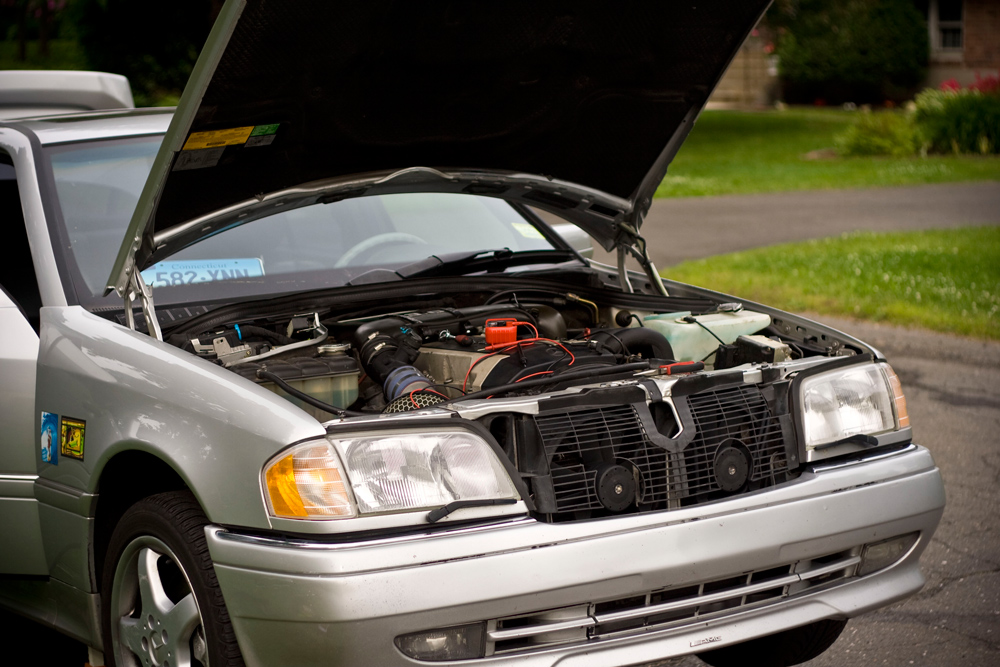
I have one of the cars originally equipped with a bio-degradable harness, which was switched out specifically as it was being acquired by the owner before me. In the car now is a completely proper silicone\rubber isolating harness.
After getting my ECU chipped with an improper IC that it didn't much enjoy, I had to revamp the entire engine electrically and inevitably moved the said harness around.
Following this the car would develop a returning code P0327. The Bentley manual isn't much help here, but if you google this code you will see that it is almost always the wiring that is the culprit. On the cheaper designed GM cars its usually corrosion, but the Mercs are blessed with military style electrical connectors, so I had the tendency to disregard this. Our cars come with Siemens KS001 piezo-electric sensor that are rather high quality/.
Well, after replacing both the knock sensors, nothing changed.
Exhibit A: Sensor input harness connector at the ECU
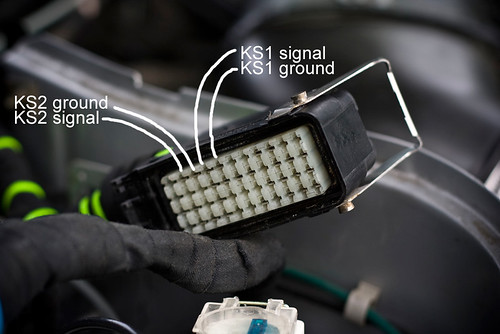
Exhibit B: Your best friend when owning an old German car
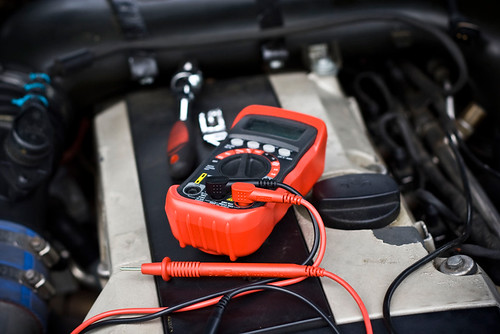
One of the knock sensors was straight up turning up a SHORT. Yes, near zero ohm resistance type short. So I got under the car an disconnected the knock sensors and yanked the harness from the top so I had access. Stuck both probes into the 2 terminals at the connector. No short.
What? All I did was move the damn thing a bit. Oh... wait. You've got to be kidding me. Move the insulator around the connector end *BEEP*. Eff my life.
Lets take a looksie, shall we:
Exhibit C: ****ty connector design
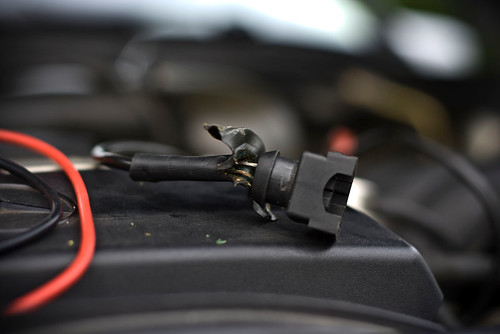
What you are looking at is bare wire. Mercedes rely on the two wires being GLUED to the opposite sides oft he insulator for them to not touch. Wow.
Exhibit D: Insulation removed
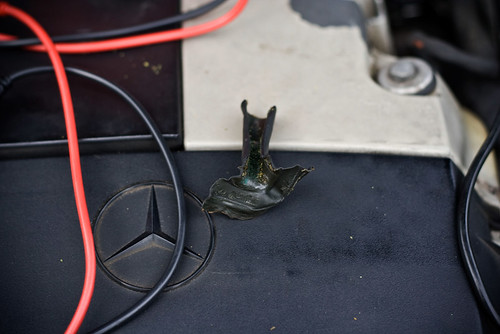
Exhibit E: Connector exposed
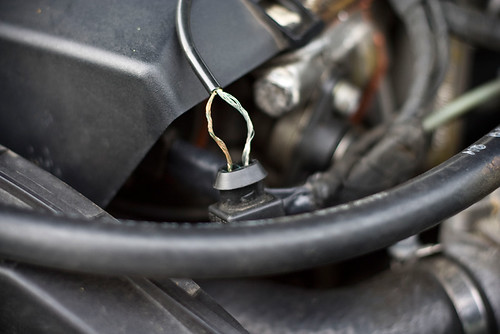
See that?! I **** you not, I didn't strip a single millimeter of that wire. That is how long the bare sections are under the insulation. Mercs use some sort of a whack phosphorus coating between the copper or something. That green stuff crumbles out of there and wires short right at where they exit the silicone insulation.
I tried a number of solutions and this is the best I could come up with: separate the two wires and shown in the image and put a generous dab of super glue or Gorilla glue right in between them. Then electrical tape wrap the two individually, then together, then ziptie the assembly in multiple places. Underhood temperatures are highly unlikely to exceed 150F and the electrical tape is required to be tested to 80C, so you should be good on that front. Just make sure to use zipties that can take the temperature drops.
High quality shots available in my flickr bin: http://www.flickr.com/photos/jumph4x/
Other things to know:
Took pictures for all you guys. Hope someone finds this, uses this and saves themselves time and frustration. Not to mention spare knock sensors.
I have one of the cars originally equipped with a bio-degradable harness, which was switched out specifically as it was being acquired by the owner before me. In the car now is a completely proper silicone\rubber isolating harness.
After getting my ECU chipped with an improper IC that it didn't much enjoy, I had to revamp the entire engine electrically and inevitably moved the said harness around.
Following this the car would develop a returning code P0327. The Bentley manual isn't much help here, but if you google this code you will see that it is almost always the wiring that is the culprit. On the cheaper designed GM cars its usually corrosion, but the Mercs are blessed with military style electrical connectors, so I had the tendency to disregard this. Our cars come with Siemens KS001 piezo-electric sensor that are rather high quality/.
Well, after replacing both the knock sensors, nothing changed.
Exhibit A: Sensor input harness connector at the ECU
Exhibit B: Your best friend when owning an old German car
One of the knock sensors was straight up turning up a SHORT. Yes, near zero ohm resistance type short. So I got under the car an disconnected the knock sensors and yanked the harness from the top so I had access. Stuck both probes into the 2 terminals at the connector. No short.
What? All I did was move the damn thing a bit. Oh... wait. You've got to be kidding me. Move the insulator around the connector end *BEEP*. Eff my life.
Lets take a looksie, shall we:
Exhibit C: ****ty connector design
What you are looking at is bare wire. Mercedes rely on the two wires being GLUED to the opposite sides oft he insulator for them to not touch. Wow.
Exhibit D: Insulation removed
Exhibit E: Connector exposed
See that?! I **** you not, I didn't strip a single millimeter of that wire. That is how long the bare sections are under the insulation. Mercs use some sort of a whack phosphorus coating between the copper or something. That green stuff crumbles out of there and wires short right at where they exit the silicone insulation.
I tried a number of solutions and this is the best I could come up with: separate the two wires and shown in the image and put a generous dab of super glue or Gorilla glue right in between them. Then electrical tape wrap the two individually, then together, then ziptie the assembly in multiple places. Underhood temperatures are highly unlikely to exceed 150F and the electrical tape is required to be tested to 80C, so you should be good on that front. Just make sure to use zipties that can take the temperature drops.
High quality shots available in my flickr bin: http://www.flickr.com/photos/jumph4x/
Other things to know:
- Work underneath the car, knock sensors are super accessible from the bottom
- The engine has multiple threaded holes, remember exactly the sensor locations
- Always use steel wool on the engine to clean that surface before reinstalling the sensor, it needs to be mirror flush
- 20 N-m is the torque rating on the bolts holding the sensors, don't overtighten
- Use anti-seize compound
- The military connector style is insulated with very soft\expensive silicone deep in the connector, theres no need to use any dielectric compound
- The size of the bolt on the sensors is 13mm
Last edited by jumph4x; May 23, 2010 at 03:11 PM.
Thread Starter
Super Member
Joined: Aug 2009
Posts: 998
Likes: 70
From: Oakland
W210 DRFT BNZ
This is pathetic though. I saw how its made and I'm not buying another one of these pieces of ****. I'll manually redo each terminal if I have to to get it straight.
This isnt the biodegradable one, so I'm keeping it.
This isnt the biodegradable one, so I'm keeping it.
Super Member

Joined: Oct 2008
Posts: 861
Likes: 3
From: Fairfield county, CT.
2004 Ran SRT-10,2007 S550,2016 E400c
Nice work... That what i said in yor last thread its very common for the ends to do that..
the insulation decinagrates and than they short out... Its more common on the coil connectors, and injector connectors but ive seen it happen on all the connectors...
Heat, vibration are main causes ......... Fix the pins your self , alot cheaper new harrness cost about 1 grand.
the insulation decinagrates and than they short out... Its more common on the coil connectors, and injector connectors but ive seen it happen on all the connectors...
Heat, vibration are main causes ......... Fix the pins your self , alot cheaper new harrness cost about 1 grand.
Trending Topics
MB World Stories
The Best of Mercedes & AMG

Manual Mercedes? 6 Times Sindelfingen Let Drivers Have All The Fun
Verdad Gallardo
Mercedes SLR McLaren 722 S Is Extremely Rare Example Modified by McLaren
Verdad Gallardo
8 Classic Boxy Mercedes Designs That Have Aged Like Fine Wine
Verdad Gallardo
Flawlessly Restored Mercedes 190E Evo II Heads to Auction
Verdad Gallardo
Electric Mercedes C-Class Unveiled: 11 Things You Need to Know
Verdad Gallardo
Mercedes EQS Gets A Major Update: Everything You Need to Know
Verdad Gallardo
5 Underrated Mercedes-Benz Models That Don't Get the Love They Deserve
Verdad Gallardo
Mercedes 300D Has Pushed Well Past 1 Million Miles and It Ain't Stopping
Verdad Gallardo
10 Most Reliable Mercedes-Benz Models You Can Buy Used
Verdad Gallardo
MBWorld Fanatic!
Joined: Feb 2007
Posts: 1,297
Likes: 1
From: Connecticut, New Haven
95' AMG SeeThreeSix
Happy ending!
That is just scary! Reminds me of my foglight connectors, I really wonder how many other "out-of-sight" connector wires are also prone to this. I suppose now when any codes come up it would be safe to check the harness going to that component thoroughly before buying the part.
Glad it all worked out and you've just donated some very valuable intel to the W202 community! Rated!
IM IN NEW HAVEN!
PS What kind of camera? Nice shots!
That is just scary! Reminds me of my foglight connectors, I really wonder how many other "out-of-sight" connector wires are also prone to this. I suppose now when any codes come up it would be safe to check the harness going to that component thoroughly before buying the part.
Glad it all worked out and you've just donated some very valuable intel to the W202 community! Rated!
IM IN NEW HAVEN!
PS What kind of camera? Nice shots!
Last edited by appatula; May 24, 2010 at 02:26 PM.
 Comparatively cheap Canon equipment: 350D body and the 1.8F 50mm prime.
Thread Starter
Super Member
Joined: Aug 2009
Posts: 998
Likes: 70
From: Oakland
W210 DRFT BNZ
Owner claimed he replaced the harness, but I'm no longer entirely sure about that. Perhaps he only replaced the squid going out to the engine?
Whatever the case, the whole thing is a piece of XXXX. I have more issues, this time on the ASR\CC\TB end of the harness. I am rebuilding this entire thing on my own.
Might be a little trickier than this: http://www.benzworld.org/forums/w140...oom-heres.html
Can't stand the electrical quality on this car. What a disaster.
Whatever the case, the whole thing is a piece of XXXX. I have more issues, this time on the ASR\CC\TB end of the harness. I am rebuilding this entire thing on my own.
Might be a little trickier than this: http://www.benzworld.org/forums/w140...oom-heres.html
Can't stand the electrical quality on this car. What a disaster.

MBWorld Fanatic!


Joined: Mar 2010
Posts: 5,890
Likes: 323
From: Land of mountains, cheese, chocolate and watches
12' W204 C63 AMG coupe "T-Rex", 12' W451 Smart Fortwo Pulse (99' W202 C43 AMG + Ultima Can-Am sold)
Checked out the thread on the other forum  TOTAL DISASTER, but an excellent job done to get it back up and running
TOTAL DISASTER, but an excellent job done to get it back up and running
Thread Starter
Super Member
Joined: Aug 2009
Posts: 998
Likes: 70
From: Oakland
W210 DRFT BNZ
Will document it for you guys with photos. Will take a little bit to do this properly. Heres what I estimate this might take if I take my time with it:
I am starting as soon as my Bimmer is back from the transmission revamp (currently in for clutch, pressure plate, slave cylinder and all that jazz).
- 1x evening to take it out
- 1x evening to do measurements, map colors and prepare the wire sections
- 1x evening to undo all connectors
- 1x evening of resoldering and re-wrapping
- [potentially] 1x evening to ring through the new loom with a multimeter going by the Bentley manual
- 1x evening to put it back in
I am starting as soon as my Bimmer is back from the transmission revamp (currently in for clutch, pressure plate, slave cylinder and all that jazz).
MBWorld Fanatic!
Joined: Mar 2010
Posts: 5,890
Likes: 323
From: Land of mountains, cheese, chocolate and watches
12' W204 C63 AMG coupe "T-Rex", 12' W451 Smart Fortwo Pulse (99' W202 C43 AMG + Ultima Can-Am sold)
Will document it for you guys with photos. Will take a little bit to do this properly. Heres what I estimate this might take if I take my time with it:
I am starting as soon as my Bimmer is back from the transmission revamp (currently in for clutch, pressure plate, slave cylinder and all that jazz).
- 1x evening to take it out
- 1x evening to do measurements, map colors and prepare the wire sections
- 1x evening to undo all connectors
- 1x evening of resoldering and re-wrapping
- [potentially] 1x evening to ring through the new loom with a multimeter going by the Bentley manual
- 1x evening to put it back in
I am starting as soon as my Bimmer is back from the transmission revamp (currently in for clutch, pressure plate, slave cylinder and all that jazz).
If this was done by a dealer, I can't imagine the final cost Was/is the C43 plagued by the same ills?

MBWorld Fanatic!


Joined: Apr 2005
Posts: 3,784
Likes: 84
From: SCV SoCal
2002 CLK430
The C43 was introduced in late 1997 and I have never heard of their having a bad harness.
MBWorld Fanatic!
Joined: Mar 2010
Posts: 5,890
Likes: 323
From: Land of mountains, cheese, chocolate and watches
12' W204 C63 AMG coupe "T-Rex", 12' W451 Smart Fortwo Pulse (99' W202 C43 AMG + Ultima Can-Am sold)
Good to know that the C43 is safe from this type of "cancer" 

Junior Member
Joined: Nov 2011
Posts: 66
Likes: 1
chevrolet z-71
Great write!! I am sorry not in the amg club but in the w202 club. I wish i could of found this thread earlier!! Not all my wiring is bad but most of the wires that hit certain connectors look like the above pics. I am currenttly trying to drive a 96 c280 with the m104 having same issues. Thanks again. And I hope this lil bump will help a few others!!!
MBWorld Fanatic!
Joined: Mar 2010
Posts: 5,890
Likes: 323
From: Land of mountains, cheese, chocolate and watches
12' W204 C63 AMG coupe "T-Rex", 12' W451 Smart Fortwo Pulse (99' W202 C43 AMG + Ultima Can-Am sold)
Both my fog light connectors looked like the photos before I fixed them. Luckily they worked and never shorted... So it looks like old age does also touches the 43


