When you click on links to various merchants on this site and make a purchase, this can result in this site earning a commission. Affiliate programs and affiliations include, but are not limited to, the eBay Partner Network.
So I would like to buy a front strut brace bar and look at if offered a rear.
I don't was cheap EBay but Renntech @$1000 each is a little excessive. Originally I was going to go with SMERC but their website has been down and I can't find a phone number anywhere, next was MB Arts I was really excited about the build quality on this one so
I ordered. The guys the next day said they are on hold from building these so he was calling to let me know plus days on order time. Next was MBH I went to their site, all I really saw headers and some other mods but nothing on strut braces. So I called, i go a Google voice voicemail but I never received a return call back. So my friends, what is left? I see the cheap $200 ones on EBay I don't want $1000 braces.
2012 P31 C63 Coupe Trackrat, 2019 GLE63S Coupe Beast
Hey Kriston, any chance to rethink and modify the design slightly for the next batch? Sadly, those look GREAT, but are little more than engine bay dress-up without firewall mounting points. Won't take that much work really to make them more useful... thanks for your thoughts.
Hi, Your car already has single point mounts to the firewall.
These strut bars were designed specifically for the strut towers. The engine bay is crowed as is. We wanted to retain 100% functionality / access of the Engine bay after install.
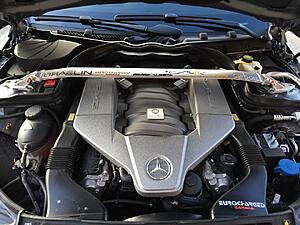
Here is a picture of it on my car.
Originally Posted by BLKROKT
Hey Kriston, any chance to rethink and modify the design slightly for the next batch? Sadly, those look GREAT, but are little more than engine bay dress-up without firewall mounting points. Won't take that much work really to make them more useful... thanks for your thoughts.
Hey Kriston, any chance to rethink and modify the design slightly for the next batch? Sadly, those look GREAT, but are little more than engine bay dress-up without firewall mounting points. Won't take that much work really to make them more useful... thanks for your thoughts.
Agreed 100%. Need somethign a lot sturdier and supported in more places in order for it to provide any potential benefit. Both of those are just eye candy, need to be removed when you want to change the air filters, and block access to the +12V boost connector.
The only one I've seen for the C63 that looked like it might actually provide some structural rigidity was a Renntech on a car with Florida plates at one of the Ontario meets (Intek?) a couple of years ago. And, the C63 doesn't really suffer from front chassis flex anyway. The double firewall certainly does a nice job of keeping it pretty stiff to begin with. I'd be more concerned with stiffening up the rear, in which case you'd lose the use of the trunk for starters...
I have no doubts that they are made from 6061 if you say so, and they are certainly beautifully finished. However, I guarantee you that if I simply push down on the middle of the bar with my hand, it would deflect by 1/2" or more - and the forces exerted on it by the chassis flexing would easliy be 100 times that. The strut braces on my old E30 and E36 M3s on the other hand were made of multiple bars of welded steel that were attached in four places at the strut towers and at the firewall... on a 2700 lb car. The very fact that the bar portion pivots around the bolt that attaches it to the mount on either side by definition precludes any load being transferred to the other strut mount.
Thanks for the input, but I have to disagree. I have had experience with the Renntech Strut bar because i Own one as well
It is the same 3 point mount on your strut tower as the ones we produced.
Secondly - I don't think you understanding the point of this strut tower bar. Its to tie the mounting points together. Creating strength and rigidity during turn in and quick maneuvering. Lateral forces wear soft moving parts on your suspension, most strut bars help alleviate some of that by assuming some the force and have it distributed through the bar.
I'm not sure you have actually seen one of the MBTN bars in real life. You have full access to the battery connection AND full access to the filters. You also have the option to quickly remove the center bar by removing 2 bolts on either side of the bar. The piece is 100% factory bolt on. No cutting / no trimming it retains all factory mounting points.
We built the MBTN bars to be robust, these bars were built using CAD programming / stress and tensile testing were done by an IS09001 facility.
If you are okay spending 1000+ dollars on a strut bar the Renntech piece is for you. I am in Toronto as well, Please come out to one of our annual Meets. I would be happy to show you the design.
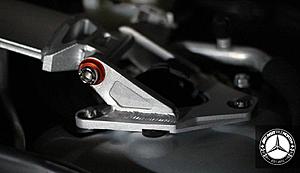
Gents remember, these strut bars were not made for mass re-sale. It was done by enthusiast for enthusiasts. We went as far as notching out the mounting plates to accommodate the OEM plastic rivets on our cars
Just For reference here is the renntech strut bar.
Originally Posted by Diabolis
Agreed 100%. Need somethign a lot sturdier and supported in more places in order for it to provide any potential benefit. Both of those are just eye candy, need to be removed when you want to change the air filters, and block access to the +12V boost connector.
The only one I've seen for the C63 that looked like it might actually provide some structural rigidity was a Renntech on a car with Florida plates at one of the Ontario meets (Intek?) a couple of years ago. And, the C63 doesn't really suffer from front chassis flex anyway. The double firewall certainly does a nice job of keeping it pretty stiff to begin with. I'd be more concerned with stiffening up the rear, in which case you'd lose the use of the trunk for starters...
Originally Posted by Diabolis
I have no doubts that they are made from 6061 if you say so, and they are certainly beautifully finished. However, I guarantee you that if I simply push down on the middle of the bar with my hand, it would deflect by 1/2" or more - and the forces exerted on it by the chassis flexing would easliy be 100 times that. The strut braces on my old E30 and E36 M3s on the other hand were made of multiple bars of welded steel that were attached in four places at the strut towers and at the firewall... on a 2700 lb car. The very fact that the bar portion pivots around the bolt that attaches it to the mount on either side by definition precludes any load being transferred to the other strut mount.
2012 P31 C63 Coupe Trackrat, 2019 GLE63S Coupe Beast
Kriston, with all due respect dude because I'm a huge fan of enthusiasts going out and making parts for our cars, you're just wrong.
Without the third mounting point to the firewall (ideally in 2 places), these bars will make next to zero difference. Maybe steering/cornering feel will be a little sharper, maybe transitional speed will be fractionally quicker, but that's about it. With this design I doubt any of that because of the hinged design - made for ease of removal - in the same plane of the forces you are looking to mitigate. That just about ensures that it's going to be nearly useless.
On top of that aluminum is used, which looks pretty but is not nearly as effective as steel. You would need a much bigger bar, the same weight of a steel one, to make it structurally as stiff. You are trying to brace an already strong steel structure, therefore you would want to strengthen it with something at least as stiff as it is.
Kudos to looking to make something beneficial for these cars, but if you want it to be truly effective and not just a placebo-effect and dress-up piece, I think a couple of minor changes would produce something quantitatively useful.
If we were to follow your train of thinking, we'd all be in trouble. I think you need to switch out your superbly crafted Vorsteiner Aluminum wheels to steel I mean aluminium aren't high tolerance right?.
Please educate yourself on tensile strengths and weight distribution to fully appreciate what Im trying to explain to you. If you wish to carry on this discussion pls PM Me.
Gents to set the record straight, these braces were not meant to be mass produced, MB True North, is a group of enthusiast here in Toronto who share the same appreciation and love for their cars as we all do on this forum. Out of that we created the group to share information and help each other. These strut bars were made for the every day user who appreciates a quality crafted piece the small proceeds we generated went straight back to the community by organizing MB events every season.
Take a look at the first pic i posted, we even went as far as to notch out the mounting plates to make space for the OEM plastic screws. We put some thought into the design and what we wanted to ultimately achieve. Which was to offer a minor 100% factory bolt on upgrade, that any person can install with the use of common house hold tools. I think we achieved that.
We will run another Group buy, but I am not a vendor on MBworld. Out of appreciation for this forum and its admins. I do not wish to violate there policies. So if you wish to take part in future group buys please feel free to join our Face book group MB TrueNorth or on instagram @MBTruenorth
Originally Posted by BLKROKT
Kriston, with all due respect dude because I'm a huge fan of enthusiasts going out and making parts for our cars, you're just wrong.
Without the third mounting point to the firewall (ideally in 2 places), these bars will make next to zero difference. Maybe steering/cornering feel will be a little sharper, maybe transitional speed will be fractionally quicker, but that's about it. With this design I doubt any of that because of the hinged design - made for ease of removal - in the same plane of the forces you are looking to mitigate. That just about ensures that it's going to be nearly useless.
On top of that aluminum is used, which looks pretty but is not nearly as effective as steel. You would need a much bigger bar, the same weight of a steel one, to make it structurally as stiff. You are trying to brace an already strong steel structure, therefore you would want to strengthen it with something at least as stiff as it is.
Kudos to looking to make something beneficial for these cars, but if you want it to be truly effective and not just a placebo-effect and dress-up piece, I think a couple of minor changes would produce something quantitatively useful.
2012 P31 C63 Coupe Trackrat, 2019 GLE63S Coupe Beast
Dude, I know you're trying to sell these bars for whatever cause - saving orphaned kittens in Afghanistan or whatever - but at least buyers should know that they're not going to do anything. Just sit in the engine bay and be pretty. And that's fine, but they should know that their car is not going to handle like an F1 car, or in fact any differently, as a result of these.
And please don't insult my intelligence by throwing around really big words like "tensile strength" and "weight distribution", thinking that I'll get confused like your customers.
The real FACTS of the matter are as follows:
- Your hinge is directly in line with the forces you are looking to mitigate. It's this fact alone that will make it useless. (see: physics 101)
- In almost all cases of well-constructed bars, they are solid throughout (i.e. no hinges just like OEM ones), and made of steel. Using your logic, the next roll cage I fab up should be out of aluminum. I've been doing it wrong all this time, thanks for making me see the light!
- Aluminum strut tower bars have zero advantage over steel, and a lot of disadvantages. Yes, aluminum and steel have the same stiffness, given the same amount of weight. Therefore, it will take a bigger bar of aluminum to achieve the same amount of stiffness as the equivalent weight steel. The aluminum bar would have to be huge for it to actually work.
- It may very well be that our front strut towers are not well supported, and can bend and flex under heavy cornering. That's fine to think that (although I have seen no evidence to support this). But your design will do nothing to help offset this. To accomplish this effectively, the bar must be rigid throughout its entire length (see above re hinge), and triangulated - meaning attached to the firewall. This is also an undisputed fact.
I don't really want to discuss over PM, because I know everything I need to without being 'educated' by you via a conversation. I just want members to KNOW what they are getting, and it is not any more rigidity or handling, that is certain beyond doubt.
I'm definitely not the one who needs to study this subject here, sorry.
Dude, I know you're trying to sell these bars for whatever cause - saving orphaned kittens in Afghanistan or whatever - but at least buyers should know that they're not going to do anything. Just sit in the engine bay and be pretty. And that's fine, but they should know that their car is not going to handle like an F1 car, or in fact any differently, as a result of these.
And please don't insult my intelligence by throwing around really big words like "tensile strength" and "weight distribution", thinking that I'll get confused like your customers.
The real FACTS of the matter are as follows:
- Your hinge is directly in line with the forces you are looking to mitigate. It's this fact alone that will make it useless. (see: physics 101)
- In almost all cases of well-constructed bars, they are solid throughout (i.e. no hinges just like OEM ones), and made of steel. Using your logic, the next roll cage I fab up should be out of aluminum. I've been doing it wrong all this time, thanks for making me see the light!
- Aluminum strut tower bars have zero advantage over steel, and a lot of disadvantages. Yes, aluminum and steel have the same stiffness, given the same amount of weight. Therefore, it will take a bigger bar of aluminum to achieve the same amount of stiffness as the equivalent weight steel. The aluminum bar would have to be huge for it to actually work.
- It may very well be that our front strut towers are not well supported, and can bend and flex under heavy cornering. That's fine to think that (although I have seen no evidence to support this). But your design will do nothing to help offset this. To accomplish this effectively, the bar must be rigid throughout its entire length (see above re hinge), and triangulated - meaning attached to the firewall. This is also an undisputed fact.
I don't really want to discuss over PM, because I know everything I need to without being 'educated' by you via a conversation. I just want members to KNOW what they are getting, and it is not any more rigidity or handling, that is certain beyond doubt.
I'm definitely not the one who needs to study this subject here, sorry.
If we were to follow your train of thinking, we'd all be in trouble. I think you need to switch out your superbly crafted Vorsteiner Aluminum wheels to steel I mean aluminium aren't high tolerance right?.
Please educate yourself on tensile strengths and weight distribution to fully appreciate what Im trying to explain to you. If you wish to carry on this discussion pls PM Me.
Gents to set the record straight, these braces were not meant to be mass produced, MB True North, is a group of enthusiast here in Toronto who share the same appreciation and love for their cars as we all do on this forum. Out of that we created the group to share information and help each other. These strut bars were made for the every day user who appreciates a quality crafted piece the small proceeds we generated went straight back to the community by organizing MB events every season.
Take a look at the first pic i posted, we even went as far as to notch out the mounting plates to make space for the OEM plastic screws. We put some thought into the design and what we wanted to ultimately achieve. Which was to offer a minor 100% factory bolt on upgrade, that any person can install with the use of common house hold tools. I think we achieved that.
We will run another Group buy, but I am not a vendor on MBworld. Out of appreciation for this forum and its admins. I do not wish to violate there policies. So if you wish to take part in future group buys please feel free to join our Face book group MB TrueNorth or on instagram @MBTruenorth
Kriston - indeed, proper reasearch is a few clicks away (well, maybe an elementary course in physics and materials technology) - but if you bother to do it, you'll realize that you're the one that's wrong for a couple of reasons.
First, the very design of the brace you are making makes it useless when it comes to transferring lateral loads to the other strut mount. You have a single bolt that is longitudinally mounted between each strut mount and the bar itself. Under high cornering loads when a given chassis may flex at the strut mounting point, the coupling of the bar portion to the strut brace mount that you make (i.e. that single longitudinally oriented bolt) is by several orders of magnitude the weakest point and allows the mount to essentially pivot or rotate around the bar on both sides. Your design is never going to transfer any of the load to the other side as the orientation of the couplings means that they will simply rotate and turn by a few tenths of a degree, in effect shifting the bar position relative to the engine but without transferring any of the lateral load to the other shock tower. If you look at the SMERC brace, at least there is no pivot around which the bar itself can move when the mounts do (so that one is going to be as strong as the bar itself, which btw does flex far too much to be of any use and which also bring me to the second point, and that is the choice of material itself. You (and most other laymen) are confusing strength with stiffness. Strengh (or yeield stress) is a very different property from stiffness (for a brief explanation as it applies to custom-made bicycle frames, see http://www.vendettacycles.com/vendet.../stiffness.htm - the application is different here, but the concept is certainly the same). The aluminum that you use has three times lower stiffness (also known as the Young's modulus) than steel. In other words, it is lot more flexible and elastic (again, for a primer, see http://aluminium.matter.org.uk/conte...eid=2144417130). An aircraft wing made of that same 6061 aluminium will flex by as much as 6' at the tip during moderate turbulence. As it applies to strut braces, by definition you DO NOT WANT the brace itself to flex but rather transfer the load to the other strut mount (and hopefully other points of the car) for greater rigidity. So - both your design and your choice of material are unfortunately wrong for the appication. I am not pulling things out my a$$ here - I just happen to be both an engineer and a track junkie, have a partial interest in an indie P-car race shop where the head mechanic was the crew chief for Scott Goodyear, so I have a fair bit of first-hand experience with strut braces and chassis stiffness in general. Yes, all other things being equal, ligher is better, but certainly not at the expense of the very property the item in question is supposed to solve or alleviate. If the half cage in my 951 track rat was built from aluminum instead of steel, it would flex and deform three times as much as the steel one, which in case of a rollover could mean a snapped neck instead of a bruised ego and soiled underwear.
Sorry to dissapoint you, but your absolutely gorgeous, hand-made strut brace will unfortunately do nothing to reduce strut mount flexing. It most definitely looks sexy as hell, but I am afraid the physics simply isn't in your favour.
Last edited by Diabolis; Mar 20, 2015 at 10:37 PM.
I encourage you to come out to one of our local meets to see it first hand, your in Toronto you should already be a part of MB True North. Like you, I am an avid auto enthusiast. i do respect your take on design and build process. But its a perspective none-the-less. I can battle back and forth till the end of time about this but i digress. The Group buy is already done. 10 owners are already using the Strut brace with great success. Certain products do not suit peoples needs, this one seems not to fit yours. Which is okay!
I have a shiny Renntech strut bar here that I can sell to you
Have a good night bud
Kris
Originally Posted by Diabolis
Kriston - indeed, proper reasearch is a few clicks away (well, maybe an elementary course in physics and materials technology) - but if you bother to do it, you'll realize that you're the one that's wrong for a couple of reasons.
First, the very design of the brace you are making makes it useless when it comes to transferring lateral loads to the other strut mount. You have a single bolt that is longitudinally mounted between each strut mount and the bar itself. Under high cornering loads when a given chassis may flex at the strut mounting point, the coupling of the bar portion to the strut brace mount that you make (i.e. that single longitudinally oriented bolt) is by several orders of magnitude the weakest point and allows the mount to essentially pivot or rotate around the bar on both sides. Your design is never going to transfer any of the load to the other side as the orientation of the couplings means that they will simply rotate and turn by a few tenths of a degree, in effect shifting the bar position relative to the engine but without transferring any of the lateral load to the other shock tower. If you look at the SMERC brace, at least there is no pivot around which the bar itself can move when the mounts do (so that one is going to be as strong as the bar itself, which btw does flex far too much to be of any use and which also bring me to the second point, and that is the choice of material itself. You (and most other laymen) are confusing strength with stiffness. Strengh (or yeield stress) is a very different property from stiffness (for a brief explanation as it applies to custom-made bicycle frames, see http://www.vendettacycles.com/vendet.../stiffness.htm - the application is different here, but the concept is certainly the same). The aluminum that you use has three times lower stiffness (also known as the Young's modulus) than steel. In other words, it is lot more flexible and elastic (again, for a primer, see http://aluminium.matter.org.uk/conte...eid=2144417130). An aircraft wing made of that same 6061 aluminium will flex by as much as 6' at the tip during moderate turbulence. As it applies to strut braces, by definition you DO NOT WANT the brace itself to flex but rather transfer the load to the other strut mount (and hopefully other points of the car) for greater rigidity. So - both your design and your choice of material are unfortunately wrong for the appication. I am not pulling things out my a$$ here - I just happen to be both an engineer and a track junkie, have a partial interest in an indie P-car race shop where the head mechanic was the crew chief for Scott Goodyear, so I have a fair bit of first-hand experience with strut braces and chassis stiffness in general. Yes, all other things being equal, ligher is better, but certainly not at the expense of the very property the item in question is supposed to solve or alleviate. If the half cage in my 951 track rat was built from aluminum instead of steel, it would flex and deform three times as much as the steel one, which in case of a rollover could mean a snapped neck instead of a bruised ego and soiled underwear.
Sorry to dissapoint you, but your absolutely gorgeous, hand-made strut brace will unfortunately do nothing to reduce strut mount flexing. It most definitely looks sexy as hell, but I am afraid the physics simply isn't in your favour.
I have to say, this is very refreshing. Here we have regular forum contributors conversing in disagreement with respect and logic. No name calling or a**hattery.
Thank you gentlemen for conducting yourselves as adults despite the differing viewpoints.
Thats what were all here for. I have no objections to design differences, whats the point of life without choice!
Either way, we are all enthusiasts none-the-less. My experiences and build philosophy will always be different then the next member. I enjoy meeting new minds, it helps innovate.
Kriston - indeed, proper reasearch is a few clicks away (well, maybe an elementary course in physics and materials technology) - but if you bother to do it, you'll realize that you're the one that's wrong for a couple of reasons.
First, the very design of the brace you are making makes it useless when it comes to transferring lateral loads to the other strut mount. You have a single bolt that is longitudinally mounted between each strut mount and the bar itself. Under high cornering loads when a given chassis may flex at the strut mounting point, the coupling of the bar portion to the strut brace mount that you make (i.e. that single longitudinally oriented bolt) is by several orders of magnitude the weakest point and allows the mount to essentially pivot or rotate around the bar on both sides. Your design is never going to transfer any of the load to the other side as the orientation of the couplings means that they will simply rotate and turn by a few tenths of a degree, in effect shifting the bar position relative to the engine but without transferring any of the lateral load to the other shock tower. If you look at the SMERC brace, at least there is no pivot around which the bar itself can move when the mounts do (so that one is going to be as strong as the bar itself, which btw does flex far too much to be of any use and which also bring me to the second point, and that is the choice of material itself. You (and most other laymen) are confusing strength with stiffness. Strengh (or yeield stress) is a very different property from stiffness (for a brief explanation as it applies to custom-made bicycle frames, see http://www.vendettacycles.com/vendet.../stiffness.htm - the application is different here, but the concept is certainly the same). The aluminum that you use has three times lower stiffness (also known as the Young's modulus) than steel. In other words, it is lot more flexible and elastic (again, for a primer, see http://aluminium.matter.org.uk/conte...eid=2144417130). An aircraft wing made of that same 6061 aluminium will flex by as much as 6' at the tip during moderate turbulence. As it applies to strut braces, by definition you DO NOT WANT the brace itself to flex but rather transfer the load to the other strut mount (and hopefully other points of the car) for greater rigidity. So - both your design and your choice of material are unfortunately wrong for the appication. I am not pulling things out my a$$ here - I just happen to be both an engineer and a track junkie, have a partial interest in an indie P-car race shop where the head mechanic was the crew chief for Scott Goodyear, so I have a fair bit of first-hand experience with strut braces and chassis stiffness in general. Yes, all other things being equal, ligher is better, but certainly not at the expense of the very property the item in question is supposed to solve or alleviate. If the half cage in my 951 track rat was built from aluminum instead of steel, it would flex and deform three times as much as the steel one, which in case of a rollover could mean a snapped neck instead of a bruised ego and soiled underwear.
Sorry to dissapoint you, but your absolutely gorgeous, hand-made strut brace will unfortunately do nothing to reduce strut mount flexing. It most definitely looks sexy as hell, but I am afraid the physics simply isn't in your favour.
hi diablolis, do you feel renntech struc bar is effective? it is not attached to the firewall and not sure how carbon fiber works compared with steel
Mercedes SLR McLaren 722 S Is Extremely Rare Example Modified by McLaren
Slideshow: A one-of-one U.S.-spec Mercedes-Benz SLR McLaren Roadster became even rarer after a factory-backed transformation at McLaren's headquarters.