



E320 straight six or v6 which one is better

Almost a Member!
Joined: Jul 2006
Posts: 36
Likes: 0
Mercedes C280
what we have here is another tommyboy.Arguing Against the facts that the v-6 out of the same 195 cu.in engine with 1 large exhaust valve instead of two small ones makes more power then the antiquated L-6 engine and at the same time achieves better mileage and lower emissions.The new LS9 corvette engine with 640 h.p. is only 2 valves per cylinder and is the most advanced engine in gm history.which proves you don't need 4 or 5 valves to produce power.
A properly designed head with 1 large exhaust valve in the proper path will out flow the obstructed path of two small valves and the shrouding they exhibit to the path of the exhaust gases. More complex and more valves and more cams does not always make a more powerful engine,and that is not feel that is facts.
1999 v-6 0-60 7.2 seconds
1997 L-6 0-60 7.9 seconds
feel?my ***!that's lengths,that's facts.
case closed
A properly designed head with 1 large exhaust valve in the proper path will out flow the obstructed path of two small valves and the shrouding they exhibit to the path of the exhaust gases. More complex and more valves and more cams does not always make a more powerful engine,and that is not feel that is facts.
1999 v-6 0-60 7.2 seconds
1997 L-6 0-60 7.9 seconds
feel?my ***!that's lengths,that's facts.
case closed

Last edited by SechsPackSound; Dec 23, 2007 at 03:59 AM.

Member
Joined: May 2006
Posts: 197
Likes: 0
1997 E320
um, neither motor is stressed, which is why they will BOTH last for a long time. There is absolutely NOTHING complicated about making either a 220bhp v6 or I6 with 3 or 3.2 liters. NOTHING. 68.7hp/l is not exactly a high specific output. Now the 3.2l I6 in the E46 BMW M3 is certainly more on the ragged edge.
As for your statement about quality, MBs from the 80s didn't have nearly the same technology, features, options or HP, that the new ones do, hence they are prone to less problems. While MB had a few bad years, the complaints about the modular engines was limited to very early years.
The I6 is a great engine, but there is nothing wrong with the V6.
To say one is better than the other is silly. However, the V6 makes more power and torque, and there is no concrete evidence to show that its longevity is in question.
As for your statement about quality, MBs from the 80s didn't have nearly the same technology, features, options or HP, that the new ones do, hence they are prone to less problems. While MB had a few bad years, the complaints about the modular engines was limited to very early years.
The I6 is a great engine, but there is nothing wrong with the V6.
To say one is better than the other is silly. However, the V6 makes more power and torque, and there is no concrete evidence to show that its longevity is in question.
This is not a fair comparison. The engines are two different designs, and each design has it's own goods and bads. The only thing we can do here is point those out.
One thing I do not agree with you is new technology should not mean more problems. I would expect a car to improve with new technology not decline in quality.
After reading the articles listed in this post, I personally do not see anything gained for me if I was given a choice to go to a v6. Gas economy is almost the same. Torque is improved but both engines are rated at the same power. The V6 is lighter.
Still the above facts are not enough for me to leave a sweet Mercedes L6 with the sound pitch of a Mercedes when rev'd up.
-I know the L6 inside out, I can work on it which cuts my trips to the dealer to almost none, and I enjoy working on it. It is a beautiful design.
-I like the feel and sound of it when I drive it. If you've ever driven one you notice a power burst when the rpm's hit 3500, the secondary intake valves activate and the car just takes off. (I don't exactly remember the mechanism but it is there). The rush is actually pretty cool for a daily driver.
I don't think arguing these two engines are going to get us anywhere. there are some gains and losses with each engine. You just have to see which one turns you on. lol

Senior Member
Joined: Dec 2004
Posts: 484
Likes: 1
From: orange county, CA
Tesla Roadster Sport
what we have here is another tommyboy.Arguing Against the facts that the v-6 out of the same 195 cu.in engine with 1 large exhaust valve instead of two small ones makes more power then the antiquated L-6 engine and at the same time achieves better mileage and lower emissions.The new LS9 corvette engine with 640 h.p. is only 2 valves per cylinder and is the most advanced engine in gm history.which proves you don't need 4 or 5 valves to produce power.
A properly designed head with 1 large exhaust valve in the proper path will out flow the obstructed path of two small valves and the shrouding they exhibit to the path of the exhaust gases. More complex and more valves and more cams does not always make a more powerful engine,and that is not feel that is facts.
1999 v-6 0-60 7.2 seconds
1997 L-6 0-60 7.9 seconds
feel?my ***!that's lengths,that's facts.
case closed
A properly designed head with 1 large exhaust valve in the proper path will out flow the obstructed path of two small valves and the shrouding they exhibit to the path of the exhaust gases. More complex and more valves and more cams does not always make a more powerful engine,and that is not feel that is facts.
1999 v-6 0-60 7.2 seconds
1997 L-6 0-60 7.9 seconds
feel?my ***!that's lengths,that's facts.
case closed
 You don't need more than two valves in a pushrod motor, and pushrod motors are considered to be low-tech motors (only recently has GM started to develop OHC motors i.e. northstar). You are obvioulsy not an engineer, I have been a calibration engineer for many years. I urge you to take a class and learn about engine theory. It says you are a retired business exec, your company slogan must have been M-I-C-K-E-Y...... DOHC will make more power and is a far more elegant solution as opposed to your crippled sohc motor. Why is it that Mercedes has ditched the SOHC design and went back to DOHC? That MLWOLFGANG link touts the economy aspects of the m112, and thats what the engine is, an economy engine. It is not a "groundbreaking" engine, its the "secretary" engine.

MBWorld Fanatic!
Joined: Dec 2006
Posts: 4,949
Likes: 39
From: Clifton, NJ
96 and 08 911 turbos
the amount of valves is the amount of valves regardless of where the cams are.
Those low tech ohv motors seem to make impressive power, and they do so without a lot of valvetrain, which is preferrable for a number of reasons.
Since you seem to be so concerned with the number of valves, show me the head flow numbers for the 4v vs. the 3v.
As for your last comment, the 6 cylinder in general is an economy engine. You don't see I6's in the big shot BMWS or MBs either, do you?
oh, and since you seem to think the 3v sohc motor is so low rent, why did MB use one on their top dollar, cost is no object, SLR?
If you can make the same power with one cam vs. two cams, you should absolutely do it.
Those low tech ohv motors seem to make impressive power, and they do so without a lot of valvetrain, which is preferrable for a number of reasons.
Since you seem to be so concerned with the number of valves, show me the head flow numbers for the 4v vs. the 3v.
As for your last comment, the 6 cylinder in general is an economy engine. You don't see I6's in the big shot BMWS or MBs either, do you?
oh, and since you seem to think the 3v sohc motor is so low rent, why did MB use one on their top dollar, cost is no object, SLR?
If you can make the same power with one cam vs. two cams, you should absolutely do it.
Senior Member
Joined: Dec 2004
Posts: 484
Likes: 1
From: orange county, CA
Tesla Roadster Sport
the amount of valves is the amount of valves regardless of where the cams are.
Those low tech ohv motors seem to make impressive power, and they do so without a lot of valvetrain, which is preferrable for a number of reasons.
Since you seem to be so concerned with the number of valves, show me the head flow numbers for the 4v vs. the 3v.
As for your last comment, the 6 cylinder in general is an economy engine. You don't see I6's in the big shot BMWS or MBs either, do you?
oh, and since you seem to think the 3v sohc motor is so low rent, why did MB use one on their top dollar, cost is no object, SLR?
If you can make the same power with one cam vs. two cams, you should absolutely do it.
Those low tech ohv motors seem to make impressive power, and they do so without a lot of valvetrain, which is preferrable for a number of reasons.
Since you seem to be so concerned with the number of valves, show me the head flow numbers for the 4v vs. the 3v.
As for your last comment, the 6 cylinder in general is an economy engine. You don't see I6's in the big shot BMWS or MBs either, do you?
oh, and since you seem to think the 3v sohc motor is so low rent, why did MB use one on their top dollar, cost is no object, SLR?
If you can make the same power with one cam vs. two cams, you should absolutely do it.
The E46 M3 had the straight 6, the M Coupe/vert uses a straight 6, I would say the "m" cars are the "big shot" cars of BMW. When the SLR was developed all Mercedes had, was the tooling for the SOHC motors. They have only recently come out with DOHC motors, after they realized there was a substantial performance ceiling with regards to SOHC motors. No car company can justify to their shareholders the need to develop a "new" motor for a limited production car. Why has Mercedes moved to DOHC and 4 valves per cylinder, if the SOHC and 3 valve design worked so well?
MBWorld Fanatic!
Joined: Dec 2006
Posts: 4,949
Likes: 39
From: Clifton, NJ
96 and 08 911 turbos
For an OHV motor there is no need to crowd up the head with valves,
The E46 M3 had the straight 6, the M Coupe/vert uses a straight 6, I would say the "m" cars are the "big shot" cars of BMW. When the SLR was developed all Mercedes had, was the tooling for the SOHC motors. They have only recently come out with DOHC motors, after they realized there was a substantial performance ceiling with regards to SOHC motors. No car company can justify to their shareholders the need to develop a "new" motor for a limited production car. Why has Mercedes moved to DOHC and 4 valves per cylinder, if the SOHC and 3 valve design worked so well?
The E46 M3 had the straight 6, the M Coupe/vert uses a straight 6, I would say the "m" cars are the "big shot" cars of BMW. When the SLR was developed all Mercedes had, was the tooling for the SOHC motors. They have only recently come out with DOHC motors, after they realized there was a substantial performance ceiling with regards to SOHC motors. No car company can justify to their shareholders the need to develop a "new" motor for a limited production car. Why has Mercedes moved to DOHC and 4 valves per cylinder, if the SOHC and 3 valve design worked so well?
You picked the lowest M cars out there. Look at the M5, it uses a V10. The m6, the V10. The new M3, the V8. Im not saying there is anything wrong with the I6, in fact I absolutely adored the I6 in my 95 M3. But to say that its better than a V6 just because of its design is silly. There are some amazing V6 motors out there (New GTR, for one).
You don't think MB had any DOHC toolings for v8 heads? You don't think they could have modified the old 5.0l castings?
Nobody is arguing that DOHC 4v vs. 3v will make more power, and since they wanted to up the power quotient in the new models.
But what that has to do with two completely separate motors, I have no idea.
The bottom line is that both are reliable, they make similar power, and they have both been highly acclaimed. Neither poses any major advantage to the other in stock or mildly modified form. This argument has simply turned into a "whatever I have is better" argument.

Member
Joined: Jul 2007
Posts: 198
Likes: 1
From: a place
my car
No, the engineer will tell you the crankshaft is too long, especially if you're talking about a straight 8.
And, the engineer will tell you that the inline engine is a safety hazard as compared to a V engine as regards front-end collision crash worthiness.
Yes, the ideal V6 engine would be a 60-degree, 120-degree, or 180-degree design, but if you're going to use same tooling to make a V8 you compromise on 90-degrees and add a balancer shaft. This stuff seems to make little difference these days, however, as for example the current V6 and V8 Mercedes diesel engines are both 75-degree designs, both with balancer shafts.
In the recent "turbo" era in Formula One, the engines were V6s. Inline engines would have created handling nightmares.
The added expense of having two versus one cylinder heads with the accompanying cam drive complications seems well worth it given the other advantages. Porsche's been doing it for years. BMW's inline engines are these days just marketing, although as noted previously it does permit "modularization" with inline fours.
And, the engineer will tell you that the inline engine is a safety hazard as compared to a V engine as regards front-end collision crash worthiness.
Yes, the ideal V6 engine would be a 60-degree, 120-degree, or 180-degree design, but if you're going to use same tooling to make a V8 you compromise on 90-degrees and add a balancer shaft. This stuff seems to make little difference these days, however, as for example the current V6 and V8 Mercedes diesel engines are both 75-degree designs, both with balancer shafts.
In the recent "turbo" era in Formula One, the engines were V6s. Inline engines would have created handling nightmares.
The added expense of having two versus one cylinder heads with the accompanying cam drive complications seems well worth it given the other advantages. Porsche's been doing it for years. BMW's inline engines are these days just marketing, although as noted previously it does permit "modularization" with inline fours.
Senior Member
Joined: Dec 2004
Posts: 484
Likes: 1
From: orange county, CA
Tesla Roadster Sport
You always make the motor as simple as it can be to get the power needed. ohv or ohc.
You picked the lowest M cars out there. Look at the M5, it uses a V10. The m6, the V10. The new M3, the V8. Im not saying there is anything wrong with the I6, in fact I absolutely adored the I6 in my 95 M3. But to say that its better than a V6 just because of its design is silly. There are some amazing V6 motors out there (New GTR, for one).
You don't think MB had any DOHC toolings for v8 heads? You don't think they could have modified the old 5.0l castings?
Nobody is arguing that DOHC 4v vs. 3v will make more power, and since they wanted to up the power quotient in the new models.
But what that has to do with two completely separate motors, I have no idea.
The bottom line is that both are reliable, they make similar power, and they have both been highly acclaimed. Neither poses any major advantage to the other in stock or mildly modified form. This argument has simply turned into a "whatever I have is better" argument.
You picked the lowest M cars out there. Look at the M5, it uses a V10. The m6, the V10. The new M3, the V8. Im not saying there is anything wrong with the I6, in fact I absolutely adored the I6 in my 95 M3. But to say that its better than a V6 just because of its design is silly. There are some amazing V6 motors out there (New GTR, for one).
You don't think MB had any DOHC toolings for v8 heads? You don't think they could have modified the old 5.0l castings?
Nobody is arguing that DOHC 4v vs. 3v will make more power, and since they wanted to up the power quotient in the new models.
But what that has to do with two completely separate motors, I have no idea.
The bottom line is that both are reliable, they make similar power, and they have both been highly acclaimed. Neither poses any major advantage to the other in stock or mildly modified form. This argument has simply turned into a "whatever I have is better" argument.
The BMW I6 motors are great engines, but there comes a point where a motor can no longer be used on a newer platform due to size/space constraints. To a lot of people a "pure" m3 will always have an I6. To keep up with other manufacturers upping the ante in terms of raw power, a V8 had to be used. I don't think anyone is arguing that a I6 is more powerful than a V8.
From a reliablity standpoint (i.e. 1 million miles) the I6 design is far superior to the V6 design, just take a look at all the tractor trailers that utilize a diesel I6 motor and who's overhaul specifications are 500k-1million miles+.
MB World Stories
The Best of Mercedes & AMG

Manual Mercedes? 6 Times Sindelfingen Let Drivers Have All The Fun
Verdad Gallardo
Mercedes SLR McLaren 722 S Is Extremely Rare Example Modified by McLaren
Verdad Gallardo
8 Classic Boxy Mercedes Designs That Have Aged Like Fine Wine
Verdad Gallardo
Flawlessly Restored Mercedes 190E Evo II Heads to Auction
Verdad Gallardo
Electric Mercedes C-Class Unveiled: 11 Things You Need to Know
Verdad Gallardo
Mercedes EQS Gets A Major Update: Everything You Need to Know
Verdad Gallardo
5 Underrated Mercedes-Benz Models That Don't Get the Love They Deserve
Verdad Gallardo
Mercedes 300D Has Pushed Well Past 1 Million Miles and It Ain't Stopping
Verdad Gallardo
10 Most Reliable Mercedes-Benz Models You Can Buy Used
Verdad Gallardo
MBWorld Fanatic!
Joined: Dec 2006
Posts: 4,949
Likes: 39
From: Clifton, NJ
96 and 08 911 turbos
Mercedes could not deploy VVT effectively (and with acceptable power gains) on the M112 motors. VVT can be added to SOHC motors but the power gains will not be anywhere near that of a DOHC motor. If the M112 had originally been fitted with DOHC's it would have been a more powerful motor (ala m272), at the time Mercedes felt that it would be better to go the "economy" route. In order for the M112 to put up anywhere near the power numbers of a conventional (of the same vintage) DOHC motor it must use forced induction. I agree that the m112 is a reliable motor, I just don't see how its a "groundbreaking" motor or "technologically advanced." I am just calling a spade a spade, and the M112 is an "economy motor."
From a reliablity standpoint (i.e. 1 million miles) the I6 design is far superior to the V6 design, just take a look at all the tractor trailers that utilize a diesel I6 motor and who's overhaul specifications are 500k-1million miles+.
From a reliablity standpoint (i.e. 1 million miles) the I6 design is far superior to the V6 design, just take a look at all the tractor trailers that utilize a diesel I6 motor and who's overhaul specifications are 500k-1million miles+.
To say that a 3v motor of the same size and compression ratio as a 4v motor will need forced induction to keep up is a bit ridiculous. Some hotter cams, ported heads, better intake and exhaust will do wonders.
The 112 made the power demanded by MB without dohc or VVT. If they wanted more power, they would have done what was necessary. The fact is, is that the motor fit their specifications.
I don't think its groundbreaking or technologically advanced, just as I don't consider a 3.0L I6 making 220bhp ground breaking or technologically advanced. Like I said, there is nothing complicated about making that kinda power out of that size engine.
Finally, what in the hell do tractor diesel motors and 1 million miles have to do with our discussion of Mercedes gasoline engines. Want me to show you a 350 chevy with 500k miles? What does that prove? Nothing, it means that the owner was diligent with maintenance and replaced parts when they needed replacement.
In my mind a motor doesn't have to go 1 million miles to be dependable and reliable. 300k is more than enough, and there is no reason that the 112 can't do that.

MBWorld Fanatic!
Joined: Apr 2007
Posts: 6,171
Likes: 16
300E a couple 1994 w124wagon E320 Wagon/,1971MGB Track/Rally, MG Midget Autocross ,2000 E320 wagon.
There goes the tommyboy
clone again.Off topic and way off base.
We were talking about the m112 v.s. the m104 and it is a more advanced engine in comparison,just as balanced,more torque,and more h.p. while getting more mpg out of the same engine size.If the straight 6 was so good why did Mercedes retool and take the next step in v design with the new engines?Simply put they advanced the engine design even more then the m112.Going backwards to early 1900's engine design is not what they desired.If they wanted to go backwards like bmw the new cars would have l-6 engines.
Thanks for the advice of the engine theory school,been building engines and racing for 40 years,with great success,so it is a little late to be schooled by some kid that can't even be kept on task.Go calibrate a thermometerthat is what you guys do isn't it?
We were talking about the m112 v.s. the m104 and it is a more advanced engine in comparison,just as balanced,more torque,and more h.p. while getting more mpg out of the same engine size.If the straight 6 was so good why did Mercedes retool and take the next step in v design with the new engines?Simply put they advanced the engine design even more then the m112.Going backwards to early 1900's engine design is not what they desired.If they wanted to go backwards like bmw the new cars would have l-6 engines.
Thanks for the advice of the engine theory school,been building engines and racing for 40 years,with great success,so it is a little late to be schooled by some kid that can't even be kept on task.Go calibrate a thermometer
that is what you guys do isn't it?
Senior Member
Joined: Dec 2004
Posts: 484
Likes: 1
From: orange county, CA
Tesla Roadster Sport
Isn't your first post a testiment to how well the 112 does without VVT?
To say that a 3v motor of the same size and compression ratio as a 4v motor will need forced induction to keep up is a bit ridiculous. Some hotter cams, ported heads, better intake and exhaust will do wonders.
The 112 made the power demanded by MB without dohc or VVT. If they wanted more power, they would have done what was necessary. The fact is, is that the motor fit their specifications.
I don't think its groundbreaking or technologically advanced, just as I don't consider a 3.0L I6 making 220bhp ground breaking or technologically advanced. Like I said, there is nothing complicated about making that kinda power out of that size engine.
Finally, what in the hell do tractor diesel motors and 1 million miles have to do with our discussion of Mercedes gasoline engines. Want me to show you a 350 chevy with 500k miles? What does that prove? Nothing, it means that the owner was diligent with maintenance and replaced parts when they needed replacement.
In my mind a motor doesn't have to go 1 million miles to be dependable and reliable. 300k is more than enough, and there is no reason that the 112 can't do that.
To say that a 3v motor of the same size and compression ratio as a 4v motor will need forced induction to keep up is a bit ridiculous. Some hotter cams, ported heads, better intake and exhaust will do wonders.
The 112 made the power demanded by MB without dohc or VVT. If they wanted more power, they would have done what was necessary. The fact is, is that the motor fit their specifications.
I don't think its groundbreaking or technologically advanced, just as I don't consider a 3.0L I6 making 220bhp ground breaking or technologically advanced. Like I said, there is nothing complicated about making that kinda power out of that size engine.
Finally, what in the hell do tractor diesel motors and 1 million miles have to do with our discussion of Mercedes gasoline engines. Want me to show you a 350 chevy with 500k miles? What does that prove? Nothing, it means that the owner was diligent with maintenance and replaced parts when they needed replacement.
In my mind a motor doesn't have to go 1 million miles to be dependable and reliable. 300k is more than enough, and there is no reason that the 112 can't do that.
was the discussion comparing the I6 vs the V6? The fact that many big truck manufacturers use the I6 design is a testament to how inherently balanced and robust the I6 design is. Show me some links to 112's that have done 300k....Why did Mercedes not just add some ported heads and hotter cams when they designed the E55 and C32 if this would yield performance gains on par with Audi and BMW? Fact is the engine wasn't designed to perform. Thus the need for forced induction
Senior Member
Joined: Dec 2004
Posts: 484
Likes: 1
From: orange county, CA
Tesla Roadster Sport
clone again.Off topic and way off base.
We were talking about the m112 v.s. the m104 and it is a more advanced engine in comparison,just as balanced,more torque,and more h.p. while getting more mpg out of the same engine size.If the straight 6 was so good why did Mercedes retool and take the next step in v design with the new engines?Simply put they advanced the engine design even more then the m112.Going backwards to early 1900's engine design is not what they desired.If they wanted to go backwards like bmw the new cars would have l-6 engines.
Thanks for the advice of the engine theory school,been building engines and racing for 40 years,with great success,so it is a little late to be schooled by some kid that can't even be kept on task.Go calibrate a thermometerthat is what you guys do isn't it?
We were talking about the m112 v.s. the m104 and it is a more advanced engine in comparison,just as balanced,more torque,and more h.p. while getting more mpg out of the same engine size.If the straight 6 was so good why did Mercedes retool and take the next step in v design with the new engines?Simply put they advanced the engine design even more then the m112.Going backwards to early 1900's engine design is not what they desired.If they wanted to go backwards like bmw the new cars would have l-6 engines.
Thanks for the advice of the engine theory school,been building engines and racing for 40 years,with great success,so it is a little late to be schooled by some kid that can't even be kept on task.Go calibrate a thermometer
that is what you guys do isn't it?
Almost a Member!
Joined: Jul 2006
Posts: 36
Likes: 0
Mercedes C280
Where did you get "more" torque from and "more hp" from. The numbers for yoru E320 are not that far off from the m104. Your logic is terrible, Going backwards? WTF are you talking about....Your car puts out 221hp and 232lb ft of torque the M104 puts out 229hp and 232lb ft of torque....You are living in a dream world Stirling Moss
The book entitled Mercedes-Benz Personenwagen seit 1986 by Günter Engelen which is published by Motorbuch Verlag has all the factual data. And the numbers as follows are official:
original data:
S414- Specs for V6
Pkw: Mercedes-Benz E320
Konstruktionsbezeichnung: W 210 E 32
Produktionszeitraum: seit 07.1999-03.2002
Motor-Typ/ -Baumuster: M 112 E 32 / 112.941 ME
Zylinderzahl / -anordnung: 6 / 90º-VForm;Leichtmetallblock
Bohrung x Hubraum: 89,9 x 84,0 mm
Gesamthubraum: 3199ccm
Verdichtungsverhältnis: 10,0
Kurbelwellenlager: 4
Leistung: 165 kw / 224 PS bei 5600 / min
Drehmoment: 315 Nm bei 3000-4800 / min
Ventilanordnung / -anzahl: 2 Einlaß, 1 Auslaß / V-förmig hängend
Ventilsteuerung: je Zylinderreihe 1 obenliegende Nockenwelle, 2 x ohc
S411- Specs for S6
Pkw: Mercedes-Benz E320
Konstruktionsbezeichnung: W 210 E 32
Produktionszeitraum: seit 06.1994 / 05.1995 - 06.1997
Motor-Typ/ -Baumuster: M 104 E 32 / 104.995 HFM
ab 08 08.1996: M 104 E 32 / 104.995 ME
Zylinderzahl / -anordnung: 6 / Reihe 15º nach rechts geneigt
Bohrung x Hubraum: 89,9 x 84,0 mm
Gesamthubraum: 3199ccm
Verdichtungsverhältnis: 10,0
Kurbelwellenlager: 7
Leistung: 162 kw / 220 PS bei 5500 / min
Drehmoment: 315 Nm bei 3850 / min
Ventilanordnung / -anzahl: 2 Einlaß, 2 Auslaß / V-förmig hängend
Ventilsteuerung: 2 obenliegende Nockenwellen (Einlaß Nockenwelle verstellbar, dohc
Translated to english:
S414- Specs for V6
passenger car: Mercedes Benz E320
construction designation: W 210 E 32
production period: since 07.1999-03.2002
motor type design: M 112 E 32/112,941 ME
number of cylinders/arrangement: 6/90º-VForm;Leichtmetallblock
drilling x capacity(Bore x Stroke): 89.9 x 84.0 mm
engine capacity: 3199ccm
compression ratio: 10.0
crankshaft bearings: 4
power output: 165 KW/224 HP at 5600 rpm
torque: 315 Nm at 3000-4800 rpm (torque curve is flat above 3,000 rpm)
Valve arrangement/number: 2 inlet, 1 discharge opening/V-shaped hanging valve gear: for each zylinder row 1 overhead camshaft, 2 x ohc
S411- Specs for S6
passenger car: Mercedes Benz E320
construction designation: W 210 E 32
production period: since 06,1994/05,1995 - 06,1997
motor type design: M 104 E 32/104,995 HFM
starting from 08 08.1996: M 104 E 32/104,995 ME
number of cylinders/arrangement: 6/row 15º to the right bent
drilling x capacity: 89.9 x 84.0 mm
gesamthubraum: 3199ccm compression ratio: 10.0
crankshaft bearings: 7
power output: 162 KW/220 HP at 5500 rpm
torque: 315 Nm at 3850 rpm
Valve arrangement/number: 2 inlet, 2 discharge opening/V-shaped hanging valve gear: 2 overhead camshafts (inlet cam shaft adjustable, dohc)
Last edited by SechsPackSound; Dec 24, 2007 at 01:12 AM.

Member

Joined: Oct 2006
Posts: 162
Likes: 2
German
And yes the I6 is a better motor IMO the only downside is the headgasket wire harness issue on the W124, other than that, it is one silky powerful transplant.
They created the V6 primaryly to lower emissions and cut down on cost- plain and simple , even the top Japanese makes have gone that route , only rival BMW continues to produce robust straight 6's a testament to good engineering.
Last edited by martz; Dec 24, 2007 at 01:15 AM.
Almost a Member!
Joined: Jul 2006
Posts: 36
Likes: 0
Mercedes C280
I believe the CE is a 3.2 in line 6 motor. 300ce model designation but 3.2 motor under the bonnet, your owners manual will confirm.
And yes the I6 is a better motor IMO the only downside is the headgasket wire harness issue on the W124, other than that, it is one silky powerful transplant.
They created the V6 primaryly to lower emissions and cut down on cost- plain and simple , even the top Japanese makes have gone that route , only rival BMW continues to produce robust straight 6's a testament to good engineering.
And yes the I6 is a better motor IMO the only downside is the headgasket wire harness issue on the W124, other than that, it is one silky powerful transplant.
They created the V6 primaryly to lower emissions and cut down on cost- plain and simple , even the top Japanese makes have gone that route , only rival BMW continues to produce robust straight 6's a testament to good engineering.
Even the Mercedes W202 DTM Racecars were powered by V6s. They never were powered by the S6 right from their introduction to their discontinuation. Here are the pics to prove it. Racecars have independant designers and engineers working on them and do not share the same hardware as the conventional W202s, the only similarity would be their engines, form and shape to the conventional production version of the W202. Also if the S6 was a more suitable route to go for MB would have done that.

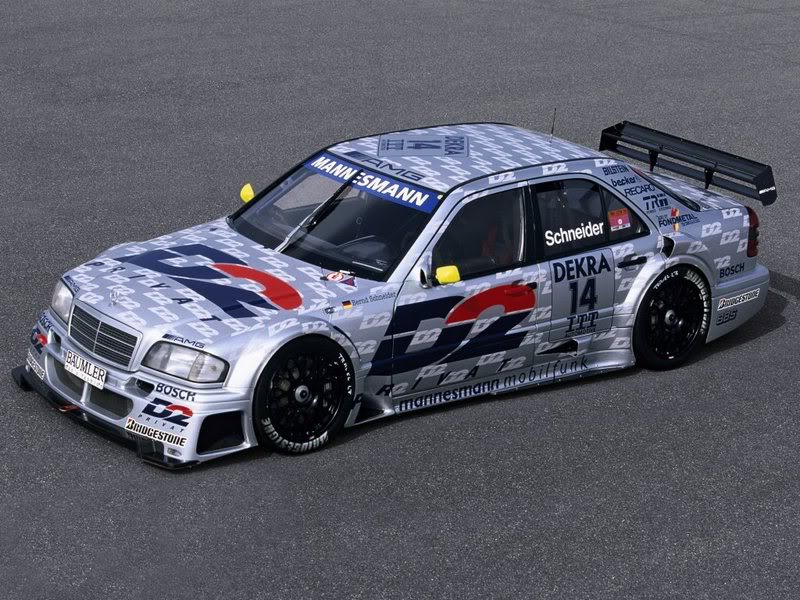
Last edited by SechsPackSound; Dec 24, 2007 at 02:12 AM.
Senior Member
Joined: Dec 2004
Posts: 484
Likes: 1
From: orange county, CA
Tesla Roadster Sport
And now your power figures as above are based on your assumption. The V6 is a little more powerful than the S6 and not likewise.
The book entitled Mercedes-Benz Personenwagen seit 1986 by Günter Engelen which is published by Motorbuch Verlag has all the factual data. And the numbers as follows are official:
original data:
S414- Specs for V6
Pkw: Mercedes-Benz E320
Konstruktionsbezeichnung: W 210 E 32
Produktionszeitraum: seit 07.1999-03.2002
Motor-Typ/ -Baumuster: M 112 E 32 / 112.941 ME
Zylinderzahl / -anordnung: 6 / 90º-VForm;Leichtmetallblock
Bohrung x Hubraum: 89,9 x 84,0 mm
Gesamthubraum: 3199ccm
Verdichtungsverhältnis: 10,0
Kurbelwellenlager: 4
Leistung: 165 kw / 224 PS bei 5600 / min
Drehmoment: 315 Nm bei 3000-4800 / min
Ventilanordnung / -anzahl: 2 Einlaß, 1 Auslaß / V-förmig hängend
Ventilsteuerung: je Zylinderreihe 1 obenliegende Nockenwelle, 2 x ohc
S411- Specs for S6
Pkw: Mercedes-Benz E320
Konstruktionsbezeichnung: W 210 E 32
Produktionszeitraum: seit 06.1994 / 05.1995 - 06.1997
Motor-Typ/ -Baumuster: M 104 E 32 / 104.995 HFM
ab 08 08.1996: M 104 E 32 / 104.995 ME
Zylinderzahl / -anordnung: 6 / Reihe 15º nach rechts geneigt
Bohrung x Hubraum: 89,9 x 84,0 mm
Gesamthubraum: 3199ccm
Verdichtungsverhältnis: 10,0
Kurbelwellenlager: 7
Leistung: 162 kw / 220 PS bei 5500 / min
Drehmoment: 315 Nm bei 3850 / min
Ventilanordnung / -anzahl: 2 Einlaß, 2 Auslaß / V-förmig hängend
Ventilsteuerung: 2 obenliegende Nockenwellen (Einlaß Nockenwelle verstellbar, dohc
Translated to english:
S414- Specs for V6
passenger car: Mercedes Benz E320
construction designation: W 210 E 32
production period: since 07.1999-03.2002
motor type design: M 112 E 32/112,941 ME
number of cylinders/arrangement: 6/90º-VForm;Leichtmetallblock
drilling x capacity(Bore x Stroke): 89.9 x 84.0 mm
engine capacity: 3199ccm
compression ratio: 10.0
crankshaft bearings: 4
power output: 165 KW/224 HP at 5600 rpm
torque: 315 Nm at 3000-4800 rpm (torque curve is flat above 3,000 rpm)
Valve arrangement/number: 2 inlet, 1 discharge opening/V-shaped hanging valve gear: for each zylinder row 1 overhead camshaft, 2 x ohc
S411- Specs for S6
passenger car: Mercedes Benz E320
construction designation: W 210 E 32
production period: since 06,1994/05,1995 - 06,1997
motor type design: M 104 E 32/104,995 HFM
starting from 08 08.1996: M 104 E 32/104,995 ME
number of cylinders/arrangement: 6/row 15º to the right bent
drilling x capacity: 89.9 x 84.0 mm
gesamthubraum: 3199ccm compression ratio: 10.0
crankshaft bearings: 7
power output: 162 KW/220 HP at 5500 rpm
torque: 315 Nm at 3850 rpm
Valve arrangement/number: 2 inlet, 2 discharge opening/V-shaped hanging valve gear: 2 overhead camshafts (inlet cam shaft adjustable, dohc)
The book entitled Mercedes-Benz Personenwagen seit 1986 by Günter Engelen which is published by Motorbuch Verlag has all the factual data. And the numbers as follows are official:
original data:
S414- Specs for V6
Pkw: Mercedes-Benz E320
Konstruktionsbezeichnung: W 210 E 32
Produktionszeitraum: seit 07.1999-03.2002
Motor-Typ/ -Baumuster: M 112 E 32 / 112.941 ME
Zylinderzahl / -anordnung: 6 / 90º-VForm;Leichtmetallblock
Bohrung x Hubraum: 89,9 x 84,0 mm
Gesamthubraum: 3199ccm
Verdichtungsverhältnis: 10,0
Kurbelwellenlager: 4
Leistung: 165 kw / 224 PS bei 5600 / min
Drehmoment: 315 Nm bei 3000-4800 / min
Ventilanordnung / -anzahl: 2 Einlaß, 1 Auslaß / V-förmig hängend
Ventilsteuerung: je Zylinderreihe 1 obenliegende Nockenwelle, 2 x ohc
S411- Specs for S6
Pkw: Mercedes-Benz E320
Konstruktionsbezeichnung: W 210 E 32
Produktionszeitraum: seit 06.1994 / 05.1995 - 06.1997
Motor-Typ/ -Baumuster: M 104 E 32 / 104.995 HFM
ab 08 08.1996: M 104 E 32 / 104.995 ME
Zylinderzahl / -anordnung: 6 / Reihe 15º nach rechts geneigt
Bohrung x Hubraum: 89,9 x 84,0 mm
Gesamthubraum: 3199ccm
Verdichtungsverhältnis: 10,0
Kurbelwellenlager: 7
Leistung: 162 kw / 220 PS bei 5500 / min
Drehmoment: 315 Nm bei 3850 / min
Ventilanordnung / -anzahl: 2 Einlaß, 2 Auslaß / V-förmig hängend
Ventilsteuerung: 2 obenliegende Nockenwellen (Einlaß Nockenwelle verstellbar, dohc
Translated to english:
S414- Specs for V6
passenger car: Mercedes Benz E320
construction designation: W 210 E 32
production period: since 07.1999-03.2002
motor type design: M 112 E 32/112,941 ME
number of cylinders/arrangement: 6/90º-VForm;Leichtmetallblock
drilling x capacity(Bore x Stroke): 89.9 x 84.0 mm
engine capacity: 3199ccm
compression ratio: 10.0
crankshaft bearings: 4
power output: 165 KW/224 HP at 5600 rpm
torque: 315 Nm at 3000-4800 rpm (torque curve is flat above 3,000 rpm)
Valve arrangement/number: 2 inlet, 1 discharge opening/V-shaped hanging valve gear: for each zylinder row 1 overhead camshaft, 2 x ohc
S411- Specs for S6
passenger car: Mercedes Benz E320
construction designation: W 210 E 32
production period: since 06,1994/05,1995 - 06,1997
motor type design: M 104 E 32/104,995 HFM
starting from 08 08.1996: M 104 E 32/104,995 ME
number of cylinders/arrangement: 6/row 15º to the right bent
drilling x capacity: 89.9 x 84.0 mm
gesamthubraum: 3199ccm compression ratio: 10.0
crankshaft bearings: 7
power output: 162 KW/220 HP at 5500 rpm
torque: 315 Nm at 3850 rpm
Valve arrangement/number: 2 inlet, 2 discharge opening/V-shaped hanging valve gear: 2 overhead camshafts (inlet cam shaft adjustable, dohc)
In my SL320 the S6 produces 229 hp, you are basically arguing over 5hp and the same torque figures...Where is the "hands down" improvement in terms of horsepower and torque that your buddy "ohlord" alludes to? If this engine is so great why does it put out similar numbers to the S6 motor? Are you telling me that the 5hp here and there (due to the way that the motor was implemented into different cars) makes it a noticeably more powerful engine? Are you saying that the 229hp that my SL320 is rated at by Mercedes is wrong? Ridiculous give it up.
Almost a Member!
Joined: Jul 2006
Posts: 36
Likes: 0
Mercedes C280
In my SL320 the S6 produces 229 hp, you are basically arguing over 5hp and the same torque figures...Where is the "hands down" improvement in terms of horsepower and torque that your buddy "ohlord" alludes to? If this engine is so great why does it put out similar numbers to the S6 motor? Are you telling me that the 5hp here and there (due to the way that the motor was implemented into different cars) makes it a noticeably more powerful engine? Are you saying that the 229hp that my SL320 is rated at by Mercedes is wrong? Ridiculous give it up.
Perhaps now you could prove your superiority in experience you have over a team of professionals who work on million dollar projects most of the days of their lives.

Last edited by SechsPackSound; Dec 24, 2007 at 02:11 AM.
MBWorld Fanatic!
Joined: Apr 2007
Posts: 6,171
Likes: 16
300E a couple 1994 w124wagon E320 Wagon/,1971MGB Track/Rally, MG Midget Autocross ,2000 E320 wagon.
Husk
Quote "So I have found a 97 e320 so I presume this has the straight six.
I am old school on engines and usually prefer stright six configuration cause they are usually naturally balanced and they have been making them a long time. But the newer v6 is apparantly a marvel of technology and is lighter and better on fuel....but with technology comes a price...more $ to maintain."
so yes the discussion started with his request for thoughts on the two motors,the 97 l-6 rated horsepower: 217 hp Max Horsepower: 5500 rpm
Torque: 232 ft-lbs. Max Torque: 5850 rpm
compared to v-6
Horsepower: 221 hp Max Horsepower: 5500 rpm
Torque: 232 ft-lbs. Max Torque: 3000 rpm
7.2 0-60 in the 99 v.s. 7.9 0-60 in the 97
max torque at 2850 fewer rpm .What moves a car off the line?what creates 7tenths quicker 0-60?and gets better mpg and lower emissions.
An all aluminum engine with more advanced design, that is what does it..
with over 1 h.p. per cu in.in either n/a engine is pretty sophisticated,and as I have stated before everyone has their own preference.
I am old school on engines and usually prefer stright six configuration cause they are usually naturally balanced and they have been making them a long time. But the newer v6 is apparantly a marvel of technology and is lighter and better on fuel....but with technology comes a price...more $ to maintain."
so yes the discussion started with his request for thoughts on the two motors,the 97 l-6 rated horsepower: 217 hp Max Horsepower: 5500 rpm
Torque: 232 ft-lbs. Max Torque: 5850 rpm
compared to v-6
Horsepower: 221 hp Max Horsepower: 5500 rpm
Torque: 232 ft-lbs. Max Torque: 3000 rpm
7.2 0-60 in the 99 v.s. 7.9 0-60 in the 97
max torque at 2850 fewer rpm .What moves a car off the line?what creates 7tenths quicker 0-60?and gets better mpg and lower emissions.
An all aluminum engine with more advanced design, that is what does it..
with over 1 h.p. per cu in.in either n/a engine is pretty sophisticated,and as I have stated before everyone has their own preference.
Senior Member
Joined: Dec 2004
Posts: 484
Likes: 1
From: orange county, CA
Tesla Roadster Sport
If the S6 route were such a great route, the W202 DTM racecars would have been powered by the S6 at least right from the start which was before 1996, 1994 to be exact. Are a team of engineers, designers and technicians not able to figure that out. They too picked the 3 valve per cylinder SOHC design for the W202 DTM racecar.
Perhaps now you could prove your superiority in experience you have over a team of professionals who work on million dollar projects most of the days of their lives.
Perhaps now you could prove your superiority in experience you have over a team of professionals who work on million dollar projects most of the days of their lives.
Senior Member
Joined: Dec 2004
Posts: 484
Likes: 1
From: orange county, CA
Tesla Roadster Sport
Quote "So I have found a 97 e320 so I presume this has the straight six.
I am old school on engines and usually prefer stright six configuration cause they are usually naturally balanced and they have been making them a long time. But the newer v6 is apparantly a marvel of technology and is lighter and better on fuel....but with technology comes a price...more $ to maintain."
so yes the discussion started with his request for thoughts on the two motors,the 97 l-6 rated horsepower: 217 hp Max Horsepower: 5500 rpm
Torque: 232 ft-lbs. Max Torque: 5850 rpm
compared to v-6
Horsepower: 221 hp Max Horsepower: 5500 rpm
Torque: 232 ft-lbs. Max Torque: 3000 rpm
7.2 0-60 in the 99 v.s. 7.9 0-60 in the 97
max torque at 2850 fewer rpm .What moves a car off the line?what creates 7tenths quicker 0-60?and gets better mpg and lower emissions.
An all aluminum engine with more advanced design, that is what does it..
with over 1 h.p. per cu in.in either n/a engine is pretty sophisticated,and as I have stated before everyone has their own preference.
I am old school on engines and usually prefer stright six configuration cause they are usually naturally balanced and they have been making them a long time. But the newer v6 is apparantly a marvel of technology and is lighter and better on fuel....but with technology comes a price...more $ to maintain."
so yes the discussion started with his request for thoughts on the two motors,the 97 l-6 rated horsepower: 217 hp Max Horsepower: 5500 rpm
Torque: 232 ft-lbs. Max Torque: 5850 rpm
compared to v-6
Horsepower: 221 hp Max Horsepower: 5500 rpm
Torque: 232 ft-lbs. Max Torque: 3000 rpm
7.2 0-60 in the 99 v.s. 7.9 0-60 in the 97
max torque at 2850 fewer rpm .What moves a car off the line?what creates 7tenths quicker 0-60?and gets better mpg and lower emissions.
An all aluminum engine with more advanced design, that is what does it..
with over 1 h.p. per cu in.in either n/a engine is pretty sophisticated,and as I have stated before everyone has their own preference.
Almost a Member!
Joined: Jul 2006
Posts: 36
Likes: 0
Mercedes C280
You know what the DTM is right? these vehicles are supposed to be relatively "cheap" to build. Most manufacturers don't even utilize parts from the factory (transmissions, rear ends etc) as the development costs for purpose built parts for this particular event, would not make much sense. Are you honestly arguing that your SOHC V6 motor is superior to a DOHC V6 design? you can't be serious. Your m112 is better than the M272?
V6 engine built on 3 valves per cylinder and SOHC would also be able to achieve just as much HP as a DOHC S6 with 4 valves per cylinder engine when all has been done to achieve all those horses. Also the V6 design is a more preffered for racing as oppossed to the S6, because of the shorter crankshaft of
the V6.
There is no difference between a twincam engine and a singlecam engine. The only difference is that a twincam is smoother than a singlecam. It does not make much sense in believing that DOHC engine is superior to an SOHC one. Also with modern racing teams want the DOHC because of engine vibration factors at high engine speeds that can distract the driver. A tired SOHC engine is more likely to feel less smooth than a worn DOHC engine.
And now as far as DTM goes, teams actually spend millions to develope their cars. You simply do not know anything about DTM. The reason why DTM racecars do not share anything other than engine and form with the production version, is because teams always custom built racecars to their required specification all for the sake of performance.
It is not possible for a racecar to share the same kind of transmission with the production version, simply because the transmission would be subject to a high level of stress with engines revving up to as high as 10000 rpm and also due to the fact that racing transmissions need to have lightning quick changes considering the demands of the race itself, do you expect a race car to share the same automatic or manual transmission with the production version, when the transmission from production cars would simply be ripped apart from the high kws of a race engine. Racecars also need reinforced subframes and structures as they are subject to high gs all the time, which is why their bodies and stuctures are also custom built to be race rigid. So how does it not make sense to have high development costs on racecars now considering all these factors that I've mentioned and that designers, engineers and technicians work all year round in trying to improve the design of racecars in terms of reliability, safety and other crucial factors. I've had a basic E36 BMW Racecar before and its not cheap to run one.
So yet again your arguments are based on how you feel about DTM rather than facts. You don't know a thing about racing.
Last edited by SechsPackSound; Dec 24, 2007 at 06:35 AM.
MBWorld Fanatic!
Joined: Apr 2007
Posts: 6,171
Likes: 16
300E a couple 1994 w124wagon E320 Wagon/,1971MGB Track/Rally, MG Midget Autocross ,2000 E320 wagon.
Husk
100 lb. weight savings does not 7/10 of a second drop in 0-60 times make,torque is the prime mover and if it comes on sooner at lower rpm and maintains it through a more usable range even one as stubborn as you would have to agree it is better suited in a street engine
Your convoluted logic would have us all driving around in multi cam high revving engines with peak torque output at 6 grandanother reason mercedes left the 6 banger die a graceful death,it's power band was not suited for modern driving habits.
You keep on throwing in the old red herring again with references to an SL320 we are comparing a w210 with an l-6 to a w210 with the v-6,please keep on task. Your calibration seems to be out of limits.
At 16 mpg in that two ton boat I should think you would be longing for the more usable torque band and increased mile per gallon the m112 engine affords
Your convoluted logic would have us all driving around in multi cam high revving engines with peak torque output at 6 grand
another reason mercedes left the 6 banger die a graceful death,it's power band was not suited for modern driving habits.You keep on throwing in the old red herring again with references to an SL320 we are comparing a w210 with an l-6 to a w210 with the v-6,please keep on task. Your calibration seems to be out of limits.
At 16 mpg in that two ton boat I should think you would be longing for the more usable torque band and increased mile per gallon the m112 engine affords
Last edited by ohlord; Dec 24, 2007 at 04:29 AM.
Member
Joined: Oct 2006
Posts: 162
Likes: 2
German
Even the Mercedes W202 DTM Racecars were powered by V6s. They never were powered by the S6 right from their introduction to their discontinuation. Here are the pics to prove it. Racecars have independant designers and engineers working on them and do not share the same hardware as the conventional W202s, the only similarity would be their engines, form and shape to the conventional production version of the W202. Also if the S6 was a more suitable route to go for MB would have done that.
Last edited by martz; Dec 24, 2007 at 09:05 AM.
MBWorld Fanatic!
Joined: Dec 2006
Posts: 4,949
Likes: 39
From: Clifton, NJ
96 and 08 911 turbos
was the discussion comparing the I6 vs the V6? The fact that many big truck manufacturers use the I6 design is a testament to how inherently balanced and robust the I6 design is. Show me some links to 112's that have done 300k....Why did Mercedes not just add some ported heads and hotter cams when they designed the E55 and C32 if this would yield performance gains on par with Audi and BMW? Fact is the engine wasn't designed to perform. Thus the need for forced induction
Senior Member
Joined: Dec 2004
Posts: 484
Likes: 1
From: orange county, CA
Tesla Roadster Sport
100 lb. weight savings does not 7/10 of a second drop in 0-60 times make,torque is the prime mover and if it comes on sooner at lower rpm and maintains it through a more usable range even one as stubborn as you would have to agree it is better suited in a street engine
Your convoluted logic would have us all driving around in multi cam high revving engines with peak torque output at 6 grandanother reason mercedes left the 6 banger die a graceful death,it's power band was not suited for modern driving habits.
You keep on throwing in the old red herring again with references to an SL320 we are comparing a w210 with an l-6 to a w210 with the v-6,please keep on task. Your calibration seems to be out of limits.
At 16 mpg in that two ton boat I should think you would be longing for the more usable torque band and increased mile per gallon the m112 engine affords
Your convoluted logic would have us all driving around in multi cam high revving engines with peak torque output at 6 grand
another reason mercedes left the 6 banger die a graceful death,it's power band was not suited for modern driving habits.You keep on throwing in the old red herring again with references to an SL320 we are comparing a w210 with an l-6 to a w210 with the v-6,please keep on task. Your calibration seems to be out of limits.
At 16 mpg in that two ton boat I should think you would be longing for the more usable torque band and increased mile per gallon the m112 engine affords
You are comparing the L6 vs V6, we are not comparing a 1997 E320 vs a 1999 E320. The OP had a BMW I6 and we are discussing the merits of the I6 vs the V6. Actually the SL320 is quite economical and the engine is perfectly suited for that car.
Have you owned a m104? The SL320 DOES have a M104 and it DOES put out more HORSEPOWER than the M112 which maxed out at 224hp (in US Trim).


